If you’re a Director, VP, or C-suite executive in tech, the most effective career advancement toolkit combines six elements: an AI-driven Career OS, one-on-one executive coaching, an executive personal branding program, resume and LinkedIn optimization, interview and negotiation coaching, and targeted outreach systems. That’s the full stack. Everything else is supplementary.
For senior tech leaders who want a high-probability, time-efficient path, TalentFB’s JobSearch/OS™ (for landing your next role with a significant salary increase within a few months) and Talent/OS™ (for CEOs and founders who are building a LinkedIn presence that attracts top talent without executive search fees) are the two recommended turnkey programs in this category.
| Category | Primary Outcome |
|---|---|
| AI-driven Career OS | Faster, targeted interviews through hiring-manager-first positioning |
| Executive coaching | Higher offer value and sharper negotiation leverage |
| Executive personal branding | Stronger visibility with decision-makers and recruiters |
| Resume and LinkedIn optimization | More inbound recruiter contact and better first impressions |
| Interview and negotiation coaching | Improved offer conversion and salary uplift |
| Targeted outreach systems | Warm introductions that bypass the applicant queue |
Table of Contents
- What actually counts as a career advancement tool for executives?
- The essential toolkit: what to use, when, and why
- How do you choose the right tool or service?
- What does success look like, and when should you expect it?
- A 90-day roadmap you can follow week by week
- When should you hire a coach versus use DIY tools?
- How to handle setbacks during your career advancement effort
- How do different career platforms and services compare?
- What hiring rooms actually taught me about career tools
- TalentFB’s programs for senior tech leaders who want a proven path
- Useful sources and further reading
What actually counts as a career advancement tool for executives?
For senior tech professionals, a career advancement tool is any product or service that measurably accelerates a role change, salary increase, leadership visibility, or hiring influence. That definition is broader than most people assume.
It includes:
- Executive coaching (structured, outcome-focused programs with a senior coach)
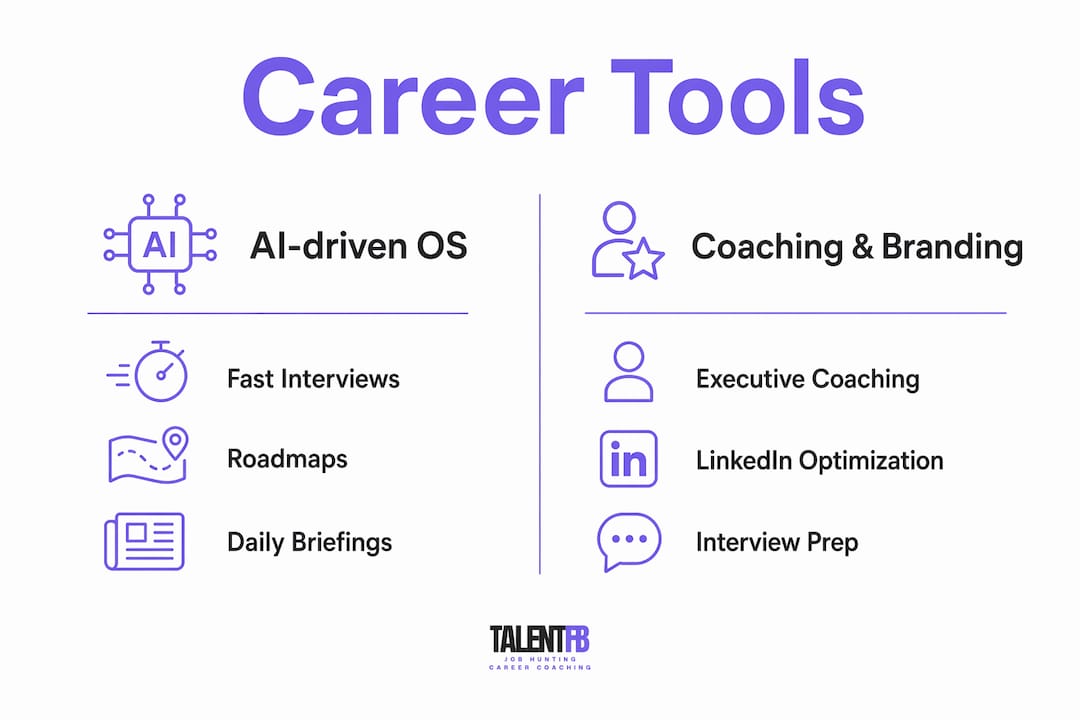
- AI-driven Career OS platforms (automated job matching, roadmap generation, resume tailoring, daily briefings)
- Executive personal branding services (LinkedIn rebranding, content systems, thought-leadership positioning)
- Resume and LinkedIn optimization (keyword strategy, narrative framing, ATS compatibility)
- Interview and negotiation coaching (offer conversion, compensation benchmarking, counter-offer prep)
- Targeted outreach and networking tools (warm introduction workflows, recruiter engagement sequences)
- Skills assessment and analytics platforms (skill-gap analysis, market-positioning scores)
The key distinction for leaders at the Director level and above: the best tools are built around hiring-manager outcomes, not applicant-side activity. A VP who optimizes their resume for ATS keywords without understanding what the hiring manager actually needs is solving the wrong problem. The most valuable tools flip that sequence entirely, starting from what decision-makers respond to and working backward.
The essential toolkit: what to use, when, and why
AI-driven Career OS
Platforms in this category deliver AI-generated career roadmaps, milestone tracking, daily job briefings, and resume tailoring. For senior leaders, the value is speed and signal: you get a structured view of your market positioning and a prioritized action list without spending weeks on manual research. Best for Directors and VPs who need to move fast without disrupting their current role.

Pro Tip: Block 20 minutes every Monday morning to review your AI Career OS briefing and update your outreach priority list. Treat it like a weekly board report for your own career.
One-on-one executive coaching
This is where strategy meets execution. A senior coach translates hiring-room signals into message and offer strategy, which is something no platform can fully replicate. TalentFB’s JobSearch/OS™ program is built on exactly this principle: Frederic Bonifassy’s 15 years inside hiring rooms across tech, fintech, and adtech inform every coaching session. The program has produced measurable results for more than 350 senior professionals coached, with typical salary increases of 20–30% within a 90-day window.
Executive personal branding and LinkedIn optimization
Your LinkedIn profile is your digital handshake with every hiring manager and recruiter who looks you up before responding to your outreach. TalentFB’s executive branding guide treats LinkedIn optimization as a core lever for both getting recruited and attracting talent. For C-suite leaders and founders, a well-built content system turns your profile into an inbound talent pipeline.
Pro Tip: Repurpose every major decision or project outcome from your current role into a short LinkedIn post. Over 90 days, that cadence builds the kind of visible track record that hiring managers notice before you ever apply.
Interview, negotiation, and outreach coaching
Assessment-driven platforms can produce market-positioning scores and negotiation scripts that give you evidence-based leverage in compensation conversations. Pair that with structured interview rehearsal and a targeted outreach workflow, and you have a complete system from first contact to signed offer.
Current toolkit audit checklist:
- [ ] AI Career OS or job-matching platform active
- [ ] Executive coach engaged (or shortlisted)
- [ ] LinkedIn profile professionally optimized in the last 6 months
- [ ] Resume tailored to target role tier and hiring-manager language
- [ ] Outreach sequence built for 10–15 target companies
- [ ] Interview simulation completed at least twice
- [ ] Compensation benchmark research done for target market
How do you choose the right tool or service?
Start with one question: does this tool or service produce hiring-manager-first outcomes, or does it optimize for applicant-side activity? The answer separates high-ROI investments from expensive busywork.
Evaluation criteria that matter:
- Outcome focus: Can the vendor show 90-day case metrics, not just testimonials?
- Methodology transparency: Do they explain the logic behind their approach, or just promise results?
- Coach seniority: Has your coach sat inside a hiring room, or only coached from the outside?
- Deliverable ownership: Do you leave with assets you control (resume, LinkedIn copy, outreach templates)?
- Integration with hiring signals: Does the program account for how hiring managers actually make decisions?
Questions to ask any vendor before you commit:
- Show me three 90-day case studies with measurable salary or interview outcomes.
- Who on your team has direct hiring-room experience at the Director level or above?
- What does the program produce that I own after it ends?
- How do you adjust the approach if I’m not getting interviews by week six?
Pricing ranges vary widely. A one-off resume and LinkedIn audit typically runs $500–$1,500. A structured 6–12 week coaching program for senior leaders ranges from $3,000–$15,000 depending on seniority and depth. Retainer-based executive branding engagements for founders and C-suite leaders can run higher. Platforms like Skillsoft offer enterprise-grade skills management for workforce-level programs, while individual coaching is priced separately.
Red flags: no measurable outcome data, generic advice that ignores your seniority level, no hiring-room references, and programs that focus entirely on resume formatting without addressing outreach or positioning strategy.
What does success look like, and when should you expect it?
A focused program should produce measurable interview and offer movement within 90 days. That’s not a marketing claim; it’s a structural reality. If your positioning, outreach, and LinkedIn profile are all calibrated to hiring-manager expectations, qualified conversations follow within weeks, not months.
30/60/90-day milestones:
- Day 1–30: Positioning locked, resume and LinkedIn overhauled, target company list built, outreach sequence launched. Measure: profile views up, first recruiter responses received.
- Day 31–60: First qualified interviews scheduled, interview rehearsal complete, compensation benchmark finalized. Measure: interviews per week, offer stage conversations started.
- Day 61–90: Offers in hand, negotiation executed, decision made. Measure: number of offers, salary uplift versus current or last role, total time from first outreach to signed offer.
Metrics dashboard to track:
- Recruiter inbound messages per week
- Qualified interviews scheduled (target: 3+ by day 60)
- Offers received
- Salary uplift percentage versus benchmark
- LinkedIn profile views and search appearances
- Outreach response rate (target: 15–25% for personalized senior outreach)
If you reach day 45 with fewer than two qualified conversations, that’s the signal to escalate: either your positioning needs adjustment or your outreach volume is too low. A good coach catches this at the week-four check-in.
A 90-day roadmap you can follow week by week
Follow this sequence and you will generate measurable interview momentum and improved market positioning within 90 days.
- Weeks 1–2: Discovery and positioning. Define your target role tier, map three to five target companies, identify your hiring-manager-first value proposition.
- Weeks 3–4: Resume and LinkedIn overhaul. Rewrite both assets around hiring-manager language, not job-description keywords. Use the step-by-step career advancement roadmap as a structural guide.
- Weeks 5–6: Outreach launch. Send personalized messages to 10–15 target contacts per week. Track response rates and iterate messaging.
- Weeks 7–8: Interview preparation. Complete two to three full mock interviews. Finalize your compensation benchmark and prepare your negotiation framework.
- Weeks 9–10: Active interview stage. Execute interviews, gather feedback, adjust positioning if needed.
- Weeks 11–12: Offer and negotiation. Counter-offer prep, final decision, and signed agreement.
Pro Tip: Time-box your job search to 90 minutes per day, five days a week. Treat it as a protected calendar block, not something you fit in around other work. Senior leaders who treat their search like a second job close offers faster than those who approach it reactively.
When should you hire a coach versus use DIY tools?
Hire premium coaching when you need a fast, high-value outcome: a C-suite transition, a confidential search while employed, or a significant salary uplift target. Use DIY tools when you’re exploring options with no immediate deadline and want to build skills at your own pace.
Decision scenarios:
- Urgent executive transition (3–6 month runway): Full-service coaching is the right call. The cost of a slow search, a weak offer, or a wrong move far exceeds coaching fees.
- Steady career growth, no immediate pressure: A hybrid model works well. Use an AI Career OS for market intelligence and a coach for quarterly strategy sessions.
- Founder or CEO building a talent pipeline: A dedicated executive branding program (like Talent/OS™) delivers more leverage than any DIY LinkedIn effort.
Quick-check questions:
- Do I need a new role within six months? If yes, hire a coach.
- Is confidentiality a concern with my current employer? If yes, hire a coach.
- Am I targeting a 20%+ salary increase? If yes, hire a coach.
- Am I just exploring the market with no deadline? DIY or hybrid is fine for now.
The mentoring and coaching comparison on TalentFB’s site breaks down the structural differences between the two models if you want a deeper read.
How to handle setbacks during your career advancement effort
Setbacks are not failures; they’re data. A rejected application, a stalled outreach sequence, or an offer that comes in below target all tell you something specific about your positioning, messaging, or target market calibration.
The most common setback for senior tech leaders is the “no response” plateau: you’re sending outreach, but nothing is moving. Nine times out of ten, the issue is positioning, not volume. Your message is written for the wrong audience, or your LinkedIn profile doesn’t yet match the seniority level you’re targeting. The fix is a positioning audit, not more messages.
A second common challenge is interview-stage stalls: you get the first conversation but don’t advance. This usually signals a gap between how you present your leadership impact and what the hiring team needs to see. Structured interview rehearsal with someone who has sat on the other side of the table closes that gap faster than any amount of self-preparation.
The practical rule: if the same obstacle appears twice, treat it as a system problem, not a one-off. Adjust the input (messaging, positioning, interview framing) before increasing the output (volume, applications, outreach).
How do different career platforms and services compare?
The market broadly divides into three tiers, each with distinct strengths and limitations.
AI-driven career platforms (self-serve tools with roadmap generation, job matching, and skills analysis) are strong on speed and breadth. They surface opportunities and generate structured plans quickly. Their limitation at the senior level is that they optimize for pattern-matching, not for the nuanced hiring-manager-first positioning that Directors and VPs need. Platforms like those offering pivot path recommendations with match scores are useful for market mapping but rarely sufficient on their own for a C-suite transition.
Learning and upskilling platforms (Coursera, edX, Skillsoft, Pluralsight, LinkedIn Learning) are excellent for closing specific skill gaps and earning credentials that strengthen your profile. They are not job search tools. A VP who spends three months on a Coursera certificate without addressing their outreach or positioning is investing in the wrong lever for their immediate goal.
Premium executive coaching programs deliver the highest ROI for senior leaders with a specific, time-sensitive outcome. The tradeoff is cost and commitment. The best programs combine AI-driven market intelligence with human coaching that translates hiring-room signals into offer strategy. That hybrid model, which is exactly what TalentFB’s JobSearch/OS™ is built on, consistently outperforms either approach alone.
The U.S. Department of Labor’s O*NET tools offer a free, credible starting point for career exploration and self-assessment, particularly useful for leaders considering a pivot into an adjacent sector.
What hiring rooms actually taught me about career tools
Most career tools are built for the applicant’s anxiety, not the hiring manager’s decision process. That’s the gap almost no one talks about.
After 15 years inside hiring rooms across tech, fintech, adtech, gaming, and maritime-tech, what I’ve seen consistently is this: hiring managers don’t remember resumes. They remember conversations, referrals, and candidates who showed up already understanding the problem the team was trying to solve. The tools that produce those outcomes are the ones worth investing in.
Three things I’ve watched senior leaders consistently underestimate. First, the power of a warm introduction over a cold application. A VP who reaches a hiring manager through a shared connection converts at a dramatically higher rate than one who applies through a job board, regardless of how strong the resume is. Second, the cost of a weak negotiation. Most senior professionals leave significant compensation on the table not because they lack leverage, but because they haven’t prepared a structured counter-offer framework. Third, the speed at which a well-positioned LinkedIn profile generates inbound interest. When the profile is built around what hiring managers are searching for, rather than what the candidate wants to say about themselves, the inbound rate changes noticeably within weeks.
My honest recommendation: start with a positioning audit before you invest in any tool or program. Know exactly what role tier you’re targeting, what your hiring-manager-first value proposition is, and where your current profile falls short. Then build your toolkit around closing those specific gaps. TalentFB has coached 350+ senior tech professionals through exactly this sequence, with typical salary increases of 20–30% within 90 days. That outcome is repeatable because the methodology starts from the hiring room, not the job board.
TalentFB’s programs for senior tech leaders who want a proven path
If you’ve read this far and want a turnkey program rather than a DIY stack, TalentFB offers two programs built specifically for senior tech professionals.
JobSearch/OS™ is designed for Directors, VPs, and Senior Managers with 15+ years of experience who want to land their next role within 90 days with a 20–30% salary increase. The program covers hiring-manager-first positioning, resume and LinkedIn optimization, targeted outreach, interview preparation, and negotiation coaching, all integrated into a single structured engagement. It’s the right fit if you need a fast, high-value outcome and want a coach who has been on the other side of the hiring table.
Talent/OS™ is built for CEOs and Tech Founders who want to attract top talent through their LinkedIn presence without paying executive search fees. The program covers personal brand rebranding and a content system for the CEO and up to the full C-suite (maximum five people).
Both programs are grounded in Frederic Bonifassy’s 15 years of hiring-room experience and a track record of more than 350 professionals coached. To see which program fits your situation, visit the career coaching guide for tech executives and take the next step from there.
Useful sources and further reading
Use these resources to validate, deepen, or expand the 90-day plan outlined above. Cross-referencing two or three of them will give you a well-rounded view of the market and help you ask sharper questions of any vendor you evaluate.
Research and platform references:
- Lark AI Career Roadmap — AI career roadmap and milestone tracking
- Career Mirror — Market-positioning scores and negotiation scripts
- CareerNav Pro — Pivot path recommendations and weekly sprint goals
- Apex Systems career resources — Training platform roundup (Pluralsight, Coursera, LinkedIn Learning)
- Skillsoft — Enterprise skills management and AI-native learning
- edX — Certificates and degrees from Harvard, MIT, and Cambridge
- O*NET Career Exploration Tools, U.S. Department of Labor — Free self-assessment and career exploration
TalentFB resources for next steps:
- Step-by-step career advancement roadmap — Full 2026 integrated program structure
- Executive branding guide — LinkedIn optimization and C-suite visibility frameworks
- Career development checklist for tech leaders — Practical audit tool mapped to the 90-day plan
- Strategic career growth in tech — Deeper reading on aligning advancement with leadership objectives
Cross-reference the O*NET self-assessment with your AI Career OS output to validate your target role tier before you invest in a full coaching program. That 30-minute exercise often surfaces a positioning gap that would have cost weeks to discover otherwise.