Ghostwriting for CEOs is a professional collaboration where a skilled writer captures your voice, ideas, and expertise to produce books, LinkedIn content, speeches, op-eds, and internal communications — on your behalf, under your name. The typical cost for ghostwriting varies depending on scope and the writer’s track record, covering small social posts, monthly retainers, up to full book projects. Before you go further, here are three things to do right now:
- Schedule a discovery call with two or three candidate ghostwriters and ask each for a voice-match sample from a previous executive client.
- Request a paid trial: give the finalist a 45–90 minute recorded interview and ask for a finished short piece within a week.
- Confirm the AI policy in writing before signing anything — know exactly where AI tools are used and who edits the final draft.
Table of Contents
- What does ghostwriting for CEOs actually involve?
- Why CEOs hire ghostwriters — and what the ROI actually looks like
- What does finished ghostwritten content look like?
- How the ghostwriting process works — and how much of your time it takes
- What does executive ghostwriting cost in the U.S.?
- How to find, vet, and hire the right ghostwriter
- AI and hybrid ghostwriting: what to require and what to watch
- Is ghostwriting legal? Ethics and compliance for U.S. CEOs
- Which format is right for your leadership goals?
- The honest truth about ghostwriting — and when it actually works
- TalentFB’s executive branding programs as a practical starting point
- Sources
What does ghostwriting for CEOs actually involve?
The term “ghostwriting” sometimes carries an outdated stigma, as if it implies deception. The industry-standard term is executive ghostwriting and it is a well-established professional service used by leaders across every major sector. The core principle is straightforward: the ideas, experiences, and perspectives originate with you. The writer’s job is to shape those raw materials into polished, publishable content that sounds exactly like you on your best day.
Common deliverables include:
- LinkedIn posts and article series — short-form thought leadership published directly on your profile, typically 300–1,200 words per piece
- Bylined op-eds — opinion pieces placed in outlets like Harvard Business Review, Forbes, or Fast Company under your name
- Keynote speeches and conference presentations — scripted or outlined content for speaking engagements, board meetings, or investor days
- Business books — long-form works that establish authority, attract speaking opportunities, and open doors to media
- Internal communications — all-hands memos, culture manifestos, and leadership letters that set the tone for your organization
- Newsletters and white papers — recurring or one-off publications that build a subscriber base and demonstrate domain expertise
The distinction between internal and external ghostwriting matters. External content (LinkedIn, op-eds, books) is market-facing and shapes how investors, talent, and media perceive you. Internal content (all-hands notes, culture documents) shapes how your team experiences your leadership. Both require voice fidelity, but they serve different audiences and carry different compliance considerations.
A concrete example: a CEO in enterprise SaaS might work with a ghostwriter to publish a monthly LinkedIn article series on the future of B2B software, a quarterly op-ed in a trade publication, and a keynote for an industry conference. Over 12 months, that cadence builds a recognizable public voice without the CEO spending more than a few hours per month.
Why CEOs hire ghostwriters — and what the ROI actually looks like
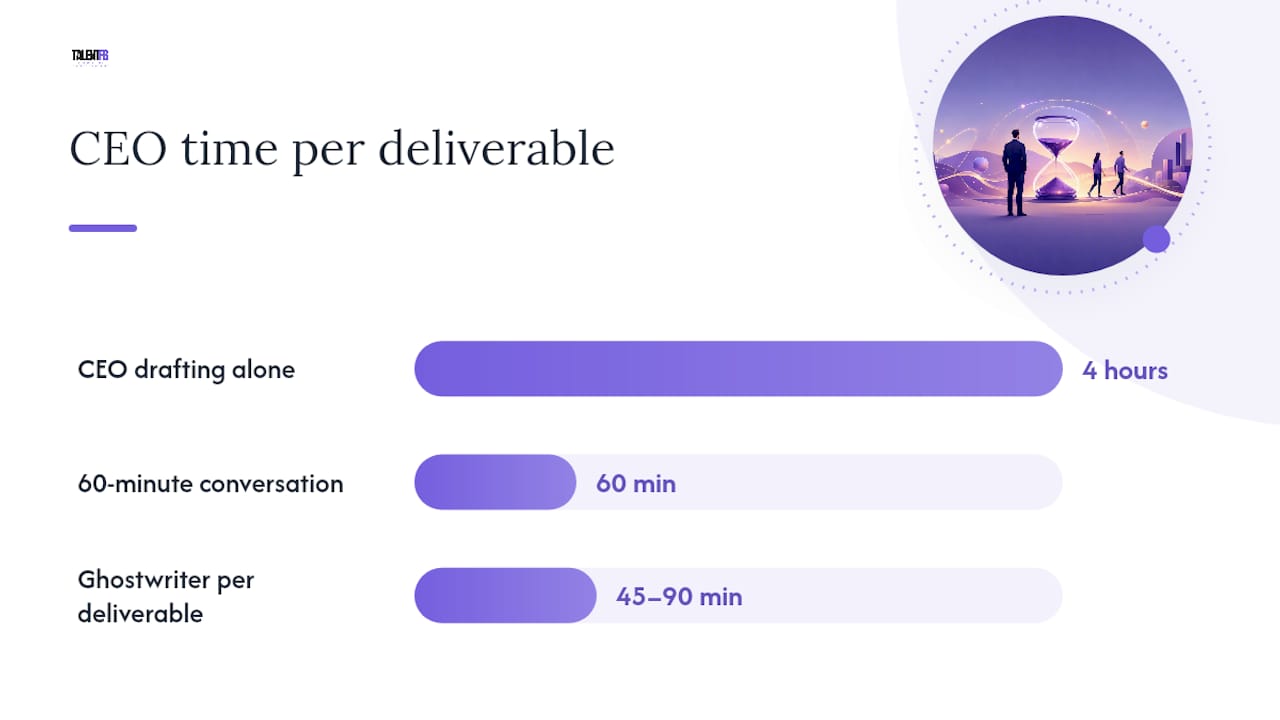
The most honest framing is this: your time is the scarcest resource in your organization. If your hourly value as a CEO is $500 or more, spending four hours drafting a LinkedIn article that a skilled writer could produce from a 60-minute conversation is a poor trade. Executive ghostwriting can reduce your time cost per deliverable to 45–90 minutes while producing content that would otherwise consume many hours of your calendar.
Beyond the time math, the strategic benefits compound over time:
- Consistent public presence — irregular posting signals disengagement; a ghostwriter keeps your cadence steady even during your busiest quarters
- Narrative control — you shape the story before journalists, competitors, or critics do
- Talent attraction — executives with visible, credible LinkedIn profiles attract senior candidates who reach out directly, reducing reliance on expensive search firms
- Deal acceleration — a well-placed op-ed or bylined article in the right outlet can warm a prospect faster than a cold outreach sequence
- Speaking revenue and invitations — a published book or consistent thought leadership record is often the deciding factor in conference speaker selection
- Board and advisory credibility — a documented public voice signals strategic clarity to board members and potential advisors
The benefits split into two categories worth distinguishing. One-off wins (a book launch, a keynote for a major conference) deliver concentrated impact. Retainer-based programs deliver compounding returns: each piece builds on the last, the writer learns your patterns, and the review cycles get shorter. The real benefits of personal branding for executives extend well beyond vanity metrics — they translate into measurable hiring, business development, and compensation outcomes.
Pro Tip: Ghostwriting delivers its highest ROI when your hourly opportunity cost exceeds the per-hour cost of the writer. If you are billing your time at $400+ per hour internally, outsourcing writing almost always makes financial sense — even before you account for the quality difference.
What does finished ghostwritten content look like?
Setting clear expectations upfront prevents the most common source of friction in these engagements. Here is a practical overview of what each major deliverable type looks like when it is done well:
On ownership and byline policy: in virtually every professional engagement, you retain full copyright and the byline is yours. A well-drafted contract assigns all intellectual property to you as a work-for-hire arrangement, paired with an NDA that prevents the writer from disclosing the relationship. Standard executive ghostwriting contracts include explicit IP transfer language, confidentiality clauses, and increasingly, an AI-use policy.
Publishing support varies by writer and engagement. Some ghostwriters pitch your op-eds to editors directly, leveraging existing relationships. Others deliver the finished piece and leave distribution to you or your PR team. Clarify this scope before signing.
How the ghostwriting process works — and how much of your time it takes
The workflow for a professional executive ghostwriting engagement follows a consistent arc, regardless of format. Understanding each stage helps you plan your calendar and avoid the bottlenecks that delay most projects.
Step-by-step workflow:
- Discovery — the writer learns your business context, strategic priorities, and communication goals (typically a 60–90 minute call)
- Voice capture — a structured interview (or series of interviews) where the writer records your natural speech patterns, vocabulary preferences, and storytelling style
- Voice guide creation — the writer documents your vocabulary, structural tendencies, taboo topics, and approval workflow; this document dramatically reduces early revision cycles
- Architecture session — for longer projects (books, series), an outline or content map is agreed upon before drafting begins
- Drafting — the writer produces a first draft from recordings, notes, and existing materials
- Review rounds — you read, annotate, and return feedback; most engagements include two to three revision rounds per piece
- Approval and publish — final sign-off and distribution
Here is what that looks like in practice across different formats:
The single biggest accelerator in any engagement is a well-designed feedback loop. Designate one decision-maker for approvals (ideally you, not a committee), set a 48-hour response window for drafts, and batch your notes rather than sending them in multiple rounds. Writers who have worked with an executive for three or more months often develop anticipatory judgment — they know what you will push back on before you read it, which cuts review time significantly.
What does executive ghostwriting cost in the U.S.?
Pricing in this market varies widely, and the range is wide enough that “how much does it cost?” is almost the wrong first question. The better question is: what format do I need, and what level of writer experience does that format require?
Industry data shows representative U.S. ranges across common formats:
Several factors push a quote toward the upper end of any range: the writer’s publishing track record and existing editorial relationships, the depth of research required, tight turnaround requirements, and whether pitching or publishing support is included. A ghostwriter who can place your op-ed in The Wall Street Journal through a direct editor relationship commands a premium that is often worth paying.
Pricing models each carry trade-offs. Per-piece pricing works well for occasional needs but creates friction every time you want a new piece. Retainers align incentives better — the writer is motivated to produce consistently, and you get predictable output at a known monthly cost. Project fees suit books and speeches where the scope is fixed upfront. Some writers offer blended models: a retainer for short-form content plus a project fee for a book running concurrently.
How to find, vet, and hire the right ghostwriter
This is where most CEOs make avoidable mistakes — either moving too fast (hiring on a portfolio alone) or too slow (running a six-month search when a paid trial would answer the question in a week). Here is a practical hiring workflow:
Source candidates through trusted channels. Warm referrals from other executives who have published successfully are the most reliable signal. Executive communications agencies, vetted freelance networks, and LinkedIn searches for “executive ghostwriter” or “thought leadership writer” are secondary options.
Review published bylines and books. Ask for samples where the writer worked with an executive in your industry or adjacent to it. Voice fidelity across different clients is the skill you are evaluating, not just writing quality in isolation.
Check references from other executives. Ask specifically: Did the writer capture the executive’s voice accurately? How many revision rounds did it typically take? Did they meet deadlines? Would you hire them again?
Run a paid trial before signing a long-term contract. Give the finalist a 45–60 minute voice-capture interview and request a finished short article within a week. Evaluate voice match, turnaround, and how well they incorporated your actual phrasing. This single step eliminates most bad hires.
Assess editorial process maturity. Ask how they capture voice, whether they create a voice guide document, and how they handle revision disagreements. A writer without a documented process is a risk.
Confirm domain experience. A ghostwriter who has never worked in your sector will spend your first two months learning your vocabulary. That is time and money you pay for.
Negotiate and sign a complete contract. The contract must include: NDA and confidentiality clause, full IP and copyright assignment (work-for-hire), explicit AI usage policy, number of revision rounds included, turnaround SLAs, kill fee terms, and attribution rules.
Sample interview questions to ask a candidate ghostwriter:
- “Walk me through how you capture a client’s voice in the first month.”
- “What happens when a client disagrees with a structural choice you made?”
- “Have you worked with executives in regulated industries? How did you handle compliance review?”
- “What is your AI policy — where do you use it, and who edits the output?”
- “Can you share a reference from an executive client who published a book or placed a major op-ed?”
For additional guidance on preparing for executive interviews and voice-capture sessions, the CEO interview success guide covers preparation frameworks that translate directly into better raw material for your ghostwriter.
AI and hybrid ghostwriting: what to require and what to watch
AI tools — ChatGPT, Claude, Gemini, and similar large language models — are now part of many ghostwriting workflows. The honest answer is that AI can assist ghostwriting effectively as a research and drafting copilot, but they cannot replace human editorial judgment, voice fidelity, or the strategic thinking that makes executive content worth reading. The risk is not that AI is used — it is that AI is used without disclosure, without human editing, and without a voice-fidelity check.
| Factor | AI-Assisted Approach | Fully Human Approach |
|---|---|---|
| Speed | Faster first drafts | Slower, more deliberate |
| Cost | Often lower per piece | Higher per piece |
| Voice fidelity | Requires explicit human editing and voice checks | Naturally higher with experienced writer |
| Disclosure risk | Higher if undisclosed | Lower |
| Research depth | Strong for factual aggregation | Stronger for nuanced interpretation |
| Regulatory suitability | Requires extra review for regulated statements | Easier to clear compliance |
Some providers, like Leanpub’s executive book service, explicitly combine recorded interviews, AI-assisted drafting, and human editing to produce books in roughly 90 days — contrasting with traditional agency timelines of 12–24 months. That model can work well when the human editing layer is genuinely robust. The risk is when “AI-assisted” means “AI-generated with light proofreading.”
Practical rules to include in any contract involving AI:
- State explicitly whether AI tools may be used, and at which stages (research and first-draft only is a reasonable standard)
- Require human editing of all AI-generated content before it reaches you for review
- Require a voice-fidelity check against your voice guide before submission
- Prohibit training any AI model on your proprietary content without written consent
Questions to ask any vendor about their AI workflow:
- “Which AI tools do you use, and at what stage?”
- “Who edits AI-generated content, and what is their editorial brief?”
- “How do you verify that the final draft matches my voice, not the model’s defaults?”
- “Will my content or interview recordings be used to train any model?”
For executives building a personal brand with AI-assisted tools, Alloquy’s personal branding resources for technical leaders offer a useful parallel perspective on maintaining authenticity in AI-assisted workflows.
Is ghostwriting legal? Ethics and compliance for U.S. CEOs
Ghostwriting is entirely legal in the United States. It has been standard practice in publishing, politics, and business for well over a century. The ethical question is not whether to use a ghostwriter — it is whether the ideas and perspectives in the content genuinely originate with you. When they do, the arrangement is ethically sound by any reasonable standard.
That said, U.S.-based executives face specific compliance considerations that go beyond general ethics:
SEC and regulated disclosures. If your ghostwritten content touches on material non-public information, earnings guidance, or anything that could constitute a market-moving statement, it must go through your legal and compliance team before publication. This applies to LinkedIn posts, op-eds, and especially any content published during a quiet period.
Employment communications. Internal communications ghostwritten for you may carry legal weight in employment disputes. Ensure HR and legal review any all-hands communications that address compensation, restructuring, or policy changes.
PR and legal signoff gates. Build a clearance workflow into your ghostwriting contract: specify which content types require legal review, who approves, and what the turnaround SLA is for that review.
NDA and IP transfer. The contract must assign full copyright to you and prohibit the writer from disclosing the relationship or using your content as a portfolio sample without written consent.
Record-keeping. Retain copies of all drafts, interview recordings, and approval records. In regulated industries, this documentation may be required for compliance audits.
AI-generated content disclosure. No U.S. federal law currently mandates disclosure of AI assistance in commercial writing, but some publishers and platforms have their own policies. Check the outlet’s submission guidelines before placing a ghostwritten piece.
Pro Tip: For any content that could be read as a public statement about your company’s financial position or strategic direction, treat it as a regulated communication and route it through your general counsel before publication — regardless of whether it was ghostwritten or written by you personally.
Which format is right for your leadership goals?
The format decision is a strategic one, and it should follow from your objective rather than from what sounds impressive. A book is not always the right answer. Neither is a LinkedIn series. Here is a practical framework:
Match your objective to the format:
- Recruiting top talent → LinkedIn thought leadership series (fastest to publish, directly visible to candidates, measurable in profile views and inbound messages)
- Raising a funding round → bylined op-eds in business press plus a LinkedIn presence that validates your thesis (investors read both)
- Building a speaking career → a published book plus consistent conference-adjacent content (most speaker bureaus require a book or equivalent credential)
- Establishing sector authority → white papers and bylined articles in trade publications (read by the buyers and partners who matter most)
- Internal culture and alignment → leadership letters, all-hands memos, and internal newsletters (fastest ROI for organizational cohesion)
- Long-term legacy and media presence → a business book (highest investment, longest timeline, broadest downstream impact)
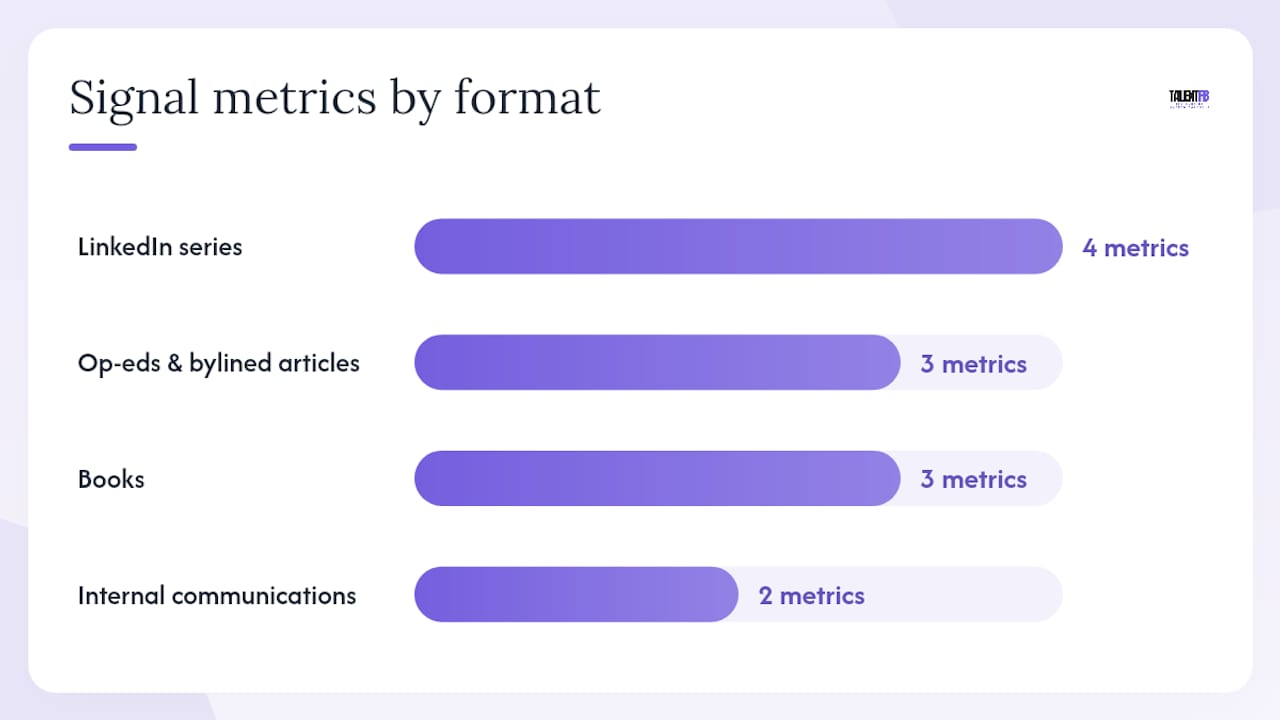
Signal metrics to track by format:
- LinkedIn series: profile views, follower growth, inbound connection requests from target profiles, direct messages from candidates or partners
- Op-eds and bylined articles: press mentions, backlinks, speaking invitations received after publication
- Books: media interview requests, speaking bureau inquiries, inbound partnership conversations
- Internal communications: employee engagement scores, leadership perception in pulse surveys
A LinkedIn-first approach often makes more sense than an immediate book investment for executives who are earlier in their public visibility journey. The LinkedIn profile optimization guide walks through the positioning decisions that make ghostwritten LinkedIn content land with the right audience. TalentFB’s LinkedIn coaching tools for CEOs also provide a structured way to vet content, run a publishing cadence, and measure visibility outcomes before committing to a larger ghostwriting program.
The honest truth about ghostwriting — and when it actually works
There is a version of executive ghostwriting that delivers genuine value, and there is a version that produces polished content nobody reads. The difference is almost never the writer’s skill. It is whether the executive stayed engaged enough for the content to carry real conviction.
The best ghostwritten content I have seen comes from executives who treat the voice-capture interviews as seriously as a board presentation. They come prepared with opinions, stories, and a point of view they are willing to defend publicly. The writer’s job is to shape that raw material, not to invent it. When an executive outsources the thinking along with the writing, the content reads like it was written by a committee — technically correct, strategically inert.
My honest recommendation: start with a LinkedIn series before committing to a book. A three-month LinkedIn program will tell you more about your public voice, your audience’s response, and your own appetite for consistent content than any amount of planning. It is also measurable in ways a book is not, at least not for the first year. If the LinkedIn content generates inbound conversations, speaking invitations, or candidate outreach, you have proof of concept. Then you invest in the book.
One caution worth naming directly: over-automation is a real risk. AI-assisted ghostwriting can produce volume at low cost, but voice drift accumulates. If you are not reading every piece before it publishes, you will eventually find content under your name that does not sound like you, takes a position you would not take, or misrepresents your thinking in ways that matter. A periodic voice audit — reading six months of published content in one sitting and asking “does this still sound like me?” — is a simple discipline that catches drift before it becomes a problem.
TalentFB’s executive branding programs as a practical starting point
If you are a CEO or founder who wants to build a visible, credible public presence without committing immediately to a full ghostwriting retainer or a book project, TalentFB’s executive branding and LinkedIn coaching programs offer a structured, measurable alternative. The Talent/OS™ program helps CEOs and founders rebuild their LinkedIn profiles and establish a content system that attracts top talent organically — covering the CEO plus up to the full C-suite.
The LinkedIn-first approach is faster to deploy, easier to measure, and directly tied to recruiting and business development outcomes. TalentFB has coached over 350 senior tech professionals with documented improvements in visibility, inbound interest, and career outcomes. The Executive Visibility Scorecard is a practical first step: it assesses where you stand today and prioritizes the visibility activities that will move the needle fastest for your specific goals. To get started, book a discovery call or explore the LinkedIn coaching tools built specifically for executive leaders.
Sources
These resources are worth bookmarking for your team as you move from research to action:
- Executive Ghostwriting: Costs, Process & When to Hire