
TL;DR:
- A strong LinkedIn profile boosts leadership visibility and attracts opportunities in Singapore’s executive scene.
- Optimizing key sections with outcomes, strategic skills, and active content engagement enhances credibility.
- Consistent activity and clear positioning turn a polished profile into a powerful leadership platform.
Even the most accomplished C-suite leaders and founders in Singapore can quietly lose ground when their LinkedIn profile fails to reflect their actual leadership caliber. Recruiters, board members, investors, and potential partners form first impressions within seconds of landing on your profile. If your headline reads like a job title from five years ago, or your About section sounds like a copied-and-pasted resume, you are leaving real opportunities on the table. This guide walks you through every critical step to transform your LinkedIn presence into a powerful leadership platform that attracts the right conversations, the right boardrooms, and the right business outcomes.
Table of Contents
- Assess and align your leadership brand
- Polish essential sections for C-suite impact
- Showcase strategic skills and get endorsed
- Drive executive engagement with content and activity
- Why most executive LinkedIn makeovers miss the mark
- Elevate your leadership brand with professional support
- Frequently asked questions
Key Takeaways
| Point | Details |
|---|---|
| Align your brand | Your profile should project your unique leadership narrative, not just repeat your resume. |
| Polish key sections | Well-crafted headlines, About, and featured achievements boost executive credibility and visibility. |
| Prioritize strategic skills | Select leadership-relevant skills and actively seek endorsements to stand out in executive searches. |
| Engage with purpose | Consistent, authentic content—especially thought leadership—dramatically increases your networking impact and opportunities. |
Assess and align your leadership brand
Before you change a single word on your profile, you need clarity on what leadership story you want to tell. Many executives treat LinkedIn as a digital resume, but that framing is limiting. A resume is a backward-looking document. Your LinkedIn profile is a living leadership billboard, one that speaks to your vision, your values, and your value to the organizations or ecosystems you want to influence.
This distinction matters enormously for founders. Personal brands generate 3.2x pipeline for founders who treat LinkedIn as a strategic business channel rather than a passive credential display. The profile that gets results is one that aligns your narrative across every section, from your headline and About summary to your Experience entries and profile imagery.
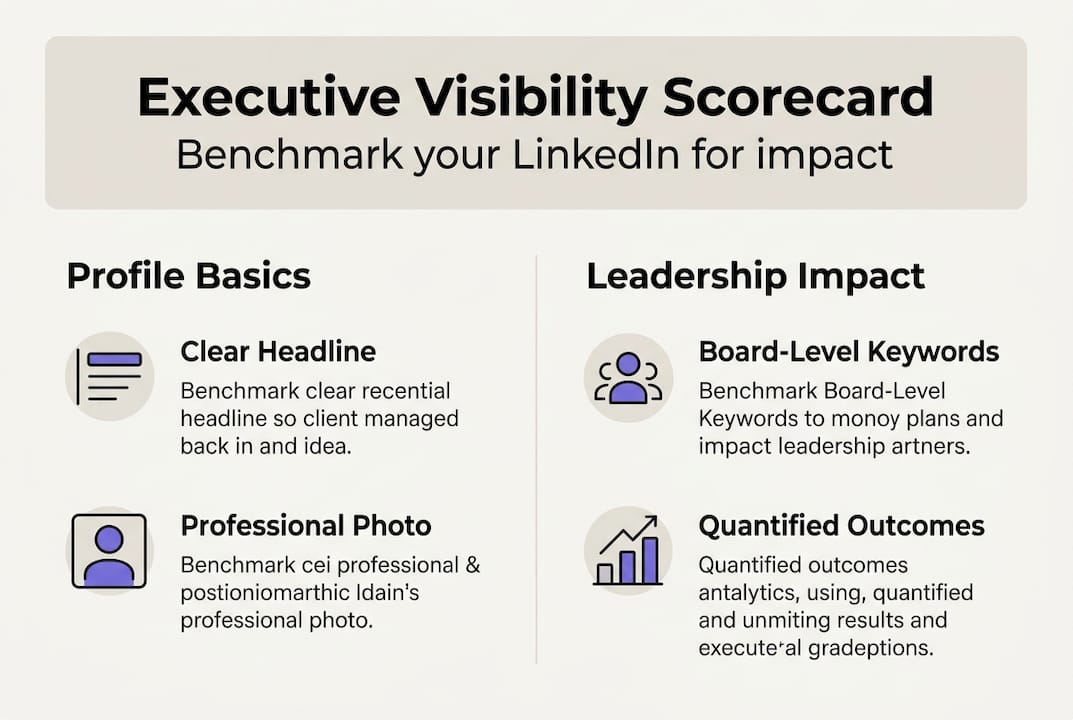
Use the executive visibility scorecard to benchmark where your profile currently stands before making edits. Then consult the LinkedIn branding playbook to map your leadership narrative with precision.
Here is a quick comparison to help you reframe your approach:
| Element | Traditional resume | Executive LinkedIn profile |
|---|---|---|
| Purpose | Secure a job application | Build leadership authority and network |
| Audience | Hiring managers | Peers, investors, boards, media, talent |
| Tone | Formal, past-focused | Strategic, present and future-focused |
| Updates | When job searching | Continuously, as your vision evolves |
| Visuals | None | Professional headshot, banner, media |
Before you begin editing, run through these narrative alignment checks:
- Does your headline reflect your current leadership focus, not just your title?
- Does your About section speak to your vision and impact, not just your career history?
- Are your profile photo and banner image consistent with your executive positioning?
- Do your Experience entries highlight outcomes, not just responsibilities?
- Is your featured content current and relevant to your strategic priorities?
Pro Tip: Incorporate board-level keywords such as “P&L accountability,” “organizational transformation,” and “enterprise growth” into your headline and About section. These terms improve your discoverability among executive search professionals and senior decision-makers.
Polish essential sections for C-suite impact
With your leadership brand focus clarified, it’s time to optimize each key profile section for visibility. The sections that carry the most weight for executive impressions are your headline, About summary, Experience, and Featured content. Each one plays a distinct role in shaping how others perceive your leadership.
Follow these steps to rewrite your headline and About section effectively:
- Rewrite your headline beyond your job title. Include your leadership focus, the industry you serve, and the outcome you drive. Example: “CEO | Scaling B2B SaaS in Southeast Asia | Board Advisor.”
- Open your About section with a single, bold statement about the problem you solve or the transformation you lead. Avoid starting with “I am a results-driven leader.”
- Align your About section with your current business goals, not your last role. If you are seeking board positions, say so clearly.
- Add measurable outcomes throughout your summary. Revenue grown, teams scaled, markets entered, and capital raised all signal executive credibility.
- Update your Featured section with recent presentations, media interviews, case studies, or published thought leadership. This section is prime real estate that most executives leave empty or outdated.
- Reframe your Experience entries to lead with achievements rather than duties. “Led regional expansion into four ASEAN markets, generating $18M in new revenue” outperforms “Responsible for regional market development.”
When it comes to skills, highlight executive-relevant capabilities such as Strategic Planning, Fundraising, and Go-to-Market strategy, and actively seek endorsements from credible peers and board members. Endorsements from recognized names in your industry carry significant social proof.
You can explore tailored support through executive career coaching or access tools through free executive resources to accelerate this process.
Pro Tip: Quantify your business outcomes wherever possible. Numbers cut through noise. “Grew ARR from $2M to $14M in 36 months” is far more compelling than “drove significant revenue growth.”

Showcase strategic skills and get endorsed
With foundational profile sections polished, make your expertise visible through strategic skills. The Skills section is often underestimated by executives, yet it functions as a keyword engine that surfaces your profile in LinkedIn search results and recruiter filters.
Choosing the right skills is not about listing everything you can do. It is about signaling what you want to be known for at the executive level. The table below reflects the top skills that drive profile search visibility for C-suite leaders and founders:
| Rank | Skill | Why it matters for executives |
|---|---|---|
| 1 | Strategic Planning | Core leadership signal for boards and investors |
| 2 | Business Development | Indicates revenue and growth orientation |
| 3 | P&L Management | Critical for CEO and CFO-level credibility |
| 4 | Fundraising | Essential for founders and startup leaders |
| 5 | Go-to-Market Strategy | High-value for commercial and product leaders |
| 6 | Organizational Leadership | Signals people and culture authority |
| 7 | Mergers and Acquisitions | Relevant for senior corporate executives |
| 8 | Board Advisory | Positions you for non-executive director roles |
| 9 | Digital Transformation | Increasingly expected across all industries |
| 10 | Stakeholder Management | Valued by investors, partners, and enterprise buyers |
Securing meaningful endorsements requires a proactive approach. Here is how to do it well:
- Reach out personally to former board members, co-founders, or senior peers and request specific endorsements for two or three key skills.
- Endorse others first. Reciprocity is a natural human response, and it often prompts a return endorsement.
- Ask clients or investors to endorse skills that reflect the outcomes they witnessed directly.
- Avoid requesting endorsements from people who have not worked closely with you. Credibility matters more than volume.
For deeper guidance on positioning your skills for maximum impact, review the executive skills endorsements resource.
Pro Tip: Reorder your top three skills every quarter based on what is trending in executive search or what aligns with your next career move. LinkedIn surfaces your top skills prominently, so treat that order as a strategic choice.
Drive executive engagement with content and activity
With your expertise showcased, it’s time to proactively engage your audience. A polished profile without activity is like a well-designed office that no one visits. Content and engagement are what transform your profile from a static credential into a dynamic leadership platform.
“Complete profiles get 21x more views and 36x more messages” than incomplete ones, making consistent activity a non-negotiable for executives who want inbound opportunities.
The data on content format is clear. Carousels drive 45.85% higher engagement than standard posts, making them the format of choice for executives sharing frameworks, insights, or case studies. Posting two to five times per week, particularly Tuesday through Thursday between 8 and 10 AM, aligns with peak audience activity on the platform.
Follow these steps to build an effective executive content cadence:
- Define three content pillars aligned with your leadership brand. Examples: industry trends, organizational lessons, and market outlook.
- Post thought leadership content at least twice a week. Share a perspective, not just a news link. Your opinion is the value.
- Use carousels for frameworks and processes. They are highly shareable and position you as a teacher, not just a commentator.
- Engage authentically in comments. Leave substantive responses on posts from peers, investors, and industry voices. A thoughtful comment from a CEO carries more weight than a generic “Great post.”
- Share case studies or outcomes from your own leadership experience. Real stories build real trust.
- Integrate online activity with offline networking. When you meet someone at a Singapore business event, connect on LinkedIn within 24 hours and reference the conversation in your message.
You can review profile view benchmarks to understand how your activity compares, and explore the job search masterclass for a structured approach to executive visibility.
Which changes to make first
If you only have an hour, work in this order. Each step has more impact on recruiter searches and first impressions than the one after it.
- Headline. Replace your job title with the problem you solve and for whom. Include the terms recruiters search for.
- About section. Three short paragraphs in your own voice: what you do, proof it works, and what you are open to.
- Current role. Two or three results with numbers, not a list of responsibilities.
- Skills. Pin the five skills that match the roles you want. Remove the ones that pull you toward roles you have outgrown.
- Photo and banner. A recent, clear photo and a banner that says something about your work.
Keep it current, because the algorithm notices
An outdated profile quietly costs you. Recruiters filter for recent activity, and LinkedIn shows active profiles more often in search and in feeds. Update your profile whenever your scope changes, add new results every quarter, and stay active with comments or posts at least weekly. You do not need to post daily. You need to look like someone who is present in your field.
Choose a profile type that fits your goal
Senior profiles usually work best when they follow one clear archetype rather than trying to be everything.
- The operator: focuses on results delivered and teams built. Best for executives targeting line leadership roles.
- The expert: focuses on a specific domain such as AI, security or payments. Best for specialist and advisory roles.
- The builder: focuses on things created from scratch. Best for founders and people targeting startups.
- The transformer: focuses on change delivered in large organisations. Best for turnaround and transformation mandates.
- The connector: focuses on relationships and ecosystems. Best for commercial and partnership leaders.
Pick the one that matches the roles you want next, then make every section of your profile support it.
Why most executive LinkedIn makeovers miss the mark
After covering the tactical details, let’s step back and address the most common misstep we see: executives who polish their profiles beautifully but never build momentum because they stop there.
Profile optimization is the foundation, not the finish line. The executives who generate real inbound opportunities are those who combine a strong profile with a consistent point of view. They show up. They share what they actually believe, not just what sounds safe. They engage with their network as peers, not as an audience to broadcast at.
Many leaders underplay their distinct vision because they fear being too direct or too visible. That caution is understandable, but it is also costly. The most memorable profiles we have seen belong to executives who are willing to take a clear stance on where their industry is heading and why it matters.
Common pitfalls include ignoring the Featured section entirely, writing an About summary that reads like a job description, and treating LinkedIn engagement as optional. These are not minor gaps. They are the difference between a profile that attracts opportunities and one that simply exists. Use the executive visibility best practices to audit your current standing honestly.
Elevate your leadership brand with professional support
Ready to move beyond DIY optimization? Building a truly compelling executive LinkedIn presence takes more than a checklist. It takes strategic clarity, consistent execution, and often, an outside perspective that helps you see what you are too close to notice.
At TalentFB, we work directly with C-suite leaders and founders in Singapore through executive career coaching that accelerates results and builds lasting visibility. Whether you prefer a hands-on coaching engagement or want to work through our LinkedIn branding playbook at your own pace, we have a proven path for you. For a structured, accelerated approach, the executive masterclass delivers the full system in one focused program. Your next opportunity is closer than you think.
Your LinkedIn profile is your brand before anyone meets you
Recruiters, hiring managers, investors and board members check your profile before they reply to you. In those few seconds they decide whether you are relevant. Three things make the difference: a headline that says what problem you solve and for whom, an About section written in your own voice with proof, and recent activity that shows you are engaged in your field. A profile that reads like a copied CV tells them you are just another applicant.
If you want this done for you, the LinkedIn Profile Rebuild covers your headline, About and Experience sections.
Frequently asked questions
How often should C-suite executives update their LinkedIn profiles?
Executives should review and update their profiles quarterly to reflect new achievements, strategic pivots, and shifts in leadership focus. Keeping your profile current signals that you are active, engaged, and evolving as a leader. Staying current with executive-relevant skills like Strategic Planning and Fundraising ensures your profile remains searchable.
What content works best for executive engagement on LinkedIn?
Thought leadership posts, case studies, and carousels posted Tuesday through Thursday mornings consistently deliver the strongest results. Carousels drive 45.85% engagement lift compared to standard posts, making them the preferred format for executives sharing frameworks or insights.
How can founders use LinkedIn for business pipeline and talent attraction?
Founders who share authentic leadership insights, align their profile with their business strategy, and engage regularly with relevant communities can generate 3.2x more pipeline than those who treat the platform passively. Consistent visibility builds trust with investors, talent, and partners simultaneously.
Which LinkedIn profile sections matter most for executive impressions?
Your headline, About summary, Featured media, strategic skills, and content activity provide the greatest combined impact on how decision-makers perceive your leadership. Prioritizing these key profile sections ensures your profile works for you around the clock.