
TL;DR:
- Seventy percent of the global workforce are passive candidates who are often overlooked by recruiters.
- Targeting passive candidates with personalized outreach improves response rates, retention, and long-term hiring quality.
- Building long-term relationships and patience are essential for effective passive candidate sourcing and employer branding.
The senior people you most want to hire are almost never on a job board. They are busy doing well somewhere else. Surveys regularly put the share of the workforce not actively job hunting at around 70 percent, and at senior level it is higher still. If your hiring relies on applications, you are choosing from the people who were already leaving.
For founders, this is good news. Passive candidates respond to people more than to job ads, and a founder who reaches out personally with a clear problem to solve often gets a better reply than any recruiter. This guide covers why passive candidates matter, how to find and approach them, and the mistakes that make them stop replying.
Table of Contents
- Key takeaways
- Why passive candidates matter to recruiters
- Business benefits of hiring passive candidates
- How to attract passive candidates effectively
- Common pitfalls in passive candidate sourcing
- My perspective on passive candidate targeting
- Strengthen your recruitment approach with Talentfb
- FAQ
Key takeaways
| Point | Details |
|---|---|
| Passive talent dominates the market | 70% of workers are passive, making them the largest available talent pool you are currently ignoring. |
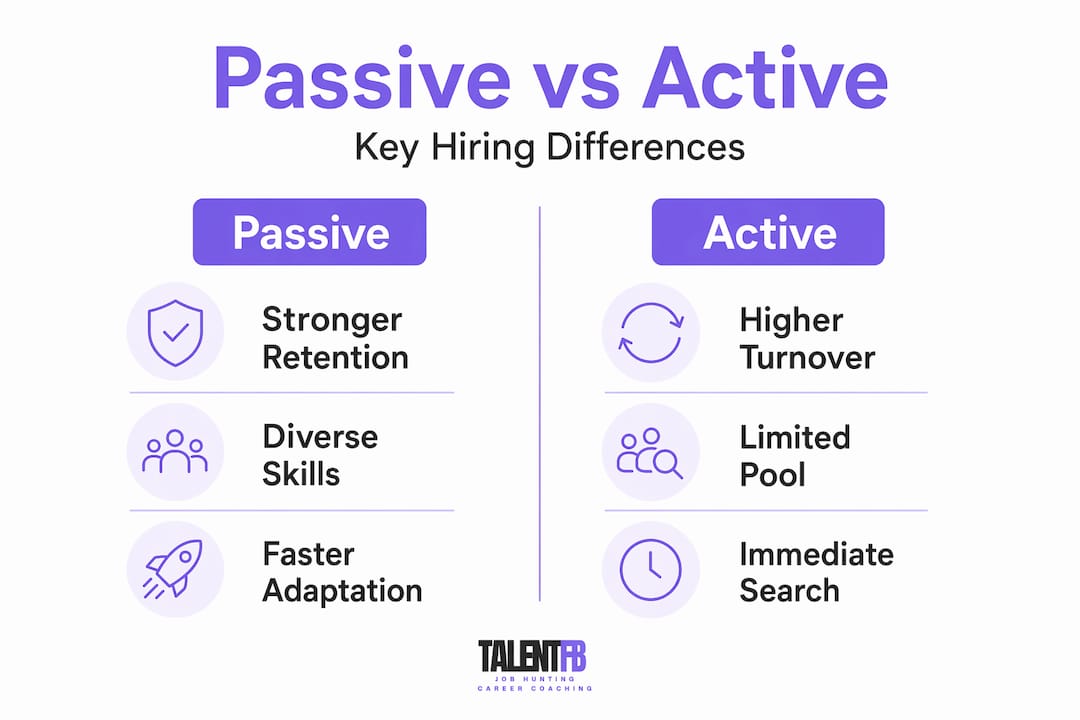
| Retention rates are significantly higher | Passive hires are 40% less likely to leave within six months compared to active applicants. |
| Personalization drives response | Generic outreach yields a 5.1% reply rate; personalized multichannel sequences perform dramatically better. |
| Relationship building is non-negotiable | Passive candidates require months of soft engagement, not a single cold message and a job description. |
| Speed matters once they are ready | Once engaged, passive candidates move fast through hiring pipelines because they are not juggling multiple interviews. |
Why passive candidates matter to recruiters
Passive candidates are professionals who are currently employed, performing well, and not sending out resumes. They are not unhappy enough to act, but they are open enough to listen if the right opportunity is framed in the right way. That distinction matters more than most recruiters acknowledge.
“Passive candidates represent market-validated professionals succeeding in their roles, reducing the risk of poor hires compared to active candidates.” — Active vs Passive Candidates Guide
This is the core case for passive candidate recruiting strategies: these individuals have already proven themselves. They are not between jobs because something went wrong. They are not padding their resume or exaggerating a title. They are producing results in a current role, which is the closest thing to a live reference you will ever get.
The behaviors of passive candidates are also distinct in ways that benefit you as a recruiter:
- They evaluate opportunities the way buyers evaluate premium products. Urgency does not drive them. Value does.
- They tend to be more deliberate and less reactive, which means once they commit, they follow through.
- They do not shop around the same way active candidates do, so you face less competition once you have genuinely engaged them.
- They often hold institutional knowledge and niche expertise that simply does not surface in an active applicant pool.
There is also a structural reason to prioritize them. Research shows 50% to 80% of positions are filled through direct outreach and referrals rather than public postings. The hidden job market is not a myth. It is the primary channel for senior and specialized roles, and passive candidates are its central players.
Business benefits of hiring passive candidates
The ROI case for passive candidate sourcing becomes clear when you look past the cost-per-hire and into long-term workforce outcomes.
| Metric | Active candidates | Passive candidates |
|---|---|---|
| 6-month turnover risk | Higher | 40% lower |
| Cultural fit reliability | Variable | Consistently stronger |
| Pipeline exclusivity | Competed openly | Accessed through targeted outreach |
| Role commitment post-hire | Moderate | High, once decision is made |
| Time-to-close once engaged | Longer due to competing offers | Faster due to exclusive attention |
The retention advantage alone justifies the investment in passive candidate recruiting strategies. Replacing a mid-to-senior-level employee typically costs 50% to 200% of their annual salary when you factor in lost productivity, recruiter fees, onboarding, and ramp time. Hiring someone 40% less likely to leave in the first six months is not a soft benefit. It is a direct financial gain.

Beyond retention, organizations investing in passive talent strategies benefit from faster adaptation and sustainable growth because these candidates bring fresh perspectives from their current high-performing roles. They carry competitive intelligence, current market context, and refined skills.
Pro Tip: One of the highest-value pools of passive candidates you already have access to is your “silver medalists.” These are candidates who made it to the final stages of a previous search but were not selected. They are pre-screened and previously interested, making them far easier to re-engage than cold contacts.
Relying exclusively on active applicants also creates organizational blind spots. You consistently hire people whose most recent experience is being between jobs, which carries its own risks around currency of skills, confidence, and cultural alignment. Passive candidates arrive from positions of strength, and that posture tends to carry into new roles.
How to attract passive candidates effectively
The single biggest mistake recruiters make with passive candidates is sending them the same message they would send an active applicant. Passive candidates evaluate employers as carefully as they are evaluated, so your outreach needs to communicate impact and growth, not just vacancy details.
Here is a practical framework for engaging passive candidates in 2026:
-
Lead with insight, not the job. Open your first message by referencing something specific about the candidate’s work, a published article, a project, or a recent role change. This signals that you actually looked at them, not just their job title.
-
Use multichannel sequencing. Personalized multichannel sequences outperform single-channel outreach significantly. Touch points across LinkedIn, email, and even voice mail create familiarity without feeling aggressive.
-
Communicate career impact clearly. Passive candidates want to know what they would own, what they would build, and what trajectory they would be on. “Senior Engineer at fast-growing company” is not a narrative. “Lead engineer who will architect our core platform during a Series B expansion” is.
-
Give them an easy off-ramp. Reduce commitment pressure by framing your first outreach as an exploratory conversation, not an interview. Passive candidates are far more likely to respond to low-stakes curiosity than high-stakes urgency.
-
Establish a follow-up cadence with limits. Two or three well-spaced messages over three to four weeks is acceptable. Beyond that, you risk damaging your employer brand. If they have not responded after three attempts, move them to a long-term nurture list and revisit in six months.
-
Demonstrate company culture with evidence. Do not tell a passive candidate your culture is collaborative or innovative. Show them. Link to team-created content, leadership interviews, or employee stories. Passive candidates do their research, and they will fact-check your claims.
Pro Tip: Timing your outreach matters more than most recruiters realize. Passive candidates who are in their second or third year at a company are statistically more open to a conversation because they have cleared initial loyalty and are beginning to assess their next plateau. Watch for profile activity signals like LinkedIn updates, new skills added, or published posts as early indicators of openness.
Recruitment in 2026 is less about attraction and more about what one talent researcher describes as “seduction” over broad attraction. The shift requires patience, specificity, and a genuine interest in the candidate’s career arc, not just your open role.
Common pitfalls in passive candidate sourcing
Knowing why focus on passive job seekers is only half the equation. The other half is avoiding the mistakes that cause most passive candidate strategies to fail.
The most common errors recruiters make include:
- Generic messaging at scale. Generic outreach has a reply rate of only 5.1%. Sending 500 identical InMails is not a sourcing strategy. It is noise that trains top candidates to ignore your name.
- Treating passive candidates like active ones. Most recruiters fail by applying transactional, speed-focused outreach to candidates who need months of relationship building. The mindset shift is significant and non-optional.
- Slow screening once a candidate is engaged. Once a passive candidate says yes to a conversation, speed becomes your most critical asset. Slow, multi-stage interview processes cause passive candidates to lose interest quickly, especially when they are not desperate for a new role.
- Over-following up. Aggressive follow-up signals desperation and poor judgment. For passive candidates, it can permanently damage your employer brand and word spreads.
- Ignoring compensation reality. Passive candidates typically require a 10% to 20% compensation increase to consider a move. If your offer cannot support that, no amount of relationship building will close the deal.
“Automation and AI can accelerate sourcing, but they cannot replace the human relationship-building that is essential to engage passive candidates effectively.” — Truffle Research, 2026
Building a long-term nurture pipeline solves many of these problems structurally. When you maintain consistent, low-pressure contact with passive candidates over months, through relevant content, occasional check-ins, or event invitations, you position yourself as a trusted advisor rather than a transactional recruiter. That distinction determines whether a candidate calls you first or ghosts you entirely when they are finally ready to move.
Passive, active and open: know who you are talking to
- Active candidates are applying now. They move fast but often have several processes running.
- Open candidates are not searching but would listen to the right offer. This is the largest and most valuable group at senior level.
- Fully passive candidates are happy where they are. They may say no today and yes in 18 months, which is why the relationship matters more than the role.
What a good experience looks like for someone who is not looking
A passive candidate owes you nothing, so the process has to earn their time.
- Start with a conversation, not an application form. Ask for 20 minutes to talk about the problem, not a CV.
- Be specific about why them. Mention something they built, wrote or said.
- Be open about the role: the mandate, the team, the rough compensation range and the timeline.
- Keep the process short and give feedback within days, not weeks.
- If it is a no, stay in touch. Share an update every few months. Today’s no is often next year’s hire.
My perspective on passive candidate targeting
I have worked with recruiters and talent leaders long enough to recognize a consistent pattern. The professionals who consistently land exceptional hires are not the ones with the biggest LinkedIn Recruiter seat or the most aggressive outreach. They are the ones who treat passive candidate engagement as a relationship discipline, not a sourcing tactic.
In my experience, the biggest gap is mindset. Recruiters are often measured on speed and volume, which creates pressure to treat every outreach like a transaction. But passive candidates detect transactional energy immediately, and they disengage. I have seen highly personalized, three-sentence messages outperform elaborate InMail templates dozens of times over, simply because the shorter message felt human.
What I have learned is that the best passive candidate strategies look more like executive job search strategies than traditional sourcing. You are not posting and praying. You are identifying, researching, connecting on something genuine, and nurturing over time with no expectation of immediate return. That patience is uncomfortable for teams measured on quarterly fills, but it consistently produces better hires.
The uncomfortable truth about passive candidate sourcing is that it requires you to care about the candidate’s career, not just your requisition. When you make that shift, passive candidates begin referring colleagues, staying long-term, and becoming advocates for your employer brand. The return compounds.
If I could give one piece of advice to any recruiter building a passive candidate strategy: slow down on the outreach and invest that time in understanding what career impact actually means to each person you contact. The results will speak for themselves.
— Frederic
Strengthen your recruitment approach with Talentfb
Understanding the benefits of passive candidates is one thing. Building the employer presence and outreach capability to actually attract them is another step entirely.
Talentfb works with HR and talent acquisition professionals who want to move beyond reactive hiring and build a proactive, high-performing recruitment approach. Whether you are refining your employer narrative to appeal to senior passive candidates or looking to deepen your LinkedIn sourcing capabilities, Talentfb’s career coaching for tech executives gives you the frameworks that top-performing talent professionals use daily. You can also explore Talentfb’s AI coaching sessions for personalized support on building outreach that converts. For a broader look at how technology and strategic coaching intersect in today’s talent market, visit Talentfb’s main platform to explore the full suite of tools and resources available to recruitment professionals.
FAQ
Why target passive candidates instead of active ones?
Passive candidates represent 70% of the global workforce and are typically higher performers with stronger retention rates. Focusing only on active applicants means competing for a much smaller, less exclusive talent pool.
How do you attract passive candidates effectively?
Effective passive candidate outreach relies on personalized, multichannel messaging that leads with career impact rather than job details. Building relationships over weeks or months, rather than a single cold pitch, produces significantly better response rates.
What is the biggest challenge in passive candidate sourcing?
The most common challenge is applying active-candidate tactics to passive candidates. Generic outreach, slow screening processes, and transactional messaging all reduce response rates and can damage your employer brand with the exact talent you are trying to reach.
How long does passive candidate engagement typically take?
Meaningful engagement with passive candidates often takes several months of consistent, low-pressure contact before a conversation turns into a genuine opportunity. Patience and a long-term nurturing pipeline are what separates successful passive sourcing from repeated cold outreach failure.
Do passive candidates cost more to hire?
Passive candidates typically expect a 10% to 20% compensation increase to make a move from a stable role. However, when weighed against lower turnover rates and stronger long-term performance, the total cost of a passive hire is frequently lower over a two to three year horizon.