TL;DR:
- Data transforms HR from administrative tasks into a strategic force by enabling evidence-based decisions on hiring and retention.
- Implementing people analytics requires developing skills, ensuring data quality, and fostering trust to effectively guide workforce strategies.
The role of data in HR is to transform human resources from an administrative function into a strategic driver of organizational performance. People analytics, the industry’s standard term for this discipline, gives HR professionals the tools to make evidence-based decisions on hiring, retention, and employee development. AI and data analytics now allow HR to move from reactive task management to proactive talent strategy, using pattern recognition instead of gut feeling. For HR professionals and business leaders who want to get ahead of workforce challenges before they become crises, understanding how data works in HR is no longer optional. It is the foundation of every good people decision.
How does data analytics transform HR processes?
HR analytics is defined as the practice of using predictive modeling and machine learning to turn raw workforce metrics into forward-looking decisions. That is a meaningful distinction from traditional HR reporting, which only tells you what already happened. Reporting answers “How many people left last quarter?” Analytics answers “Who is likely to leave next quarter, and why?”

The data feeding these models comes from systems HR teams already use: HRIS platforms, payroll records, performance reviews, and engagement surveys. The shift is in how you connect them. When these sources are integrated, patterns emerge that no single system would reveal alone. A drop in engagement scores, combined with flat performance ratings and no recent promotion, becomes a reliable early signal of flight risk.
| Approach | Focus | Output |
|---|---|---|
| Traditional reporting | Past events | Descriptive summaries |
| HR analytics | Future trends | Predictive recommendations |
| Prescriptive analytics | Optimal actions | Decision support |
Advanced analytics also improves accuracy in workforce planning and turnover prediction, and it links employee engagement directly to performance outcomes. That connection matters because it gives HR a business case, not just a people case, for every intervention it proposes.
Pro Tip: Before buying any analytics platform, map out which HR systems you already have and confirm they can export clean, consistent data. The tool is only as good as what you feed it.
What are the biggest challenges in data-driven HR?
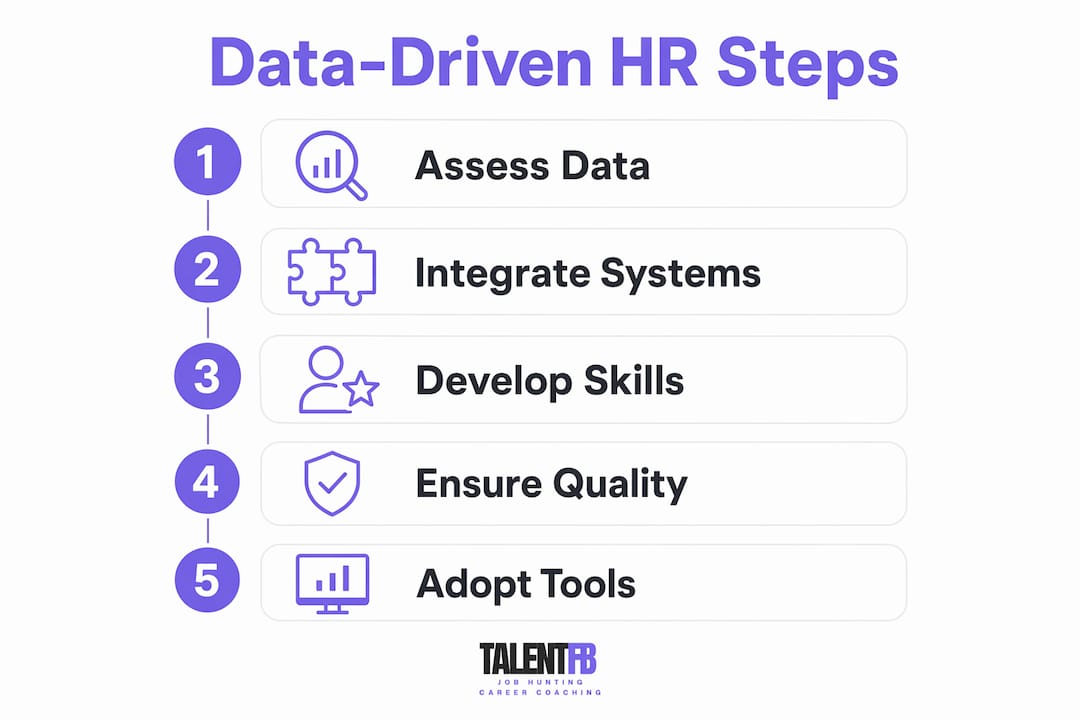
Implementing people analytics is not simply a technology project. Successful adoption requires developing internal analytical skills and building a culture that accepts data as a guide, not a threat. Many HR teams face a real skills gap: they are excellent at managing people but have limited experience with statistical models or data interpretation.
Data quality is the most underrated obstacle. Without clean, integrated data and consistent job taxonomies across systems, predictive models produce biased or incorrect outputs. Many organizations invest in advanced analytics tools before they have solved this foundational problem, and the results disappoint. The fix is unglamorous: audit your data sources, standardize job titles and levels, and establish a single source of truth before running a single model.
Ethical and regulatory concerns add another layer of complexity. The 2026 EU AI Act mandates explicit human accountability for AI-driven employment decisions, including hiring and compensation. This regulation reflects a broader principle: automated outputs in HR require continuous review to catch bias and maintain legal compliance. Good data protection practices are not just a legal requirement. They are the foundation of employee trust.
Key challenges HR leaders face when implementing analytics:
- Skills gaps: Most HR professionals need training in data literacy before they can interpret or act on analytical outputs confidently.
- Organizational resistance: Employees and managers often distrust decisions that feel algorithmic. Transparency about how data is used reduces this friction.
- Data silos: Payroll, HRIS, and engagement tools rarely talk to each other by default. Integration takes deliberate technical work.
- Ethical blind spots: Algorithms trained on historical data can encode past biases into future decisions if no one audits the outputs.
Pro Tip: Run a data literacy workshop with your HR team before launching any analytics initiative. Even a basic understanding of correlation versus causation changes how people interpret dashboards.
Practical applications of data in recruitment, engagement, and retention
The clearest return on investment from people analytics shows up in four areas: hiring, engagement, retention, and learning. Combining diverse data sources improves proactive decision-making across all of them.
-
Recruitment efficiency. Data identifies which sourcing channels produce candidates who stay longest and perform best. Instead of posting everywhere and hoping, HR teams can concentrate resources on the channels with the strongest track record. The talent shortlisting process becomes faster and more defensible when it is grounded in criteria validated by past performance data rather than hiring manager preference.
-
Employee engagement. Sentiment analysis tools process open-ended survey responses, exit interview transcripts, and even anonymized communication patterns to surface themes that structured surveys miss. When engagement data is reviewed monthly rather than annually, HR can intervene before disengagement becomes resignation.
-
Turnover prediction. Predictive models flag at-risk employees weeks or months before they hand in notice. A typical model weighs factors like tenure, recent performance trajectory, manager relationship scores, and time since last promotion. Acting on these signals with targeted conversations or development opportunities costs far less than replacing a senior employee.
-
Learning and development effectiveness. Data links training completion and content type to subsequent performance outcomes. This tells HR which programs actually move the needle and which ones employees complete without any measurable impact on their work.
| HR Function | Data Input | Business Outcome |
|---|---|---|
| Recruitment | Source, tenure, performance | Lower cost per hire |
| Engagement | Survey scores, sentiment | Higher retention |
| Retention | Flight risk model | Reduced turnover cost |
| Learning | Completion + performance | Stronger ROI on training |
For tech leaders who want to go deeper on data-driven talent acquisition, the principles above apply directly to building engineering and product teams in competitive markets.
How do you build a data-driven culture in HR?
The most common mistake HR leaders make is starting with data availability rather than business problems. Google’s People Analytics team is explicit about this: define the people problem first, then identify which data would help you understand it. This sequence prevents the trap of measuring everything and learning nothing.
Building analytic capacity inside HR requires four commitments from leadership:
- Start with questions, not dashboards. Every analytics project should begin with a specific, answerable business question. “Why is attrition higher in our Singapore engineering team than in our Jakarta team?” is a good starting question. “Let’s look at all our data” is not.
- Invest in upskilling. HR teams need training in data interpretation, not just data access. Partnering with a data analyst or people scientist accelerates this, but the HR team must develop enough literacy to ask the right questions and challenge the outputs.
- Secure leadership commitment. Analytics initiatives stall when senior leaders do not use the outputs in their own decisions. When a CHRO or CEO visibly acts on a data recommendation, it signals to the whole organization that this is how decisions get made now.
- Protect human judgment. Analytics identifies patterns and options, but hiring, promotion, and compensation decisions require human accountability. Data is the input, not the verdict.
The real role of HR analytics in workforce management is to give leaders better questions, not just better answers. That reframe changes how HR teams relate to data: less as a threat to their expertise, more as a tool that makes their expertise sharper.
What I have learned from 15 years inside the hiring room
After spending 15 years in hiring rooms across tech, fintech, adtech, and maritime-tech in APAC, I have watched the same mistake play out in organization after organization. Leaders invest in a shiny analytics platform, generate a beautiful dashboard, and then make the same decisions they always made. The data sits unused because no one built the habit of consulting it before acting.
The organizations that actually benefit from people analytics share one trait: they treat data as a conversation starter, not a conclusion. A flight risk score does not tell you to fire someone or give them a raise. It tells you to have a conversation you might have delayed. That is a fundamentally human act, supported by a number.
I am also honest with my clients about the ethical weight of this work. When you use data to make decisions about people’s careers, you carry a responsibility to audit your models, question your assumptions, and never let an algorithm be the last word. The 2026 EU AI Act is a regulatory floor, not a ceiling. The best HR leaders hold themselves to a higher standard than compliance requires.
My warmest recommendation: start small. Pick one problem, one data source, and one clear question. Build confidence with a small win before scaling. The organizations that try to do everything at once rarely do anything well.
— Frederic Bonifassy
How TalentFB helps leaders put data to work for their teams
HR professionals and tech leaders who understand the power of people analytics still need a clear path to apply it in their own careers and organizations. TalentFB was built for exactly that intersection.
Whether you are a CHRO building an analytics function or a senior tech leader navigating your next career move, the principles of evidence-based decision-making apply to both sides of the hiring table. TalentFB’s career coaching for tech executives gives you the frameworks to read the talent market the same way a data-driven HR team reads its workforce. You will find practical guidance on positioning, outreach, and negotiation grounded in 15 years of real hiring room experience. For leaders ready to attract top talent organically, the C-suite hiring tips page is a strong next step.
FAQ
What is the role of data in HR?
The role of data in HR is to enable evidence-based decisions on hiring, retention, performance, and development by replacing intuition with measurable insights drawn from HRIS, payroll, and engagement systems.
How does data improve employee retention?
Predictive models analyze factors like tenure, engagement scores, and promotion history to flag at-risk employees before they resign, allowing HR to intervene with targeted conversations or development opportunities.
What is the difference between HR reporting and HR analytics?
HR reporting describes past events, while HR analytics uses predictive modeling and machine learning to generate forward-looking recommendations that guide future workforce decisions.
What ethical rules apply to HR data in 2026?
The 2026 EU AI Act requires explicit human accountability for AI-driven employment decisions, meaning automated outputs in hiring, pay equity, and promotion must be reviewed and approved by a human decision-maker.
How can HR leaders build a data-driven culture?
Start with a clearly defined business problem rather than available data, invest in data literacy training for HR teams, and ensure senior leaders visibly act on analytical insights to model the behavior they want to see across the organization.