TL;DR:
- Success in a CEO interview depends on demonstrating cultural fit and problem-solving under pressure.
- Candidates must present a strategic leadership narrative, deep research, and a clear 100-day plan to impress boards.
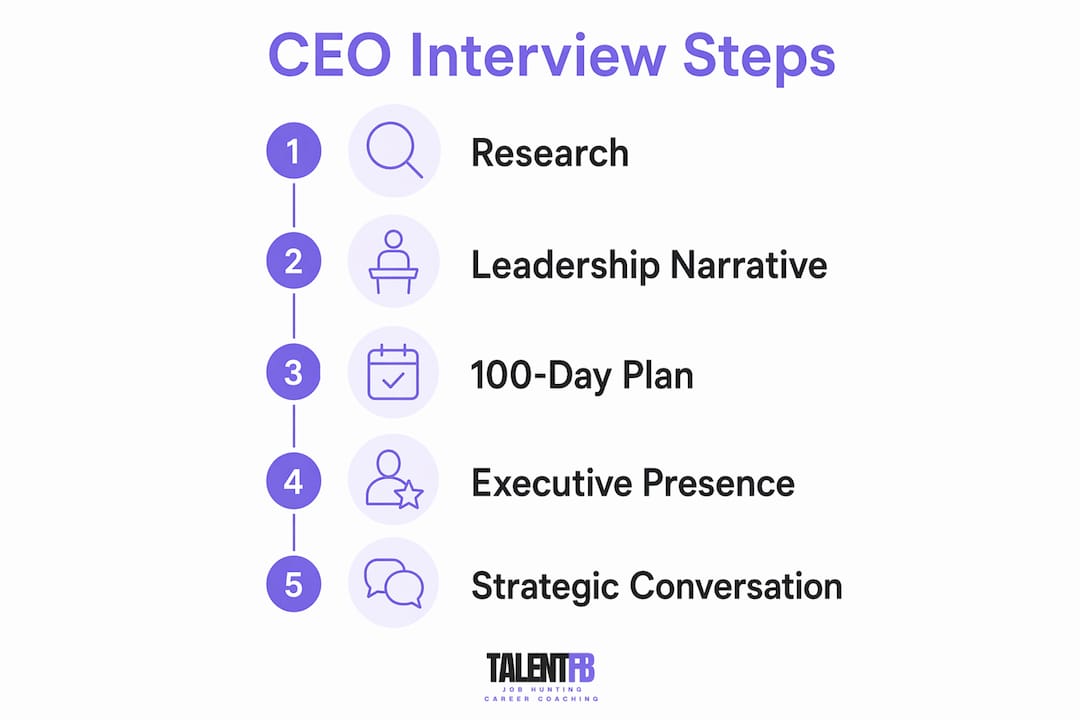
A CEO interview success guide is the structured framework that separates candidates who perform well from those who actually get the offer. Boards do not evaluate you on functional competence alone. 70% of hiring committees prioritize cultural fit, and 60% emphasize demonstrated problem-solving under pressure as primary criteria. That changes everything about how you should prepare. This guide gives you the exact strategies to research the organization deeply, craft a leadership narrative that resonates at the board level, and walk into the room with the composed authority that hiring committees remember.
What does a CEO interview success guide actually cover?
CEO interview preparation is formally known as executive leadership positioning. It goes well beyond rehearsing answers to standard questions. The CEO interview tests leadership maturity over functional competence, focusing on judgment and strategic impact. That distinction matters because most executives prepare the wrong way. They polish their resume story when they should be building a board-level conversation.

Three elements define a successful CEO interview: your leadership narrative, your enterprise-wide vision, and your executive presence. Boards want to see how you think, not just what you have done. They are evaluating whether you can sit across from them as a peer and lead a company through complexity.
How do you research the CEO role and hiring organization deeply?
Deep research is the foundation of every strong CEO interview strategy. Generic preparation produces generic answers, and boards notice immediately. You need to understand the company’s strategic priorities, financial health, and governance dynamics before you walk in.
Start with these research areas:
- Financial performance: Read the last two to three annual reports. Identify revenue trends, margin pressure, and capital allocation decisions. Form a point of view on what the numbers reveal about strategic priorities.
- Board composition: Research each board member’s background, tenure, and public statements. Understand where they agree and where tensions exist. This shapes how you frame your answers.
- Media and analyst coverage: Track recent press releases, earnings calls, and analyst reports. These reveal how the company positions itself versus how the market perceives it.
- Organizational metrics: Look at employee review patterns, leadership team tenure, and any public signals of cultural friction. These tell you what the new CEO will actually inherit.
- Strategic gaps: Identify what the company has not done that its position demands. This is where your most powerful observations live.
Avoid generic questions easily answered by research. Boards view candidates who ask surface-level questions as underprepared. Instead, present a specific, contrarian but respectful read of the company’s state to provoke real strategic dialogue.
Pro Tip: Before the interview, write a one-page “state of the company” memo as if you were briefing your own board. This forces you to synthesize your research into a coherent point of view, which is exactly what the hiring committee wants to see.
For a broader view of what boards look for in executive hires, the C-suite hiring tips resource from TalentFB offers useful context on how selection committees structure their evaluation criteria.
How do you craft a leadership narrative that resonates at the board level?
Your leadership narrative is not a career summary. It is a story about organizational impact told through the lens of strategic judgment. The difference is significant. A career summary lists what happened. A leadership narrative explains why your decisions mattered and what they produced at scale.
Follow this four-step structure when building your narrative:
- Open with enterprise context. Start every major answer by naming the organizational challenge, not your personal role. “The company was facing margin compression across three product lines” lands differently than “I was brought in to fix the P&L.”
- Apply the STAR method with a strategic lens. Situation, Task, Action, Result works well, but at the CEO level, the Result must include organizational or market-level impact. Revenue numbers alone are not enough. Boards want to see how your decision changed the trajectory of the business.
- Anchor your vision in a long-term timeline. Boards expect candidates to anchor answers in a “Next 10 Years” view rather than immediate tactical fixes. This signals that you think like an owner, not a manager.
- Demonstrate cross-functional thinking. Show that you have led beyond your functional silo. A CFO who only talks about finance, or a COO who only talks about operations, signals limited CEO readiness. Boards want enterprise-wide perspective.
The CEO interview is a peer-level conversation. Boards look for candidates who can transcend functional silos and create long-term value across the entire organization. Your narrative must reflect that scope.
Pro Tip: Record yourself answering your three most important narrative questions. Watch it back without sound first. Your body language and energy tell a story before your words do. Adjust accordingly.
For executives in tech and adjacent sectors, the advanced interview preparation guide from TalentFB covers how to anchor answers to long-term strategic timelines in high-stakes executive settings.
Why does a 100-day plan matter in a CEO interview?
A 100-day plan is not just a deliverable. It is a signal of intellectual honesty and strategic agility. Boards use it to assess whether you understand the difference between what you want to do and what the organization actually needs right now.
A strong 100-day plan covers four areas:
| Focus Area | What to Include | Why Boards Care |
|---|---|---|
| Listening and diagnosis | Structured stakeholder interviews, team assessments | Shows humility and curiosity before action |
| Quick wins | One or two visible, low-risk improvements | Demonstrates momentum and execution instinct |
| Strategic alignment | Review of current priorities against market reality | Signals you will challenge assumptions, not just inherit them |
| Stakeholder engagement | Board, leadership team, key customers, investors | Proves you understand that trust is built before decisions are made |
The plan should include measurable goals, but avoid over-engineering it. Boards are not looking for a perfect document. They are looking for evidence that you think in structured phases and that you will not arrive and immediately disrupt everything before you understand the system.
A specific, actionable 100-day plan that delineates how to drive value in the first quarter is one of the most cited differentiators in CEO hiring decisions. Bring it to the interview as a working draft, not a polished presentation. A draft invites dialogue. A polished deck closes it down.
For additional frameworks on career advancement planning, AccomplishMint’s resource on corporate professional development offers practical structure that translates well to executive-level preparation.
How do you handle tough questions with executive presence?
Executive presence is composed authority. It is not charisma, and it is not volume. Composed authority means staying grounded while matching the board’s energy, especially during technical or challenging questions. Most executives underestimate how much the room reads their physical and emotional state.
Watch for these common pitfalls:
- Hiding behind “we.” Boards want to know what you decided, not what the team did. Own your choices, including the ones that did not work.
- Over-technical answers. When a board member pushes back on a financial or operational detail, resist the urge to go deeper into the data. Reframe to the strategic implication instead.
- Defensive body language. Leaning back, crossing arms, or speeding up your speech under pressure all signal discomfort. Slow down deliberately when the question gets hard.
- Avoiding failure questions. Boards test for what is called Correction Logic. They want to hear that you failed, that you understood why, and that you changed your approach structurally.
“Candidates who successfully explain how they learned from past failures with precise structural changes demonstrate executive accountability and build board trust. Transparency about failure is not a weakness in a CEO interview. It is the clearest signal of leadership maturity a board can observe.”
Boards view insightful, probing questions about governance or board-CEO partnership as the ultimate signal of readiness to lead. The questions you ask at the end of the interview carry as much weight as the answers you gave throughout it.
What I have learned from 15 years inside hiring rooms
The single biggest mistake I see senior executives make in CEO interviews is treating the conversation as a performance. They prepare answers. They rehearse stories. They arrive ready to impress. And then they lose the room within the first ten minutes because they are talking at the board instead of thinking with them.
The fatal error is treating CEO interviews as standard Q&A sessions. The candidates who get offers shift to strategic consultation within the first 90 seconds. They turn “tell me about yourself” into a conversation about the company’s specific revenue challenges or market position. That pivot signals immediately that you are a peer, not a candidate.
Authenticity matters more than polish at this level. Boards have interviewed enough executives to recognize a rehearsed answer instantly. What they cannot fake-detect is genuine curiosity and intellectual honesty. If you do not know something, say so and explain how you would find out. That answer builds more trust than a confident bluff.
My honest recommendation: prepare until you feel ready, then prepare one more day. The executives who walk into CEO interviews with real composure are not the ones who are naturally calm. They are the ones who have done so much preparation that they have nothing left to prove. That is when the conversation becomes natural, and natural is what wins.
— Frederic Bonifassy
How TalentFB helps executives prepare for CEO-level interviews
Refining your leadership narrative and building a board-ready 100-day plan takes more than reading a guide. It takes structured feedback from someone who has sat on both sides of the table.
TalentFB’s executive coaching for tech leaders is built specifically for Directors, VPs, and senior executives targeting CEO and C-suite roles. With 350+ professionals coached and a 90-day results framework, TalentFB gives you the personalized preparation that generic interview advice cannot. From sharpening your leadership narrative to positioning your LinkedIn profile as a board-level asset, every element of your executive brand gets built with intention. If you are serious about your next role, explore what a structured coaching engagement looks like.
FAQ
What do boards evaluate most in a CEO interview?
70% of hiring committees prioritize cultural fit, and 60% emphasize problem-solving under pressure. Boards also assess leadership maturity, enterprise-wide judgment, and stakeholder credibility.
How quickly should I shift to strategic conversation in a CEO interview?
Successful candidates shift to strategic consultation within the first 90 seconds. Turn the opening question into a discussion about the company’s specific challenges rather than a personal career recap.
Should I bring a 100-day plan to a CEO interview?
Yes. A working draft of a 100-day plan signals intellectual honesty and structured thinking. Boards respond better to a draft that invites dialogue than to a polished presentation that closes it down.
How do I answer questions about past failures in a CEO interview?
Apply Correction Logic: name the failure, explain your analytical process, and describe the structural change you made to avoid repeating it. Transparency about failure builds board trust and demonstrates executive accountability.
What questions should I ask at the end of a CEO interview?
Ask about governance dynamics, board-CEO partnership expectations, and the most divisive strategic debate the board is currently navigating. Insightful, probing questions about governance signal that you are ready to lead, not just to manage.