TL;DR:
- Technology in HR automates repetitive tasks and enables data-driven workforce management. HR leaders must leverage AI and integrated platforms to focus on strategic decisions and talent development. Risks include trust loss from lack of transparency and algorithmic bias without proper governance.
Technology in human resources is defined as the use of AI, automation, and integrated digital platforms to shift HR from administrative work to strategic workforce management. This transformation is no longer optional. 91% of CHROs identified AI and workplace digitization as their top agenda items in 2026, with adoption concentrated first in talent acquisition. That number tells you where the profession is heading. HR leaders who treat technology as a back-office upgrade will fall behind those who use it to drive business decisions. This guide gives you the full picture: what works, what risks to watch, and where HR technology is going next.
What is the role of technology in HR today?
Technology in HR does one fundamental thing: it frees HR professionals from repetitive tasks so they can focus on work that actually requires human judgment. Payroll processing, benefits enrollment, compliance tracking, and interview scheduling all consume enormous time when done manually. Automated HR software solutions handle these tasks faster and with fewer errors.

The shift goes deeper than efficiency, though. Skills management, learning experience platforms, and internal talent marketplaces are now considered critical HR technology categories in 2026. This reflects a foundational change: companies are moving from resume-based hiring to skills-based talent strategy. That means HR systems must do more than store employee records. They must map capabilities, identify gaps, and match people to opportunities in real time.
Integrated HR ecosystems unify hiring, payroll, benefits, and performance evaluation into a single data environment. When these systems talk to each other, HR leaders get a complete picture of workforce health without chasing data across spreadsheets. The talent acquisition workflow becomes faster, more consistent, and easier to measure.
How technology improves recruitment, onboarding, and performance
The impact of tech on HR shows up most clearly in three core processes.
- Talent acquisition: AI-driven tools screen resumes, rank candidates by skills fit, and flag potential biases in job descriptions. This cuts time-to-hire and improves the quality of shortlists. Talent acquisition is treated as a bounded AI testing ground because its structured processes carry lower risk than other HR functions.
- Digital onboarding: Automated onboarding platforms deliver compliance training, equipment setup workflows, and culture introductions before a new hire’s first day. New employees arrive prepared, not overwhelmed.
- Performance management: Continuous feedback tools replace the annual review cycle with real-time data. Managers see performance trends as they develop, not six months after the fact.
Pro Tip: Avoid building your HR tech stack from siloed point solutions. A recruiting tool that does not connect to your learning platform or payroll system creates data gaps that cost you insight. Invest in integrated platforms from the start, even if it means a slower rollout.
How does predictive analytics change HR’s strategic role?
HR is evolving into what the SHRM CEO describes as an organizational “meteorologist” role, using predictive analytics to forecast workforce trends rather than react to them. That metaphor is worth sitting with. A meteorologist does not wait for the storm to arrive. HR leaders with the right analytics tools can identify attrition risk months before resignations happen, model the workforce impact of a new product launch, and advise the C-suite on hiring strategy with data behind every recommendation.
Predictive analytics pulls from performance scores, engagement surveys, compensation benchmarks, and external labor market data to surface patterns that humans would miss. An HR team using these tools can tell leadership: “We expect to lose 15% of our senior engineers in the next two quarters unless we adjust compensation bands.” That is a strategic conversation, not an administrative one.
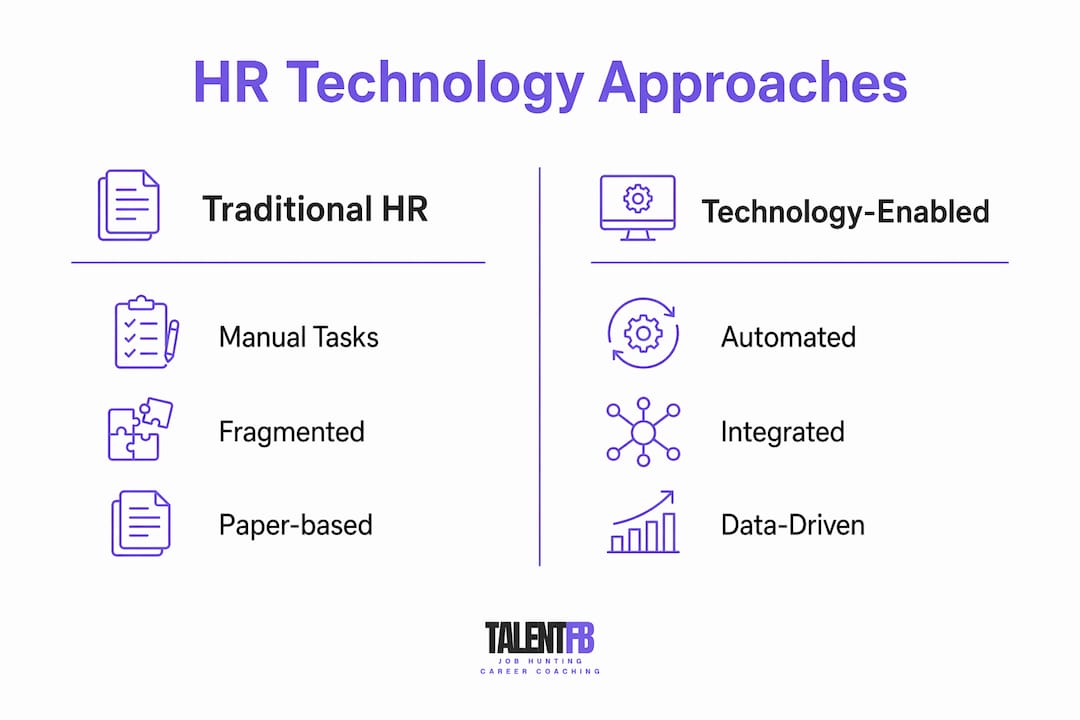
HR now also manages a blended workforce of human employees and AI-driven workers. Justifying the ROI of each, relative to AI infrastructure costs, is a new responsibility that requires financial literacy alongside people skills. The table below shows how this strategic shift looks in practice.
| HR function | Traditional approach | Technology-enabled approach |
|---|---|---|
| Workforce planning | Annual headcount review | Continuous predictive modeling |
| Attrition management | Exit interviews after resignation | Early-warning analytics dashboards |
| Talent sourcing | Job board postings | Skills-based internal talent marketplaces |
| Performance review | Annual appraisal cycle | Real-time feedback and continuous data |
| Learning and development | Scheduled classroom training | Personalized learning experience platforms |
This table is not theoretical. These shifts are happening now across tech, fintech, and enterprise organizations across APAC and globally. HR leaders who understand modern talent management as a data-driven discipline will be the ones advising the board, not reporting to it.
What are the risks of AI in HR?
The biggest risk of AI in HR is not a technical failure. Disruption of the psychological contract occurs when employees discover that algorithms are making decisions about their careers without transparent communication. When people feel that a machine decided their promotion, their performance rating, or their termination, trust collapses. And trust, once lost in an organization, is extraordinarily expensive to rebuild.
Algorithmic bias is the second major risk. AI models trained on historical hiring data reproduce the patterns in that data, including patterns that excluded qualified candidates based on gender, ethnicity, or educational background. Without regular audits, these biases scale silently across thousands of decisions.
Practical steps to manage these risks include:
- Establish human-in-the-loop governance before expanding AI into high-stakes areas like performance management or termination decisions. Human oversight controls are not optional; they are the foundation of ethical AI in HR.
- Communicate transparently about how AI tools influence decisions. Employees do not need to understand the algorithm. They do need to know that a human reviewed the outcome.
- Conduct regular bias audits on AI outputs across demographic groups. Schedule these quarterly, not annually.
- Build an ethical AI framework that defines which decisions AI can inform, which it can make, and which must remain entirely human. A practical guide on HR change management can help structure this process.
Pro Tip: The cultural and human impact of AI adoption is harder to manage than the software rollout itself. Change management around AI is a larger challenge than deployment. Plan your communication strategy before you deploy, not after.
What does the future of HR technology look like?
The future of HR technology is “agentic HR,” a model where discrete AI agents handle specific HR domains rather than one large AI system managing everything. Domain-specific AI agents integrated with existing HR systems outperform monolithic AI implementations. This architecture allows organizations to adopt AI incrementally, connecting new agents to legacy data without replacing entire systems at once.
Josh Bersin’s HR 2030 Vision describes a future where HR orchestrates a workforce of human employees, AI agents, and automated processes working together. The shift from Centers of Excellence to a systemic HR business enablement model is necessary for HR to remain relevant in 2030. That is a significant structural change for most HR organizations.
One measurement insight that often gets overlooked: tracking “capacity reinvestment” is more valuable than measuring hours saved by automation. Where does the time go after a process is automated? If it flows into strategic workforce planning, coaching, and employee support, the technology is delivering real value. If it disappears into more administrative work, the investment has not changed anything meaningful.
| Dimension | Traditional HR systems | Agentic HR model |
|---|---|---|
| Architecture | Monolithic, single platform | Modular, interoperable AI agents |
| Adoption path | Full system replacement | Incremental agent integration |
| Data handling | Siloed by function | Unified across HR domains |
| Decision-making | Rule-based workflows | Predictive, context-aware recommendations |
| Workforce scope | Human employees only | Human employees plus AI workers |
The strategic guide for talent acquisition in tech organizations already reflects many of these principles. The HR leaders who study this architecture now will be far better positioned when their organizations are ready to adopt it.
What I’ve learned about technology and the human soul of HR
After 15 years inside hiring rooms across tech, fintech, adtech, and maritime-tech in APAC, I have watched HR technology go from a novelty to a necessity. And I want to be honest with you about something most articles will not say directly: the technology is the easy part.
The hard part is keeping HR human when the pressure to automate everything is intense. I have seen organizations deploy AI screening tools and then wonder why their employer brand suffered. The candidates who were filtered out by an algorithm never received a human response. That is not an efficiency gain. That is a trust deficit that compounds over time.
My honest recommendation is this: use technology to handle what technology does well, which is speed, scale, and pattern recognition. Reserve human judgment for what humans do well, which is context, empathy, and nuance. A hiring manager reading between the lines of a candidate’s career story will always catch something an algorithm misses. A great HR business partner having a real conversation with a disengaged employee will surface insights no engagement survey can replicate.
The HR professionals who will thrive in 2030 are not the ones who know the most about AI. They are the ones who know how to lead people through change, build trust in uncertain environments, and make technology serve the organization’s values rather than override them. That skill set is worth developing right now.
— Frederic Bonifassy
TalentFB’s resources for HR and tech leaders
HR leaders navigating digital transformation need more than software knowledge. They need a clear personal strategy for growing their own influence and expertise as the profession changes around them.
TalentFB works with senior HR and tech executives across APAC to build that strategy. Whether you are looking to sharpen your career advancement roadmap or position yourself as the kind of leader who drives technology adoption rather than reacts to it, TalentFB’s coaching gives you a structured path. The career coaching guide for tech executives covers exactly what senior professionals need to move from functional expert to strategic leader in a technology-driven environment.
FAQ
What is the role of technology in HR?
Technology in HR automates administrative tasks and enables data-driven workforce decisions. Its core function is shifting HR from reactive administration to proactive strategic management.
How does AI improve human resource management?
AI in human resource management accelerates talent acquisition, personalizes learning, and predicts attrition risk before it becomes a resignation. 91% of CHROs in 2026 ranked AI adoption as a top priority, with talent acquisition leading implementation.
What are the biggest risks of HR technology?
The biggest risk is disrupting employee trust when AI decision-making lacks transparency. Algorithmic bias and loss of procedural justice are the two most damaging outcomes of poorly governed HR technology.
What is agentic HR?
Agentic HR is a model where domain-specific AI agents handle discrete HR functions and integrate with existing systems incrementally. This approach outperforms single large AI implementations and allows organizations to adopt AI without replacing legacy infrastructure.
How should HR measure the impact of automation?
HR should measure capacity reinvestment, meaning where the time saved by automation is actually applied. Time reinvested into coaching, strategic planning, and employee support signals real organizational value.