
TL;DR:
- Most tech companies struggle with outdated workflows that hinder talent acquisition despite sufficient budgets. Implementing AI-integrated systems, optimizing candidate screening, and adopting skills-based criteria can expand pools and reduce time-to-fill effectively. Continual measurement, strong governance, and organizational buy-in are essential for sustainable, scalable hiring success.
Even the most well-resourced tech companies lose their best candidates to faster, more responsive competitors. The problem often isn’t budget or brand recognition. It’s the workflow itself. Fragmented sourcing tools, manual screening steps, and disconnected data create invisible gaps where top talent quietly disappears. According to AI in Talent Acquisition 2025, the path forward requires organizations to prioritize AI-integrated systems, measure outcomes beyond time-to-fill, and adopt skills-first approaches that dramatically expand candidate access. This guide shows you exactly how to build that future-ready workflow.
Table of Contents
- Assessing your current talent acquisition workflow
- Essential tools and technologies for scalable workflows
- Step-by-step: Implementing an AI-driven talent acquisition workflow
- Measuring, optimizing, and scaling your workflow
- The reality most tech leaders miss in talent acquisition workflow transformation
- Enhance your talent acquisition results with proven resources
- Frequently asked questions
Key Takeaways
| Point | Details |
|---|---|
| Skills-first approach | Replacing credentials with skills expands the candidate pool up to eightfold. |
| AI integration | AI tools streamline sourcing, screening, and compliance in talent acquisition. |
| Holistic metrics | Success hinges on tracking NPS and hires per recruiter, not just time-to-fill. |
| Continuous improvement | Effective workflows are data-driven and evolve through ongoing measurement. |
Assessing your current talent acquisition workflow
Having established why outdated workflows cannot keep pace, let’s examine how to assess your current approach and its limitations before making any changes.
Every workflow assessment begins with mapping the stages you already have in place: sourcing, screening, interviewing, and hiring. Most teams know these stages exist. What they don’t realize is how much friction accumulates between each one. A candidate who enters your pipeline on Monday may not receive their first screening call until Thursday, simply because there’s no automated handoff between your applicant tracking system and your recruiting calendar. These delays compound quickly, and in tech hiring, they can cost you a finalist.
When mapping your workflow, look specifically for two things: bottlenecks and drop-off points. Bottlenecks are stages where volume slows down, usually due to manual work or limited bandwidth on the team’s side. Drop-off points are stages where candidates voluntarily exit your process, often because communication is slow or the experience feels disorganized. Both are measurable, and both are fixable.
Here are the baseline metrics you should be capturing right now before layering in any new technology:
- Time-to-fill: The number of days from job requisition approval to accepted offer
- Offer acceptance rate: The percentage of extended offers that candidates accept
- Candidates per requisition: How many applicants are reviewed per open role
- Pipeline conversion rate: How many candidates move from each stage to the next
- Cost-per-hire: Total recruiting investment divided by the number of hires made
Comparing these numbers to industry benchmarks helps you prioritize where to invest. For tech roles specifically, time-to-fill benchmarks hover between 30 and 45 days for mid-level positions, while senior and specialized roles often exceed 60 days. If your numbers are above those benchmarks, you have a clear signal that workflow optimization is overdue.
One particularly powerful shift is rethinking how you define a qualified candidate. Switching to skills-based criteria over traditional credential filters can expand the candidate pool by 6 to 8 times. That’s not a minor adjustment. It fundamentally changes the scale of talent you’re working with, and it requires your workflow to be built to handle that volume intelligently.
Pro Tip: Before purchasing any new tool, audit your current ATS data for the last 12 months. Look at where candidates were most likely to drop out of the process. That pattern tells you more than any vendor demo.
For a broader strategic framework, the strategic talent acquisition guide and modern HR hiring strategies provide context on how workflow design fits into your larger talent strategy.
| Metric | Typical manual workflow | AI-optimized workflow |
|---|---|---|
| Time-to-fill (tech roles) | 55 to 75 days | 28 to 40 days |
| Offer acceptance rate | 62 to 70% | 78 to 88% |
| Candidate pool per req | 40 to 80 applicants | 200 to 500+ (skills-first) |
| Recruiter capacity | 15 to 20 reqs/month | 30 to 45 reqs/month |
Essential tools and technologies for scalable workflows
Once baseline gaps are understood, it’s essential to equip your team with the right technology stack to address those needs effectively and sustainably.
The modern talent acquisition technology stack is built around four core platform categories. Your applicant tracking system manages requisitions, candidate records, and compliance documentation. Your candidate relationship management platform handles pipeline nurturing, talent community engagement, and long-term relationship building. Assessment tools provide structured, skills-based evaluation at scale. And scheduling automation eliminates one of the most frustrating manual tasks in recruiting: coordinating interview times across multiple stakeholders.
For tech-focused teams specifically, several must-have features separate adequate tools from genuinely competitive ones:
- Skills parsing: The ability to extract and interpret technical skills from resumes, portfolios, and LinkedIn profiles without requiring keyword-exact matches
- Interview intelligence: AI-powered analysis of recorded interviews that surfaces candidate signals, sentiment, and structured scoring patterns
- Automated compliance tracking: Built-in logs that document every step of the evaluation process for audit purposes
- Integration capabilities: Open APIs that allow your ATS, CRM, assessment, and scheduling tools to share data without manual data entry
The governance question often gets treated as an afterthought. It shouldn’t. Strong governance policies and audits are essential for AI-integrated ATS and CRM systems, particularly as regulatory scrutiny around algorithmic hiring increases. When an AI tool makes a recommendation, you need a documented audit trail that shows why that recommendation was made and how it was acted upon. This protects your organization legally and builds trust with candidates.
| Tool category | Key function | Example use case |
|---|---|---|
| AI-powered ATS | Resume parsing, workflow automation | Auto-advance top candidates to phone screens |
| CRM for recruiting | Talent nurturing, pipeline health | Re-engage silver medalists for new openings |
| Skills assessments | Structured technical evaluation | Coding challenges for engineering roles |
| Interview scheduling | Calendar coordination | Automated multi-interviewer scheduling links |
| Analytics dashboard | Metrics tracking and reporting | Recruiter efficiency and funnel conversion views |
How these tools fit together matters as much as what each one does individually. When your ATS can automatically push a screened candidate into your scheduling tool and simultaneously notify the hiring manager, you’ve removed three or four manual steps from the process. Multiply that across 50 open requisitions, and the efficiency gains become substantial.
Pro Tip: When evaluating AI recruiting platforms, ask vendors specifically how their systems handle bias mitigation and what audit documentation they provide. If they can’t answer clearly, that’s a governance red flag.
For a detailed comparison of platforms worth evaluating, explore AI recruiting tool alternatives to see how today’s leading options measure up against each other.
Step-by-step: Implementing an AI-driven talent acquisition workflow
Equipped with the right tools, you’re ready to transform your process. Here’s a clear sequence for rollout and optimization that minimizes disruption while maximizing impact.
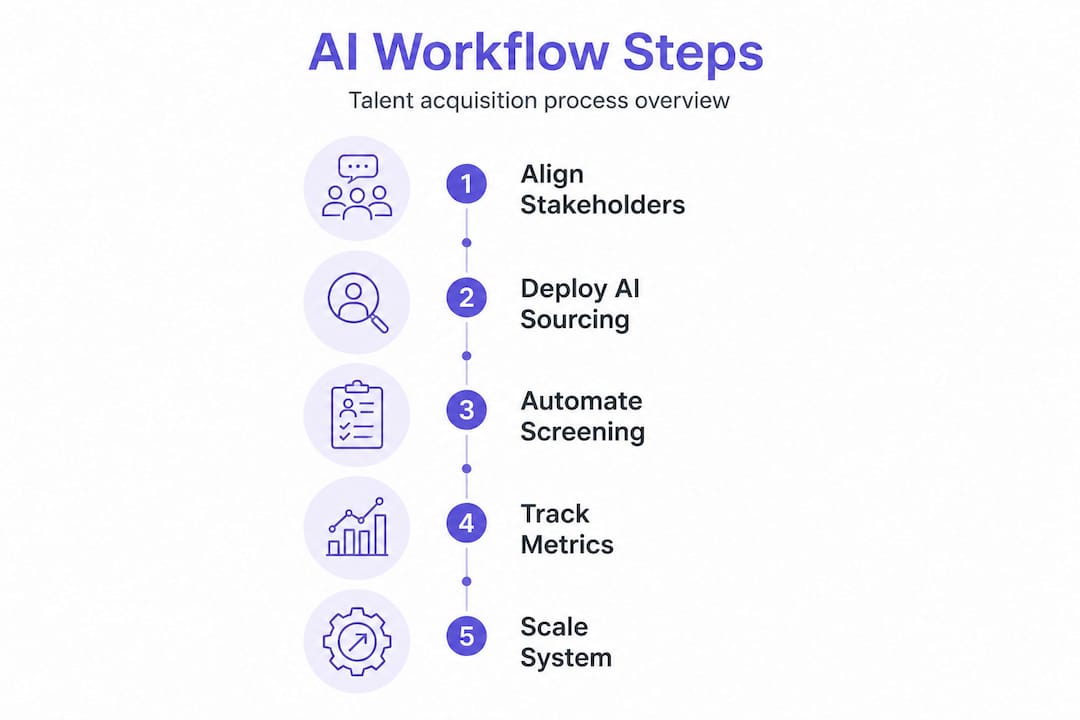
Step 1: Define requirements and align stakeholders. Before any software is configured, align your recruiting team, HR leadership, and key hiring managers around shared definitions. What does a qualified candidate look like for each role family? What stages are non-negotiable, and where does your team have the most flexibility? Document these decisions explicitly. Without this alignment, AI tools will optimize for the wrong things.
Step 2: Deploy AI-powered sourcing with a skills-first filter. Replace traditional job description filters with skills-based criteria. Configure your sourcing tools to surface candidates based on demonstrated capabilities, project history, and technical assessments rather than degree requirements or job title patterns alone. This is where your candidate pool expands dramatically and where talent attraction strategies play a critical role in communicating your value proposition to broader audiences.
Step 3: Automate screening while maintaining bias controls. Set up automated screening workflows that move qualified candidates forward without waiting for recruiter availability. At the same time, build in regular bias audits. Review screening outcomes by demographic group quarterly to identify any patterns that suggest the system is filtering unfairly. Automation doesn’t eliminate bias on its own. It scales whatever criteria you’ve built in.
Step 4: Use AI scheduling and interview analytics. Once candidates reach the interview stage, deploy scheduling automation to reduce the typical 3 to 5 day coordination delay to under 24 hours. Use interview intelligence tools to provide structured scoring frameworks to all interviewers before the session, and capture analytics on response patterns and evaluation consistency across your panel.
Step 5: Track outcomes and close the feedback loop. After offers are extended, track not just whether they were accepted, but why they were or were not. Collect candidate experience surveys immediately post-process. Gather hiring manager satisfaction scores within 90 days of a new hire’s start date. Success in these workflows is best measured through NPS, completion rates, and hires per recruiter, not just time-to-fill.
“Measuring time-to-fill alone is like judging a restaurant by how fast the food arrives rather than whether guests come back. The metrics that predict long-term hiring success are the ones that measure experience, quality, and efficiency together.”
Pro Tip: Run a 30-day pilot on a single role family before full rollout. Use one job category, one AI sourcing tool, and one set of structured interview prompts. The learnings from a contained pilot prevent costly mistakes at scale.
Measuring, optimizing, and scaling your workflow
After implementation, success hinges on consistently measuring the right metrics and refining your system for greater scale and predictive value over time.

The most effective talent acquisition leaders treat their workflows the same way a product team treats a software release: with sprint reviews, data-driven iteration, and clear ownership of outcomes. Organizations that track NPS, completion rates, and hires per recruiter consistently outperform those still focused narrowly on time-to-fill as the primary signal of workflow health.
Setting up an audit process means scheduling regular reviews of your AI tool outputs, your recruiter efficiency data, and your candidate experience scores. Monthly reviews work well during the first 6 months after implementation. Once the workflow stabilizes, quarterly reviews are sufficient unless a significant hiring ramp or organizational change is underway.
Here’s what a complete measurement framework looks like in practice:
- Candidate NPS: Surveys sent within 48 hours of a final hiring decision, regardless of outcome
- Pipeline completion rate: The percentage of candidates who complete each step without dropping out
- Hires per recruiter per month: A direct measure of workflow efficiency and tool effectiveness
- Quality of hire: A 90-day performance rating from the hiring manager for every new hire
- Source effectiveness: Which sourcing channels and tools are producing the highest-quality hires at the lowest cost
Common pitfalls in the optimization phase include over-automating feedback collection, which leads to survey fatigue and low response rates, and under-investing in recruiter training on new tools. When recruiters don’t trust the technology or understand how it makes decisions, they work around it rather than with it. That’s a cultural problem that no software update can fix.
| Signal | What it tells you | Optimization action |
|---|---|---|
| Low candidate NPS | Poor communication or slow process | Audit touchpoint frequency and response time |
| High drop-off at assessment | Assessment too long or misaligned | Shorten or replace assessment tool |
| Low hires per recruiter | Over-reliance on manual steps | Identify which tasks can be automated |
| Low offer acceptance | Compensation or process friction | Review offer benchmarks and experience quality |
For deeper guidance on building long-term capability in your team, the talent development guide provides frameworks specifically designed for tech executives navigating growth-phase hiring.
Pro Tip: Share your workflow metrics monthly with hiring managers, not just the recruiting team. When business leaders see pipeline health data, they make better decisions about interview panel availability and offer speed.
The reality most tech leaders miss in talent acquisition workflow transformation
With your new workflow running and evolving, it’s critical to step back and see what most experts overlook when they talk about transformation.
Here’s the uncomfortable truth: most AI-powered talent acquisition failures aren’t technology failures. They’re organizational failures. The tools work. The process logic is sound. But the change was never fully embraced by the people who have to operate it every day. Recruiters who weren’t involved in the selection process feel like they’re executing someone else’s vision. Hiring managers who weren’t trained on the new structured interview framework default back to gut-feel decisions. The governance documentation gets completed but never actually reviewed.
This is why building a hiring strategy isn’t just a process design exercise. It’s a leadership exercise. The technical side of workflow optimization is genuinely the easier part. The harder work is convincing your most experienced hiring managers that a skills-first framework surfaces better candidates than their intuition alone. It’s creating a culture where a recruiter flags a potential bias signal in the AI output and is celebrated for it rather than seen as slowing things down.
Governance also tends to slide from active practice into bureaucratic checkbox. At the start, audit logs are reviewed carefully and AI recommendations are questioned. Six months later, the process is running smoothly, and that scrutiny fades. That’s precisely when blind spots grow. The organizations that maintain genuinely strong governance treat it as a living discipline, not a launch requirement.
The best workflows we’ve seen in tech are never static. They’re built with the explicit expectation that they will need to change. A workflow designed in Q1 for a software engineering ramp may need significant reconfiguration by Q3 when the hiring focus shifts to product or sales leadership. If your workflow can’t adapt to that shift within two to three weeks, it will become an obstacle rather than an accelerant.
Skills-first frameworks also require more than a sourcing setting change. They require leadership to communicate clearly why a candidate without a specific degree is being advanced to a final-round interview. That message has to come from the top. Without executive sponsorship, the skills-first approach will quietly revert to credential screening the moment a hiring manager raises an eyebrow.
Enhance your talent acquisition results with proven resources
Having worked through the core frameworks in this guide, many talent leaders find that having trusted resources and expert support makes the difference between good intentions and real adoption.
At TalentFB, we work with HR leaders and talent acquisition professionals who want to move faster, hire smarter, and build workflows that actually hold up under pressure. Whether you’re evaluating AI talent acquisition tools for your team or looking for structured approaches to implement skills-first hiring, our resources are built for tech environments specifically. The AI Job Search Playbook offers practical, ready-to-use frameworks that support both sides of the hiring equation. For leaders who want personalized strategic support, career coaching for tech leaders provides the expert guidance needed to align talent strategy with business outcomes.
Frequently asked questions
What is the most important metric to track in talent acquisition workflows?
Go beyond time-to-fill and track NPS, completion rates, and hires per recruiter to get a complete picture of both workflow efficiency and candidate experience quality.
How does AI improve the talent acquisition workflow?
AI increases candidate pool size, streamlines sourcing and screening, and enables skills-based selection that expands your qualified pipeline by 6 to 8 times compared to traditional credential filters.
Why are governance policies crucial when using AI in hiring?
Strong governance policies and audit processes provide oversight to AI systems, preventing bias from scaling unchecked and ensuring your hiring decisions remain defensible and compliant as AI-integrated ATS and CRM platforms become standard.
What steps should we take to integrate AI into our existing workflow?
Assess your baseline processes, align stakeholders around skills-first criteria, implement AI in stages beginning with sourcing, and establish continuous data-driven measurement practices before scaling further.