
TL;DR:
- A strategic hiring plan aligns talent needs with company goals over 6 to 18 months.
- Successful tech hiring emphasizes structured multi-stage assessments and proactive candidate sourcing.
- Employer branding and passive outreach are crucial for attracting top senior tech talent.
Posting more job ads is not a hiring strategy. Yet many senior tech leaders operate as if the two are interchangeable, flooding LinkedIn with listings and wondering why the pipeline stays shallow or the wrong candidates keep surfacing. The reality is that most hiring failures trace back to a missing strategic foundation, not a lack of candidates. If you are a CTO, VP of Engineering, or tech executive responsible for building high-performing teams, this guide breaks down what a real hiring strategy looks like, how it differs from reactive recruiting, and how you can use it to attract and retain the talent your organization actually needs.
Table of Contents
- Defining a hiring strategy in the tech sector
- Core components of a successful hiring strategy
- Hiring strategy for executives and senior tech roles
- Integrating employer branding and sourcing channels
- Why great hiring strategy in tech is about more than algorithms
- Take your hiring to the next level with TalentFB
- Frequently asked questions
Key Takeaways
| Point | Details |
|---|---|
| Strategy beats tactics | A hiring strategy aligns process with business goals, not just filling seats. |
| Multi-stage processes matter | Layered assessments and interviews lead to higher-quality tech hires. |
| Leadership roles need nuance | Senior hires require focus on culture, business acumen, and timing. |
| Branding boosts results | A strong employer brand and proactive sourcing attract top talent fast. |
Defining a hiring strategy in the tech sector
A hiring strategy is not a collection of tactics stitched together at the last minute. It is a deliberate, forward-looking plan that aligns your talent acquisition goals with your company’s technical roadmap, culture, and growth trajectory. Tactics are what you do. Strategy is why you do it, when, and how it all fits together.
In the technology sector, this distinction carries serious weight. A company filling ten engineering roles reactively, posting job ads only when seats are empty, will always lag behind a competitor that maps talent needs six to twelve months ahead and builds relationships with candidates before a vacancy exists.
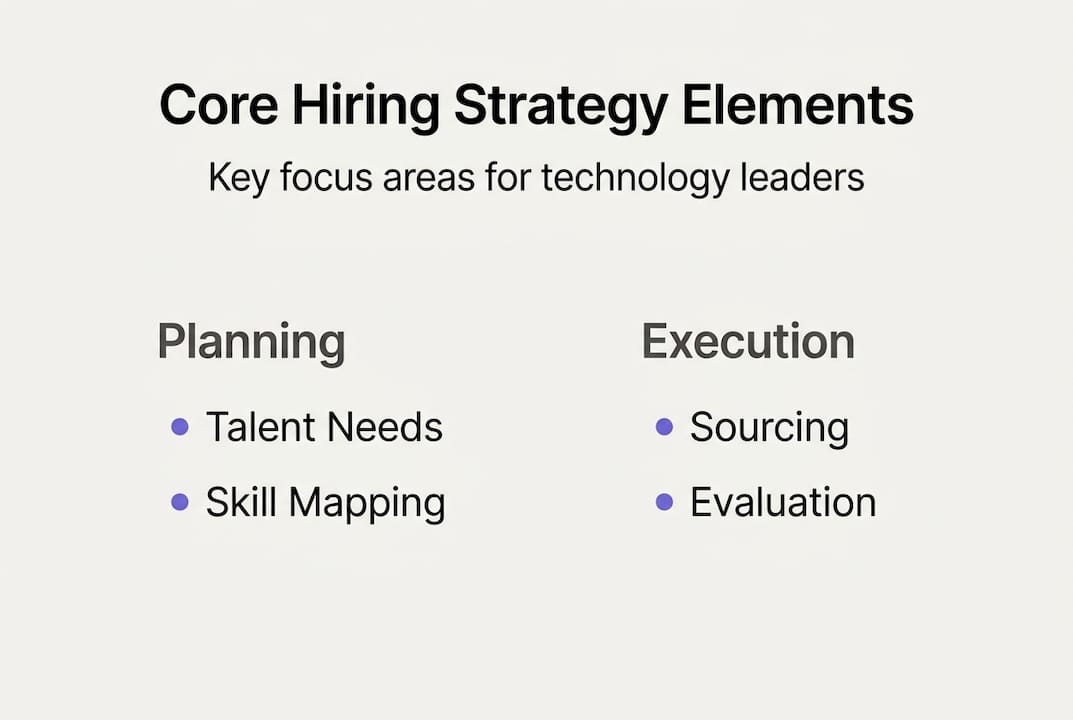
Here is a side-by-side look at how these two approaches compare:
| Dimension | Hiring strategy | Traditional recruitment |
|---|---|---|
| Time horizon | 6 to 18 months ahead | Immediate or short-term |
| Focus | Pipeline building and brand | Filling open roles |
| Candidate type | Active and passive talent | Mostly active applicants |
| Success metrics | Quality of hire, retention | Time to fill, cost per hire |
| Tools used | AI screening, assessments, data | Job boards, basic ATS |
For tech companies specifically, the elements that make a hiring plan truly strategic go beyond sourcing. They include:
- Skills-based assessments tied to actual job requirements
- Technical test pipelines that evaluate depth without over-indexing on trivia
- Culture add focus rather than culture fit cloning
- Employer brand management across GitHub, LinkedIn, and engineering communities
- Data-driven sourcing that targets where your ideal candidates actually spend their time
As noted in research on skills-based assessments and sourcing, key mechanics include multi-stage interviews, data-driven sourcing from networks like LinkedIn and GitHub, employer branding, and AI tools for screening. These are not optional extras. They are the backbone of strategic talent acquisition in any competitive tech environment.
“The organizations winning the talent war are those treating hiring as a business-critical function, not an HR administrative task.” — Senior hiring advisor perspective
When strategy replaces guesswork, your entire hiring operation becomes more predictable, more efficient, and far more capable of attracting people who genuinely move the needle.
Core components of a successful hiring strategy
Understanding what a strategy is matters less than knowing what one includes. The most effective hiring frameworks for tech companies share a recognizable structure, even when the details vary by company size or stage.
Here is how a robust tech hiring funnel typically unfolds:
- Workforce planning — Identify skills gaps and future needs based on your product and engineering roadmap.
- Sourcing — Use LinkedIn, GitHub, referral programs, and talent communities to surface active and passive candidates.
- Initial screening — AI-powered tools filter for baseline qualifications before any human time is invested.
- Technical assessment — Skills-based tests and take-home challenges that reflect real work, not trivia.
- Multi-stage interviews — A structured sequence covering system design, behavioral scenarios, and team fit.
- Offer and negotiation — Competitive, data-informed offers crafted to close strong candidates quickly.
- Onboarding — A structured integration plan that accelerates time to productivity and reduces early attrition.
The interview stage deserves special attention. A single-round process may feel faster, but it consistently produces worse outcomes. Compare the two approaches:
| Approach | Advantages | Risks |
|---|---|---|
| Single-round interview | Fast, low friction | Misses depth, higher mis-hire rate |
| Multi-stage interview | Reveals full picture, fairer | Longer timeline if poorly designed |
Research confirms that a structured multi-stage process covering resume screening, coding tests, system design, behavioral rounds, and team fit consistently outperforms one-and-done approaches for technical roles.
AI-powered screening tools are now central to this workflow. Platforms built for AI-based hiring platforms can parse thousands of applications, score candidates against defined criteria, and reduce unconscious bias in early-stage filtering.

Pro Tip: Do not let coding challenges dominate your evaluation. For most senior roles, system design thinking and behavioral signals predict long-term success far better than raw algorithm speed. Structuring your process to prioritize these factors is what separates elite teams from average ones, especially when attracting tech talent at the senior level.
Hiring strategy for executives and senior tech roles
When the role is a VP of Engineering, a Principal Architect, or a CTO, the hiring calculus changes dramatically. The stakes are higher. The candidate pool is smaller. And the cost of a mis-hire multiplies across the entire organization.
For executive and senior tech roles, a strong hiring strategy must account for several realities that simply do not apply to mid-level or entry-level positions.
First, the evaluation criteria shift. Technical depth remains important, but leadership ability, business acumen, and the capacity to drive cross-functional alignment become equally critical. A brilliant engineer who cannot communicate strategy to a board or inspire a team during a product crisis is the wrong hire for a senior seat.
Second, passive candidates dominate this tier. The best people for your most important roles are rarely browsing job boards. They are working. Reaching them requires a deliberate outreach strategy, warm referrals, and sometimes a retained executive search firm that has the relationships you need.
Key elements every senior tech hiring process should include:
- Leadership assessment frameworks that go beyond technical interviews
- Reference checks with depth — conversations with former direct reports, not just supervisors
- Business case presentations where candidates demonstrate strategic thinking
- Culture and values alignment sessions with cross-functional stakeholders
- Confidential outreach protocols to protect both candidate and company
Research on senior developer hiring highlights that for tech executives and seniors, the focus should be on leadership combined with technical fluency, cultural fit, and referrals or executive search firms. Timing hires during scaling moments and avoiding an over-emphasis on technical testing are edge cases that consistently trip up otherwise capable hiring teams.
Pro Tip: Hire ahead of scale. The worst time to recruit a senior engineering leader is when you are already under pressure to grow. Build the relationship six months before you need the hire. The candidates you bring in proactively will always be stronger than those sourced in crisis mode.
For a deeper look at this dynamic, executive recruiters in tech often have access to passive networks and confidential candidate pipelines that in-house teams simply cannot replicate.
Integrating employer branding and sourcing channels
Even the most refined hiring process underperforms when no one knows your company is worth joining. Employer branding is not a marketing department concern. It is a strategic hiring asset that either amplifies or undermines everything else in your talent acquisition plan.
Your brand as an employer lives in places you might not check often: Glassdoor reviews, GitHub contributions your team makes publicly, LinkedIn posts from your engineers, and word-of-mouth in tech communities. Every positive touchpoint compounds over time, creating a reputation that draws high-caliber candidates toward you without you having to chase them.
High-ROI branding and sourcing tactics for tech companies include:
- Employee-generated content on LinkedIn showcasing real culture and engineering challenges
- Open-source contributions that signal technical excellence to the GitHub talent pool
- Targeted direct outreach to passive candidates with personalized, research-backed messages
- Referral programs with real incentives that activate your existing team as talent scouts
- Thought leadership from executives and senior engineers at conferences and on podcasts
- Transparent job descriptions that sell the role, not just list requirements
Data confirms that employer branding and sourcing through active, data-driven methods are key levers separating elite tech organizations from those constantly struggling to fill roles.
“The companies that invest in their employer brand before they need it are the ones that hire faster, pay less per hire, and retain more of who they bring in.”
LinkedIn and GitHub are your two most powerful sourcing channels for technical talent. LinkedIn is ideal for networking, direct outreach, and showcasing culture. GitHub surfaces engineers who demonstrate their skills publicly, making it easier to evaluate fit before the first conversation.
For executives building a talent brand from scratch or revitalizing a stale one, the playbooks developed for C-suite recruiter strategies and broader job search strategy for tech leaders offer frameworks that translate directly into employer-side thinking.
Why great hiring strategy in tech is about more than algorithms
Here is a perspective worth sitting with: the smartest AI screening tool in the market will not save you from a poor hiring decision if you have not done the human work first.
We often see organizations invest heavily in assessment platforms and structured processes, only to lose their top candidate at the offer stage because nobody told a compelling story about where the company is going. The best senior professionals are not just evaluating your compensation package. They are evaluating your leadership, your vision, and whether your culture will let them do their best work.
The hidden return on investment of relationships, authentic culture storytelling, and strategic timing is almost never captured in a hiring dashboard, but it is felt in every team that performs at its ceiling. Leverage the executive operating system insights that connect process discipline with the human elements that actually close great candidates. Data gets you to the finalist. Judgment and vision seal the hire.
Take your hiring to the next level with TalentFB
Understanding the architecture of a strong hiring strategy is one thing. Building and executing it at the executive level is another challenge entirely, especially when you are already managing competing priorities.
At TalentFB, we work with senior tech professionals and executives to sharpen both sides of the talent equation. Whether you are trying to attract better candidates or position yourself as the best hire for your next leadership role, our AI career coaching and AI job search playbook give you the strategic edge that most professionals are missing. If you are ready for a more personalized path forward, explore our executive career coaching program designed specifically for tech leaders who want results, not just resources.
Frequently asked questions
What is the primary goal of a hiring strategy?
The goal is to proactively attract, evaluate, and retain top talent to meet both current and future business needs. Most hiring failures stem from the absence of a strategic approach rather than a shortage of candidates.
How is a hiring strategy different from simple recruitment?
A hiring strategy is a long-term plan focused on talent pipeline, brand, and structured evaluation methods, while recruitment is typically tactical and reactive. Multi-stage assessments and branding are what distinguish strategy from simple sourcing.
Which hiring methods are most effective for senior tech roles?
Passive sourcing through referrals, executive search firms, and leadership-focused assessments consistently outperform traditional job postings. The most effective approach blends technical depth with business acumen evaluation and relationship-based outreach.
Does employer branding impact hiring outcomes?
Yes, significantly. Strong employer branding increases both the volume and quality of applicants, while also reducing time to fill and cost per hire. Employer branding and data-driven sourcing are among the highest-leverage investments a tech organization can make in its talent strategy.