TL;DR:
- Performance coaching is an ongoing, personalized partnership where a coach helps professionals close performance gaps through feedback and goal alignment. It emphasizes self-discovery and continuous dialogue, leading to measurable improvements in organizational results and leadership behaviors. Unlike performance management, coaching focuses on long-term development without disciplinary connotations.
Performance coaching is defined as a continuous, one-on-one development partnership where a coach helps a professional close the gap between their current performance and their full potential through targeted feedback, goal alignment, and structured reflection. Unlike a one-time training session or an annual review, this process unfolds over weeks and months. It is sometimes called developmental coaching or executive coaching in organizational contexts, though the industry term “performance coaching” specifically anchors the work to measurable professional outcomes. The Center for Creative Leadership (CCL) and research platforms like iResearchNet both recognize it as a distinct discipline within coaching psychology, one that drives leadership growth and organizational results.
What is performance coaching and how is it defined?
Performance coaching is a personalized, ongoing process designed to improve a professional’s skills, behaviors, and outcomes in their current role. The coach does not give instructions or fix problems. Instead, they create a structured space where the coachee identifies their own blind spots, challenges limiting beliefs, and builds new habits. This distinction matters because it separates coaching from consulting or mentoring.
The performance coaching definition centers on three pillars: clarity of goals, quality of feedback, and consistency of engagement. A leader working with a coach at CCL, for example, would start by mapping their current strengths and gaps, then build a development plan tied to real business objectives. The process is not abstract. It connects directly to what the professional needs to deliver in their role.
Research confirms the impact is real. Coaching increases execution speed and strategic delivery by 20–40%. That is not a soft benefit. It translates directly to how fast a team ships a product, closes a deal, or resolves a crisis.
How does performance coaching work in professional settings?
The coaching process follows a recognizable cycle, though the best coaches adapt it to the individual. Here is how a typical engagement unfolds:
- Goal setting. The coach and coachee align on two or three specific, measurable development goals tied to the professional’s role and career trajectory.
- Skill gap analysis. The coach uses structured conversations, 360-degree feedback tools, or behavioral assessments to identify where the gap lives between current performance and the target state.
- Development plan. Together, they build a plan with milestones, practice opportunities, and accountability checkpoints.
- Ongoing feedback. Sessions happen regularly, often bi-weekly, with real-time reflection on actual work situations rather than hypothetical scenarios.
- Evaluation. Progress is reviewed against the original goals, and the plan adjusts as the professional grows.
What makes this different from a performance review is the real-time, continuous nature of the dialogue. Coaching integrates continuous dialogue into the management cycle, which removes surprises and builds a genuine learning culture. A sales leader who role-plays a difficult client conversation with their coach before a major pitch is practicing in a safe environment. That kind of preparation has been linked to measurable improvements, including a 5% increase in sales closing rates from role-play-based coaching.
The coachee’s active engagement is non-negotiable. Coaching is a two-way partnership that requires openness and willingness to examine assumptions. A coach cannot do the work for you.

Pro Tip: Keep a short reflection journal between sessions. Write down one situation each week where you noticed your old pattern showing up. Bring it to your next session. This single habit accelerates progress faster than any other practice.
What are the benefits and measurable impacts of performance coaching?
The benefits of performance coaching fall into two categories: behavioral shifts that happen first, and KPI improvements that follow. Most professionals expect immediate output gains. The research tells a different story.
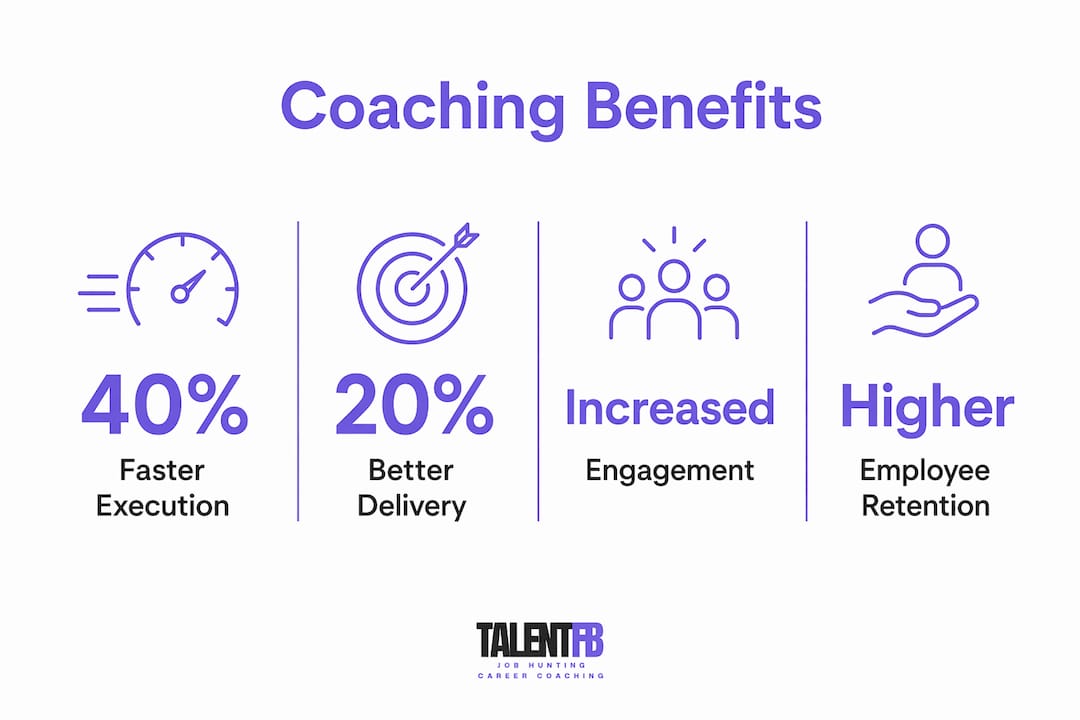
Coaching improves mindset and behavioral enablers first. Resilience, decision-making quality, and emotional regulation improve before raw output metrics move. This is a critical insight for leaders who want to measure coaching ROI too early and abandon the process.
Here is what the evidence shows across professional and organizational settings:
- Job performance: Effect sizes of 0.29–0.36 on standardized performance measures, which represents a meaningful and consistent improvement across studies.
- Stress reduction: Effect sizes of 0.37–0.46, making coaching one of the most evidence-backed tools for reducing professional burnout.
- Execution speed: Organizations report 20–40% improvements in how fast leaders deliver on strategic priorities.
- Decision-making: Coached leaders demonstrate stronger judgment under pressure, particularly in ambiguous or high-stakes situations.
- Team dynamics: Continuous coaching builds high-performing teams and creates cultures where people adapt faster to change.
“Coaching is an evidence-backed catalyst for organizational results, driving engagement and aligning roles strategically.” — Salomons Coach Research
The emotional benefits are just as significant as the performance numbers. Professionals who receive consistent coaching report higher motivation, stronger self-awareness, and greater confidence in their leadership identity. These are not soft outcomes. They are the foundation of every hard result that follows.
Performance coaching vs. performance management and pips
This is where most organizations get confused, and the confusion is costly. Performance coaching, performance management, and Performance Improvement Plans (PIPs) are three distinct tools. Treating them as interchangeable destroys trust and undermines development.
| Feature | Performance Coaching | Performance Management | Performance Improvement Plan (PIP) |
|---|---|---|---|
| Purpose | Growth and development | Alignment and accountability | Corrective action |
| Trigger | Proactive, ongoing | Periodic review cycles | Performance failure |
| Tone | Collaborative, exploratory | Evaluative | Formal, often disciplinary |
| Relationship | Trust-based partnership | Manager to direct report | HR-mediated process |
| Outcome focus | Long-term capability | Short-term goal delivery | Minimum standard compliance |
| Frequency | Continuous | Quarterly or annually | Fixed remediation period |
Using coaching as a disciplinary tool damages trust and produces worse results than either approach used correctly. When a manager says “we need to coach you” right before placing someone on a PIP, the word “coaching” becomes associated with punishment. That association poisons every future coaching conversation.
Performance management and coaching can coexist. In fact, the best organizations use coaching to make formal reviews simpler. When a leader has been in continuous dialogue with their manager throughout the year, the annual review holds no surprises. The conversation shifts from evaluation to celebration and planning.
Pro Tip: If you manage a team, never use the word “coaching” in the same conversation where you discuss formal consequences. Keep the two conversations separate, in different meetings, on different days. This protects the coaching relationship.
What are effective performance coaching techniques for leaders?
The most effective performance coaching techniques share one quality: they stimulate self-discovery rather than delivering answers. Effective coaching avoids directive solutions and instead uses probing questions to challenge limiting beliefs. This is harder than it sounds for experienced managers who are trained to solve problems quickly.
Here are the techniques that consistently produce results:
- Active listening. The coach listens for what is not being said as much as what is. Pausing before responding signals that the coachee’s words are being genuinely processed.
- Probing questions. Questions like “What would you do if you knew you couldn’t fail?” or “What assumption are you making here?” open up thinking that directive advice closes down.
- Reflective feedback. The coach mirrors back what they observe without judgment. “I noticed you said ‘I should’ three times. What does that tell you?” is more powerful than any recommendation.
- Goal alignment. Every session reconnects to the original development goals. This prevents coaching from drifting into venting or general conversation.
- Confidentiality agreements. Effective coaching requires mutual trust, and trust requires clear boundaries around what stays in the room. This is especially important when the coach is also the direct manager.
The coaching mindset is the hardest part for most leaders to adopt. The instinct to fix, advise, and direct is deeply embedded in management culture. Coaching requires you to sit with uncertainty and resist the urge to hand over the answer. The professional who discovers their own solution owns it far more deeply than one who was told what to do.
Pro Tip: Try the “2-minute rule” in your next one-on-one. After your team member finishes speaking, wait two full seconds before responding. That pause alone changes the quality of the conversation.
How can organizations embed coaching into their culture?
Moving from annual reviews to continuous coaching requires structural changes, not just a mindset shift. The organizations that do this well share three characteristics: leadership buy-in at the top, trained managers in the middle, and clear metrics at every level.
| Organizational Level | Key Action | Success Metric |
|---|---|---|
| C-Suite | Model coaching behavior publicly | Frequency of developmental conversations |
| Middle Management | Complete formal coaching skills training | Team engagement and retention scores |
| HR / L&D | Build coaching into performance frameworks | Reduction in PIP usage over time |
| Individual Contributors | Participate actively in coaching conversations | Self-reported skill growth and goal progress |
The shift from periodic reviews to continuous feedback culture does not happen overnight. Organizations like Google and Microsoft have invested years in building manager coaching capability as a core leadership competency. The payoff is measurable: lower turnover, faster onboarding, and stronger internal promotion pipelines.
For leaders at TalentFB who work with senior tech professionals across APAC, the pattern is consistent. The professionals who advance fastest are not always the most technically skilled. They are the ones who have had access to consistent coaching and have developed the self-awareness to use feedback productively.
The uncomfortable truth about coaching i’ve learned over 15 years
After spending 15 years inside hiring rooms across tech, fintech, and adtech in APAC, I have seen what separates professionals who grow from those who plateau. It is rarely talent. It is almost always access to honest, consistent feedback from someone who is not evaluating them for a promotion.
Most managers think they are coaching when they are actually advising. There is a real difference. Advice transfers your solution to someone else’s problem. Coaching helps them find their own. The second approach takes longer in the short term and produces dramatically better results over time.
The professionals I have worked with at TalentFB who made the biggest leaps, Directors moving to VP, VPs stepping into C-suite roles, all had one thing in common. They were willing to be uncomfortable. They brought their real challenges to coaching sessions, not the polished version. That vulnerability is what makes the process work.
My honest recommendation: if you are a senior leader considering coaching, do not wait until you are struggling. The best time to invest in your development is when things are going well and you have the mental bandwidth to absorb new perspectives. Coaching under pressure is harder and slower. Coaching from a position of strength is where the real breakthroughs happen.
— Frederic Bonifassy
Ready to put coaching into practice for your career?
If this article has clarified what performance coaching is and why it matters, the natural next question is: what does it look like for your specific situation?

TalentFB works with senior tech professionals, Directors, VPs, and Senior Managers across APAC who want structured, personalized coaching to accelerate their next career move. The approach is not generic. It is built around your goals, your market, and your timeline. If you want to see what a coaching-driven career strategy looks like in practice, explore the client success stories from professionals who have made the leap. You can also review the career coaching guide built specifically for tech executives who are ready to move faster.
FAQ
What is the performance coaching definition in simple terms?
Performance coaching is a structured, ongoing partnership between a coach and a professional designed to improve skills, behaviors, and outcomes in a specific role. It focuses on growth through feedback and self-discovery, not instruction.
How does performance coaching differ from a performance improvement plan?
A PIP is a formal corrective process triggered by underperformance, while performance coaching is a proactive development tool. Confusing the two damages trust and undermines both processes.
How long does it take to see results from performance coaching?
Behavioral and mindset shifts typically appear within the first few months, while KPI improvements follow as a lagged effect. Coaching impacts resilience and decision-making before raw output metrics move.
Who benefits most from performance coaching?
Senior professionals, managers, and leaders benefit most, particularly those navigating transitions, managing teams, or preparing for expanded responsibilities. The importance of performance coaching grows with the complexity of the role.
What should you expect from a performance coaching engagement?
Expect clear goal setting, regular one-on-one sessions, structured reflection, and honest feedback. Coaching involves confidentiality agreements, progress reviews, and a focus on uncovering assumptions that limit your growth.