
TL;DR:
- Coaching bridges the leadership gap for senior tech professionals in Singapore, developing strategic and emotional skills.
- It enables faster career pivots, higher salaries, and stronger positioning in Singapore’s competitive tech market.
- Selecting a sector-experienced coach with a tailored, systemic approach maximizes leadership growth and market opportunities.
Singapore’s technology sector is one of the most competitive talent markets in Asia, and a growing number of senior professionals are discovering a hard truth: technical expertise alone does not open the door to the leadership roles they deserve. The gap between being an outstanding individual contributor and becoming a recognized, influential executive is wider than most people expect. Coaching bridges that gap with precision, helping you develop the strategic mindset, emotional intelligence, and executive presence that hiring managers and boards actively seek. This article explores exactly how coaching accelerates leadership advancement for senior tech professionals in Singapore.
Table of Contents
- The leadership gap: Why coaching matters for senior tech professionals
- Real-world impact: How coaching drives career pivots and higher salaries
- Advanced benefits: EQ, blind spot identification, and adaptability
- Choosing the right coach and platform in Singapore
- Why conventional career paths are no longer enough for Singapore’s tech leaders
- Unlock your next leadership role with proven coaching strategies
- Frequently asked questions
Key Takeaways
| Point | Details |
|---|---|
| Leadership requires more than technical skills | Visionary and adaptive traits are essential for tech professionals to advance as leaders in Singapore. |
| Coaching accelerates career pivots | Professional coaching enables faster transitions and higher salaries for tech experts navigating change. |
| EQ and adaptability are critical | Coaching develops emotional intelligence and flexibility — crucial abilities for thriving in multicultural and AI-driven teams. |
| Choosing the right coach is vital | Tech leaders should select coaches with sector experience and a proven track record for the best results. |
The leadership gap: Why coaching matters for senior tech professionals
Many senior tech professionals reach a point in their careers where the very skills that made them successful begin to plateau in their impact. Writing cleaner code, architecting more robust systems, or managing tighter delivery timelines will not, by themselves, position you for a Chief Technology Officer seat or a regional leadership role. This is not a failure of ambition. It is a structural gap that exists at every level of Singapore’s technology sector, from FinTech to cybersecurity to enterprise software.
The obstacles that senior tech professionals commonly face include:
- Isolation at the top: As you rise, the number of peers who truly understand your pressure decreases. Candid feedback becomes rare.
- Multicultural team complexity: Singapore’s workforce is one of the most diverse in the world. Leading effectively across Chinese, Malay, Indian, and expatriate team cultures requires deliberate skill-building.
- AI-driven disruption: The rapid adoption of generative AI tools is reshaping roles overnight. Staying strategically relevant demands more than technical upskilling.
- The pivot from doer to visionary: Boards and CEOs want leaders who can set direction, not just execute it.
These are precisely the challenges that coaching is built to address. Leaders in Singapore invest in coaching to tackle “lonely-at-the-top” syndrome, build cross-cultural teams, navigate AI complexity, and shift from technical to visionary leadership, particularly in high-pressure environments like FinTech.
“The best coaches do not give you the answers. They ask the questions your current environment never will. For senior tech leaders in Singapore, that external perspective is not a luxury. It is a competitive advantage.”
A skilled coach acts as a mirror, reflecting your leadership patterns back to you with clarity and without the political filters that exist inside any organization. They help you identify whether your communication style lands differently with your Singaporean colleagues versus your counterparts in Sydney or London. They challenge your assumptions about what leadership actually looks like in an AI-augmented workplace.
Optimizing your LinkedIn executive profile is one visible output of this coaching process, projecting the leadership narrative you have built internally to the external market. Equally important are the AI-powered job search strategies that help you activate your new positioning with speed and precision.
Pro Tip: When evaluating a coach, prioritize those with direct experience in high-pressure tech environments, specifically FinTech, enterprise SaaS, or deep tech. A generalist coach may lack the sector fluency to challenge you where it actually counts.
Real-world impact: How coaching drives career pivots and higher salaries
After understanding the leadership gap, let’s see how coaching translates into tangible career benefits that you can measure in job titles, salary bands, and career velocity.
Singapore offers compelling, real-world evidence of coaching’s power to accelerate career pivots. One well-documented case involves a retrenched professional who, with targeted coaching support through Workforce Singapore programs, successfully rebuilt her tech career and landed a role at Microsoft. Her journey illustrates that retrenchment, which many professionals fear as a career-ending event, can become the catalyst for an even stronger trajectory when the right coaching infrastructure is in place. Platforms like Hupo are scaling this model for FinTech firms and major banks across Singapore, embedding coaching into talent development programs at an organizational level.
The return on investment from coaching is not abstract. Consider these measurable outcomes:
| Coaching Outcome | Typical Timeframe | Career Impact |
|---|---|---|
| Leadership positioning clarity | 4 to 8 weeks | Accelerates internal promotion readiness |
| Salary negotiation confidence | 8 to 12 weeks | Average increase of 15 to 25 percent |
| Career pivot execution | 90 days | Structured transition to target role |
| Executive network expansion | Ongoing | Access to hidden job market roles |
The numbers reflect a broader pattern. Coaching helps you compress a career pivot that might otherwise take two to three years of trial and error into a focused 90-day sprint with clear milestones.
Here is a practical sequence for finding the right coaching platform and maximizing your ROI:
- Define your specific goal. Are you targeting a promotion within your current organization, a lateral pivot into a new tech vertical, or a move into a board advisory role? Each goal requires a different coaching focus.
- Research platforms with sector relevance. Look for coaching services that have a documented track record with Singapore-based technology companies, not generalist career platforms.
- Assess the methodology. Does the platform use structured frameworks for goal-setting, progress tracking, and accountability? Informal mentoring is valuable but coaching should be systematic.
- Request case studies or referrals. A credible coaching platform should be able to share anonymized examples of clients who achieved outcomes similar to your target.
- Pilot before committing. Many platforms offer discovery sessions. Use them to evaluate coach chemistry, sector knowledge, and communication style before signing a long-term engagement.
For senior tech professionals thinking about strategic career advancement, coaching provides the scaffolding that turns ambition into a structured plan. Understanding how executive recruiters operate is another layer of this strategy, and the strongest candidates combine both coaching-driven self-awareness with sharp recruiter relationship skills.
Pro Tip: The majority of senior tech roles in Singapore are filled through referrals and recruiter relationships, not public job postings. Coaching helps you position yourself inside the hidden talent pipeline, where the most competitive opportunities live.
Advanced benefits: EQ, blind spot identification, and adaptability
Now, let’s dig deeper into the advanced skills coaching develops that set leaders apart from technically excellent but organizationally stagnant professionals.
Emotional intelligence (EQ) has moved from being a soft skills buzzword to a hard selection criterion for senior leadership roles. In Singapore’s multicultural, high-stakes tech environment, the ability to read a room, manage conflict across cultural expectations, and inspire trust in diverse teams is as strategically important as any technical certification. Yet most technical professionals invest years sharpening their IQ-adjacent skills while EQ remains underdeveloped by default.
| Skill Area | IQ-Driven Approach | EQ-Driven Approach | Leadership Outcome |
|---|---|---|---|
| Decision-making | Data and logic-first | Stakeholder empathy integrated | Faster buy-in and execution |
| Conflict resolution | Process-based | Relationship-aware | Sustainable team cohesion |
| Change leadership | Systems thinking | Emotional climate management | Lower resistance, higher adoption |
| Executive presence | Knowledge demonstration | Authentic connection | Greater influence at board level |
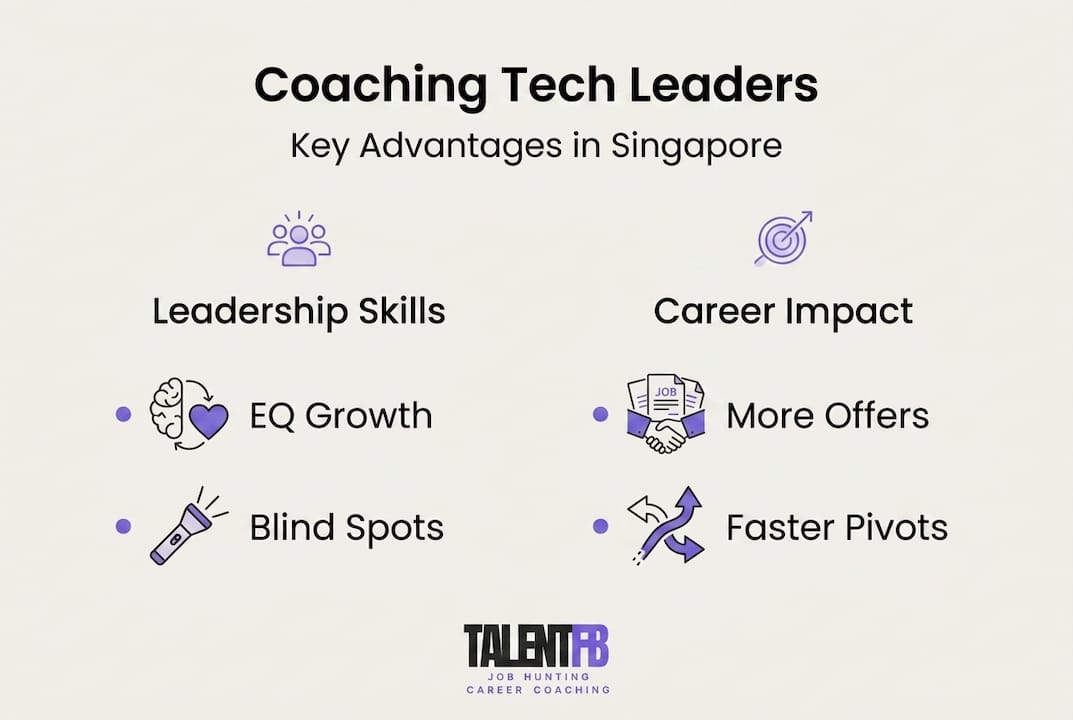
Coaching for senior tech professionals builds EQ, helps identify blind spots, and develops adaptability in multicultural and AI-driven settings, giving you a competitive edge for leadership roles and higher salaries, though success depends significantly on your coachability and the systemic support around you.

Blind spot identification is one of the most uncomfortable and most valuable aspects of coaching. A blind spot is a behavioral pattern or assumption you carry that limits your impact without your awareness. For example, a technically brilliant engineering director might consistently undermine collaboration by presenting solutions before fully hearing out team members’ concerns. Inside the organization, colleagues may have adapted around this pattern for years. A skilled coach, operating from outside that system, identifies it quickly and creates a structured practice for change.
Key areas where coaching surfaces common blind spots for Singapore tech leaders include:
- Communication style mismatches across hierarchical versus flat team cultures
- Over-reliance on data when stakeholders need narrative and vision
- Avoidance of visibility because many technical leaders underestimate the strategic value of personal branding
- Delegation gaps that prevent scaling leadership impact beyond personal capacity
Adaptability, the third pillar, has become non-negotiable. Singapore’s Ministry of Manpower data consistently highlights that digital transformation, AI adoption, and shifting global supply chains are restructuring entire job categories. Leaders who cannot adapt their mental models as fast as the technology evolves will find their influence shrinking even as their titles remain the same.
To maximize your coaching outcomes, consider booking executive interview coaching sessions alongside leadership development work. The two reinforce each other, ensuring that the growth you achieve internally is communicated with equal clarity to external audiences. TalentFB’s AI-powered coaching sessions are designed specifically for this integrated approach.
Choosing the right coach and platform in Singapore
Having seen the skills coaching develops, let’s walk through finding the best coaching match for your specific career goals and context.
Not every coach is equipped to serve senior tech professionals in Singapore effectively. The market includes a wide range of practitioners, from certified executive coaches with deep FinTech backgrounds to generalist life coaches with little understanding of what it means to lead a 200-person engineering team through a platform migration. Knowing how to evaluate the field protects your investment and your time.
The criteria that matter most when selecting a coach or platform:
- Proven track record with tech leaders: Ask for specific examples of clients who have moved into VP, Director, or C-suite roles within the technology sector.
- Sector-specific fluency: Your coach should understand the difference between leading a product team at a startup and managing a compliance-heavy engineering function at a bank. These environments require fundamentally different leadership approaches.
- Tailored methodology: Avoid coaches who rely exclusively on generic frameworks like GROW or MBTI without adapting them to your specific organizational context and career goals.
- Cultural intelligence: In Singapore’s context, navigating multicultural leadership and AI complexity requires a coach who has lived or worked within similar environments, not one who approaches diversity as a theoretical concept.
- Systemic support: The best coaching relationships include accountability structures, between-session resources, and a community of peers facing similar challenges.
Platforms like Hupo have emerged as strong options for professionals within larger FinTech firms and banks, offering scalable, tech-integrated coaching that fits within corporate talent development frameworks. For independent senior professionals seeking a more personalized approach, boutique coaching platforms with senior tech career specialization often deliver faster results.
Practical questions to ask any potential coach before engaging:
- What percentage of your clients are senior tech professionals in Singapore or Southeast Asia?
- How do you measure progress and hold clients accountable between sessions?
- What is your approach to helping clients access roles that are not publicly advertised?
- How do you stay current with AI-driven changes to the tech labor market?
Your coaching partnership should feel like a well-matched collaboration, not a one-size-fits-all program. If the initial conversation does not demonstrate sector knowledge and genuine curiosity about your specific situation, keep looking. For a structured framework to guide your overall tech leadership job search, combining coaching with a clear strategy is the most reliable path to your target role.
Pro Tip: Ask your coach directly how they support clients in accessing the hidden job market. If they focus exclusively on visible job postings, their approach may be too conventional for a senior professional who needs referral-led opportunities and executive recruiter relationships.
Why conventional career paths are no longer enough for Singapore’s tech leaders
Here is a perspective that most career advice articles will not state plainly: the traditional model of working harder, earning another certification, and waiting for recognition is structurally broken for senior tech professionals in 2026.
Singapore’s technology sector is now shaped by global competition, AI-driven role disruption, and the expectation that leaders will operate across cultural and organizational boundaries simultaneously. In this environment, technical mastery is the entry ticket, not the winning move. The professionals advancing into VP and C-suite roles are those who have deliberately built emotional intelligence, strategic communication, and executive visibility.
Coaching is the most direct intervention available for exactly this kind of growth. It is not a remedial tool for underperformers. It is a strategic investment that the most ambitious and self-aware leaders make when they recognize that their current toolkit cannot take them where they want to go. The professionals we have seen build genuinely transformative careers have not waited for their organizations to develop them. They have taken ownership through structured coaching, a reversed job search system, and consistent personal positioning.
If you are still operating on the assumption that doing exceptional technical work will eventually earn you the leadership recognition you deserve, the data and the market say otherwise. The next chapter of your career is built intentionally, not by default.
Unlock your next leadership role with proven coaching strategies
The insights in this article point toward one clear conclusion: advancing into leadership in Singapore’s tech sector requires more than hard work and technical excellence. It requires a strategic, structured approach to career development that most professionals were never taught.
TalentFB’s AI coaching sessions are designed specifically for senior tech professionals who are ready to move faster and smarter. Whether you are targeting a promotion, navigating a career pivot, or preparing for a salary negotiation, the AI job search playbook and our tech leadership job search guide give you the strategic framework to compete at the highest level. Take the next step toward the role you have been working toward.
Frequently asked questions
What’s the main benefit of investing in coaching for Singapore tech leaders?
Coaching helps senior tech professionals access leadership roles by developing emotional intelligence, adaptability, and visionary skills that Singapore’s competitive tech sector demands. Leaders in Singapore invest in coaching specifically to navigate “lonely-at-the-top” syndrome, multicultural team dynamics, and AI complexity.
Can coaching help with mid-career pivots or retrenchment in Singapore?
Yes, coaching enables structured mid-career pivots and supports retrenched professionals in transitioning to new tech roles through targeted skill development and executive visibility strategies. Real examples show that career coaching aided pivots from retrenchment to roles at major technology companies like Microsoft.
How does coaching differ from traditional mentoring?
Coaching is more structured, goal-driven, and tailored to current industry challenges like AI disruption and multicultural team leadership, while mentoring typically focuses on broader guidance drawn from a mentor’s personal experience over time.
What should I look for when selecting a coach in Singapore?
Seek coaches with a proven track record in the tech sector, sector-specific expertise in FinTech or enterprise technology, and the ability to support multicultural and AI-driven career contexts. Coaching that enhances EQ and blind spot identification in these settings delivers the strongest competitive edge for senior professionals.