TL;DR:
- Most C-suite hiring failures result from culture misfit, unclear mandates, and poor onboarding, not skills gaps.
- Hiring processes often focus on capability and overlook identity, increasing the risk of misalignment and failure.
A failed C-suite hire rarely looks like failure at first. The new CFO or CTO arrives with a strong track record, the first months feel busy, and then somewhere around month nine the founder realises the relationship is not working. In my 15+ years in recruitment, I have seen the same pattern again and again: the problem is almost never raw capability. It is an unclear mandate, a culture mismatch nobody tested for, and an onboarding that amounted to a welcome lunch.
This guide is written for founders and CEOs making their first senior hires. It covers why these hires fail, then the practical fixes: a precise brief, the right sourcing model, interviews that test judgement, how to work with recruiters, and how to plan succession so one departure does not stall the company.
What are the primary causes of C-suite hiring failures?
Executive failure is rarely a talent problem. It is a situational one, driven by misalignment between the person and the environment they step into. The research is consistent on this point.
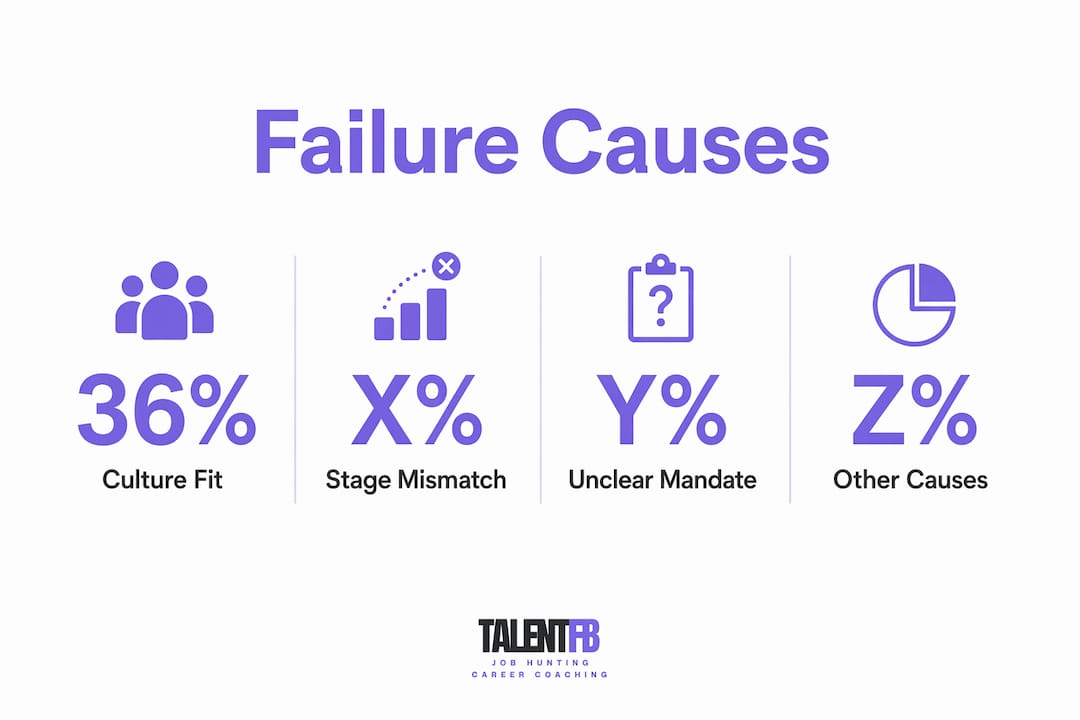
The breakdown of root causes looks like this:
| Root Cause | Approximate Share of Failures |
|---|---|
| Culture and values misfit | ~36% |
| Stage mismatch (wrong company phase) | ~28% |
| Unclear or shifting role mandate | ~20% |
| Poor onboarding and integration | ~11% |
| Technical skill gaps | ~5% |
Culture misfit is the leading cause. A CFO who thrives in a high-growth startup will often struggle inside a mature enterprise with entrenched processes, and vice versa. The skills transfer. The instincts do not.

Stage mismatch is the second most common failure point. Hiring a turnaround specialist when the company needs a steady operator, or bringing in a scale-up executive when the business is still finding product-market fit, sets everyone up for frustration. The executive is not wrong. The brief is.
Unclear mandates create a different kind of failure. Boards want transformation, CHROs want stability, and CFOs want cost control. When those three voices pull in different directions, the incoming executive faces stalled initiatives and contradictory priorities from day one. That is not a leadership failure. That is an organizational one.
The cost of getting this wrong is significant. A failed C-suite hire costs 3–5x the executive’s annual salary, factoring in lost strategic momentum, team disruption, and market value erosion. When a CEO exits, the ripple effect is immediate. CFO replacement rates after CEO turnover reach 71%, meaning one failed hire often triggers a cascade. CEO tenure has also dropped to 7.1 years by 2025, down from 8.3 years in 2021. That shrinking window makes every hire more consequential.
How do common hiring processes contribute to failure?
Most executive hiring processes are built to assess capability. They are not built to assess identity. That distinction matters more than most hiring managers realize.
Capability covers what a candidate has done: the deals closed, the teams built, the P&Ls managed. Identity covers who the candidate is: their values, their motivations, and how they behave under pressure. Impression management during interviews can mask identity deficits entirely. A polished executive can present a compelling narrative of past success while concealing the values misalignment that will surface six months into the role.
Reference checks suffer from the same blind spot. Most references confirm capability. They rarely surface the candidate’s relationship with ambiguity, their tolerance for conflict, or how they handle being wrong. Those are identity questions, and they require a different kind of conversation.
The “unicorn profile” trap compounds the problem. Companies spend 90+ days pursuing a candidate profile that combines an unrealistic combination of experience, skills, and cultural fit before realizing the profile is unfindable. Then they reset. The search restarts with a revised brief, months of momentum lost, and the organization still exposed.
Three other process failures show up consistently:
- Insufficient stakeholder alignment before the search begins. The board, the CEO, and the CHRO each carry a different version of what success looks like. Without a unified brief, the search team chases a moving target.
- Overreliance on familiar networks. Board reliance on internal networks and recycled candidates limits access to transformative leadership profiles. The same names circulate, and diversity of thought suffers.
- Skipping succession planning entirely. 60% of firms lack robust succession plans, which forces reactive, high-pressure searches that prioritize speed over fit.
Pro Tip: Before launching any C-suite search, run a structured stakeholder alignment session. Get the board, CEO, and CHRO to independently write down the three outcomes the new hire must deliver in year one. Compare the answers. The gaps you find will tell you more about your hiring risk than any candidate assessment.
What role does onboarding play in executive success?
Onboarding is where most organizations spend the least and lose the most. Less than 10% of the executive search budget typically goes toward structured onboarding. That imbalance is one of the clearest predictors of failure.
Most executive onboarding programs are logistical. They cover IT access, org chart introductions, and a few stakeholder dinners. What they miss is the strategic integration work that determines whether the executive builds credibility or burns it in the first quarter.
Effective onboarding for a C-suite hire involves four concrete steps:
- Stakeholder mapping before day one. Identify the five to eight people whose support the executive needs most. Brief the executive on each person’s priorities, communication style, and history with the role.
- Early win planning. Define two or three visible, achievable outcomes for the first 90 days. These are not the executive’s long-term goals. They are credibility builders that signal competence and cultural fit to the organization.
- Cultural immersion with structure. Pair the executive with a trusted internal guide who can translate unwritten rules, flag political landmines, and provide honest feedback without career risk.
- Expectation alignment checkpoints. Schedule formal check-ins at 30, 60, and 90 days with the CEO and board. These are not performance reviews. They are alignment conversations.
Early warning signs of executive failure often appear within 60 days: avoidance of key stakeholders, backchannel concerns from direct reports, and a pattern of deferred decisions. Acting on those signals immediately is far less costly than waiting. Delaying intervention beyond six months significantly increases both the cost and difficulty of correcting the situation.
Pro Tip: Treat the first 90 days as part of the hiring process, not a separate phase. The executive’s success in that window is a direct reflection of how well you set them up, not just how good they are.
For a deeper look at how executive integration works in practice, the research on structured onboarding frameworks is worth reviewing.
How can organizations improve their C-suite hiring success rates?
Improving executive hiring success starts with changing what you measure and when. Most organizations evaluate candidates on past performance. The better question is whether that performance happened in a context similar enough to yours to be predictive.
Here is a practical framework for reducing executive placement risk:
- Stress-test the role mandate before the search. Write down what success looks like at 6, 12, and 24 months. If the leadership team cannot agree on that document, the search will produce a hire who satisfies no one.
- Separate capability and identity assessments. Run multiple conversations across different settings. Probe specific decisions the candidate made, not just outcomes. Triangulated references based on real decisions reveal identity far more reliably than standard reference calls.
- Expand your candidate sources. Move beyond the familiar network. Engage sector-adjacent talent, international candidates, and internal successors who are close to ready. The average time to fill a C-suite role reached 160 days in 2026, partly because firms keep fishing in the same small pond.
- Invest in onboarding proportionally. If you spend $200,000 on a search, allocate at least $20,000 toward structured integration support. That ratio is still low by best-practice standards, but it is a significant improvement over the current norm.
- Align the board before day one. The incoming executive should never discover stakeholder disagreements by walking into them. Surface those tensions in advance and resolve them as part of the hiring process.
The organizations that consistently get C-suite hiring right treat leadership selection and integration as a single, continuous process. They do not hand off the hire to HR after the offer is signed. They stay engaged through the critical first quarter.
Pro Tip: Build a 90-day integration plan as part of the offer package. Present it to the candidate before they accept. It signals organizational seriousness, reduces their anxiety about the transition, and creates shared accountability from the start.
A founder’s playbook for getting senior hires right
1. Write the brief before you talk to anyone
Most failed executive hires trace back to a vague brief. Before you speak to a single candidate, write down what this person must deliver in 12 months, what they will own outright, what stays with you, and which two or three existing leaders they must win over. If you cannot write that page, you are not ready to hire.
2. Pick the sourcing model that fits the role
Not every senior role needs a retained search. If the role is well understood and your network is strong, founder led outreach plus referrals will often produce a better shortlist faster. Retained search earns its fee when the role is confidential, the talent pool is tiny, or you are hiring outside your own market.
3. Interview for judgement, not polish
Senior candidates are practised interviewees. Replace generic questions with real decisions from your business: give them a live problem, a messy dataset or a board scenario and watch how they reason, what they ask, and what they refuse to assume. Then check references beyond the ones they gave you.
4. Avoid the pedigree trap
A famous logo on a CV tells you the candidate succeeded inside a machine that already worked. Early stage and scaling companies need people who have built the machine. Ask what they created, with what resources, and what broke along the way.
5. Use recruiters well, if you use them
If you hire a search firm, you still own the scorecard and the final assessment. Agree the scorecard with them up front, ask to see the full longlist and not just the shortlist, and insist on structured feedback from candidates who said no. Their reasons tell you more about your company than your careers page does.
6. Plan the first 90 days before they start
Agree the first 90 day priorities, introductions and decision rights before day one. Book fortnightly check ins with the founder for the first quarter. Most executive failures are visible by month three if anyone is looking.
Succession planning for founders: do not wait for a resignation
Succession planning sounds like something for large corporates, but founders need it earlier than they think. When one senior person holds the key customer relationships, the architecture, or the finance function, their resignation becomes a company risk.
- List the five roles whose sudden departure would hurt most.
- For each one, name at least one internal person who could step up within a year, and one external person you already know and could approach.
- Give internal successors real exposure: board updates, key accounts, budget ownership.
- Keep in touch with the external names. That is your talent pipeline for senior roles, and it costs nothing but a coffee every few months.
Founders who are visible and credible on LinkedIn find this much easier, because strong people already know who they are. That is the idea behind The LinkedIn/OS for founders and CEOs.
What I have learned from 15 years inside the hiring room
After spending 15 years in hiring rooms across tech, fintech, adtech, gaming, and maritime-tech in APAC, the pattern I keep seeing is this: organizations invest enormous energy in finding the right person and almost none in making that person successful.
The identity assessment gap is the one that frustrates me most. I have watched technically brilliant executives fail because no one asked the right questions before the offer was signed. Not questions about their resume. Questions about how they handle being challenged by a peer, how they respond when a board member contradicts them in public, or what they do when their instincts conflict with the data. Those conversations are uncomfortable. They are also the ones that predict outcomes.
The hidden cost that organizations consistently underestimate is not the search fee or the severance package. It is the strategic momentum lost during the 12 months the failed hire was in seat. Initiatives stalled. Teams lost confidence. Competitors moved. That cost never shows up on a spreadsheet, but it is real.
My honest recommendation is this: stop treating onboarding as an afterthought. The first 90 days of an executive’s tenure are not a grace period. They are the most consequential window in the entire hiring cycle. If you are not actively managing that window, you are leaving the outcome to chance.
The mindset shift I encourage every hiring manager to make is simple. The hire does not end when the contract is signed. It ends when the executive is genuinely embedded, trusted, and delivering. Everything between the offer and that moment is still your responsibility.
— Frederic Bonifassy
How TalentFB supports executive hiring and leadership success
Executive hiring failures are preventable when the right frameworks are in place before, during, and after the search. TalentFB works with both sides of that equation.
For organizations looking to reduce C-suite executive turnover and build more durable leadership teams, TalentFB’s C-suite hiring tips for HR leaders offer a structured starting point. For executives navigating leadership transitions and wanting to land the right role with confidence, TalentFB’s career coaching for tech executives provides a proven 90-day system built on 15 years of real hiring room experience. The goal is the same on both sides: fewer failed hires, stronger leadership teams, and careers that move forward with purpose.
FAQ
What is the most common reason C-suite hires fail?
Culture and values misfit accounts for approximately 36% of executive failures, making it the leading cause. Technical skill gaps are the smallest contributor, at roughly 5%.
How much does a failed executive hire actually cost?
A failed C-suite hire costs 3–5x the executive’s annual salary when you factor in lost strategic momentum, team disruption, and market value erosion.
Why do C-suite hiring processes miss identity fit?
Most processes assess capability through interviews and references, which candidates can manage through impression management. Identity assessment requires multiple conversations probing specific real decisions, not rehearsed career narratives.
How long does it take to fill a C-suite role in 2026?
The average time to fill a US C-suite role reached 160 days in 2026, driven largely by the pursuit of unrealistic “perfect fit” candidate profiles instead of developing internal successors.
When should organizations act on early warning signs of executive failure?
Warning signs such as stakeholder avoidance and backchannel concerns often appear within 60 days. Delaying intervention beyond six months significantly increases both the cost and difficulty of correcting the hire.