Executive onboarding is the structured, time-limited process an organization uses to integrate a new senior leader into its culture, stakeholder network, and strategic priorities. It goes far beyond handing over a laptop and a security badge. According to the U.S. Office of Personnel Management, effective executive onboarding acquires, accommodates, assimilates, and accelerates new leaders into the organizational culture and business. The goal is to fast-track meaningful, productive work and strong relationships from day one.
Here is what a well-designed executive onboarding process covers:
- Cultural immersion: Understanding unwritten norms, decision-making styles, and behavioral expectations
- Stakeholder alignment: Building trust with the board, peers, direct reports, and key external partners
- Operational readiness: Gaining clarity on budgets, team structures, and governance processes
- Early strategic wins: Identifying and delivering visible results that build credibility fast
- Ongoing feedback loops: Regular check-ins and reviews that extend well beyond the first month
Both the organization and the executive share responsibility here. The company must provide structure and support. You, as the incoming leader, must show up prepared and proactive.

What does a successful executive onboarding process look like?
Egon Zehnder’s research identifies three core phases that define effective leadership onboarding: a diagnostic listening tour, a planning phase, and an execution phase focused on early wins.
Phase 1: The listening tour (Days 1–30)
Your first month is not the time to announce changes. It is the time to listen. Schedule one-on-ones with every direct report within the first two weeks. Have candid conversations with peers across functions. Ask the same question in every meeting: “What is the one thing I need to understand that nobody will tell me unless I ask?” This approach builds relational trust before you take any strategic action, which protects your political capital for when you actually need it.
Phase 2: Planning (Days 31–60)
Once you have gathered enough context, you translate insights into priorities. Set clear milestones, align with your direct supervisor on success metrics, and draft a 100-day plan that names key stakeholders and expected deliverables. This is also when cultural diagnostics deepen: you start to see who the real decision-makers are, not just the ones on the org chart.
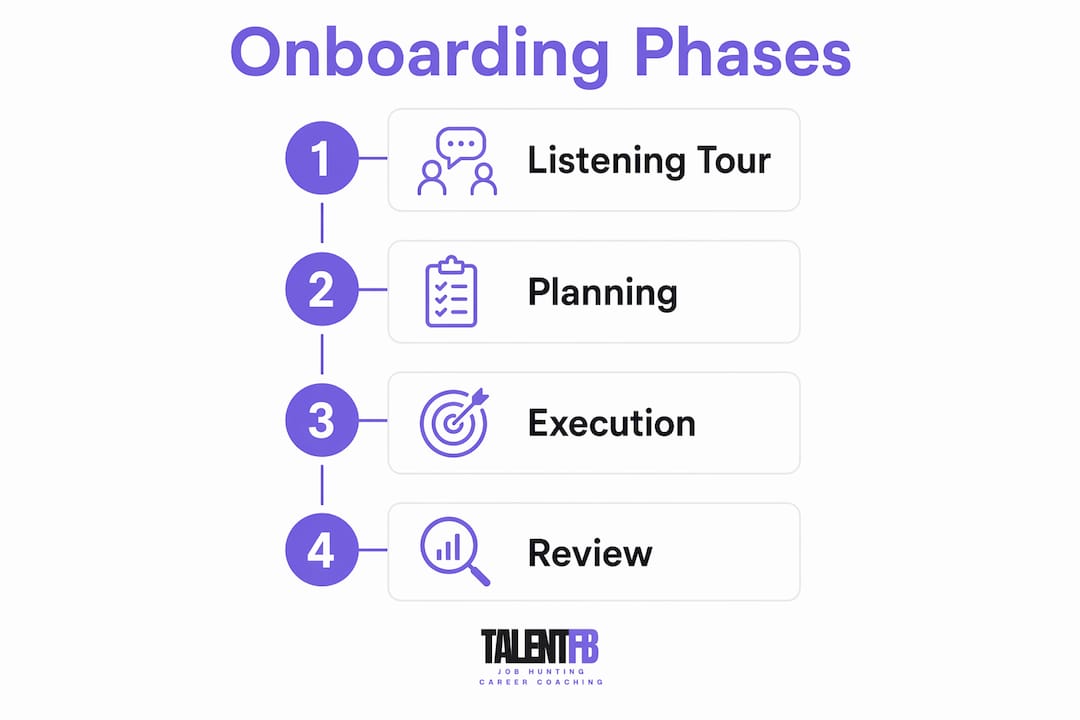
Phase 3: Execution (Days 61–90)
Deliver something visible. Early wins do not need to be transformational. They need to be credible. A structured 100-day review framework has been found to improve executive onboarding success rates, according to JRG Partners’ research.
Pro Tip: Do not confuse speed with urgency. Rushing to prove yourself in week two often costs you the trust you need to lead effectively in month six. Pace your integration deliberately.
Onboarding vs. transition: why the difference matters
These two concepts are often used interchangeably, but they describe very different experiences. Conflating them is one of the most common mistakes new executives make.
Onboarding is what the organization does for you: the structured resources, introductions, briefings, and support systems it provides. Transition is what happens inside you: the cognitive and emotional adjustment to a new identity, new relationships, and new expectations. Both must be managed at the same time, and research confirms that organizations often address only the former while leaving leaders to navigate the latter alone.
The practical implication is real. You might receive a polished onboarding schedule and still feel disoriented, because the internal transition, processing a new power dynamic, letting go of your previous role’s identity, and building confidence in an unfamiliar culture, is happening on a separate track. Recognizing this distinction lets you seek the right support at the right time. For the personal transition side, an executive career transition guide can help you structure that internal journey alongside the formal process.
The hiring-onboarding gap: a costly organizational blind spot
Organizations routinely spend months and significant resources finding the right executive. Then, once the offer is signed, the investment drops sharply. This is the hiring-onboarding gap, and it is well-documented as one of the primary drivers of executive failure.
The consequences are not abstract. When a senior leader exits prematurely, the organization loses strategic momentum, team trust erodes, and the search process starts over. Executive failures carry enormous financial and reputational costs, which is why treating the first 90–100 days as high-stakes is not an overreaction. It is organizational insurance.
Common pitfalls that widen this gap include:
- No pre-boarding: Onboarding that starts on day one is already late. The strongest programs begin before the official start date.
- Generic programs: A CIO transitioning from a different industry needs a different onboarding plan than an internally promoted CFO. One-size-fits-all programs miss the mark.
- Culture ignored: Cultural mismatch is one of the primary reasons senior executives fail, according to ACHE research on executive onboarding. Yet many programs treat culture as a soft add-on rather than a core priority.
- No follow-up: Programs that end after a few weeks leave executives without the feedback they need to course-correct early.
If your organization’s onboarding falls short, do not wait for it to improve. Take ownership of the gaps yourself.
How to own your executive onboarding when the organization falls short
The most effective executives treat onboarding as their responsibility, not just something that happens to them. Research confirms that successful onboarding starts before day one, with pre-boarding activities like stakeholder engagement and cultural research.
Here is what that looks like in practice:
- Before you start: Request a strategic briefing package. Ask for the last two board decks, the current operating plan, and any recent employee engagement survey results. Meet your future peers informally if possible.
- Week one: Map your stakeholders, including the informal influencers who do not appear on the org chart. These relationships often determine whether your early initiatives gain traction.
- Month one: Conduct your listening tour with discipline. Avoid the trap of forcing early changes that risk your political capital before you have built the relational trust to back them.
- Month two: Share a draft of your priorities with your direct supervisor. Invite feedback before you commit publicly. This signals collaborative leadership and surfaces blind spots early.
- Month three: Deliver a visible win. It does not need to be large. It needs to demonstrate that you understand the business and can move it forward.
Pro Tip: Your personal brand inside the organization starts forming on day one. How you listen, how you credit others, and how you communicate your thinking shapes the leadership reputation you will carry for years. Pair your onboarding with a deliberate approach to executive LinkedIn visibility so your external profile reflects the leader you are becoming internally.
At TalentFB, Frederic Bonifassy has spent 15 years inside hiring rooms across tech, fintech, and adtech. The pattern he sees repeatedly: executives who proactively manage their own onboarding, rather than waiting for the organization to guide them, land faster, build trust sooner, and negotiate from a position of strength when it matters most.
How do you measure whether executive onboarding is working?
Metrics for executive onboarding effectiveness fall into two categories: leading indicators you can track early, and lagging indicators that confirm long-term success.
| Metric | Timeframe | What it signals |
|---|---|---|
| Stakeholder relationship quality | Days 30–60 | Trust-building pace |
| Clarity on role expectations | Day 30 | Alignment with leadership |
| First visible win delivered | Day 60–90 | Credibility and momentum |
| 100-day plan completion rate | Day 100 | Execution discipline |
| Retention — | — | Onboarding ROI |
| Team engagement scores | — | Cultural integration depth |
The 100-day mark is the natural checkpoint. Boards and direct supervisors should schedule a formal review at that point, not to evaluate whether the executive has “figured it out,” but to assess alignment, surface emerging challenges, and recalibrate priorities together.
Who actually owns executive onboarding?
The short answer: everyone, but with clear accountability at the center. ACHE research identifies three core players: the new executive, their direct supervisor, and HR. Beyond that trio, effective onboarding draws in a wider cast.
- The CEO or direct supervisor: Sets strategic context, facilitates key introductions, and provides consistent feedback throughout the first 100 days.
- HR or executive services: Coordinates the logistics, manages the onboarding timeline, and ideally assigns a single point of contact so the new leader is not bouncing between departments.
- An onboarding peer or “buddy”: A senior colleague who can offer candid cultural guidance and help the new executive navigate unwritten norms.
- The broader leadership team: Egon Zehnder’s accelerated onboarding research makes a point that most companies miss: bringing in a new C-suite executive reshapes the entire leadership team, not just one seat. The team itself needs to adapt, not just the new hire.
- The executive themselves: Ultimately, no stakeholder can substitute for the new leader’s own initiative. Proactive engagement, honest self-assessment, and a willingness to ask for help are what separate executives who thrive from those who quietly struggle.
What do the best executive onboarding programs actually do differently?
The gap between average and excellent onboarding programs comes down to a few specific choices, not budget or company size.
They start before day one. Pre-boarding is not a perk. It is a structural advantage. Organizations with strong programs introduce the incoming executive to culture during the interview process itself, so cultural fit is assessed and communicated honestly from both sides.
They tailor the experience to the role. A new CIO moving from a different industry needs deep immersion with product and marketing teams. A promoted CFO needs more focus on expanded strategic authority than cultural orientation. Generic programs miss these distinctions entirely.
They treat culture as a two-way conversation. Cultural mismatch drives executive failure more than any other single factor. The best programs do not just assess whether the executive fits the culture. They also give the executive an accurate, candid picture of what life at the company actually looks like, before they accept the offer.
They extend well beyond 90 days. Feedback sessions at six or nine months give executives enough runway to demonstrate wins while addressing development areas. Treating onboarding as a 90-day sprint and then walking away is one of the most common and costly mistakes organizations make. For a practical framework you can apply right now, TalentFB’s career coaching guide for tech executives walks through how to structure your integration for lasting impact.
Why organizational culture is the hidden variable in executive onboarding
Culture does not appear on a balance sheet, but it determines whether a new executive succeeds or fails faster than almost any other factor. As one HR leader quoted in ACHE’s research put it, “culture eats strategy for lunch,” and the worst thing an organization can do is misrepresent its culture during the hiring process.
For executives, the practical challenge is that culture is largely invisible until you are inside it. Decision-making styles, communication norms, how conflict is handled, who actually has influence regardless of title: none of this appears in the onboarding materials. It has to be learned through observation, relationship-building, and sometimes uncomfortable conversations.
The executives who navigate this best are the ones who approach culture with genuine curiosity rather than judgment. They ask questions before drawing conclusions. They observe how meetings run before proposing changes to how meetings should run. And they recognize that their own leadership style will inevitably reshape the culture around them, which means they carry responsibility for that influence from the moment they walk in.
Frederic Bonifassy is the Founder and CEO of TalentFB, with 15 years of experience in executive recruitment and coaching across tech, fintech, adtech, gaming, and maritime-tech in APAC. TalentFB’s JobSearch/OS™ has helped 350+ senior professionals land leadership roles, often with a 20–30% salary increase, within 90 days.
Ready to take control of your executive transition? TalentFB’s coaching programs are built specifically for senior professionals navigating leadership moves. Whether you are stepping into a new C-suite role or preparing for one, the JobSearch/OS™ framework gives you the structure, the strategy, and the support to land well and lead with confidence from day one.