What is employer branding, and why should you care?
Employer branding is the deliberate, ongoing process of shaping how your organization is perceived as a place to work. It covers everything from the stories your current employees tell at dinner to the impression a candidate forms after reading your job posting. Every organization already has an employer brand, whether it has been intentionally built or not. The only question is whether you are the one shaping it.

Think of it this way: your employer brand is your organization’s reputation in the talent market. It reflects your culture, your values, the day-to-day experience of working there, and the promises you make to people who join you. When managed well, it becomes one of the most powerful tools you have for attracting the right people and keeping them.
The components that make up an employer brand include:
- Company culture and values — the behaviors and principles that define how people work together
- Employee experience — what it actually feels like to work at your organization, from onboarding through career development
- External reputation — how candidates, alumni, and the broader market perceive you as an employer
- Leadership and management quality — the tone set by executives and direct managers
- Diversity, equity, and inclusion commitments — how genuinely the organization reflects and supports its people
- Compensation and benefits — not just salary, but the full package of tangible rewards
- Career growth opportunities — whether employees see a real future inside the organization
Employer brand management extends well beyond communication. It touches every employee touchpoint from hire to retire, shaping perceptions at every stage of the employment lifecycle.
What is an employer value proposition, and how does it anchor your brand?
The employer value proposition, commonly called the EVP, is the core of your employer brand. It is the specific, honest articulation of what your organization offers employees in exchange for their skills, time, and commitment. Not a tagline. Not a list of perks. A genuine answer to the question every candidate and employee silently asks: “Why should I work here instead of somewhere else?”
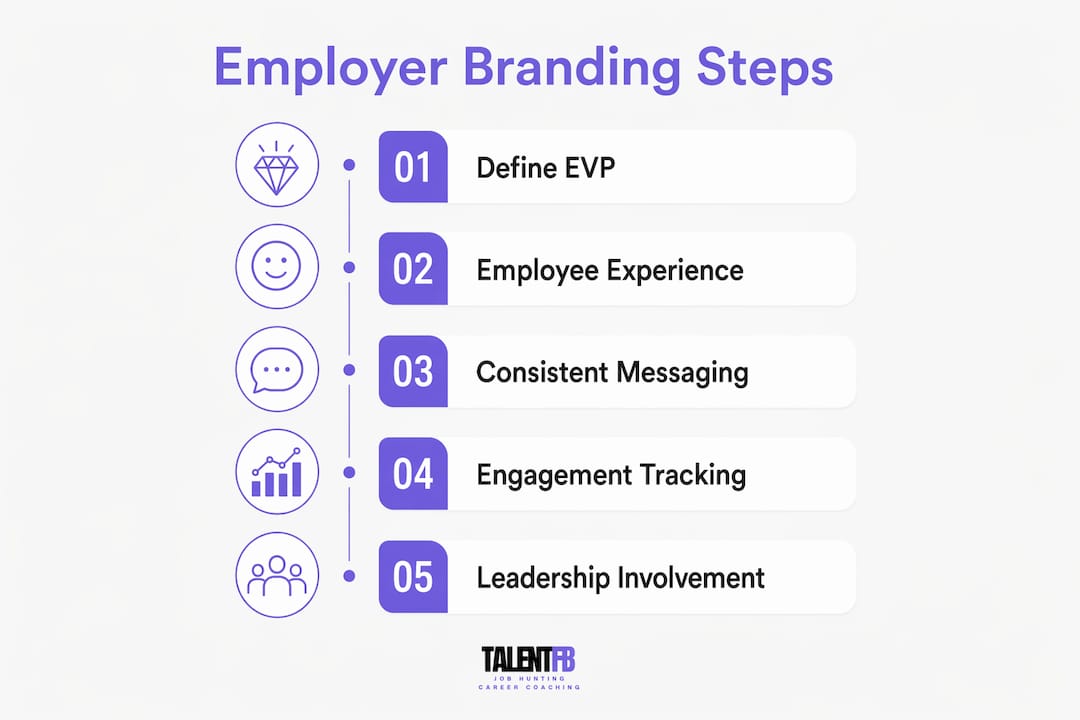
A well-crafted EVP does two things simultaneously. It attracts candidates who genuinely fit your culture and repels those who would not thrive there. That filtering function is underappreciated. A clear EVP acts as a hiring filter, reducing unfit applications and improving the quality of your pipeline without increasing your recruiting spend.
The components of a strong EVP typically include:
- Meaningful work — the sense that the role contributes to something larger than a task list
- Compensation and rewards — competitive pay, equity, bonuses, and benefits that reflect the market
- Career development — mentorship, training, promotion pathways, and learning opportunities
- Culture and belonging — psychological safety, team dynamics, and inclusion
- Work environment — flexibility, location, tools, and the physical or remote setup
- Leadership quality — access to inspiring, transparent, and supportive leaders
Your EVP should be grounded in what employees actually experience, not what leadership wishes they experienced. The gap between those two things is where employer brands quietly fall apart.
Why employer branding matters: the business case is hard to ignore
Strong employer branding directly reduces cost-per-hire, accelerates time-to-fill, and improves the quality of applicants who apply. Companies with strong employer brands attract 50% more qualified applicants, hire 1–2x faster, and reduce turnover by 28%, according to LinkedIn research. Those are not marginal gains. For a company hiring at scale, that math translates into millions of dollars saved annually.
Stat to know: Companies with strong employer brands attract 50% more qualified applicants, hire 1–2x faster, and reduce turnover by 28%, per LinkedIn research.
The flip side is equally clear. Organizations with weak or negative employer brands often have to offer higher salaries just to get candidates in the door, and even then, poor employer brands struggle to attract the quality of talent that drives growth. You end up paying more for less.
Beyond recruiting, a strong employer brand shapes employee engagement. When people understand and believe in what their organization stands for, they are more likely to stay, perform at a higher level, and refer others. Employer branding creates shared purpose among employees, which is especially valuable in distributed or hybrid teams where culture can otherwise feel abstract.
Who actually owns employer branding inside an organization?
Ownership of employer branding is one of the most debated questions in HR circles, and honestly, the answer depends on the organization’s size and structure. What is clear is that no single department can do it alone. Successful employer branding requires genuine collaboration between HR, talent acquisition, marketing, leadership, and sometimes communications or PR.
Here is how ownership typically breaks down:
- HR and People teams — define the employee experience, culture programs, and internal policies that form the foundation of the brand
- Talent acquisition — translate the employer brand into recruitment messaging, candidate experience, and job content
- Marketing — bring creative execution, brand consistency, and channel expertise to external campaigns
- Senior leadership and the CEO — set the tone, model the values, and lend credibility to the brand through their own visibility
- PR and communications — manage external reputation, media presence, and crisis response when needed
- All employees — act as the most authentic and credible ambassadors the brand has
The organizations that do this best treat employer branding as a cross-functional discipline with a clear lead, usually sitting in HR or talent acquisition, and a shared responsibility across the business. Without that structure, messaging becomes inconsistent and the brand drifts. For HR leaders navigating this, C-suite hiring strategy plays a direct role in setting the tone from the top.

How to build an employer brand that actually holds up
Building an employer brand is not a one-time project. It is a continuous cycle of listening, defining, communicating, and refining. Here is a practical sequence that works:
- Conduct an internal audit. Survey current employees, run focus groups, and interview leaders. Understand what people genuinely value about working there and where the gaps are between promise and reality.
- Analyze your external reputation. Review what candidates and former employees say on platforms like Glassdoor and LinkedIn. Look at your social media presence and how your job postings read.
- Define or sharpen your mission, vision, and values. These need to reflect the real culture, not an aspirational fiction. If they do not resonate with your own employees, they will not resonate with candidates either.
- Develop your EVP. Based on the data from steps 1 and 2, articulate what makes your organization genuinely distinctive as an employer. Ground it in specifics, not generalities.
- Embed diversity, equity, and inclusion. Your employer brand should reflect a genuine commitment to building an inclusive workplace, not just a statement on your careers page.
- Design your candidate experience. Every touchpoint in the hiring process, from the job description to the offer call, should feel consistent with the brand you have defined.
- Activate your employees. Equip and encourage current employees to share their authentic experiences. Internal advocacy is far more credible than any campaign you can run.
- Build feedback loops. Use exit interviews, engagement surveys, and candidate feedback to continuously learn and adjust.
Best practices to keep in mind throughout:
- Align your talent acquisition strategy with your EVP from day one of the hiring process
- Never promise something in your employer brand that the daily reality does not deliver
- Involve employees in creating brand content, not just approving it
- Treat your careers page as a living document, not a static brochure
Practical ways to amplify your employer brand
Defining your employer brand is only half the work. Getting it in front of the right people, in a way that feels genuine, is where most organizations struggle. The tactics that consistently work:
- Employee storytelling on social media — authentic posts from real employees on LinkedIn, Instagram, or TikTok outperform polished corporate content every time
- Employee ambassador programs — identify enthusiastic employees who want to represent the brand publicly, give them training and content support, and let them speak in their own voice
- Recruitment marketing campaigns — build targeted campaigns around your EVP, using the channels where your ideal candidates actually spend time
- Employer awards and rankings — applying for recognition like Fortune’s “100 Best Companies to Work For” or Glassdoor’s “Best Places to Work” builds third-party credibility
- LinkedIn company page and executive profiles — a well-maintained company page and visible, active leadership profiles signal organizational health to passive candidates
- Internal events and learning programs — showcasing professional development, team events, and CSR initiatives gives candidates a window into the culture
- Consistent messaging across all channels — your careers page, job descriptions, social content, and recruiter conversations should all tell the same story
One area worth investing in that many organizations overlook: the personal brand of the CEO and senior leaders. When executives are visible, credible, and authentic on LinkedIn, it directly amplifies the employer brand. TalentFB’s Talent/OS™ program is built specifically around this, helping CEOs and tech founders build a content presence that attracts top talent organically. A strong executive LinkedIn profile is one of the most cost-effective employer branding tools available.
How do you measure whether your employer brand is working?
Measurement is where employer branding often gets vague, and that vagueness makes it hard to justify investment. The good news is that the metrics are concrete once you know what to track.
Key performance indicators to monitor:
- Applicant quality — are more qualified candidates applying, and are hiring managers more satisfied with the shortlists?
- Time-to-hire — is the time from job posting to accepted offer decreasing?
- Cost-per-hire — are you spending less to fill roles as your brand reputation grows?
- Offer acceptance rate — are candidates saying yes more often?
- Employee retention and turnover rates — are people staying longer?
- Employee Net Promoter Score (eNPS) — would your employees recommend your organization as a place to work?
- Glassdoor and LinkedIn ratings — what is the trend in your external review scores?
- Social media engagement — how is employer brand content performing in terms of reach and interaction?
- Candidate experience scores — what do candidates say about the hiring process, regardless of outcome?
Run engagement surveys at least twice a year. Conduct brand perception audits annually. And pay close attention to exit interview data, because departing employees often tell you exactly what your brand is failing to deliver.
The 4 P’s framework: a sharper lens for your employer brand
The 4 P’s of employer branding offer a structured way to assess whether your brand is genuinely cohesive or just well-packaged. The 4 P’s framework covers People, Purpose, Place, and Product, and each pillar reveals a different dimension of the employment experience.
- People — who works at your organization, what they are like, how they collaborate, and whether the culture is one where talented people want to spend their careers. This includes leadership quality, team dynamics, and the diversity of the workforce.
- Purpose — why the organization exists beyond profit, and whether employees feel connected to that mission. Purpose is increasingly a deciding factor for top candidates, especially in tech and mission-driven sectors.
- Place — the physical and cultural environment where work happens, including office design, remote flexibility, geographic presence, and the overall sense of belonging employees feel.
- Product — what the organization makes or does, and whether employees feel proud to be associated with it. Working on something meaningful or technically exciting is a genuine draw for high-caliber talent.
Use the 4 P’s as a diagnostic tool. If your employer brand is strong on Purpose but weak on People, candidates will sense the disconnect. All four pillars need to be aligned and honestly represented for the brand to hold up under scrutiny.
Common pitfalls that quietly undermine employer branding efforts
The most common employer branding mistake is treating it as a marketing problem when it is actually a culture problem. Organizations invest in polished careers pages and employer award applications while the day-to-day employee experience tells a completely different story. Candidates figure this out quickly, and former employees make sure the world knows.
A few specific traps to avoid:
Overpromising in recruitment. If your job descriptions describe a culture of flexibility and autonomy but new hires encounter micromanagement on day one, you have not just disappointed one person. You have created a future Glassdoor review.
Treating perks as a substitute for culture. Free lunches and ping-pong tables were never employer branding. As the Harvard Business Review noted, most business leaders now recognize that superficial perks play no meaningful role in attracting or retaining top talent. What people want is meaningful work, fair compensation, and leaders they respect.
Ignoring the internal audience. Employer branding that only faces outward misses the point. Your current employees are your most credible ambassadors, and if they do not believe the brand, no external campaign will save it.
Letting the brand go stale. A company that defined its EVP in 2019 and has not revisited it since the shift to hybrid work is operating on outdated assumptions. The employment market changes, and your brand needs to keep pace.
Neglecting offboarding. Former employees who leave on good terms become alumni ambassadors and potential boomerang hires. A poor offboarding experience wastes that opportunity and often creates a vocal critic instead.
What strong employer branding looks like across industries
Strong employer branding is not exclusive to tech giants with unlimited budgets. It shows up in every sector when organizations commit to authenticity and consistency.
Technology: Companies like Google and Microsoft have built employer brands around intellectual challenge, career development, and mission-driven work. Their brands attract candidates who want to work on hard problems at scale, which filters the applicant pool effectively.
Healthcare: Leading hospital systems and health networks compete for nurses, physicians, and allied health professionals in a tight labor market. The organizations that win do so by emphasizing purpose, team culture, and career pathways rather than just compensation.
Retail and hospitality: Brands like Costco have built strong employer reputations by paying above-market wages and offering genuine career mobility. Their employer brand is built on actions, not campaigns.
Professional services: Consulting and accounting firms compete heavily on learning and development, mentorship, and alumni networks. The management consulting sector in particular treats the employer brand as a long-term investment in talent pipeline quality.
Manufacturing and logistics: Organizations in these sectors often struggle with employer branding because they assume it is only relevant to white-collar industries. The companies that break through do so by showcasing safety culture, advancement opportunities, and the pride employees take in what they build.
The common thread across all of these examples is alignment. The brand promise matches the actual experience, and employees can see themselves in the story being told.
Internal communication and employee engagement are the engine, not the exhaust
Internal communication is not a support function for employer branding. It is the mechanism through which the brand becomes real for the people who live it every day. When employees understand the organization’s mission, feel informed about decisions that affect them, and see their contributions recognized, the employer brand strengthens from the inside out.
Engagement surveys, town halls, manager one-on-ones, and transparent leadership communication all feed into how employees perceive and talk about their employer. In distributed or hybrid teams, this is even more critical. Consistent communication of mission and values enhances belonging and retention in ways that no external campaign can replicate.
Recognition programs matter more than most organizations realize. When employees feel seen and valued, they talk about it. That word-of-mouth is the most credible employer branding content you will ever produce, and it costs almost nothing compared to a paid campaign.
Company culture is not a backdrop for employer branding. It is the brand.
Culture is not what you write on your values poster. It is what happens in the room when the CEO is not there. And candidates, especially experienced ones, are remarkably good at sensing the difference between a culture that has been described and one that has been built.
A strong culture gives your employer brand something real to communicate. It provides the raw material for authentic employee stories, genuine EVP statements, and a candidate experience that feels consistent at every touchpoint. When culture is weak or misaligned, no amount of employer branding investment will fix the underlying problem. It will only make the gap more visible.
The organizations that build the strongest employer brands treat culture as a leadership responsibility, not an HR initiative. Senior leaders model the values publicly and consistently. They hold themselves and their teams accountable to the standards the brand communicates. That alignment between what is said and what is done is what gives an employer brand its durability.
The honest truth about building an employer brand that lasts
Most employer branding efforts fail not because of poor strategy but because of poor follow-through. Organizations invest in defining a compelling EVP, launch a polished careers page, and then let the whole thing drift as soon as the next priority arrives. The brand becomes a document rather than a living practice.
What I have seen work, time and again, is treating employer branding as a leadership commitment rather than a marketing project. When the CEO is genuinely invested, when HR and marketing are aligned, and when employees feel the brand in their daily experience, the whole system reinforces itself. Candidates feel it in the hiring process. New hires feel it on day one. And the people who eventually leave, if they leave well, carry that brand with them into the market as advocates.
The reputation damage from a misaligned employer brand is real and lasting. A single wave of negative Glassdoor reviews can suppress application volume for months. But the upside of getting it right compounds over time. Every great hire who stays, grows, and refers others is a return on the investment you made in building something genuine.
My honest recommendation: start with your current employees, not your careers page. Ask them what they would tell a friend about working there. Their answers will tell you everything you need to know about where your employer brand actually stands, and where to focus first.
If you are a CEO or tech founder looking to attract top talent without relying on expensive executive search firms, TalentFB’s Talent/OS™ program is built exactly for that. And if you are an HR leader wanting to align your hiring strategy with a stronger employer brand, the step-by-step career advancement framework offers a practical roadmap worth exploring.