

TL;DR:
- Successful tech leadership hiring relies on proactive talent pipelines, not reactive applications.
- Pipelines are curated, ongoing relationships with pre-vetted candidates aligned to future roles.
- Senior professionals must actively nurture their networks and visibility to access top opportunities.
Most senior technology professionals still treat job searching as a reactive exercise: wait for a role to appear, polish the resume, apply, and hope. But the most coveted leadership positions are rarely filled that way. Research consistently shows that a significant portion of executive roles are filled before they are ever publicly posted, often through structured talent pipelines that organizations build and maintain over months or even years. If you are a technology executive or senior professional aiming for your next career milestone, understanding how talent pipelines work is not optional. It is a strategic advantage that separates those who land transformative roles from those who are always one step behind.
Table of Contents
- Defining the talent pipeline: Beyond the buzzword
- How talent pipelines work: Key stages and frameworks
- Strategic value for tech executives: Why pipelines matter
- Metrics, risks, and edge cases: What leaders must know
- Our take: Why most leaders misuse talent pipelines
- Take the next step: Leverage your pipeline for career acceleration
- Frequently asked questions
Key Takeaways
| Point | Details |
|---|---|
| Talent pipeline definition | A talent pipeline is a group of pre-qualified, engaged candidates ready to fill high-value roles quickly and strategically. |
| Strategic advantage | For executives, pipelines enable proactive internal mobility, smoother succession, and visibility to leading employers. |
| Pipeline process | Effective pipelines rely on workforce planning, skill gap analysis, smart sourcing, and sustained nurturing. |
| Metrics matter | Monitoring coverage, conversions, and automation ROI is critical for leaders to get true value from their talent pipelines. |
Defining the talent pipeline: Beyond the buzzword
The term “talent pipeline” gets used loosely, but its meaning is precise and powerful. According to TechTarget, “a talent pipeline is a pool of pre-qualified candidates, either internal prospects for promotion or external pre-vetted individuals, ready to fill specific roles when openings arise.” That definition carries real weight for senior professionals.
A pipeline is not the same as a talent pool. The distinction matters enormously. A talent pool is a broad, loosely organized collection of potential candidates, often sourced from past applicants or general networking. A pipeline, by contrast, is curated, skills-based, and oriented toward proximity to hire. Candidates inside a pipeline are actively nurtured, assessed for readiness, and aligned to specific future roles. Think of it as the difference between a contact list and a trusted inner circle.
For technology executives, this distinction shapes how you should position yourself professionally. Organizations building pipelines for senior roles are not waiting for you to apply. They are watching your LinkedIn activity, tracking your thought leadership, and mapping your skills against future needs. This is why talent management tips for tech leaders consistently emphasize visibility and ongoing relationship-building over transactional applications.
Here is what separates a pipeline from a pool at a glance:
| Feature | Talent pool | Talent pipeline |
|---|---|---|
| Qualification level | Broad, general | Pre-vetted, role-specific |
| Engagement | Passive | Active and ongoing |
| Time horizon | Indefinite | 6 to 24 months |
| Use case | Volume hiring | Leadership and critical roles |
The strategic implications for executives are significant. Pipelines are built around succession planning and leadership continuity. Organizations use them to ensure that when a CTO departs or a VP of Engineering role opens, there is already a shortlist of known, trusted candidates ready to move. If you are not in that shortlist, you are invisible to the opportunity. The strategic guide for tech leaders on talent acquisition reinforces this point: proactive positioning is the foundation of executive career growth.
“The pipeline is not a waiting room. It is a proving ground where relationships, reputation, and readiness converge.”
How talent pipelines work: Key stages and frameworks
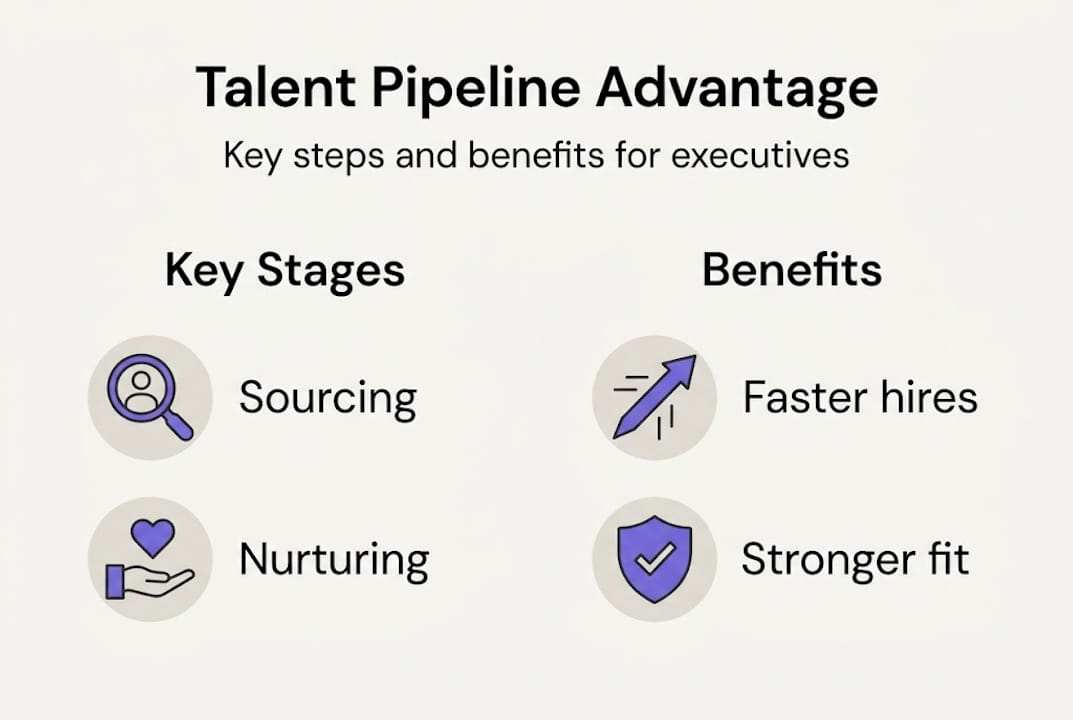
Understanding the mechanics of a pipeline helps you engage with it strategically rather than passively. Pipeline development typically follows six structured stages:
- Workforce forecasting: Organizations plan 12 to 24 months ahead, identifying roles likely to open based on business growth, retirements, or restructuring.
- Skills gap analysis: People analytics tools identify where current teams fall short, defining the exact competencies needed in future hires.
- Strategic sourcing: Talent teams reach out through professional networks, referrals, industry events, and platforms like LinkedIn.
- Candidate nurturing: Relationships are maintained through content sharing, invitations to events, and periodic check-ins, often over many months.
- Technology tracking: Applicant tracking systems (ATS) and candidate relationship management (CRM) tools log interactions and readiness signals.
- Role segmentation: Candidates are sorted by skill level, leadership readiness, and proximity to hire.
For senior professionals, stage four is where careers are made or lost. Nurturing is not passive. It means staying active in your professional community, publishing insights, engaging with industry conversations, and maintaining genuine relationships with talent leaders and hiring managers.

Pro Tip: Use LinkedIn’s CRM-like features to track your own relationship touchpoints with key contacts. Note when you last engaged, what you discussed, and what follow-up would be natural. Treat your network like a pipeline of your own.
The contrast between traditional recruitment and pipeline-based hiring is stark:
| Dimension | Traditional recruitment | Pipeline approach |
|---|---|---|
| Timing | Reactive, post-vacancy | Proactive, pre-vacancy |
| Speed to hire | 60 to 90 days average | 30 to 45 days or less |
| Candidate quality | Variable | Pre-assessed and relationship-tested |
| Executive fit | Often uncertain | Validated over time |
For those exploring talent acquisition strategies to attract top tech talent, the pipeline model consistently outperforms reactive hiring on every dimension that matters for senior roles. Understanding LinkedIn OS for pipeline management can also give you a structural edge in how you present and maintain your professional presence.
Strategic value for tech executives: Why pipelines matter
The benefits of pipeline engagement are concrete and measurable for senior technology professionals. Pipeline development research confirms that for executives, pipelines emphasize passive candidate sourcing, long-term relationship building over a 6 to 18 month horizon, succession planning, and skills-based targeting that goes well beyond credentials alone.
Here is what that means in practice:
- Passive visibility: You become known to organizations before a role is posted. This is how the best opportunities reach you, not the other way around.
- Internal mobility: Executives inside pipeline-aware organizations can signal readiness for expanded roles through structured succession frameworks.
- Network depth: Pipeline engagement builds relationships with talent leaders, board members, and peers who become long-term career advocates.
- Negotiating leverage: Candidates sourced through pipelines typically enter conversations with more context, more credibility, and stronger positioning for salary negotiation.
Consider the strategic leadership guide perspective: organizations that invest in pipeline development reduce leadership vacancy risk and improve retention of high-potential talent. As an executive, aligning yourself with those organizations signals that you understand how modern talent strategy works.
Pro Tip: Update your LinkedIn profile to reflect not just your current role but your leadership philosophy and future direction. Pipeline managers are looking for trajectory, not just tenure.
The executive OS for succession planning framework reinforces a critical point: executives who invest in their own visibility and relationship infrastructure are consistently the ones who receive inbound opportunities. The job search for tech leaders is not about sending more applications. It is about being already known when the right role opens.
Metrics, risks, and edge cases: What leaders must know
Effective pipeline strategy is not just about participation. It requires understanding how pipelines are measured and where they can fail. Key pipeline metrics include pipeline coverage ratio, conversion rate to hire, time-to-fill with a median benchmark of 45 days per SHRM, offer acceptance rates, and ROI from automation tools, which Gartner estimates can reach up to 412%.
| Metric | What it measures | Benchmark |
|---|---|---|
| Coverage ratio | Candidates per open role | 3 to 5 per role |
| Conversion rate | Pipeline to hire | 15 to 25% |
| Time-to-fill | Days from open to offer | 30 to 45 days (pipeline) |
| Acceptance rate | Offers accepted | 85% or higher |
| Automation ROI | Efficiency from CRM tools | Up to 412% per Gartner |
For executives evaluating organizations, these metrics reveal how seriously a company invests in talent strategy. A low acceptance rate, for example, often signals misalignment between pipeline promises and actual role quality.
There are also real risks and limitations to understand. Edge cases where pipelines underperform include one-off or highly specialized roles that do not recur, organizations without dedicated talent acquisition capacity, and situations where internal mobility is neglected in favor of external sourcing.
Compliance is another critical factor. EEOC recordkeeping requirements apply to pipeline candidates, meaning organizations must track and document interactions carefully. As a candidate, this means your pipeline engagement is on record, which reinforces the importance of consistent, professional conduct throughout the process.
Key risks to watch for:
- Pipeline stagnation: Candidates who are nurtured but never advanced become disengaged and leave the pipeline entirely.
- Over-reliance on external candidates: Ignoring internal mobility creates retention problems and signals poor culture.
- Technology gaps: Poorly configured ATS or CRM systems lead to missed follow-ups and lost relationships.
For those exploring AI and CRM technology options to support pipeline engagement, the right tools can dramatically improve how you track and nurture your own professional relationships. Additional free resources can help you build a personal pipeline strategy without a large investment.
Our take: Why most leaders misuse talent pipelines
Here is the uncomfortable truth: most senior technology professionals know pipelines exist, but they treat them like a passive database to be discovered rather than a dynamic relationship system to be cultivated. That mindset is career-limiting.
The biggest mistake we see is executives who update their LinkedIn profile once, attend one industry event, and then wait. A pipeline is not a set-it-and-forget-it structure. It rewards consistent, strategic visibility over time. The professionals who land the best roles are not necessarily the most qualified on paper. They are the ones who stayed engaged, shared relevant insights, and built genuine trust with the people who make hiring decisions.
Reactive application-first thinking kills career momentum at the executive level. By the time a role is posted publicly, the pipeline candidate often already has an informal offer in motion. If you are only applying to what you can see, you are competing for the leftovers.
Our advice: invest in your talent acquisition strategies the same way you invest in your technical skills. Measure the quality of your network relationships, not just the size. Prioritize depth over breadth, and treat every meaningful professional interaction as a pipeline touchpoint.
Take the next step: Leverage your pipeline for career acceleration
Understanding talent pipelines is the first move. Acting on that knowledge is what separates executives who wait for opportunities from those who create them. Strategic pipeline positioning, combined with expert coaching and the right tools, can compress your timeline from months to weeks.
At TalentFB, we have built a system designed specifically for senior technology professionals who are ready to move with intention. The AI Job Search Playbook gives you a structured framework for pipeline engagement and proactive outreach. For personalized guidance, AI career coaching sessions connect you with experts who understand how executive hiring actually works. And if you want the full strategic picture, the Dream Job Masterclass walks you through every stage of a modern, pipeline-aware job search.
Frequently asked questions
What is the difference between a talent pipeline and a talent pool?
A talent pipeline is a curated list of pre-qualified candidates actively nurtured for specific roles, while a talent pool is a broader, less vetted group of prospects without immediate readiness or role alignment.
How do executives benefit from engaging in a talent pipeline?
Executives gain increased visibility for leadership roles and stronger positioning for internal mobility, networking, and succession planning, since pipelines emphasize passive sourcing and long-term relationship building over reactive applications.
What are the risks or downsides of talent pipelines?
Key risks include resource misallocation, EEOC compliance obligations, and reduced effectiveness for one-off or rare roles that do not fit a recurring hiring pattern.
What key metrics should leaders track for pipeline performance?
Leaders should monitor pipeline coverage ratio, conversion rate to hire, time-to-fill, offer acceptance rate, and ROI from automation tools, which can reach up to 412% according to Gartner research.