
Your executive cover letter is not a formality. It is the first document a retained search partner, CEO, or board chair reads before deciding whether you belong on the shortlist. Get it right, and it opens the door. Get it wrong, and even a stellar resume may not save you.
An effective executive cover letter is concise, ideally 250-350 words and no longer than one page, and built around four tightly focused paragraphs. Each paragraph earns its place by signaling P&L scope, stakeholder fluency, or strategic judgment. Nothing else belongs on that page.
Must-have elements at a glance:
- A tailored opening that names the role and anchors your P&L credibility
- Leadership achievements ideally quantified
- A paragraph that shows you understand the company’s specific strategic moment
- References to board, audit committee, or investor stakeholder dynamics where relevant
- A confident closing with a call to action, not a generic thank-you
- Professional contact details and an optional LinkedIn profile link
- Zero resume copy-paste, zero cultural philosophy paragraphs
How to structure your executive cover letter for maximum impact
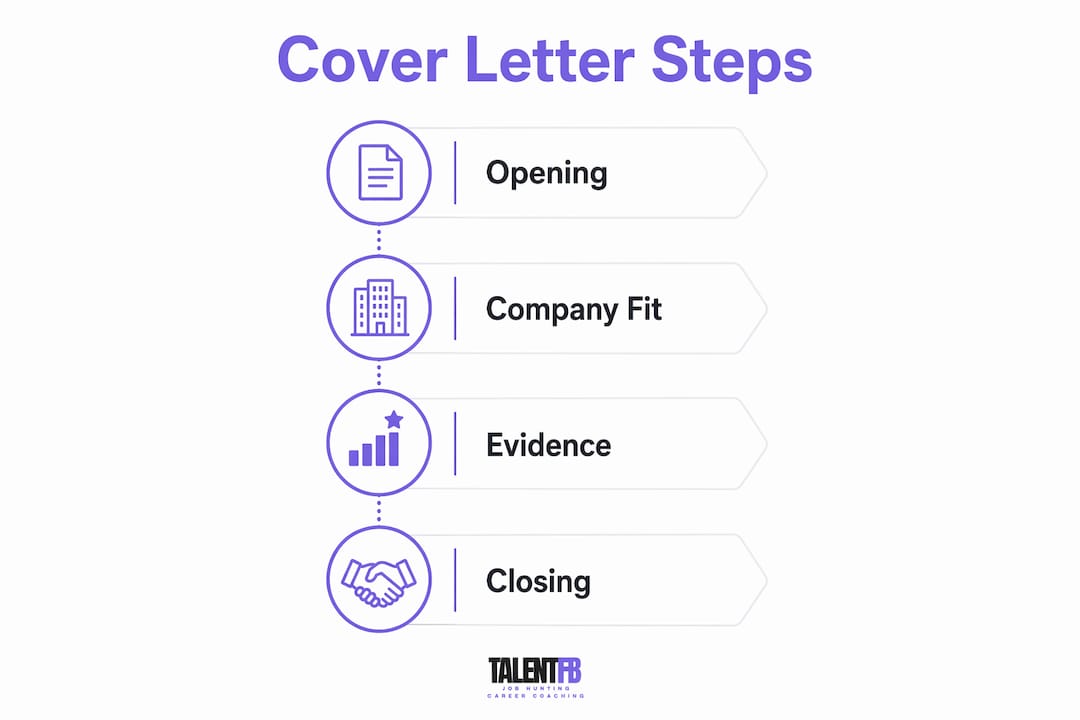
The four-paragraph rule is the industry standard for letters at VP level and above. Each paragraph has a defined job, and deviating from it usually signals mid-level thinking to the search partner reading your file.
Paragraph 1: Opening. State the role and company, then anchor your credibility with one recent P&L outcome. The goal is to earn the next thirty seconds of attention, not to summarize your career.

Paragraph 2: Why this company, why now. Name the company’s strategic moment: a pending IPO, a turnaround mandate, a PE-sponsor exit horizon, or a geographic expansion. Position your background as a precise fit for that moment, not as a generally strong fit for any executive role anywhere.
Paragraph 3: Evidence. Two or three P&L-anchored accomplishments that map directly to the mandate. Each one names the scope and the outcome. Avoid storytelling here; this paragraph is read for board-level signal.
Paragraph 4: Close. Signal readiness to discuss governance fit and board interaction style. Close with availability for a call, not with thanks.
Formatting standards:
- One-inch margins on all sides, left-aligned text, single or 1.5 line spacing
- Font: Times New Roman, Arial, or Calibri at an appropriate size
- Professional header: full name, current title, phone, email, LinkedIn profile link
- Date formatted in a professional style
Pro Tip: If your letter drifts to six or seven paragraphs, you have almost certainly added a cultural framing section or a leadership philosophy paragraph. Neither lands with a search partner. Cut both.
How to personalize your letter so it actually resonates
Generic executive letters fail because they signal that you want “an executive role,” not this specific role at this specific company. The fix is research, and it shows up in Paragraph 2.

Before you write a single word, identify the company’s strategic mandate. Is the board preparing for an IPO? Integrating a recent acquisition? Rebuilding margins after a downturn? Your letter should name that context explicitly and position your experience as the answer to it. Showing that level of awareness separates you from candidates who send the same letter to ten companies.
Ways to integrate company research authentically:
- Reference a recent earnings call, press release, or board announcement
- Name the specific market or function where the company needs to accelerate
- Connect your prior P&L scope to the scale of their current challenge
- Align your stakeholder management experience with their governance structure
When it comes to language, use broad industry terminology rather than company-specific jargon. A search partner reading your letter may not know your previous employer’s internal acronyms, and insider terms create distance rather than credibility. The goal is to sound fluent in the language of the boardroom, not the language of your last company’s all-hands meeting.
Pro Tip: Pair your cover letter with a polished LinkedIn profile that tells the same leadership story. Search partners cross-reference both within minutes of reading your letter.
Common mistakes that undermine executive cover letters
The most damaging mistakes are not typos. They are structural and strategic errors that signal a candidate is not yet thinking at the board level.
- Overlength: Letters that run to two pages or six-plus paragraphs dilute the credibility signal. Search partners spend roughly 60–90 seconds on the letter; a second page rarely gets read.
- Resume copy-paste: Restating your resume in paragraph form wastes the one page you have. The letter should add context and narrative, not repeat bullet points.
- Excessive jargon: Company-specific language alienates readers outside your former organization.
- No forward vision: Dwelling entirely on past roles without addressing what you will do for this company reads as backward-looking at the executive level.
- Outdated contact details: An old email address or a disconnected phone number signals carelessness. Use the contact information you check daily.
- Ignoring the strategic moment: A letter that could apply to any company at any time is a letter that applies to no company in particular.
- Cultural philosophy paragraphs: Paragraphs about leadership values or personal motivation do not land with search partners and actively dilute the P&L signal.
Expert insights on leadership narratives and strategic relevance
The single most common weakness in executive cover letters is telling rather than showing. Phrases like “proven leader” or “results-driven executive” carry no weight because every candidate uses them. What carries weight is a quantified outcome tied to a named scope.
The pattern that holds across functions is: strategic action, plus scope, plus quantified P&L outcome, plus board context. For a CFO candidate, that might mean naming a refinancing size and the covenant headroom it created. For a COO, it might mean on-time delivery improvement as a percentage of revenue. For a CRO, net revenue retention and pipeline coverage are the board-readable signals. The function changes; the pattern does not.
Strong action verbs matter too. “Directed,” “restructured,” “negotiated,” and “divested” signal executive ownership. “Assisted,” “supported,” and “helped” signal a supporting role, even when the candidate led the work. Choose verbs that reflect the level of authority you actually held.
Pro Tip: Retained search partners and board members read your letter before your resume. Write the letter for that audience first, not for an HR coordinator. Every sentence must signal P&L gravity or stakeholder fluency within thirty seconds of attention.
A practical executive cover letter example and template
The table below maps each paragraph to its purpose and the content it should carry.
| Paragraph | Purpose | What to include |
|---|---|---|
| Opening | Establish credibility fast | Role name, company name, one P&L example |
| Strategic fit | Show company-specific awareness | Named strategic moment, precise fit statement |
| Evidence | Prove impact with accomplishments | Several accomplishments with scope |
| Close | Signal governance readiness | Board interaction style, availability for a call |
Sample letter excerpt (VP of Operations, manufacturing company preparing for PE exit):
Key takeaways from this example:
- The opening names the role, the P&L scope, and a quantified outcome in two sentences
- Paragraph 2 names the PE exit context explicitly, not generically
- The close signals board interaction experience and invites a specific next step
- The entire letter stays within the ideal 250–350 word length, well within the one-page standard
How to address career gaps or transitions in your cover letter
Career gaps and transitions are more common at the executive level than many candidates realize, and the cover letter is not the place to apologize for them. The right approach is to frame the gap or transition as a deliberate choice that added relevant capability.
If you took time away for a board advisory role, a family commitment, or a deliberate pivot, name it briefly and move forward. One sentence is enough. Spending more than that on the explanation signals anxiety about it, which transfers to the reader. The evidence paragraph is where you redirect attention: strong quantified accomplishments from before and after the gap make the gap itself irrelevant.
For career transitions, the key is connecting your transferable P&L experience to the new sector’s specific challenges. A CFO moving from private equity to a public company should name the governance shift explicitly and position it as an asset, not a gap. A COO moving from manufacturing to technology should anchor the letter in operational scale, not functional similarity. The executive job search strategies that work best treat transitions as a story of expanding scope, not as a detour.
How to handle confidential or sensitive information appropriately
At the executive level, you often hold information that is not yours to share: unreleased financials, pending M&A activity, proprietary operational data. The cover letter is not the place for any of it, and sharing it, even to impress a search partner, creates legal and reputational risk.
The solution is to describe impact at the level of scope and outcome without naming the confidential detail. Instead of citing a specific acquisition target, write “led the due diligence process for a $200M acquisition.” Instead of naming an unreleased product, write “directed the go-to-market strategy for a new product line entering three international markets.” The scope and the outcome are yours to share. The confidential specifics are not.
If a search partner asks directly for details you cannot share, say so plainly: “I am bound by confidentiality on the specifics, but I am happy to walk through the decision framework and the outcome in a conversation.” That answer signals integrity, which is exactly what a board wants in a senior hire.
Language pitfalls that weaken executive cover letters
Certain phrases appear so often in executive letters that they have lost all meaning. Reading them signals to a search partner that the candidate has not thought carefully about what they are actually trying to say.
Phrases to cut entirely:
- “Proven track record of success”
- “Results-driven leader”
- “Passionate about driving growth”
- “Strong communication skills”
- “Team player with a collaborative approach”
- “Seeking a challenging opportunity”
- “I believe I would be a great fit”
Replace every one of these with a specific, quantified claim. “Proven track record” becomes “grew EBITDA from 8% to 19% over three years.” “Strong communication skills” becomes “presented quarterly to the audit committee and managed investor relations for a $1.2B public company.” The specificity does the work that the cliché only promises to do.
Watch for passive constructions too. “Was responsible for” and “was involved in” both obscure your actual level of authority. Own the verb: “led,” “built,” “restructured,” “negotiated.” Your executive resume and your cover letter should use the same active, ownership-level language throughout.
What most executive cover letter advice gets wrong
Most guides treat the executive cover letter as a longer, fancier version of a mid-level letter. That framing is the root of most failures I see when working with senior professionals.
The executive letter is actually shorter and more disciplined than a mid-level letter, no longer. The discipline of fitting everything onto one page, in four paragraphs, is itself a signal of seniority. A candidate who cannot edit their own story to fit one page is signaling something about how they will run a board presentation. Search partners notice.
The second thing most advice misses is the audience. The letter is not written for an HR coordinator who will scan it for keywords. It is written for a retained search partner who has been in the room with your prospective board and knows exactly what they are looking for. That audience reads two or three sentences and triangulates whether you have been in the same kind of room. Professional branding, including how you present yourself visually, matters too. A polished executive headshot on your LinkedIn profile reinforces the same credibility your letter is working to establish.
My honest recommendation: write the letter last, after you have done the company research and identified the two or three accomplishments that map most directly to their mandate. The letter almost writes itself when you know exactly what problem you are solving for them.
TalentFB’s coaching gives your executive application a real edge
Most senior professionals spend weeks perfecting their cover letter while the roles they want are being filled through retained search networks they are not part of. That is the gap TalentFB’s JobSearch/OS™ coaching program is built to close.
TalentFB’s reverse job search method starts with the hiring managers, not the application portal. Instead of waiting for a role to be posted, you position yourself directly in front of the decision-makers before the search begins. The program covers cover letter and resume positioning, LinkedIn profile optimization, and targeted outreach, all structured to deliver results within a few months. Many senior professionals have used this approach to land roles with significant salary increases. If you are a Director, VP, or C-suite leader ready to move with intention, TalentFB’s career advancement roadmap is the structured path forward.