TL;DR:
- An executive CV is a strategic marketing document that highlights leadership impact and measurable results, not just a career history. It should be concise, tailored to each role, and use a clear structure with a strong summary, core competencies, context lines, and achievement bullets. Focusing on outcomes, quantifiable metrics, and alignment with the specific mandate increases chances of earning callbacks.
An executive CV is defined as a strategic marketing document that proves your ability to deliver measurable commercial outcomes, not a chronological record of your career. This distinction matters enormously. Boards and retained executive search firms spend under 60 seconds on a first scan, which means your document must earn attention fast. The biggest misconception executives carry into this process is treating their CV as a comprehensive career history rather than a precise pitch for a specific leadership mandate. This executive CV writing guide gives you the framework, language, and judgment to fix that.
What are the core structural components of an effective executive CV?
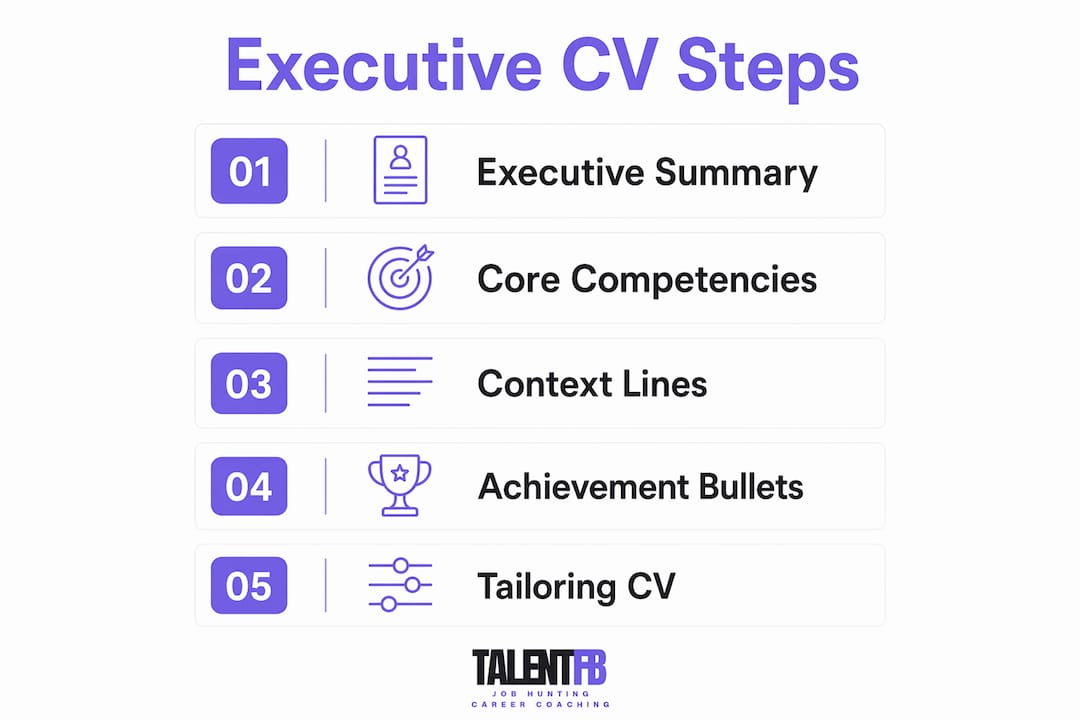
Every effective executive CV follows a clear architecture. Each section serves a specific purpose, and understanding that purpose is what separates a document that gets callbacks from one that gets filed away.
The executive summary sits at the top of your first page and carries the most weight. Recruiters scan the top third of the first page first, so your summary of 4–6 sentences must anchor your impact signature, your scale of operation, and your forward direction. Think of it as your leadership thesis. It answers one question: why are you the right person to solve this organization’s specific problem right now?

Core competencies replace the traditional “Key Skills” section entirely. At C-suite level, a competencies grid of 12–15 strategic capabilities signals executive maturity far better than a bullet list of software tools. Focus on areas like capital allocation, M&A integration, board relations, and governance. These are the capabilities that boards and search committees actually evaluate.
Context lines are one of the most underused tools in executive CV writing. Placed before your achievement bullets for each role, a context line states the company’s revenue, headcount, ownership structure, and your specific mandate. This commercial framing gives recruiters the reference point they need to assess the scale and complexity of what you achieved.
Achievement bullets follow the context line and do the heavy lifting. Each bullet should reflect a decision you made or an initiative you led, followed by a quantifiable result. The goal is to show that you are a business asset, not an operational manager.
Pro Tip: Format your core competencies as a two-column or three-column grid rather than a vertical list. It reads faster, takes less space, and looks more like a board-ready document.
Here is a quick reference for the essential sections and their purpose:
- Executive summary: 4–6 sentences establishing your leadership identity, scale, and value proposition
- Core competencies grid: 12–15 strategic capabilities aligned to the target role
- Context lines: One to two sentences per role covering company size, mandate, and ownership
- Achievement bullets: Impact-first statements with hard metrics
- Board and advisory roles: Listed separately if applicable, as they signal governance credibility
- Education and credentials: Brief, placed at the end unless an MBA or specific qualification is a role requirement
How do you write achievement bullets that prove leadership impact?
The single most common failure in executive CVs is listing responsibilities instead of results. A bullet that reads “Responsible for P&L management across three business units” tells a recruiter nothing about your judgment or your outcomes. It describes a job, not a leader.
The AOI method fixes this. AOI structures each bullet by naming the Activity you initiated, the Outcome you produced, and the Impact on the business. This sequence forces you to lead with a decision, not a duty. The result is a bullet that reads like a case study rather than a job description.
Here is a practical transformation using AOI:
- Weak: “Managed regional sales teams across Southeast Asia.”
- Strong (AOI): “Restructured the Southeast Asia sales organization across six markets, consolidating 14 teams into four regional pods, which drove a 34% increase in revenue per headcount within 18 months.”
- Weak: “Oversaw cost reduction program.”
- Strong (AOI): “Initiated a zero-based budgeting review across all operating divisions, eliminating $28M in redundant spend and improving EBITDA margin by 6 percentage points within two fiscal years.”
- Weak: “Led digital transformation initiative.”
- Strong (AOI): “Sponsored a company-wide ERP migration affecting 2,400 employees across five countries, delivering the project 11% under budget and reducing order-to-cash cycle time by 22 days.”
Hard metrics like revenue growth, EBITDA, and market share are non-negotiable at this level. They shift your perceived value from operational contributor to business asset. If you cannot attach a number, describe the organizational change you drove and the scale of the people or capital involved.
Pro Tip: Go back through your last three roles and write down every decision you made that changed a number. Revenue, cost, headcount, cycle time, customer retention. That list is the raw material for your achievement bullets.
What length and formatting standards apply in 2026?
Length is a judgment call, and boards notice when you get it wrong. The standard executive CV runs two pages for leaders with under 20 years of experience. Three pages are acceptable only when you carry extensive board-level experience that genuinely requires the space. Going beyond three pages signals an inability to synthesize complex information, which directly contradicts the core competency of executive decision-making. Brevity demonstrates good judgment.
Formatting should serve clarity, not creativity. Use a clean, readable font like Georgia or Calibri at 10–11pt for body text and 13–14pt for your name and section headings. White space is your friend. Dense pages feel like operational reports, not leadership documents.
| Element | Standard | Common mistake |
|---|---|---|
| Total length | 2 pages (3 max for board-level) | Exceeding 3 pages |
| Executive summary | 4–6 sentences, top third of page 1 | Buried below a long profile header |
| Font size | 10–11pt body, 13–14pt headings | Sub-9pt to squeeze content in |
| Core competencies | 12–15 items in a grid | Vertical list of 25+ generic skills |
| Context lines | One to two sentences per role | No context, just bullet points |
| Metrics in bullets | Hard numbers in every bullet | Vague descriptors like “significant growth” |
One formatting pitfall worth calling out specifically: the redundant skills section. Many executives list a “Technical Skills” or “Key Skills” block that duplicates what is already in their competencies grid and their bullets. Cut it. Every line on your CV must earn its place.
How do you align your executive CV with the role to increase callbacks?
Tailoring your CV is not optional at the executive level. An executive CV that fails to align with the specific pain points in a job description is the fastest way to get overlooked, even when your experience is genuinely strong. The document must answer the decision-maker’s actual question: “Can this person solve our specific problem?”
Start with the job description and the company’s public communications. Annual reports, earnings calls, and press releases reveal the strategic priorities the board is focused on. Your executive summary and competencies grid should mirror that language directly. If the role centers on international expansion, your summary should lead with your track record of building businesses across new markets, not your general leadership philosophy.
Here is a practical alignment checklist:
- Read the job description and identify the top three strategic challenges the role must address
- Rewrite your executive summary to speak directly to those three challenges
- Reorder your core competencies grid so the most relevant capabilities appear first
- Pull forward the achievement bullets from your career that most directly match those challenges
- Use the company’s own language and metrics where possible (market share, geographic footprint, customer segments)
- Check that your context lines reflect scale comparable to the target organization
Aligning your social profile with the same language and priorities reinforces your positioning across every touchpoint a recruiter will check. Your CV and your LinkedIn profile should tell the same story with the same emphasis. Inconsistency between the two raises questions you do not want to answer in an interview.
Pro Tip: Create a master CV with every role, every bullet, and every achievement fully documented. Then build a tailored two-page version for each application by selecting and reordering content. Never start from scratch each time.
What are the most common mistakes executives make on their CV?
The errors that cost senior leaders the most are rarely about qualifications. They are about framing, focus, and judgment in how the document is constructed.
- Listing duties instead of outcomes. Phrases like “responsible for” or “managed” describe a job function. They do not describe leadership. Every bullet must reflect a decision and its commercial result.
- Including outdated or irrelevant information. Roles from more than 15–20 years ago rarely need more than a single line. Early career detail dilutes the impact of your recent leadership record.
- Submitting a CV that is too long. A four-page CV does not signal depth of experience. It signals an inability to prioritize, which is a core executive skill.
- Failing to tailor to the role. A generic CV sent to multiple opportunities tells every reader that you did not care enough to understand their specific situation.
- Omitting context lines. Without knowing the revenue, headcount, and mandate of each role, a recruiter cannot assess whether your achievements are impressive or expected given the scale of the organization.
The importance of executive resumes at the C-suite level goes beyond the document itself. Your CV is the first signal of how you think, how you communicate, and how you prioritize. Every choice you make in it sends a message.
What I have learned from 15 years inside the hiring room
The executives who get the most traction from their CVs share one habit: they write for the reader, not for themselves. They ask “what does this board need to know about me?” rather than “what am I proud of?” Those are very different questions, and they produce very different documents.
The most common thing I see when working with senior leaders is a CV that reads like a LinkedIn profile printed on paper. It lists titles, companies, and responsibilities in chronological order, with a few numbers scattered in. It is not wrong, exactly. It is just not a marketing document. And at the C-suite level, that distinction costs people real opportunities.
My honest recommendation: treat your executive CV as a living document that you refine every six months, not just when you are actively searching. The market shifts, your experience deepens, and the language boards use to describe their priorities evolves. Your CV should evolve with it.
Partnering with certified executive resume writers experienced in C-suite advisory is worth serious consideration, particularly when you are navigating a retained search process where relationships and positioning matter as much as credentials. A specialist brings the outside perspective you cannot give yourself. They see what the hiring room sees, and that view is genuinely different from your own.
Be authentic, but be precise. The executives who land the roles they want are not the ones with the longest CVs or the most impressive titles. They are the ones who can articulate, in two pages, exactly why they are the right person for this specific problem at this specific moment.
— Frederic Bonifassy
How TalentFB helps senior leaders build CVs that get results
Senior leaders who invest in their CV presentation consistently outperform those who rely on outdated documents and generic formats. A well-crafted executive CV is the foundation of every successful leadership career move, and getting it right requires both self-knowledge and an outside perspective.
TalentFB works with Directors, VPs, and C-suite executives across tech, fintech, and APAC markets to build CVs and career positioning that open the right doors. The career coaching guide for tech executives covers the full process, from CV architecture to targeted outreach, with a proven system that delivers results within 90 days. If you are ready to position yourself as the candidate boards and search firms remember, TalentFB’s executive career advancement roadmap is the place to start.
FAQ
What is an executive CV and how does it differ from a regular resume?
An executive CV is a strategic marketing document that proves your ability to deliver measurable commercial outcomes for an organization. Unlike a standard resume, it leads with leadership impact, uses context lines to frame scale, and replaces generic skills lists with a core competencies grid.
How long should an executive CV be in 2026?
The standard length is two pages for executives with under 20 years of experience, and three pages only for those with extensive board-level roles. Exceeding three pages is viewed as poor judgment and signals an inability to synthesize complex information.
What is the AOI method for writing executive CV bullets?
AOI stands for Activity, Outcome, Impact. This structure leads each bullet with the strategic decision or initiative you drove, followed by the quantifiable result and its broader business impact. It shifts your perceived value from operational manager to business asset.
Should I tailor my executive CV for each application?
Yes, always. An executive CV that does not address the specific strategic challenges in the job description is the fastest way to be overlooked. Rewrite your executive summary and reorder your competencies grid for each role to reflect the decision-maker’s actual priorities.
What should go in the executive summary section?
Your executive summary should be 4–6 sentences placed at the top of your first page. It must establish your leadership identity, the scale at which you have operated, and the specific value you bring to the target organization. Think of it as your leadership thesis, not your career overview.