

What is strengths-based coaching?
Strengths-based coaching is a professional development approach rooted in positive psychology that focuses on identifying, developing, and applying an individual’s innate strengths rather than primarily correcting weaknesses. The goal is not to ignore what is not working. It is to direct the majority of your energy toward what already works exceptionally well, and build from there.

Think of it this way: most traditional development models start with a gap analysis. Strengths-based coaching starts with a strengths inventory. That single shift changes everything about how a person grows.
Here are the defining features of this approach:
- Strengths-focused: The primary lens is identifying and amplifying what you do naturally and energetically well.
- Collaborative partnership: Coach and client work together as equals, built on trust and mutual respect.
- Client-centered: The process is tailored to your unique strengths, values, and goals, not a generic template.
- Positive mindset: Growth is framed around possibilities and potential, not deficits.
- Goal-oriented: Meaningful goals are set in direct alignment with your signature strengths.
- Evidence-based: The approach draws on positive psychology research and structured coaching frameworks.
Core principles and how the coaching process actually works
The principles of strengths-based coaching are straightforward to understand but genuinely challenging to practice well. Most coaches, even well-intentioned ones, drift back toward deficit-based thinking without realizing it.
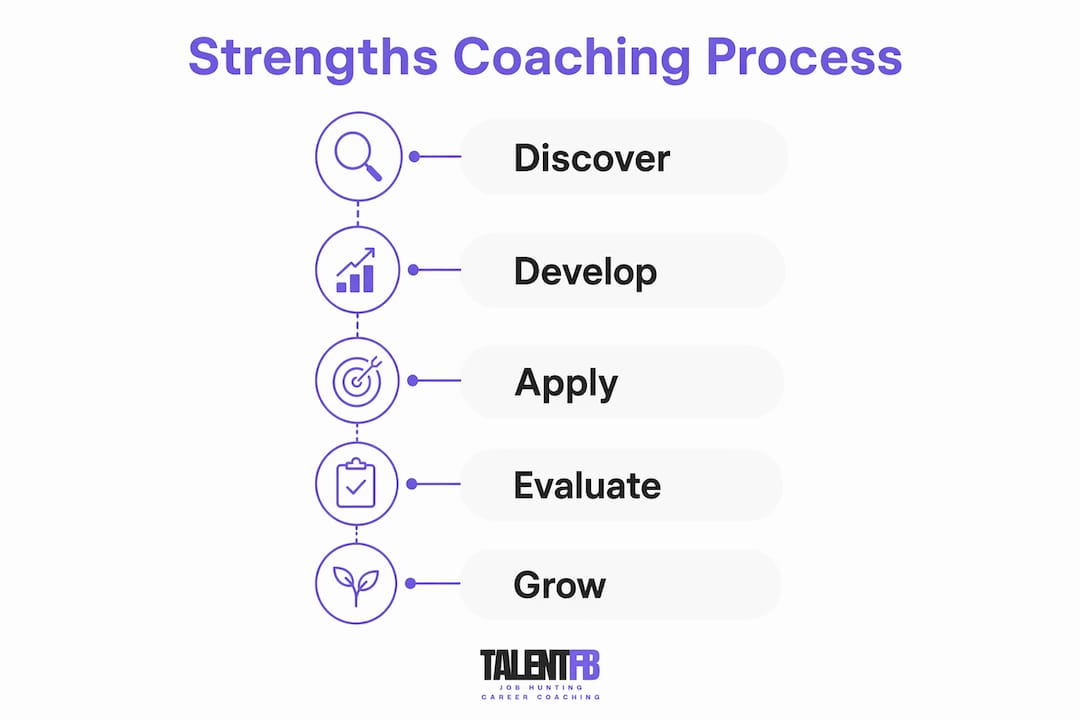
The coaching process typically follows these steps:
- Identify signature strengths: Using structured assessments or powerful questioning, the coach helps you uncover your most energizing and authentic capabilities.
- Set strength-aligned goals: Goals are built around what you are already wired to do well, which accelerates motivation and progress.
- Manage “drainers”: Activities that deplete your energy and represent genuine weak areas are acknowledged and managed, not ignored.
- Watch for “strengths in overdrive”: A top strength, when overused or applied in the wrong context, can become a liability. A highly analytical person who over-analyzes every decision in a fast-moving environment is a classic example.
- Apply strengths to real challenges: The most impactful coaching happens when you apply your strengths to specific, live problems rather than discussing them in the abstract.
One useful framework for structuring this process is the STRONG model, which builds on the classic GROW coaching structure by explicitly embedding strengths at each stage: Set Goals, Translate into Strategies, Release Strengths, Overcome Risks, Nurture Progress, and Generate Commitment. The explicit addition of strengths into a structured model gives clients a tangible framework and balances the positive energy of strengths with honest risk mitigation.
Pro Tip: Avoid “strength labeling,” which means simply telling a client what their strengths are based on an assessment score. Real strengths-based coaching uses powerful questions to help clients discover and articulate their own energizing capabilities. The discovery process itself builds ownership and confidence.
The psychological foundations and proven benefits of strengths coaching
Strengths-based coaching does not rest on optimism alone. It is grounded in decades of positive psychology research, and the evidence for its effectiveness is genuinely compelling.
The core psychological insight is this: when people engage with their strengths, they experience positive emotions like joy, pride, and engagement. Those positive emotions, in turn, create a cascade of benefits across wellbeing, performance, and resilience. A field experiment published in the Journal of Happiness Studies found that even a brief strengths intervention produced short-term increases in positive affect and both short- and long-term increases in psychological capital among working adults.
Research highlight: A 5-week strengths-based micro-coaching program with automotive industry workers significantly improved both work engagement and job performance, with benefits that held up in follow-up assessments.
The benefits of a strengths-focused approach include:
- Higher engagement: Employees who use their strengths at work are more engaged and more likely to achieve their goals.
- Improved performance: Emphasizing personal strengths in the workplace helps people achieve goals more effectively.
- Greater wellbeing: Strengths interventions increase psychological capital and life satisfaction over time.
- Faster growth: Building on existing strengths produces faster improvement than starting from scratch in areas of weakness.
- Increased confidence: Focusing on what you do well creates a positive cycle of self-efficacy and motivation.
- Reduced burnout: Positive affect generated by strengths use mediates improvements in burnout and work engagement.
The Frontiers in Psychology systematic review defines positive psychological coaching as a short- to medium-term professional relationship aimed at the identification, utilization, and development of personal strengths to enhance wellbeing, optimal functioning, and the actualization of potential. That definition captures why this approach resonates so strongly with practitioners and clients alike.
Common misconceptions that hold people back
A few persistent myths about strengths-based coaching cause people to either dismiss it or misapply it. Getting these straight matters.
- Myth: It ignores weaknesses. Strengths-based coaching absolutely addresses weaknesses. It categorizes them as “drainers,” acknowledges their impact on performance, and builds strategies to manage them. The difference is that weaknesses do not consume the majority of coaching energy.
- Myth: It is just positive thinking. This approach is grounded in empirical research and structured frameworks. It requires trained coaches who can identify strengths accurately, manage the risks of overdrive, and navigate complex professional realities.
- Myth: It is only for people who are already performing well. Strengths-based coaching is particularly powerful for people who feel stuck, disengaged, or undervalued, because it reconnects them with what genuinely energizes them.
- Myth: Assessments tell you everything you need to know. As Don Clifton, the psychologist who founded the strengths movement, emphasized, using assessments as static labels rather than dynamic tools reduces coaching effectiveness. The assessment is a starting point, not the destination.
- Myth: Any coach can do it. Truly strengths-based coaching requires a fundamental mindset shift. Many coaches use strengths language while still defaulting to a deficit-based approach in practice.
The complexity here is real. Managing strengths in overdrive, identifying drainers, and helping clients apply their strengths situationally requires skill, training, and genuine self-awareness from the coach.
How strengths-based coaching differs from traditional approaches
Traditional coaching models typically begin with a gap analysis: where are you now, where do you want to be, and what is missing? That deficit-based framing is deeply embedded in most organizational development cultures. Strengths-based coaching challenges that framing directly.
Here is how the two approaches compare across key dimensions:
| Dimension | Traditional (deficit-based) | Strengths-based |
|---|---|---|
| Starting point | Identify weaknesses and gaps | Identify signature strengths |
| Coach’s role | Problem-solver and advisor | Facilitator of client potential |
| Client’s role | Recipient of guidance | Primary agent of change |
| Growth driver | Correcting what is wrong | Amplifying what is right |
| Motivation source | External feedback and targets | Internal strengths and values |
| Outcome focus | Fixing failures | Building exceptional performance |
The shift in the coach’s role is particularly significant. Clients are the primary agents of change in strengths-based coaching, using their strengths to navigate their environment rather than relying on external advice. This is grounded in self-determination theory, which holds that people are more motivated and persistent when they feel autonomous and competent.
Fixing weaknesses prevents failure. Building strengths leads to success. Those two outcomes are not the same thing, and the distinction shapes every conversation in the coaching room. Tools like CliftonStrengths and the STRONG model make this shift concrete and structured, giving both coaches and clients a shared language for the work.
Frederic Bonifassy’s perspective: what actually makes this approach work
After 15 years inside hiring rooms across tech, fintech, and adtech in APAC, and coaching 350+ senior professionals through career transitions, I have seen both sides of this equation clearly. The professionals who advance fastest are almost never the ones who spent years grinding away at their weaknesses. They are the ones who got crystal clear on what they do exceptionally well, and then built their career narrative, their LinkedIn profile, and their outreach strategy around exactly that.
Strengths-based coaching works in career development because it solves a real problem: most senior professionals undersell themselves. They have spent so long in environments that focus on performance gaps that they have lost the vocabulary to describe what makes them genuinely exceptional. A good strengths-based coach helps you recover that vocabulary and use it with confidence.
The mindset shift required is not trivial. You have to genuinely believe that your natural way of thinking and working is an asset, not just a default. That belief, once internalized, changes how you show up in interviews, how you negotiate salary, and how you lead teams. I have watched it happen repeatedly with the professionals I work with at TalentFB.
One honest warning: the biggest pitfall I see is coaches who run a CliftonStrengths assessment, hand over the report, and call it strengths-based coaching. That is strength labeling, and it does not work. The real coaching happens in the conversation that follows, when you help someone connect their top themes to a specific challenge they are facing right now.
Pro Tip: When applying strengths-based coaching to your career, do not just list your strengths on paper. Ask yourself: “In which specific situations did this strength produce a result I am genuinely proud of?” That question connects your strengths to evidence, which is exactly what hiring managers and leadership teams respond to.
What strengths-based coaching looks like in practice
Abstract principles are useful. Concrete scenarios are more useful.
Scenario 1: The senior manager who keeps getting passed over for promotion. A client comes in frustrated after two promotion cycles without advancement. Traditional coaching might focus on the feedback she received about being “too detail-oriented.” Strengths-based coaching reframes that: her analytical depth is a genuine strength. The coaching work focuses on identifying the contexts where that strength creates the most visible value, and building her visibility in those contexts. The weakness is managed by pairing her with a collaborator who excels at rapid decision-making, rather than trying to rewire her natural style.
Scenario 2: The VP of Engineering navigating a leadership transition. A technical leader moving into a broader executive role often feels exposed because the skills that made him exceptional as an engineer are not the ones most visible in the boardroom. Strengths-based coaching helps him identify which of his technical instincts translate directly into leadership strengths, such as systems thinking, precision under pressure, and deep credibility with engineering teams, and builds his executive presence from that foundation rather than asking him to become someone he is not.
Scenario 3: The career pivoter who feels like a beginner again. Someone moving from one industry to another often discounts their existing strengths because the context has changed. Strengths-based coaching surfaces the transferable capabilities that remain constant across roles and industries, rebuilding confidence and clarity about the unique value they bring to a new field.
These scenarios reflect a consistent pattern: the most effective coaching connects strengths to real, specific situations rather than keeping the conversation at the level of abstract themes. That is where genuine growth happens.
Key tools and assessments used in strengths-based coaching
Several well-established tools support the strengths identification process. Each has a different focus and is best suited to different coaching contexts.

CliftonStrengths (formerly StrengthsFinder): Developed by Don Clifton and published by Gallup, this is the most widely used strengths assessment in professional coaching. It identifies your top talent themes from a taxonomy of 34 themes. The full assessment reveals all 34 in ranked order; the standard version surfaces your top five. It is most powerful as a conversation starter, not a final answer.
VIA Character Strengths Survey: Developed by Martin Seligman and Christopher Peterson as part of the Values in Action project, this free assessment identifies 24 character strengths across six broad virtues. It is widely used in positive psychology coaching and therapy contexts, and is particularly useful for clients exploring meaning and purpose alongside performance.
Strengthscope: A UK-based tool that maps strengths across four clusters: emotional, relational, thinking, and execution. It explicitly incorporates the concepts of strengths in overdrive and drainers, making it well-suited to coaches who want a framework that addresses risk alongside potential.
The STRONG Coaching Model: Not an assessment but a structured coaching framework that embeds strengths at every stage of a coaching conversation. It upgrades the classic GROW model by adding explicit strengths-release and risk-management stages, giving coaches a practical structure for strengths-focused sessions.
Peak Experience Exercise: A qualitative technique where the client narrates a moment of genuine success or pride. The coach listens for recurring patterns and capabilities, then reflects them back as potential strengths. This approach surfaces strengths that formal assessments sometimes miss, particularly for clients who are skeptical of psychometric tools.
The most effective coaches use these tools in combination, treating assessment results as hypotheses to be tested in real coaching conversations rather than verdicts to be delivered.
Who benefits most from a strengths-focused approach
Strengths-based coaching is not a niche methodology for a narrow audience. It applies across a wide range of professional and personal contexts, though some groups tend to see particularly strong results.
Senior professionals in career transition: Directors, VPs, and senior managers navigating a role change or industry pivot benefit enormously from reconnecting with their core strengths. The clarity that comes from a well-facilitated strengths process directly improves how they position themselves in interviews and salary negotiations. This is the heart of what TalentFB’s career coaching for executives addresses.
Leaders building high-performing teams: Managers who understand their own strengths, and those of their team members, can assign work more intelligently, reduce friction, and build a culture where people feel genuinely valued. Strengths-based talent management is one of the most practical applications of this methodology at the organizational level.
Professionals experiencing disengagement or burnout: When someone feels chronically drained by their work, a strengths audit often reveals a fundamental mismatch between their natural capabilities and their current role. Identifying that mismatch is the first step toward resolving it.
Early-career professionals building self-awareness: Younger professionals who have not yet developed a clear professional identity benefit from strengths coaching as a foundation for intentional career development, rather than drifting into roles that do not fit.
Coaches and HR professionals: Practitioners who want to shift from deficit-based development models to a more empowering approach find strengths-based coaching frameworks directly applicable to their work with clients and employees.
The common thread across all these groups is a desire to grow from a place of genuine self-knowledge rather than external prescription.
How to measure success in strengths-based coaching
Measuring outcomes in strengths-based coaching requires a mix of quantitative and qualitative indicators, because the most meaningful changes often show up in ways that a single metric cannot capture.
Engagement and performance metrics: In organizational settings, work engagement scores and performance ratings provide measurable benchmarks. The Journal of Happiness Studies research demonstrated that strengths interventions produce measurable short-term increases in positive affect and longer-term improvements in psychological capital, both of which correlate with performance outcomes.
Psychological capital: This composite measure covers self-efficacy, optimism, resilience, and hope. It is one of the most reliable indicators of sustained performance and wellbeing, and it responds well to strengths-based interventions.
Goal attainment: Tracking whether clients achieve the specific goals set during coaching provides a concrete outcome measure. Strength-aligned goals tend to have higher completion rates because they draw on natural motivation rather than willpower alone.
Qualitative self-report: Clients’ own accounts of how they feel about their work, their confidence in their capabilities, and their clarity about their professional direction are valid and important data points. Pre- and post-coaching reflections, structured around specific questions, capture changes that numbers alone miss.
Behavioral observation: In leadership coaching, 360-degree feedback from colleagues and direct reports before and after a coaching engagement provides external validation of behavioral change.
The most honest measure of success is a simple one: does the client show up to their work and their career with more energy, more clarity, and more confidence than they did before? When the answer is yes, the coaching has done its job.
If you are a senior tech professional ready to apply a strengths-based lens to your next career move, TalentFB’s JobSearch/OS™ program is built exactly for that. Frederic Bonifassy works with Directors, VPs, and Senior Managers to identify their signature strengths, build a compelling career narrative around them, and land their next role within a few months, typically with a significant salary increase. Explore the success stories from professionals who have already made that shift.