What is executive branding, and why does it matter now?
Executive branding is the deliberate, strategic process of shaping how a senior leader is perceived by clients, investors, employees, and industry peers. Think of it as your professional reputation, made intentional. Rather than letting others define your leadership identity by default, executive branding puts you in the driver’s seat.
At its core, a strong executive brand rests on four interlocking elements:
- Credibility: A track record communicated clearly and consistently across every channel
- Thought leadership: Original perspectives that demonstrate intellectual authority in your field
- Digital presence: An optimized LinkedIn profile, personal website, and structured online footprint
- Messaging consistency: The same values, tone, and narrative whether you’re speaking at a conference or posting on LinkedIn
This is not the same as personal branding in the general sense. Personal branding focuses primarily on individual career advancement. Executive branding extends that focus to encompass organizational reputation, stakeholder trust, and market positioning simultaneously. When you lead a team, a division, or a company, your visibility directly shapes how the world perceives the organization behind you.
The practical payoff is real. Executives with strong personal brands close deals 60% faster, attract three times more qualified candidates, and generate $2M–$5M in annual business value. Those numbers should reframe how you think about investing time in your brand.
Table of Contents
- Why executive branding is a leadership priority, not a vanity project
- How executive branding differs from corporate branding
- How to build your executive brand: a step-by-step approach
- Tips for keeping your executive brand sharp over time
- What a seasoned career coach sees that most executives miss
- What successful executive branding looks like in practice
- Which tools and platforms actually support executive branding?
- TalentFB helps senior leaders build brands that open real doors
Why executive branding is a leadership priority, not a vanity project
The most common objection I hear from senior leaders is: “I don’t want to look like I’m self-promoting.” That instinct is understandable, but it misreads what executive branding actually does.
A well-built executive brand is a risk-mitigation and leadership tool that opens doors to investors, talent, and customers that generic corporate messaging simply cannot reach. Here is what it delivers in practice:
- Trust acceleration: Open, consistent communication from a named leader humanizes the company. Prospects feel familiar with you before the first sales call, which drastically shortens the trust cycle and builds demand organically.
- Talent attraction: Top candidates research leadership before accepting offers. A visible, credible executive brand signals organizational health and cultural clarity.
- Investor confidence: The “CEO Premium” describes the additional corporate value investors assign to companies led by executives with strong, verified personal brands. Investor confidence and stock performance correlate positively with CEO brand strength.
- Career optionality: Board seats, advisory roles, and speaking invitations flow toward leaders who are known quantities in their space.
- Partnership velocity: When your reputation precedes you, partnership conversations start from a position of established credibility rather than from zero.
The leaders who treat their brand as a strategic asset tend to find that opportunities come to them. The ones who neglect it spend more energy chasing the same outcomes.
How executive branding differs from corporate branding

Corporate branding and executive branding serve different purposes, even when they reinforce each other. Understanding the distinction helps you allocate effort correctly.
| Dimension | Corporate branding | Executive branding |
|---|---|---|
| Focus | Company identity, products, mission | Individual leader’s expertise and values |
| Voice | Institutional, collective | Personal, authentic |
| Audience | Broad market, consumers | Investors, talent, peers, media |
| Ownership | Marketing team | The leader themselves |
| Flexibility | Slow to change | Evolves with the individual |
The key insight is that they are complementary, not competing. An authentic executive brand complements rather than competes with corporate branding efforts. When a CEO speaks with genuine authority on industry trends, it reinforces the company’s credibility in ways that a polished press release never can.
Where corporate branding requires the leader’s personal narrative to align deliberately with the company’s mission and strategic goals, executive branding gives that narrative a human face. Investors, in particular, respond to this. They are not just buying into a product or a balance sheet. They are betting on the judgment of the people running the organization.
Pro Tip: If your LinkedIn profile reads like a corporate bio, it is doing corporate branding work, not executive branding work. The difference is specificity, perspective, and a point of view that only you can hold.
How to build your executive brand: a step-by-step approach
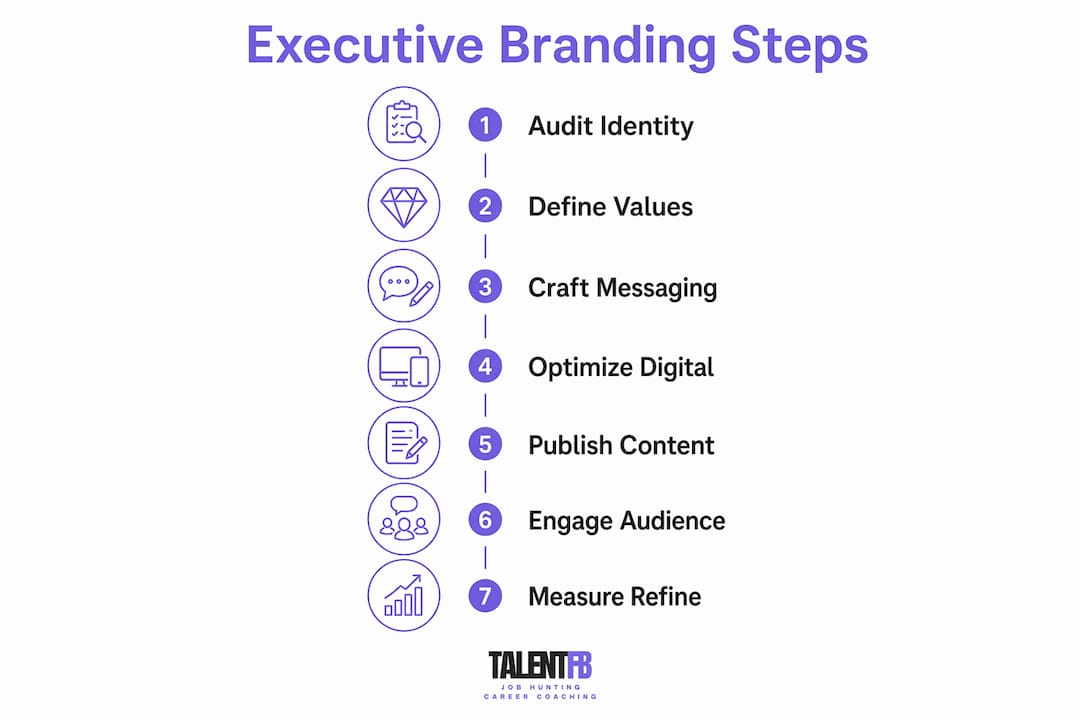
1. Audit your current leadership identity
Before building anything, get an honest read on where you stand. Search your name on Google. Review your LinkedIn profile as a stranger would. Ask trusted colleagues how they would describe your professional reputation in two sentences. The gap between how you see yourself and how others perceive you is exactly where your brand work begins.
2. Define your core values and leadership point of view
What do you stand for? What problems do you solve better than most? What perspective do you bring that your peers do not? Your answers to these questions become the foundation of every piece of content, every speaking opportunity, and every media appearance you pursue. Vague answers produce generic brands. Specific answers produce memorable ones.
3. Craft your core messaging
Translate your values and expertise into a clear, repeatable narrative. This includes a sharp professional headline, a first-person LinkedIn summary that reads like a person wrote it, and two or three signature themes you return to consistently. Signal quality matters more than follower volume: intellectual authority, proof of range, and a consistent point of view are what build lasting credibility.
4. Build and optimize your digital infrastructure
Your LinkedIn profile is non-negotiable, but it is not sufficient on its own. A personal website with structured schema.org/Person markup helps AI systems and search engines accurately resolve your identity, which matters more in 2026 than most leaders realize. This technical layer also provides a layer of protection against deepfake misrepresentation. Optimize your LinkedIn profile for executive success with a professional headshot, keyword-rich headline, and achievement-focused experience section.

5. Publish thought leadership content consistently
Writing and speaking are the fastest ways to establish authority. Start with LinkedIn articles or posts on the two or three themes you identified in step two. Pitch bylines to industry publications. Apply for speaking slots at conferences where your target audience gathers. Consistency matters more than volume: one substantive post per week outperforms five shallow ones.
6. Engage strategically with your audience
Responding to comments, joining relevant conversations, and building trust in executive search digitally are all part of the equation. Engagement signals that there is a real person behind the brand, which accelerates the trust-building that executive branding is ultimately designed to create.
7. Measure and refine continuously
Track profile views, content reach, inbound opportunities, and speaking invitations. These are leading indicators that your brand is gaining traction. Revisit your messaging every six months to ensure it still reflects where you are headed, not just where you have been.
Tips for keeping your executive brand sharp over time
Building a brand is one challenge. Sustaining it is another. Here is what separates leaders whose brands compound in value from those who plateau:
- Update your digital assets quarterly. A LinkedIn profile that reflects a role you left two years ago actively undermines your credibility. Treat it like a living document.
- Monitor your online reputation. Set up Google Alerts for your name. Know what surfaces when investors or candidates search for you.
- Respond to industry shifts proactively. When your sector faces disruption, the leaders who publish a clear perspective on it gain authority. Silence reads as uncertainty.
- Avoid generic content. Sharing motivational quotes or reposting company announcements is not executive branding. It is noise. Your audience wants your analysis, your experience, and your honest take.
- Stay authentic. The fastest way to erode a brand is to post content that does not sound like you. Audiences are perceptive, and inauthenticity is detectable.
What a seasoned career coach sees that most executives miss
After 15 years inside hiring rooms across tech, fintech, and adtech, and having coached over 350 senior professionals through career transitions, the pattern is consistent: the executives who struggle most with branding are not the ones who lack expertise. They are the ones who underestimate how much their digital presence shapes decisions made about them before they ever enter a room.
A few things I recommend that most guides overlook:
- Implement schema.org/Person markup on your personal website. In 2026, semantic authority and strategic digital visibility are core pillars of executive brand success. Structured data helps AI tools and search engines confirm your identity accurately.
- Share behind-the-scenes insights, not just polished wins. Deep expertise combined with authentic process transparency builds relationships faster than highlight reels alone.
- Think of your brand as a trust infrastructure. Every post, every interview, every speaking slot is a deposit into an account that pays dividends when you need it most, whether that is closing a deal, attracting a key hire, or navigating a leadership transition.
What successful executive branding looks like in practice
The most effective executive brands share a few common traits: they are specific, consistent, and genuinely useful to the people they are trying to reach.
A technology executive who publishes a weekly LinkedIn post on the practical realities of scaling engineering teams, drawing from real decisions and real tradeoffs, builds a following of exactly the people who matter: engineers who want to work for her, founders who want her on their board, and investors who trust her judgment. The content is not promotional. It is generous. That generosity is what makes the brand magnetic.
Another pattern worth noting: executives who speak at industry events and then publish a written version of their talk extend the reach of a single idea dramatically. One conference appearance becomes a LinkedIn article, a podcast guest spot, and a reference point that new contacts encounter months later. The compounding effect of consistent thought leadership is one of the most underused advantages available to senior leaders.
Which tools and platforms actually support executive branding?
You do not need a large tech stack to build a strong executive brand. You need the right tools used consistently.
- LinkedIn: Still the primary platform for B2B executive visibility. Optimize your profile, publish original content, and engage with your network deliberately.
- Personal website: A clean, professional site with your bio, speaking topics, and published work. Add schema.org/Person markup for AI identity verification.
- Google Alerts: Free and underused. Monitor your name and your key topics to stay current and catch reputation issues early.
- Canva or Adobe Express: For creating professional visual assets that match your brand identity without requiring a design team.
- Podcastle or Riverside.fm: If you are building a podcast or video presence, these tools make production accessible without a studio setup.
- Notion or Airtable: For managing a content calendar and tracking your publishing cadence across platforms.
The benefits of personal branding for executives compound when these tools work together as a system rather than as isolated efforts. Consistency across platforms is what creates the impression of a leader who is genuinely present and engaged, not one who posts sporadically and disappears.
TalentFB helps senior leaders build brands that open real doors
If you have read this far, you already understand that executive branding is not optional for leaders who want to stay competitive in 2026. The question is how to build it without spending months figuring out what works.
TalentFB was built for exactly this situation. Frederic Bonifassy spent 15 years inside hiring rooms across tech, fintech, and adtech before founding TalentFB, and that insider perspective shapes every coaching engagement. The Talent/OS™ program helps CEOs and tech founders rebrand their LinkedIn profiles and build a content system that attracts top talent organically, covering the full C-suite for up to five leaders. For senior professionals navigating a career transition, the JobSearch/OS™ program has helped 350+ executives land new roles within 90 days, typically with a 20–30% salary increase.
The approach is direct: start with how hiring managers and investors actually search for leaders, then build your brand backward from that reality. No guesswork, no generic templates.
If you are ready to build a leadership brand that works as hard as you do, the career coaching guide for tech executives is the right place to start.