TL;DR:
- By 2026, the future of work centers on humans owning judgment and AI handling execution within organizations. Leaders must shift to outcome-focused models, govern agents effectively, and foster continuous learning to capture AI’s full value. Emphasizing human-AI collaboration, redesigning work capabilities, and updating leadership practices are essential for success.
The future of work in 2026 is not a distant concept. It is the operating reality you are navigating right now. At its core, it means one thing: humans own judgment, agents handle execution, and the organizations that capture the most value are the ones that build systems around that division of labor. MIT Sloan researchers frame this as “humanize AI” — design human-AI combinations so each does what it does best.
For senior tech leaders, three implications land immediately:
- Shift to outcome-focused operating models. Stop measuring activity. Start measuring decisions and results.
- Build agent oversight and evaluation routines. Agents are already in your workflows. The question is whether you are governing them or just hoping they perform.
- Invest in continuous learning-in-flow. Episodic training programs are obsolete. Real work must become the primary learning loop.
Gartner reports only 1 in 50 AI initiatives delivers transformative value, and only 1 in 5 yields measurable ROI. That gap is not a technology problem. It is a leadership and systems problem. TalentFB has coached many senior tech professionals through this transition, placing them promptly with significant salary improvements. The playbook exists. The question is whether you will use it.
Pro Tip: Before reading further, write down the single outcome your role is most accountable for. Everything in this guide maps back to that anchor.
Table of Contents
- What does “future of work” actually mean in 2026?
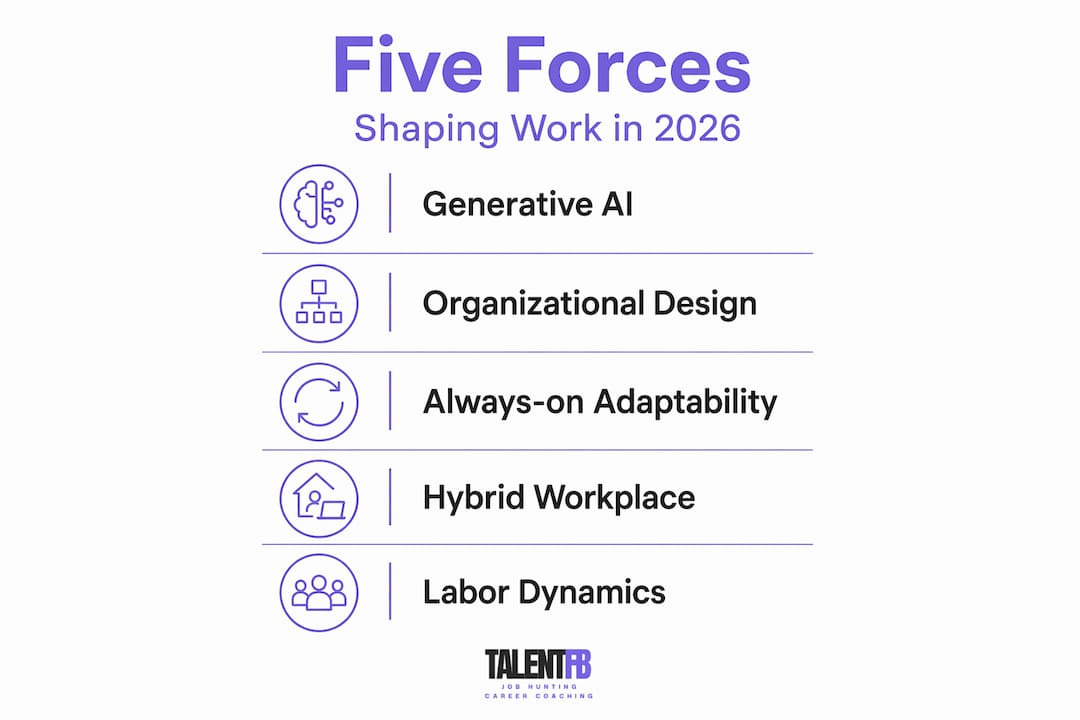
- Five forces reshaping work right now
- What these shifts mean for your career and your team
- Eight moves senior tech leaders should take now
- How long does this take, and what does it cost?
- Evidence and frameworks that have produced results
- The one strategy I would adopt first
- TalentFB helps senior tech leaders make this shift
- Curated sources for further reading
What does “future of work” actually mean in 2026?
The phrase gets used loosely, so let’s be precise. The future of work describes a human-centered, AI-augmented era where organizations redesign outcomes, skills, and physical spaces to capture human judgment and agency at scale. It is not about replacing people. It is about redeploying them toward the decisions that machines cannot reliably make.
Three pillars define it for senior tech leaders:
- Pillar 1: Humanize AI. Humans set intent, evaluate outputs, and own high-stakes judgment. Agents execute, synthesize, and accelerate.
- Pillar 2: Continuous learning-in-flow. Skills are built through real work, not classroom events. Deloitte’s 2026 Human Capital Trends identifies compressed S-curves and three tipping points driving the need for always-on adaptability.
- Pillar 3: Lifestyle-oriented workplaces and flexible operating models. Offices are connection and learning hubs, not attendance centers.
Stat to anchor your planning: Gartner finds only some AI initiatives yield measurable ROI. Organizations that treat AI as a tool without redesigning the human systems around it are the ones failing to capture that value.
Five forces reshaping work right now
Generative AI and agentization
Agents are moving from novelty to infrastructure. As they absorb more execution tasks, the premium on human judgment rises, not falls. Your value as a leader is increasingly in the quality of the intent you set and the rigor of the evaluation you apply to agent outputs.
Organizational design: from jobs to capabilities
Static job descriptions are giving way to orchestrated capability models. Microsoft’s 2026 Work Trend Index calls this the “new agency equation” — agents expand human capability, but organizations must redesign how work is measured to capture that value. Outcome-focused teams, not function-defined silos, are the emerging unit of delivery.

Always-on adaptability
The old model — learn a skill, apply it for five years — is gone. The organizations winning right now are those where learning happens in the flow of real work, not in scheduled offsites. Understanding career resilience for tech professionals is no longer optional; it is the baseline expectation for senior roles.
Workplace lifestyle and hybrid design
IIDA and Gensler research shows offices are being redesigned around autonomy, comfort, and choice. The Gensler Global Workplace Survey 2026 found that AI power users collaborate more intentionally and value offices specifically for learning and connection, not for presence. Hybrid is not a compromise. It is a design choice.
Labor-market dynamism and new roles
Microsoft-cited LinkedIn data shows employers created at least 1.3 million AI-related job opportunities in the past two years. Roles like AI engineers, forward-deployed engineers, and data annotators did not exist at scale five years ago. For hiring leaders, this reshapes both what you recruit for and how you brand your organization to attract those candidates.
Pro Tip: Map each of these five drivers against your current org chart. Any driver with no named owner or active initiative is a gap your competitors are already filling.
What these shifts mean for your career and your team
Leadership roles are changing in a specific direction: less functional management, more outcome-setting, agent governance, and cross-functional orchestration. If your LinkedIn profile still reads like a list of team sizes and budget ownership, it is describing a role that is becoming less relevant.
For hiring leaders, the evaluation criteria need updating. Four things worth adding to your interview process and performance metrics right now:
- Agent-savvy judgment: Can this person evaluate AI outputs critically, not just use the tools?
- Evidence of continuous learning: What have they learned in the last 90 days, and how did it change their work?
- Outcome ownership: Can they articulate the business result they drove, not just the activity they managed?
- Systems thinking: Have they redesigned a process, not just optimized within one?
Microsoft’s analysis found that organizational factors account for more than 2x the reported AI impact of individual factors (67% vs. 32%). The tools are not the constraint. The systems around them are.
| Dimension | Old Model | 2026 Model |
|---|---|---|
| Leadership focus | Functional management | Outcome-setting and agent governance |
| Hiring signal | Tenure and team size | Applied judgment and learning velocity |
| Executive brand | Role history | Systems design and intent-setting |
| Performance metric | Activity and output | Decision quality and business result |
Eight moves senior tech leaders should take now
- Reframe your role around outcomes. Write a one-paragraph role charter that names the three outcomes you are accountable for. Share it with your team.
- Build agent-evaluation routines. Designate 30 minutes weekly to audit agent outputs in your workflows. Document what passes and what fails.
- Upgrade your decision-making portfolio. Identify the three decisions only you can make. Protect the time and information access to make them well.
- Invest in applied AI fluency. Not theory. Pick one agent tool and use it on a real project this week. Digital skills for executives are now table stakes for senior roles.
- Redesign team structures for rapid reconfiguration. Move at least one team to a project-based model with clear outcome metrics and a defined end date.
- Refresh your executive brand for the agent-enabled era. Your LinkedIn profile should show judgment, intent-setting, and systems design — not just titles. Optimizing your LinkedIn profile for this shift is a 48-hour project, not a six-month one.
- Create learning-in-flow programs. Replace one quarterly training event with a weekly 20-minute team debrief on what the team learned from real work that week.
- Track early signals and capture wins. Identify two metrics that will show progress in 30 days. Write them down before you start.
Pro Tip: Run move #2 as a team exercise. Have each person bring one agent output they reviewed that week. The conversation that follows will teach you more about your team’s judgment than any performance review.
A 90-day starter checklist: weeks 1–4 on moves 1–3, weeks 5–8 on moves 4–6, weeks 9–12 on moves 7–8.
How long does this take, and what does it cost?
Realistic expectations matter here. The leaders who get frustrated are usually the ones who expected transformation in 30 days and got incremental progress instead.
| Timeline | Career moves | Org pilots | Key metric |
|---|---|---|---|
| — | Role reframe, LinkedIn refresh, first agent routine | One team on outcome model, EX audit | Interview requests, agent adoption rate |
| 3–9 months | New role secured or promotion case built | Two pilots showing measurable ROI | Salary delta, team velocity |
| — | Executive brand established, network repositioned | Org-wide learning-in-flow system | Retention, talent attraction, revenue per head |
MangoApps research shows unified employee experience platforms can reach frontline adoption rates near 87% when deployed as strategic investments rather than IT rollouts. That distinction — strategic vs. tactical deployment — is what separates the 1 in 5 AI initiatives that yield ROI from the 4 in 5 that do not.
Key levers by resource level:
- Low budget, high time: Moves 1–3 and 7 cost almost nothing. They require attention and discipline.
- Moderate budget: Moves 4–6, including LinkedIn optimization and one agent tool subscription.
- Significant investment: Move 5 (team redesign) and move 8 (tracking infrastructure) require budget and organizational will.
Evidence and frameworks that have produced results
The frameworks that work in practice share one feature: they start with the human system, not the technology.
“The greatest gains from AI come when we make work more human — designing combinations where AI handles execution and humans own high-level judgment. That is not a philosophical position. It is a design requirement.”
MIT Sloan, Future of Work research
Three frameworks worth adopting directly:
- Agent governance loop: Weekly audit of agent outputs against defined quality criteria. Assign a named human owner to each agent workflow.
- Outcome-first operating model: Every team meeting starts with the outcome, not the activity. Every performance conversation references the outcome charter, not the job description.
- Learning-in-flow playbook: Real work generates the learning agenda. Weekly debriefs replace quarterly training.
TalentFB’s results map directly to these frameworks. With 15 years inside hiring rooms across tech, fintech, adtech, gaming, and maritime-tech, Frederic Bonifassy built JobSearch/OS™ around the same principle: start with the hiring manager’s decision, not the job application. The result across 350+ coached professionals is a 90-day placement window with a 20–30% salary uplift. The job market trends that drive those outcomes are the same ones reshaping your organization right now.
The one strategy I would adopt first
If I had to pick a single starting point for a senior tech leader reading this, it would be the combination of outcome-first role design and an agent-evaluation routine, paired immediately with an executive personal brand pivot that reflects that capability.
Here is why this compounds. When you reframe your role around outcomes, you change what you measure, what you delegate, and what you communicate about yourself. When you add an agent-evaluation routine, you build the judgment muscle that the market is now pricing at a premium. When you update your LinkedIn profile to reflect both, you become visible to the exact hiring managers and boards who are looking for leaders who understand this shift.
The 30/60/90-day version: in the first 30 days, write your outcome charter and run your first agent audit. In days 31–60, refresh your LinkedIn profile and begin one learning-in-flow debrief with your team. By day 90, you should have at least two inbound conversations from your network that would not have happened before.
The leaders who wait for organizational permission to do this are the ones who find themselves repositioning reactively in 18 months. The ones who move now are the ones setting the terms.
TalentFB helps senior tech leaders make this shift
The roadmap above is real and proven. TalentFB exists to help you execute it faster and with less guesswork about what actually moves the needle.
JobSearch/OS™ is built for Directors, VPs, and Senior Managers who want to land their next role within 90 days with a 20–30% salary increase. It starts with the hiring manager’s perspective, not the job board. Talent/OS™ helps CEOs and founders rebuild their LinkedIn presence and build a content system that attracts top talent without executive search fees. Both programs are grounded in 15 years of hiring-room experience and 350+ successful placements.
If you are ready to move from reading about the future of work to positioning yourself at the front of it, the career coaching guide for tech executives is the right next step. You can also review the AI job search playbook to see the system in action, or explore client success stories from professionals who have already made this transition.
Curated sources for further reading
The research behind this guide is worth exploring directly, especially if you are briefing a leadership team or building a pilot proposal.
| Source | Why it matters |
|---|---|
| MIT Sloan: Future of Work | Foundational “humanize AI” framing; human-AI design principles |
| Microsoft 2026 Work Trend Index | Agentization, the new agency equation, and organizational readiness data |
| Gartner: Future of Work Trends 2026 | AI ROI benchmarks; 1-in-50 transformative value finding |
| Deloitte 2026 Human Capital Trends | Always-on adaptability and compressed S-curve analysis |
| IIDA: Workplace Evolution and Lifestyle | Lifestyle-first office design; autonomy and retention research |
| Gensler Global Workplace Survey 2026 | AI power users and hybrid office behavior data |
| MangoApps: Employee Experience Tools | EX platform adoption rates and strategic deployment evidence |
| OECD: Future of Work | Policy and labor-market context; automation risk by occupation |
Use these sources to build the evidence base for your next leadership team briefing. The data is there. The question is who in your organization acts on it first.