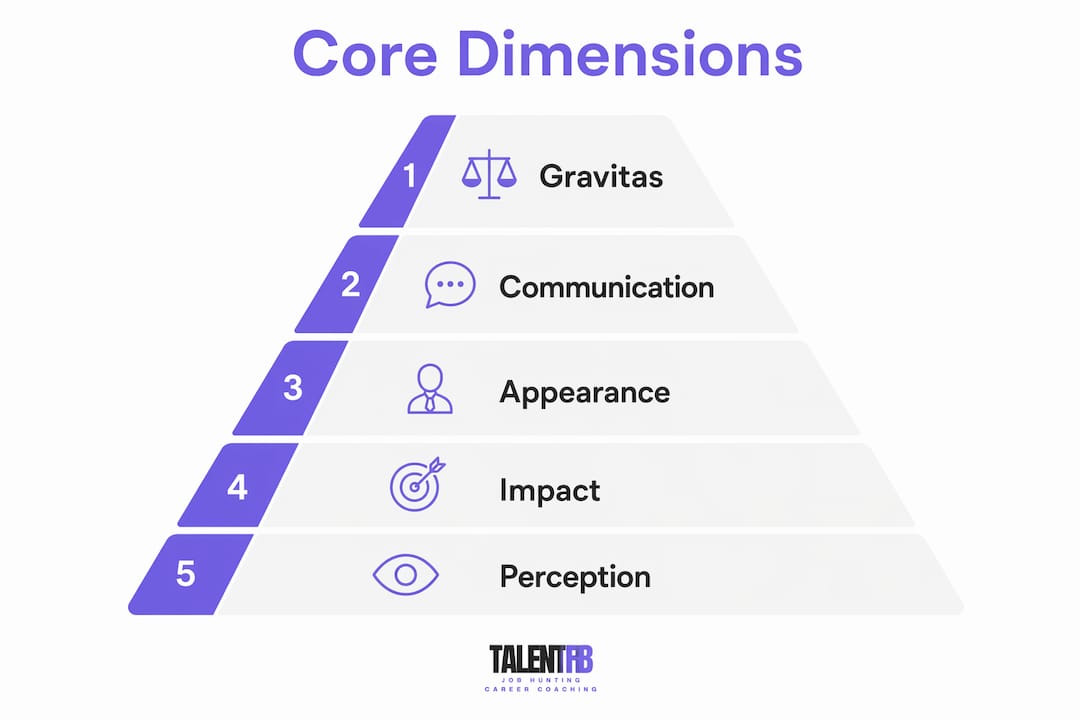
Executive presence is the combination of gravitas, communication, and appearance that signals to others you are ready to lead at a higher level. Sylvia Ann Hewlett’s Coqual framework defines these three dimensions precisely, and the weight is not evenly distributed: gravitas accounts for the majority of how others assess your leadership presence, while communication and appearance contribute smaller portions. That single data point is the most practical thing you can take from this guide. If you have 30 days to invest, spend them on one gravitas behavior — composure under pressure, decisive framing, or confident silence — before touching your wardrobe or your slide deck.
This guide draws on Hewlett’s research, Harvard Business Review analysis, and TalentFB’s coaching experience with 350+ senior tech professionals to give you a complete, development-first playbook.

Table of Contents
- What is executive presence, and what are its three core dimensions?
- Why executive presence matters for your career trajectory
- How executive presence expectations have changed in 2026
- How to develop executive presence: a dimension-by-dimension practice plan
- How to measure your progress and set realistic expectations
- Common myths that slow your executive presence development
- The evidence-based 4-step playbook for building executive presence
- The honest truth about executive presence that most guides won’t tell you
- How coaching can accelerate your executive presence development
- Further reading and authoritative sources
What is executive presence, and what are its three core dimensions?
The three dimensions are not equally visible, but each one plays a distinct role in how you are perceived.

Gravitas: the foundation others feel first
Gravitas is your ability to project calm judgment, decisiveness, and composure when the stakes are high. In a meeting, it shows up as the person who pauses before responding rather than filling silence with noise. It is the VP who, when a product launch goes sideways, reframes the situation clearly and assigns next steps without panic. Kellogg coaching research identifies credibility, ease, and ego balance as the trainable components here — all of which respond well to deliberate practice.
Observable signals of gravitas:
- Pauses before answering a difficult question
- Holds a position under pushback without becoming defensive
- Frames bad news with context and a path forward
- Stays physically still and grounded during high-pressure moments
Communication: clarity that moves people
Communication presence is not about volume or charisma. It is about whether your message lands cleanly and whether you listen in a way that makes others feel heard. The leaders who score highest here open with the point, not the backstory. They use stories to make data stick, and they ask questions that open up a room rather than close it down.
Observable signals of communication presence:
- Opens remarks with the conclusion, not the context
- Uses a short narrative arc (situation, insight, implication) rather than a data dump
- Maintains eye contact without staring; nods to signal active listening
- Avoids filler words (“um,” “you know,” “sort of”) under pressure
Appearance: the gate, not the score
Appearance functions as a baseline signal: it either opens the door to credibility or creates friction that distracts from your message. Inconsistent nonverbal cues — slouching while delivering a confident statement, or dressing far below the room’s register — can undermine trust even when your competence is unquestionable.
Observable signals of appearance:
- Dress aligns with the room’s expectations (slightly above, never jarring)
- Posture is open and grounded, not contracted or restless
- Facial expression matches the emotional tone of the message
- Camera framing and background on video calls signal professionalism
| Dimension | Relative weight | Core behaviors | High-leverage practice |
|---|---|---|---|
| Gravitas | ~67% | Composure, decisiveness, judgment | Decision journaling, scenario rehearsal |
| Communication | ~28% | Clarity, storytelling, listening | Concise opening drills, recorded reviews |
| Appearance | ~5% | Nonverbal alignment, professional presentation | Camera audit, posture check, dress calibration |
Why executive presence matters for your career trajectory
Perception shapes opportunity. When senior leaders and hiring committees decide who gets a stretch assignment, a board presentation, or a promotion, they are not running a spreadsheet of competencies. They are asking: “Does this person feel ready?” That feeling is executive presence.
Hewlett’s research, cited widely in Harvard Business Review, makes the mechanism explicit: leaders who project presence are more likely to be trusted by stakeholders, which creates access to the conversations where strategy is shaped. Two examples illustrate how this plays out in practice.
A mid-career engineering director at a fintech firm was passed over for a VP role twice despite strong delivery metrics. Her skip-level manager described her as “technically excellent but hard to read in the room.” She worked with a coach for 90 days on one gravitas behavior: pausing for three seconds before responding in executive forums. Later, she was described as “measured and strategic” in her next performance review and received the VP offer.
Contrast that with a product leader who was fast-tracked after a major platform outage. While peers scrambled, he walked into the incident call, stated the known facts calmly, named three unknowns, and proposed a decision framework. He had not resolved the crisis — he had demonstrated he could lead through one. That single moment notably accelerated his trajectory.
How executive presence expectations have changed in 2026
The old ideal of executive presence was shaped by a narrow archetype: tall, loud, and certain. That model has given way to something broader and more demanding. Authenticity, inclusiveness, and online presence are now central expectations alongside decisiveness.
What this means in practice:
Do:
- Show genuine curiosity about others’ perspectives before asserting your own
- Acknowledge uncertainty clearly rather than projecting false confidence
- Maintain consistent presence across physical and digital touchpoints
- Adapt your directness and warmth to the cultural context of the room
- On video calls, optimize camera framing and vocal variety as deliberately as you would your posture in person
Don’t:
- Perform confidence you don’t feel — audiences read the gap immediately
- Use the same communication register with a Tokyo engineering team as with a New York board
- Neglect your LinkedIn profile as a presence signal — it is often the first impression before any meeting
- Conflate assertiveness with dominance; the most respected leaders in hybrid teams listen more than they speak
A note on cultural and organizational context. Experienced leaders treat presence as a set of adjustable dials rather than a fixed persona. In a consensus-driven organization, gravitas often shows up as patient facilitation rather than decisive pronouncements. In a fast-moving startup, it looks like rapid, confident triage. Neither is wrong — the skill is reading the room and calibrating accordingly. For leaders working across global regions, accent and pronunciation can also affect perceived authority; resources like accent coaching for executives address this directly without asking you to erase your identity.
How to develop executive presence: a dimension-by-dimension practice plan
The fastest gains come from picking one high-leverage behavior and iterating it with real feedback for 30 days, rather than trying to improve everything at once.
Gravitas exercises
- Decision journal. After every significant meeting, write two sentences: the decision you made (or deferred) and the reasoning you used. Review weekly for patterns in hesitation or overconfidence.
- Scenario rehearsal. Before a high-stakes meeting, spend five minutes mentally rehearsing the two hardest questions you could be asked and your composed, concise responses.
- Pause practice. In your next three meetings, commit to a three-second pause before every response. It feels longer to you than to the room.
Communication exercises
- Concise opening drill. Record yourself opening a meeting or presenting a recommendation. Edit the recording to cut the first 30 seconds — that is usually the warm-up you don’t need. Practice leading with the point.
- Listening drill. In your next one-on-one, ask one open question and do not speak again until the other person has finished completely. Note what you learn that you would have missed.
- Narrative structure. Practice the three-part frame: situation (one sentence), insight (one sentence), implication (one sentence). Use it in your next email update before applying it live.
Pro Tip: Record a two-minute opening of your next team meeting and watch it back without sound first. You will see posture, expression, and energy before you hear a single word — and so does your audience.
Appearance and nonverbal alignment exercises
- Camera audit. Spend five minutes adjusting your video setup: eye-level camera, clean background, adequate lighting. Then record 60 seconds of yourself speaking and watch it back.
- Posture anchor. Before entering any high-stakes room or call, take one slow breath and consciously widen your stance or sit fully upright. This is a physical cue, not a performance.
- Dress calibration. Identify the dress register of the most senior person in your next three meetings and aim one notch above your current default.
A simple 90-day practice schedule
| Period | Focus | Micro-goal | Frequency |
|---|---|---|---|
| Days 1–30 | Gravitas | Three-second pause before every response | Every meeting |
| — | Communication | Lead with conclusion in all written and verbal updates | Daily |
| — | Appearance/nonverbal | Weekly camera review; one posture adjustment per call | Weekly review |
How to measure your progress and set realistic expectations
Progress in executive presence is observable, but you need a system to see it.
Self-assessment checklist (use monthly)
- Did I hold my position under pushback at least once this week without becoming defensive?
- Did I open my last three presentations with the conclusion rather than the context?
- Did I receive at least one piece of unsolicited positive feedback on my communication clarity?
- Did my nonverbal cues (posture, eye contact, expression) match the message I was delivering?
- Did I adapt my communication style to the cultural or organizational context of the room?
Feedback questions to ask others
Ask peers: “When I present in meetings, does my opening feel clear and direct, or does it take a while to get to the point?”
Ask direct reports: “Do you feel I listen fully before responding, or do I sometimes cut in too early?”
Ask your manager: “In your view, what is the one presence behavior I could improve that would most affect how senior stakeholders perceive me?”
Timeline: what to expect
| Timeframe | Realistic outcome | Measurement signal |
|---|---|---|
| 30 days | One behavior noticeably more consistent | Peer observation or self-recording review |
| 60 days | Feedback language shifts (e.g., “more decisive”) | Informal comments from colleagues |
| 90 days | Visible change in how you are positioned in meetings | Assigned to higher-visibility work or conversations |
External coaching tends to accelerate this timeline by six to eight weeks because it provides objective baseline data and structured feedback that self-observation alone cannot replicate.
Common myths that slow your executive presence development
Clearing these up will save you months of misdirected effort.
- Myth: “It’s mostly about clothes.” Appearance is a gate, not a score. Dressing appropriately removes friction; it does not create presence. Gravitas does.
- Myth: “Only extroverts can have it.” Some of the most commanding leaders in tech are introverts who project deep composure and precision. Presence is not volume.
- Myth: “You either have it or you don’t.” Executive presence is learnable and develops fastest with deliberate practice and feedback. It is a skill set, not a personality trait.
- Myth: “Performing confidence is the same as having it.” Performative behaviors — speaking loudly, dominating airtime, using jargon to signal expertise — tend to backfire. Audiences sense the gap between performance and substance quickly, and it erodes trust rather than building it.
- Myth: “The same presence works everywhere.” A direct, assertive style that reads as decisive in a US tech company can read as dismissive in a Japanese or Singaporean context. Presence is always interpreted through a cultural lens.
A note for underrepresented leaders. The Coqual research acknowledges that presence standards have historically reflected a narrow demographic archetype. If you are navigating a workplace where the “default” presence model does not match your background, the practical answer is not to erase your identity but to identify the two or three behaviors that carry the most weight in your specific context (usually gravitas behaviors) and build those first. Authenticity and credibility are not in conflict.
The evidence-based 4-step playbook for building executive presence
Coaching frameworks that produce results consistently follow the same cycle: baseline, focus, practice, measure. Here is how to apply it.
- Baseline. Collect objective data before you start. Ask three colleagues the feedback questions from Section 6. Record yourself in one meeting. Identify your biggest gap across the three dimensions.
- Focus. Pick one or two behaviors to work on, not five. The Kellogg research is clear that credibility and ease are trainable when the practice is specific and deliberate. Broad “be more confident” goals produce no measurable change.
- Practice in high-stakes contexts. Generic workshops help less than real situations. Volunteer for the next board update, the next difficult stakeholder call, the next all-hands. These are your rehearsal stages.
- Measure and iterate. Return to your feedback sources every 30 days. Ask the same questions. Look for language shifts in how others describe you.
A coaching vignette. A senior engineering manager at a US-based SaaS company came to coaching with strong technical credibility but consistent feedback that he “didn’t seem ready for the VP level.” His baseline gap was gravitas: he over-explained decisions, hedged under pressure, and rarely paused before responding. His 30-day micro-goal was a single behavior: pause three seconds before every response in executive forums. By day 60, his manager described him as “more measured and strategic.” At 90 days, he was invited to present to the board for the first time. The behavior change was small. The perception shift was not.
The role of coaching in accelerating this cycle is not about motivation — it is about the quality of the feedback loop. A coach sees what you cannot see about yourself.
The honest truth about executive presence that most guides won’t tell you
Most executive presence advice focuses on the wrong end of the problem. It tells you to dress better, speak louder, or “own the room.” That advice is not wrong — it is just addressing the 5% when the 67% is sitting untouched.
What I have seen consistently across 15 years of hiring rooms in tech, fintech, and adtech across APAC: the leaders who get promoted are not the loudest or the most polished. They are the ones who make others feel that the situation is under control. That is a gravitas signal, and it comes from one thing — how you behave when something goes wrong.
My honest recommendation: pick one gravitas behavior this week and commit to it for 30 days. Not a wardrobe overhaul, not a presentation skills course. One behavior. Pause before you respond. Or frame bad news with a path forward before anyone asks. Or hold your position calmly when someone pushes back. Do it in every meeting for 30 days, then ask a trusted colleague what they noticed. That feedback will tell you more than any self-assessment checklist.
Setbacks are part of this. You will slip back into old patterns under pressure — that is when the behavior is hardest and most visible. When it happens, note it, don’t judge it, and return to the practice. Progress in executive presence is not linear, but it is real.
How coaching can accelerate your executive presence development
Building executive presence on your own is possible. Doing it faster, with fewer wasted months, usually requires an outside perspective.
TalentFB’s coaching for senior tech professionals is built around exactly the 4-step cycle described in this guide: objective baseline, focused micro-goals, high-stakes practice, and iterative feedback. A first diagnostic call covers a baseline assessment of your three dimensions, two or three specific focus recommendations, and a 30-day micro-goal plan you can start the same week. TalentFB has worked with 350+ senior tech professionals across Director, VP, and C-suite levels, and the programs are designed to produce visible results within 90 days.
Coaching is one of several valid paths. Free resources, peer feedback, and the self-directed plan in this guide are all legitimate starting points. If you want to compress the timeline and get objective data on where you actually stand, a structured coaching program is the most direct route. Book a diagnostic call with TalentFB to get your baseline assessment and your first 30-day micro-goal.
Further reading and authoritative sources
These are the sources that informed this guide. Each one adds something distinct.
- Coqual / Sylvia Ann Hewlett framework via Paperbell — The clearest summary of the three-dimension framework and the research behind it; start here for the conceptual foundation.
- Kellogg Insight: Executive Presence Isn’t One-Size-Fits-All — Covers credibility, ease, and ego balance as trainable components; excellent for the gravitas dimension.
- The New Rules of Executive Presence (Physician Leaders / HBR-aligned) — Best source for modern expectations: authenticity, inclusiveness, and virtual presence.
- Modern Compass: Developing Executive Presence — Practical dimension weightings and micro-goal coaching methodology.
- Schulich Executive Education: Step-by-Step Guide — The repeatable baseline-focus-practice-measure cycle explained in full.
- Training Magazine: What Executive Presence Is and Isn’t — Useful myth-busting on appearance and the gate vs. score distinction.