
TL;DR:
- Building authentic relationships with senior leaders focuses on offering value first and demonstrating genuine relevance. Engaging meaningfully with their content and preparing thoroughly increases the chances of successful networking. Long-term relationship building relies on consistency, curiosity, and mutual trust rather than transactional approaches.
Networking with executives is defined as the practice of building authentic, value-focused relationships with senior leaders to advance your career, gain mentorship, and access strategic opportunities. Most professionals approach this backward. They send a generic LinkedIn request, wait for a reply that never comes, and conclude that executives are unreachable. The truth is simpler and more demanding: executives respond to people who respect their time, demonstrate genuine relevance, and lead with something useful. This guide walks you through the full process, from your first research step to sustaining relationships that last years.
How to network with executives using a value-first strategy
The single most important principle in connecting with senior leaders is this: offer value before you ask for anything. Executives prioritize connections that improve their thinking, solve a real problem, or bring a fresh perspective. Generic outreach gets ignored because it signals that you have not done the work.
Effective outreach messages are brief, under 100 words, and reference the executive’s recent work directly. That specificity shows you paid attention, which is rare and memorable. A message that says “I read your post on supply chain resilience and wanted to share a related data point” will always outperform “I’d love to connect and pick your brain.”
The visibility, credibility, and profitability model describes the correct sequence for building executive relationships. You become visible first through consistent, thoughtful engagement. Credibility follows when your contributions demonstrate real expertise. Only then does a request or collaboration feel natural rather than opportunistic.
Here is what a value-first approach looks like in practice:
- Comment meaningfully on the executive’s posts before sending any connection request. Aim for 3–5 substantive comments over 2–4 weeks.
- Share a relevant insight from your own work or industry that connects to something they have publicly discussed.
- Reference a specific piece of their writing, speaking, or project in your outreach message.
- Ask a thoughtful question that invites dialogue rather than a favor.
- Avoid flattery without substance. Compliments without context read as hollow and transactional.
Pro Tip: Before you write a single word of outreach, spend 20 minutes reading the executive’s last five LinkedIn posts, their company announcements, and any recent interviews. Your message should reflect that research clearly.
How to prepare before reaching out to senior leaders
Preparation separates professionals who get responses from those who get silence. Executives receive 20–50+ LinkedIn requests weekly. The ones that stand out arrive with context, relevance, and a clear reason for the connection.
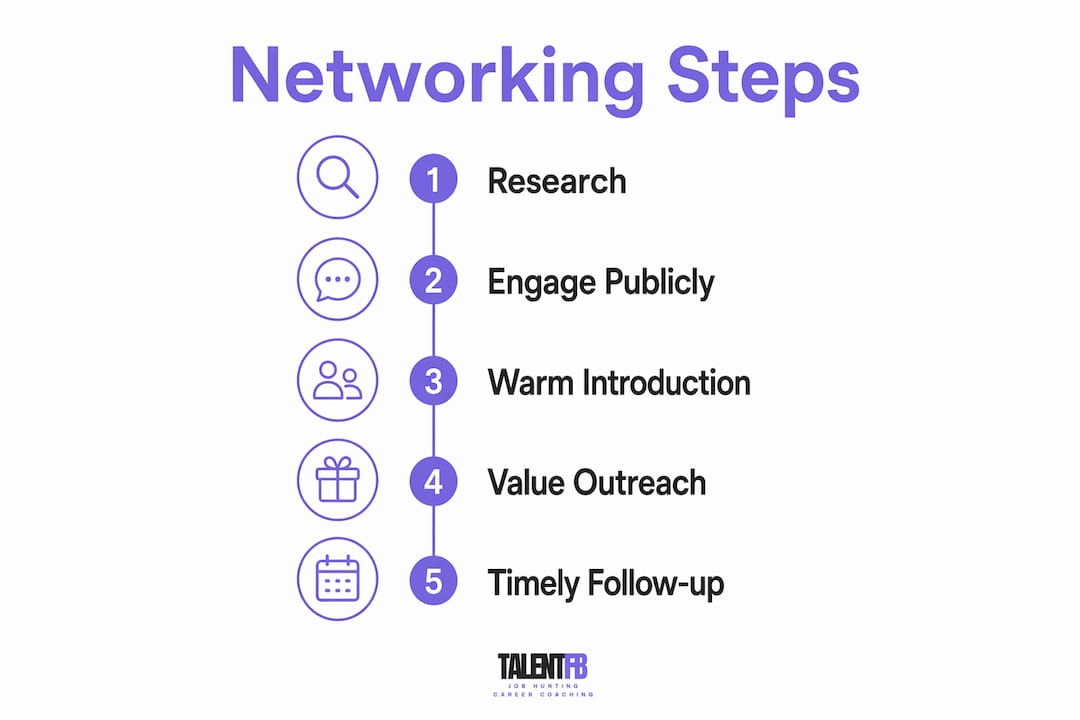
Follow these steps before you send any message:
- Research their recent work. Read their latest posts, articles, and public statements. Identify the themes they care about most right now, not six months ago.
- Map your shared ground. Look for mutual connections, shared alma maters, overlapping industries, or common professional challenges. A warm introduction through a mutual contact dramatically increases your acceptance rate.
- Define your value proposition. Ask yourself honestly: what can you bring to this person? A unique data point, a relevant case study, an introduction to someone in your network? Be specific.
- Engage with their content first. Commenting meaningfully 3–5 times over 2–4 weeks before sending a connection request significantly raises the chance your request gets accepted.
- Draft your message under 100 words. Write it, then cut it. Every sentence should earn its place. If a sentence does not add context or value, remove it.
Your LinkedIn profile also needs to be ready before you reach out. An executive who receives your request will check your profile immediately. A strong, well-positioned profile signals that you are a peer worth knowing. TalentFB’s guide on LinkedIn profile optimization covers exactly how to position yourself for this moment.
Step-by-step methods to initiate and sustain executive connections
Starting a relationship with a C-suite leader requires a clear pathway. There are four proven approaches that work consistently.

Thought leadership response. Engage publicly with the executive’s content by adding a substantive comment that extends the conversation. This creates visibility without any direct ask. It also signals that you think at a level worth engaging with.
Warm introduction. Ask a mutual connection to introduce you directly. This is the highest-conversion pathway available. A trusted peer vouching for you removes the cold-start problem entirely.
Value-first outreach. Send a personalized connection request that references a specific insight from their work. Successful requests stay under 300 characters and combine context, relevant credentials, and a low-pressure invitation. No ask, no pitch.
Uncommon credentials. If you have a rare skill, experience, or perspective that directly relates to a challenge the executive faces publicly, lead with that. Specificity creates curiosity.
Once initial contact is made, follow-up timing matters enormously. Following up within 24–48 hours after any interaction, whether online or in person, increases the effectiveness of the connection significantly. Your follow-up message should reference something specific from the exchange and add one piece of value, a relevant article, a data point, or a brief thought.
| Outreach method | Best used when | Key success factor |
|---|---|---|
| Thought leadership response | Executive is active on LinkedIn | Comment adds genuine insight |
| Warm introduction | Mutual connection exists | Introducer has strong credibility |
| Value-first cold outreach | No mutual connection available | Message is specific and under 100 words |
| Uncommon credentials | You have rare relevant expertise | Credential directly addresses their challenge |
Pro Tip: At in-person events, executives rarely carry business cards. Ask for their preferred platform or offer your contact details instead. This removes transactional pressure and makes follow-up feel natural.
Communication style matters throughout every exchange. Write as a peer, not as a supplicant. Be clear, direct, and respectful of their time. Keep every message shorter than you think it needs to be.
Common mistakes that damage your chances with executives
Most networking attempts fail not because of bad intentions but because of predictable, avoidable errors. Recognizing these patterns protects your reputation and your time.
- Sending generic messages. “I’d love to connect” with no context is the fastest path to being ignored. Every message must demonstrate that you know who this person is and why the connection is relevant.
- Treating executives as unreachable icons. The most effective networking rests on genuine human connection and curiosity, not reverence. Excessive flattery without substance signals insecurity, not respect.
- Making an immediate ask. Requesting a favor, a referral, or a meeting in your first message destroys trust before it forms. Build the relationship first.
- Over-following up. One follow-up after no response is appropriate. Two is the limit. Sending three or more messages without a reply signals poor judgment and damages your professional reputation.
- Networking only during a job search. This is the most damaging pattern of all. Reaching out only when you need something makes every interaction feel transactional. Elite executives network hardest when they are not looking for a job, treating it as ongoing infrastructure rather than a crisis tool.
The critical pitfall in executive networking is making it transactional. Leading with help and curiosity sets the strongest foundation. Every interaction should leave the executive thinking “this person adds value” rather than “this person wants something.”
How to build a strong executive network over the long term
A strong executive network is career infrastructure, not a contact list. Executives view their networks as key risk-management tools that help them pivot faster into board roles, advisory positions, or new industries during periods of disruption. Building that kind of network takes consistent, intentional effort over months and years.
- Prioritize depth over volume. Ten genuine relationships with senior leaders outperform 500 superficial connections. High-value networks focus on weekly interaction with a small core group rather than broadcasting to a large audience.
- Mix online and offline engagement. LinkedIn is the starting point, not the destination. Industry conferences, executive forums, and curated communities create the face-to-face moments where trust deepens fastest. For practical networking in your job search, combining both channels consistently produces the best results.
- Join curated executive communities. Peer groups, advisory boards, and industry roundtables put you in the same room as senior leaders repeatedly. Repeated exposure builds familiarity, and familiarity builds trust.
- Track your relationships systematically. Use a simple spreadsheet or CRM to record when you last spoke with each contact, what you discussed, and what follow-up you committed to. Consistency in nurturing relationships separates professionals who build lasting networks from those who let connections go cold.
- Schedule periodic, relevant touchpoints. Share an article that connects to a conversation you had. Congratulate them on a company milestone. Comment on a new post. These small, consistent gestures maintain warmth without requiring a major time investment.
For a broader view of how career development for corporate professionals intersects with long-term networking, the principles are consistent: treat relationships as assets that require regular attention, not transactions that end after the first exchange.
| Approach | Short-term result | Long-term result |
|---|---|---|
| Volume-focused networking | Many weak connections | Low engagement, fast decay |
| Depth-focused networking | Fewer but stronger ties | Referrals, mentorship, opportunities |
| Event-only networking | Occasional visibility | Inconsistent relationships |
| Consistent digital engagement | Steady visibility | Trust and credibility over time |
Networking during a senior job search
Most senior roles are filled through someone the hiring manager already knows or trusts. That makes networking the core of an executive job search, not a side activity. The difference between networking that works and networking that wastes your evenings is structure.
Organise your network in three tiers
- Tier 1: 15 to 25 people who know your work well and would recommend you without hesitation. Former managers, peers, clients. Talk to them first.
- Tier 2: 50 to 100 people who know you but less closely. Former colleagues, alumni, people you met at events. Reconnect with a reason.
- Tier 3: people you want to know at your target companies. Reach them through Tier 1 and 2 introductions wherever possible.
Use the informational conversation
Ask for 20 minutes to learn about someone’s company, team or market, not for a job. Prepare three good questions, listen more than you talk, and end by asking who else you should speak to. One conversation done well usually leads to two more.
Follow up with something useful
A thank you note is polite. A thank you note with an article, an introduction or an idea related to what they told you is memorable. Then put a reminder in your calendar to check in again in six to eight weeks.
Measure it like a project
Track conversations per week, introductions received and conversations that turned into interviews. Around five meaningful conversations a week is a solid pace for an active senior search. If the numbers are low, look at your message and your target list before you blame the market.
Mistakes that close doors
- Asking for a job in the first message.
- Sending the same message to everyone.
- Only reaching out when you need something.
- Going to large events with no plan for who you want to meet.
What 15 years in hiring rooms taught me about reaching senior leaders
I have spent 15 years on the other side of the table, inside hiring rooms across tech, fintech, adtech, and gaming in APAC. I have watched thousands of professionals attempt to connect with senior leaders, and the pattern is almost always the same. The ones who succeed are not the most impressive on paper. They are the most genuinely curious.
The advice I give most often is this: stop thinking about what the executive can do for you and start thinking about what problem you can help them solve. Executives prefer networking that comes from authentic, problem-solving interactions rather than small talk. Trust grows faster when you collaborate on a real challenge than when you exchange pleasantries at a cocktail reception.
The follow-up is where most professionals lose the relationship they just started building. Sending a short, specific message within 48 hours of any interaction, referencing exactly what you discussed, signals genuine interest. Most people do not do this. The ones who do are remembered.
My honest recommendation is to treat your executive network the way you treat your most important professional skills: invest in it continuously, not just when you need it. The professionals I have seen advance fastest are those who built relationships before they needed them, so that when an opportunity appeared, the trust was already there.
— Frederic Bonifassy
How TalentFB helps you build the executive presence to network effectively
Building relationships with senior leaders requires more than good intentions. It requires a clear professional brand, a well-positioned LinkedIn profile, and a targeted outreach strategy that reflects your real value.
TalentFB works with senior tech professionals, Directors, VPs, and Senior Managers, to build exactly that foundation. The career coaching guide for tech executives covers how to clarify your unique value proposition, position your LinkedIn profile to attract the right attention, and craft outreach that gets responses from the leaders you want to reach. With 350+ professionals coached and a proven 90-day system, TalentFB gives you the structure and the playbook to make your networking efforts count. Explore the guide and take the first step toward building the executive relationships your career deserves.
FAQ
What is the best way to start networking with executives?
Start by engaging with their public content for 2–4 weeks before sending any connection request. Meaningful comments on 3–5 posts build familiarity and increase the chance your request gets accepted.
How long should my outreach message to an executive be?
Keep it under 100 words on LinkedIn, and under 300 characters for a connection request. Reference a specific piece of their work and avoid any immediate ask.
When is the best time to follow up after meeting an executive?
Follow up within 24–48 hours with a short, specific message that references your conversation. Include one relevant piece of value, such as an article or insight, to reinforce the connection.
Why should I network with executives when I am not job searching?
Elite executives treat networking as long-term infrastructure, not a crisis tool. Building relationships before you need them means trust is already established when an opportunity appears.
How do I avoid coming across as transactional when reaching out to executives?
Lead with curiosity and a genuine offer of value rather than a request. The strongest executive relationships begin with help, not asks, and grow through consistent, relevant engagement over time.