Skip the ATS. The highest-leverage move for executive hiring in 2026 is building your LinkedIn personal brand and running targeted outreach directly from your profile. Before you spend $15,000–$50,000 on an executive search retainer or evaluate executive branding alternatives, do these three things first: rewrite your headline to signal the kind of leader you are (not just your title), identify five passive candidates in your network worth a warm message this week, and commit to one post per week for the next 30 days. That is your starting point.
Pro Tip: Run a 15-minute LinkedIn audit right now: check your headline, your About section’s first two lines, and your Featured section. If none of them mention the type of leader you want to attract, you have found your highest-priority fix.
Table of Contents
- What should your LinkedIn profile look like before you start outreach?
- How do you build a content system that draws in executive candidates?
- How do you run targeted outreach that actually gets responses from senior candidates?
- What results should you expect in the first 90 days?
- Why I recommend starting here before buying any HR software
- TalentFB’s Talent/OS™ gets you to inbound executive candidates faster
What should your LinkedIn profile look like before you start outreach?
The single highest-impact change you can make in the next 30 minutes is rewriting your headline. Most CEO headlines read “CEO at [Company].” That tells a senior candidate nothing about why they should want to work with you.
High-impact items (complete in 60 minutes)
- Add two or three speaking engagements, publications, or media mentions to your Experience or Featured section.
- Rewrite your three most recent Experience entries so each one opens with a decision you made and the outcome it produced, not a list of responsibilities.
- Add a clear call-to-action at the end of your About section: what you are building and who you want to hear from.
Nice-to-have (90-minute session with a comms colleague)
- Embed function-specific keywords (e.g., “Series B scaling,” “enterprise SaaS,” “maritime logistics”) so your profile surfaces in recruiter searches.
- Pin a post that reflects your hiring philosophy.
- Ask two or three senior team members to update their own profiles to reference shared initiatives.
Pro Tip: Your About section’s opening line is your digital handshake with every passive executive who lands on your profile. Frame it as: “[What I believe about building teams] + [What we are building at (Company)] + [Who I want to connect with].” This three-part structure takes 20 minutes to write and does more work than any InMail template.
For a deeper walkthrough, optimize your LinkedIn profile for executive success with TalentFB’s step-by-step guidance.
How do you build a content system that draws in executive candidates?
One principle covers everything: post what a senior executive would want to read, not what makes you look impressive. Substance attracts peers. Tactics attract followers.
Core content themes
- Decision frameworks you use internally (how you prioritize, how you hire, how you handle failure)
- Lessons learned from scaling a team or navigating a difficult quarter
- Your hiring philosophy: what you look for, what you do not tolerate, what growth looks like on your team
- Team rituals and operating principles that reflect culture in action
LinkedIn works best as a community, and thoughtful commenting on other leaders’ posts often creates more candidate sourcing opportunities than publishing alone. Spend 15 minutes per day replying to posts from people you want to attract, not just broadcasting your own.
Sample 4-week content calendar
| Week | Post format | Theme | Engagement goal |
|---|---|---|---|
| 1 | Short post (3–5 lines) | Your hiring philosophy in one paragraph | Attract passive candidates who share your values |
| 2 | Long-form thread (5–7 points) | A decision framework you use with your leadership team | Position yourself as a thoughtful operator |
| 3 | Curated commentary | Share an article relevant to your industry with a two-sentence opinion | Build credibility with domain experts |
| 4 | Short post | A lesson from a recent hire or team challenge | Signal psychological safety and honest leadership |
Repeat this cycle with fresh themes each month. After 90 days, your profile becomes a living signal of who you are as a leader, and the right candidates start reaching out. For tactical depth on building your network alongside this content system, see LinkedIn networking tactics for tech executives.
How do you run targeted outreach that actually gets responses from senior candidates?
Outreach to passive executives is a relationship sequence, not a transaction. A cold InMail asking someone to consider a role lands in the same mental folder as spam. A warm, value-first message from a credible leader lands differently.
What results should you expect in the first 90 days?
The two signals that matter most in the first 30 days are profile view growth and meaningful inbound messages from people you did not contact first. Everything else is a lagging indicator.
| Weeks | Focus | Expected signals | Your action |
|---|---|---|---|
| 1–2 | Profile rebuild + first post | Increased profile views | Note who is viewing; prioritize outreach to relevant profiles |
| 3–4 | Content cadence + outreach begins | Connection acceptance rate rises | Send value-first follow-up messages |
| 5–8 | Consistent posting + sequence follow-ups | Inbound messages from passive candidates | Move qualified conversations to calls |
| 60–90 | Refine themes + warm intros | Qualified conversations, shortlist forming | Evaluate fit, move top candidates to formal process |
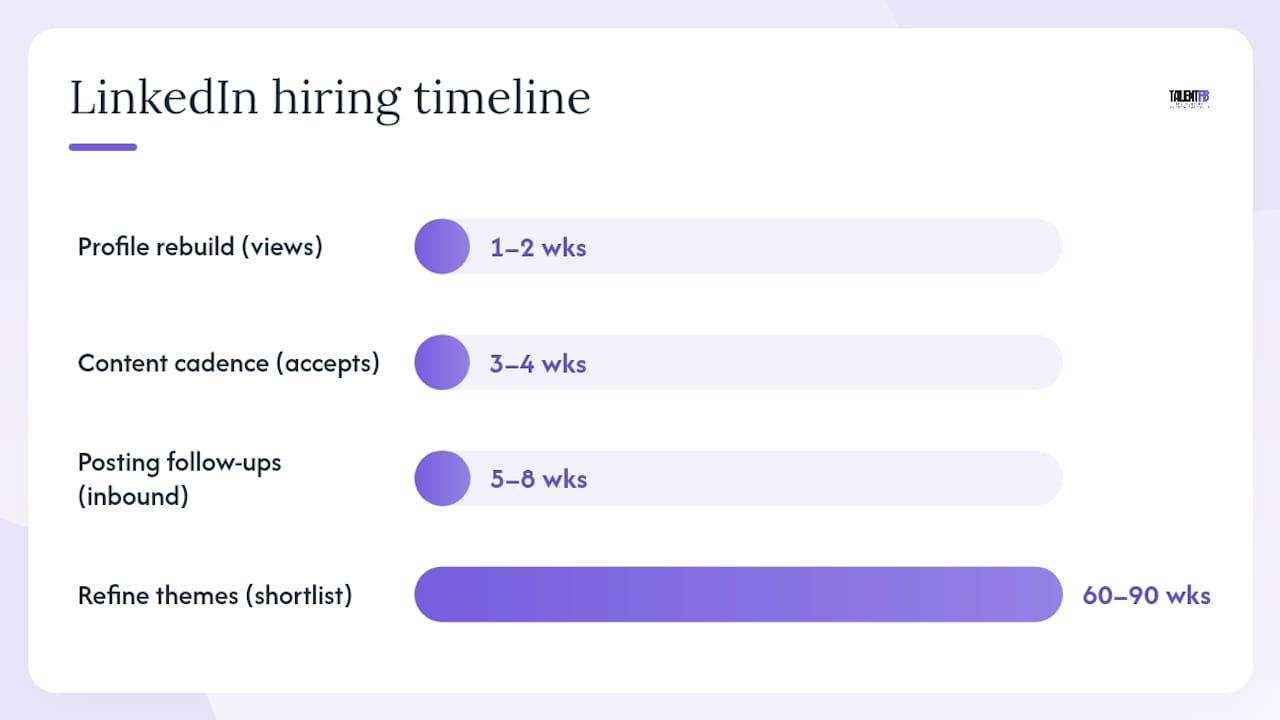
TalentFB’s client success stories show that leaders who follow a structured LinkedIn-first approach consistently see qualified inbound conversations within 60–90 days. The 90-day timeline is realistic when the profile, content, and outreach run in parallel from week one.
Why I recommend starting here before buying any HR software
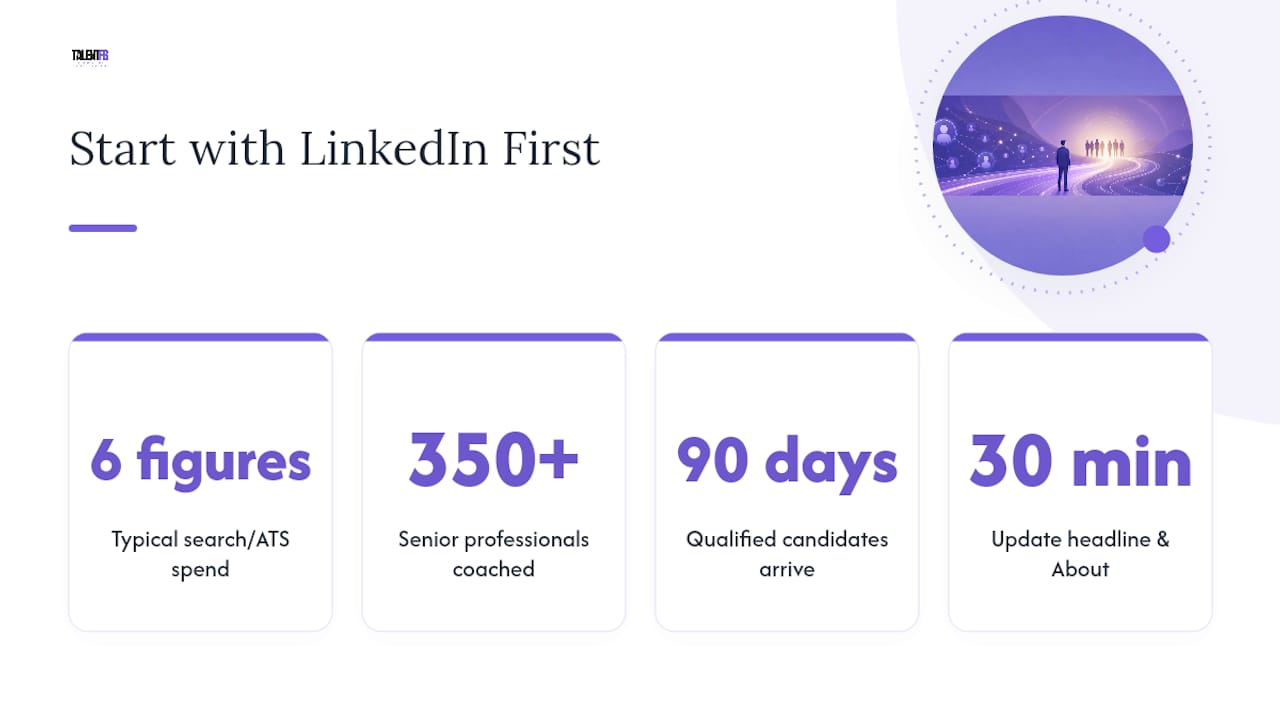
After 15 years inside hiring rooms across tech, fintech, and adtech, I have watched companies spend six figures on executive search retainers and ATS platforms while the CEO’s LinkedIn profile sat untouched for three years. The irony is that the most powerful recruiting asset in most organizations is the founder’s voice, and it costs nothing to activate.
The leaders who attract the best senior talent are not the ones with the most sophisticated HR systems. They are the ones whose LinkedIn presence makes a passive VP think, “I want to work for someone who thinks like that.” That is a brand problem, not a software problem.
I built TalentFB’s Talent/OS™ specifically for this gap. The 350+ senior professionals we have coached through our programs confirm the same pattern: when the leader’s brand is clear and the outreach is structured, qualified candidates arrive within 90 days. No ATS required.
If you are skeptical, start with the profile checklist above. Spend 30 minutes on your headline and About section this week. If you see a measurable uptick in profile views and meaningful messages within 30 days, you will have your answer before you spend a dollar on software.
TalentFB’s Talent/OS™ gets you to inbound executive candidates faster
Rebuilding your LinkedIn presence and running a structured outreach program takes real time, and most founders and CEOs do not have it to spare. TalentFB’s Talent/OS™ program does the heavy lifting: a full LinkedIn rebrand for up to five executives, a 30-day content calendar built around your hiring priorities, outreach sequences with editable templates, and a measurement scorecard so you know exactly what is working.
The program runs on a 90-day cycle: a profile and strategy audit in week one, full implementation across weeks two through four, and coaching support through the remainder of the engagement. You keep every asset after the program ends. For CEOs who want a practical, executive coaching framework to back the process, TalentFB brings both the playbook and the hands-on support to execute it.
The starting point is a LinkedIn coaching audit for CEOs. Book yours and you will leave with a prioritized action plan you can use immediately, with or without ongoing support.