
TL;DR:
- Career coaching helps senior tech leaders clarify goals and strengthen their leadership narrative.
- Engaging coaching reduces job search time from months to a few months and enhances negotiation power.
- The right coach provides objective feedback, strategic positioning, and tailored plans for leadership transitions.
Most senior tech leaders only think about a career coach when a search has already stalled. By then they have sent fifty applications, heard nothing back, and started to wonder whether the market has moved on without them. It usually has not. What has changed is how senior roles get filled: through referrals, targeted outreach and people hiring managers already recognise.
I spent 15+ years in recruitment before I started coaching, and I have now worked with 350+ senior professionals. This guide explains what career coaching for tech executives actually covers, how it differs from executive and leadership coaching, how to choose a coach, and what to expect from online programmes.
Table of Contents
- What is career coaching for tech executives?
- How career coaching accelerates tech executive advancement
- Personal branding and job search strategy: The coach’s role
- Selecting the right career coach for your tech leadership journey
- Career coaching vs. executive training: What’s the real difference?
- Why most tech executives undervalue coaching—and how to avoid their mistake
- How TalentFB supports your executive career advancement
- Frequently asked questions
Key Takeaways
| Point | Details |
|---|---|
| Personalized guidance | Executive career coaching delivers tailored advice for senior tech leaders navigating complex transitions. |
| Accelerated advancement | Coaches help translate experience into persuasive leadership narratives that fast-track job search success. |
| Strategic branding | A skilled coach sharpens your personal brand and job search approach to stand out in the tech sector. |
| Right-fit matters | Matching with a sector-savvy coach is crucial for measurable leadership growth in technology. |
What is career coaching for tech executives?
Career coaching is far more than resume advice or interview rehearsal. As Coursera explains, career coaching is a professional service where trained coaches partner with clients, particularly senior professionals and executives, to clarify career goals, optimize job search strategies, refine personal branding, prepare for interviews, and navigate transitions to leadership roles, especially in tech.
For executives, that partnership looks very different from what early-career professionals experience. A coach working with a VP of Engineering or a Chief Technology Officer is not filling knowledge gaps. They are helping a highly capable leader identify blind spots, sharpen their executive narrative, and position their experience in ways that resonate with boards, hiring committees, and executive search firms.
Here is what executive-level career coaching typically covers:
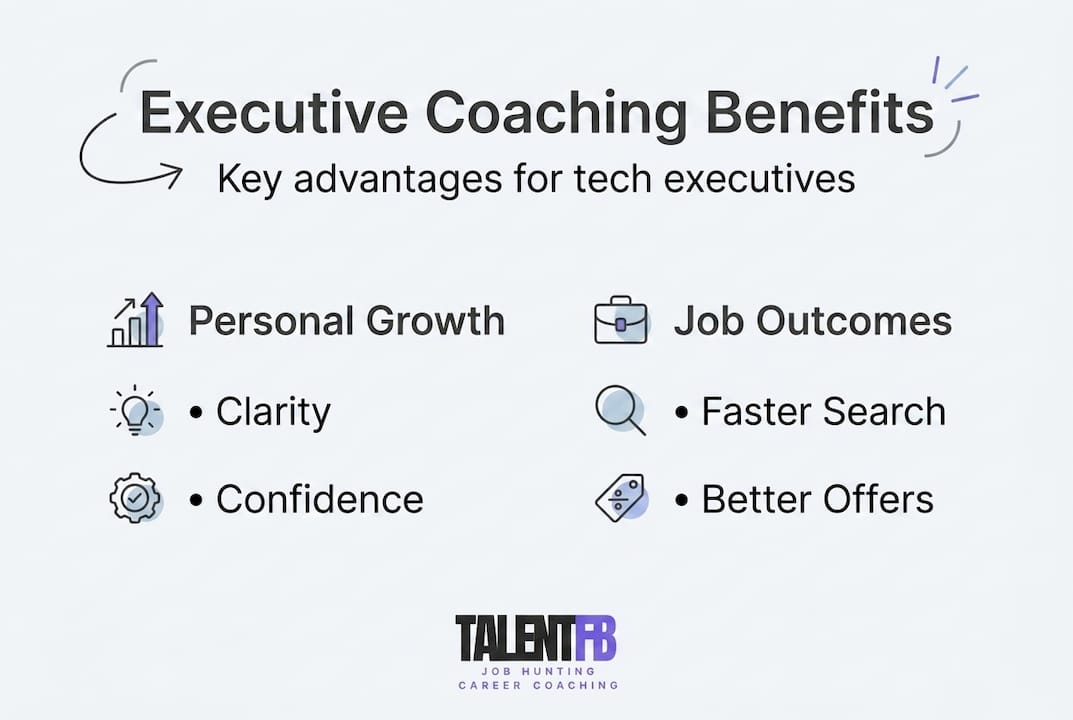
- Goal clarity: Defining what the next role should look like, including scope, culture, compensation, and industry
- Job search optimization: Building a targeted, proactive strategy rather than relying on reactive applications
- Personal branding: Shaping how you appear on LinkedIn, in executive bios, and in conversations with recruiters
- Interview preparation: Practicing executive-level storytelling, handling board-level questions, and negotiating offers
- Leadership transition support: Navigating the first 90 days in a new role with confidence
“Coaching is not about fixing what’s broken. For executives, it’s about amplifying what already works and eliminating what quietly holds you back.”
The technology sector moves faster than almost any other industry. Leadership expectations evolve constantly, from AI fluency to organizational design to stakeholder communication. Executives who rely solely on past achievements often find themselves outpaced by peers who have invested in methods for tech leaders that keep their positioning sharp and current. Coaching provides the structured, individualized support that makes that difference real.
How career coaching accelerates tech executive advancement
The clearest way to understand coaching’s value is to look at what changes when an executive engages a skilled coach versus navigating a leadership job search alone.
According to Forbes, coaching accelerates transitions by translating experience into strategic narratives and proof points, but it requires coach-industry fit, client openness, and measurement for ROI. That last point matters. Coaching is not passive. It demands that you show up ready to be challenged, to rethink assumptions, and to act on feedback consistently.
Here is how the outcomes compare:
| Outcome area | Without coaching | With executive coaching |
|---|---|---|
| Job search duration | 9 to 18 months average | Often 3 to 6 months |
| Offer quality | First available opportunity | Targeted, well-negotiated role |
| Executive narrative | Chronological, task-focused | Strategic, impact-driven |
| Confidence in interviews | Variable, often under-prepared | Consistent and compelling |
| Salary negotiation | Accepts initial offer | Negotiates 15 to 30% above baseline |
The numbers reflect a pattern we see repeatedly. Senior tech leaders who engage coaching early in their search tend to move faster, land better roles, and negotiate stronger packages. The reason is not that they lacked ability before coaching. It is that coaching gives them a clear strategy, honest feedback, and accountability that a job search conducted in isolation simply cannot provide.
Translating a 15-year career in technology into a compelling leadership narrative is harder than it sounds. Most executives can describe what they did. Far fewer can articulate the strategic impact of what they led, in language that resonates with a CEO or a board of directors. A skilled coach closes that gap through targeted exercises, mock interviews, and iterative refinement of your story.
Pro Tip: When evaluating coaches, prioritize those with direct experience placing or coaching executives in the technology sector. A coach who understands the difference between a Series B startup and an enterprise software company will ask better questions and give more relevant feedback. Explore proven job search strategies and the AI Job Search Playbook to complement your coaching engagement.
Personal branding and job search strategy: The coach’s role
Your personal brand as a senior tech leader is the story the market tells about you when you are not in the room. A career coach helps you take control of that story, ensuring it reflects your actual leadership value rather than a fragmented collection of job titles and technical accomplishments.

Career coaching supports senior professionals in refining personal branding, optimizing job search approaches, and preparing for high-stakes leadership transitions. In practice, this means a coach works with you across several interconnected areas.
Here is how a coach typically builds your executive brand strategy:
- Audit your current presence: Review your LinkedIn profile, executive bio, resume, and any public-facing content to identify gaps between how you appear and how you want to be perceived.
- Define your leadership positioning: Clarify the specific value you bring as a leader, the types of organizations you serve best, and the problems you are uniquely equipped to solve.
- Refine your core narrative: Develop a concise, compelling story about your career arc that you can deliver in a board meeting, a recruiter call, or a networking conversation.
- Optimize your LinkedIn profile: Update your headline, summary, and experience sections to reflect executive-level impact rather than operational detail. Guidance on refining executive branding can accelerate this step significantly.
- Build a targeted outreach plan: Identify the companies, roles, and decision-makers you want to reach, then design a proactive outreach strategy that goes beyond submitting applications.
- Activate your network strategically: A coach helps you identify warm connections, craft outreach messages, and request introductions in ways that feel natural rather than transactional.
Pro Tip: Your LinkedIn headline is often the first thing a recruiter or executive search firm sees. It should communicate your leadership identity, not just your current title. Think “Scaling Enterprise SaaS from $10M to $100M ARR” rather than “VP of Sales at XYZ Corp.” A strong job search strategy for tech leaders starts with making sure the right people can find you and understand your value immediately.
The job search strategy component is equally important. Many senior tech executives apply to roles reactively, responding to postings rather than creating opportunities. A coach helps you shift to a proactive model, where you are identifying target companies, building relationships before roles open, and positioning yourself as the obvious choice rather than one of many applicants.
Selecting the right career coach for your tech leadership journey
Choosing a career coach is a significant decision. The wrong fit wastes time and money. The right fit can be genuinely career-defining. As Forbes notes, coaching requires coach-industry fit, client openness, and measurement for ROI. That framework is a useful starting point for your evaluation.
Here are the key factors to assess when comparing coaches:
| Evaluation factor | What to look for |
|---|---|
| Tech sector experience | Has coached executives in your specific tech segment |
| Client outcomes | Can share specific examples of placement speed and role quality |
| Coaching methodology | Clear, structured process with defined milestones |
| Network access | Connections to recruiters, hiring managers, or executive search firms |
| Communication style | Direct, honest, and willing to challenge your assumptions |
| Pricing transparency | Clear scope and deliverables, not vague retainer arrangements |
Beyond the table, there are warning signs worth watching for:
- Coaches who guarantee specific outcomes or timelines without understanding your situation
- Vague or generic coaching programs not tailored to executive-level searches
- No verifiable client testimonials or case studies from the technology sector
- Reluctance to discuss their own methodology or track record in detail
- Pressure to sign long-term contracts before a discovery conversation
When you speak with prospective coaches, ask direct questions. How many tech executives have you coached in the past two years? What does your typical engagement look like from week one to placement? How do you measure progress? What happens if we are not seeing results after 60 days? Strong coaches welcome these questions. They have clear answers because they have a repeatable process.
Your career development checklist is a practical tool for evaluating where you stand before you begin the coaching conversation, helping you arrive with clarity about your goals and gaps.
Career coaching vs. executive training: What’s the real difference?
This distinction matters more than most executives realize. Training and coaching are both valuable, but they serve fundamentally different purposes. Confusing them leads to investing in the wrong solution at the wrong time.
Executive training transfers knowledge and skills. A leadership development program, a course on financial acumen for non-financial executives, or a workshop on AI strategy all fall into this category. Training is typically structured, group-based, and designed to bring participants up to a defined standard. It is enormously useful when you need to acquire specific capabilities.
Coaching, by contrast, works from the inside out. As Forbes describes, coaching focuses on personalized behavioral change, translating your existing experience into strategic proof points rather than adding new knowledge to your toolkit. The transformation happens through self-awareness, honest feedback, and individualized action plans built around your specific situation.
“Training fills a knowledge gap. Coaching closes the distance between who you are and who you need to be as a leader.”
Here is when to choose coaching versus training:
- Choose coaching when: You are navigating a leadership transition, your job search has stalled, your executive narrative feels unclear, or you need objective feedback on your leadership presence
- Choose training when: You need to build a specific technical or functional skill, you are preparing for a new domain, or your organization requires certification in a defined area
- Choose both when: You are making a significant industry pivot that requires both new knowledge and a repositioned personal brand
Leadership transitions, in particular, require more than new skills. Moving from a Director role to a VP, or from VP to C-suite, involves a fundamental shift in how you think about your work, communicate your value, and lead through ambiguity. Understanding the role of executive recruiters and applying a reverse job search method are examples of strategic behaviors that coaching develops, not training programs.
Career coaching, executive coaching and leadership coaching are not the same thing
The labels get mixed up constantly, and choosing the wrong one wastes months.
- Career coaching is about your next move: what role you should target, how you position yourself, and how you get in front of the people who hire for it. It ends when you have landed the right role.
- Executive coaching is usually paid for by your employer and focuses on performance in your current seat: stakeholder management, board presence, running a leadership team.
- Leadership coaching is broader development work on how you lead, often run through a company programme alongside 360 feedback.
If you are planning to leave, pivot or step up somewhere new, you need career coaching. If your company wants you to grow in role, you need executive or leadership coaching, and your employer should fund it.
Why companies pay for coaching, and what that tells you
Companies bring in coaches at predictable moments: a promotion into the C suite, a new CEO, a merger, a leader who is brilliant technically but struggling with people. They pay because a senior leader failing in role costs far more than the coaching. The same logic applies to your own search. A senior search that drifts for months costs you income, options and confidence. Structured help at the start is cheaper than a long, reactive search.
Online coaching: how to judge a programme
Most coaching for busy executives now happens online, and that is fine. What matters is the substance. Before you sign up to any programme, including mine, ask:
- What is the method? You want a clear sequence (positioning, target companies, outreach, interviews, negotiation), not open ended chats.
- Who is the coach? Look for someone who has sat on the hiring side and knows how decisions really get made.
- What do you do between sessions? Progress comes from the work you do in the week, so the programme should give you tools, templates and accountability.
- What happens if it is not a fit? A clear refund policy is a good sign.
If you want to see where your search stands before you speak to anyone, take the free Senior Job Search Score. It takes a few minutes and shows which of the five areas is holding you back. If you want structured support, compare the self paced AI Job Search OS with 1:1 executive job search coaching.
Coaching for senior tech leaders in Singapore
Singapore’s tech market is small and well connected. Hiring managers talk to each other, and a large share of senior roles are filled through referrals and regional search firms. Coaching here works best when it combines positioning with local market knowledge: which companies are growing their regional teams, how to approach them, and how to present experience from other markets. If you are relocating or returning to Singapore, that local context matters even more.
LinkedIn coaching: when it is worth it
LinkedIn coaching focuses on one channel: your profile, your content and how you use the platform to build relationships. It is worth it if your search depends on being found, if you want inbound opportunities over time, or if you know you should be more visible but do not know where to start. For senior professionals and founders, that is the focus of The LinkedIn/OS. If you need your profile fixed first, start with the LinkedIn Profile Rebuild.
Why most tech executives undervalue coaching—and how to avoid their mistake
Here is what we observe consistently: the executives who resist coaching the longest are often the ones who need it most. Not because they lack skill or intelligence, but because their success has insulated them from honest feedback. When you have built strong teams, shipped successful products, and earned the respect of your peers, it becomes easy to assume that the next role will come through the same channels that brought you this far.
But the executive job market does not reward past performance as directly as you might expect. It rewards clarity, positioning, and strategic visibility. A strong network helps, but it rarely replaces a sharp narrative and a proactive strategy. The most successful executives we see treat strategic career advancement for tech leaders as an ongoing discipline, not a one-time event triggered by a layoff or a moment of dissatisfaction.
Coaching gives you something your network cannot: unbiased challenge. A trusted colleague will soften difficult feedback. A coach will tell you that your LinkedIn profile reads like a job description, that your interview answers are too operational for a C-suite audience, or that your target company list reflects comfort rather than ambition. That clarity, delivered with respect and intention, is what accelerates real momentum.
How TalentFB supports your executive career advancement
If this guide has clarified what career coaching can do for you, the next step is finding the right structure to put it into practice.
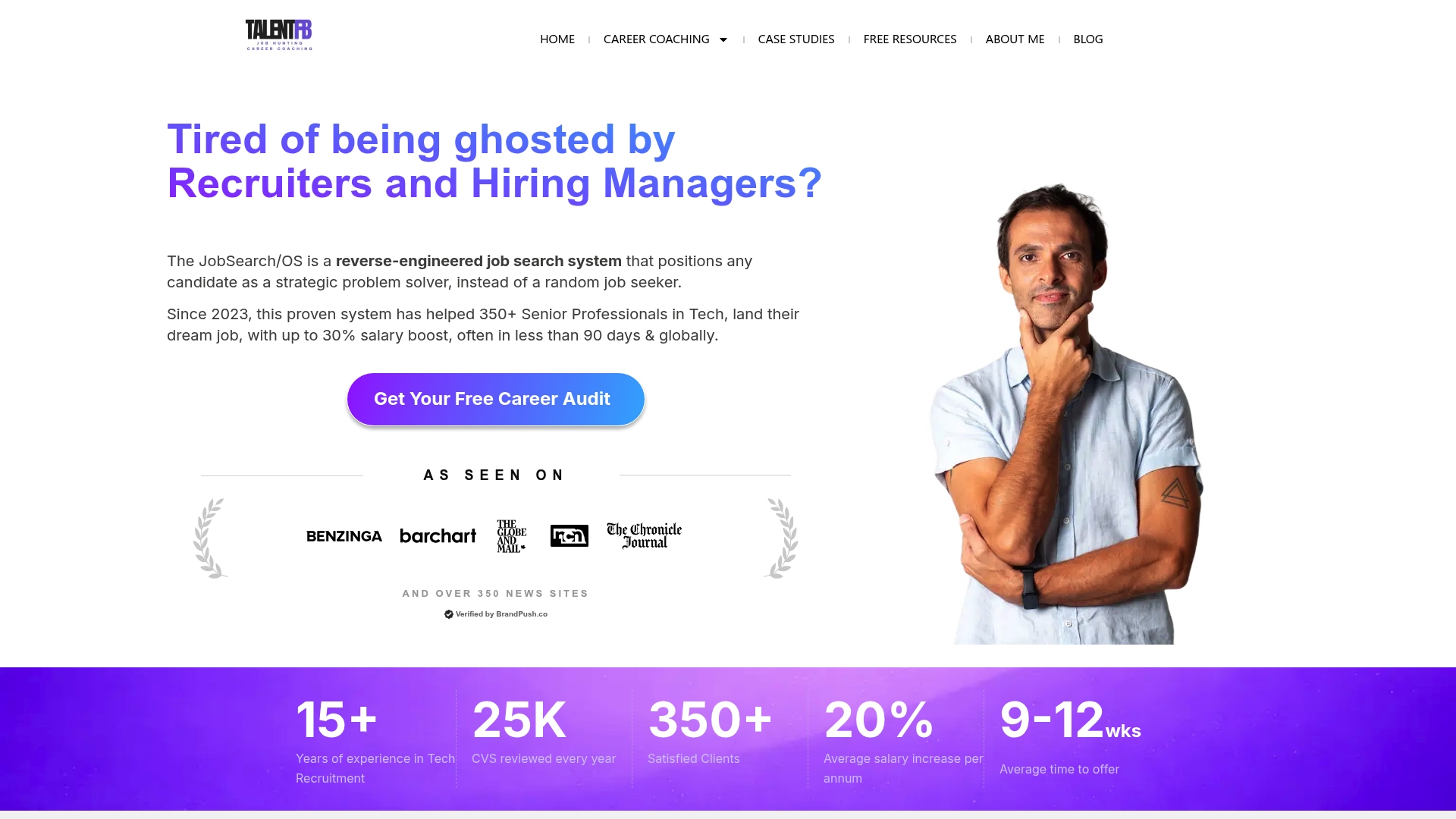
At TalentFB, we work specifically with senior professionals and executives in the technology sector who are ready to move with intention. Our career coaching sessions are designed for leaders who want a clear strategy, not generic advice. Whether you are refining your executive narrative, rebuilding your job search approach, or preparing for high-stakes interviews, we bring both coaching expertise and deep tech sector knowledge to every engagement. Start with our AI Job Search Playbook for immediate, actionable tools, or explore how we can help you optimize your executive LinkedIn to attract the right opportunities from the right people.
Frequently asked questions
What exactly does a career coach do for tech executives?
A career coach helps tech executives clarify goals, build personal brands, strategize job searches, and prepare for leadership transitions. As Coursera explains, coaching is a professional partnership focused on optimizing every dimension of the executive job search and career advancement process.
How does career coaching differ from executive training?
Career coaching focuses on individualized behavioral change and leadership mindset, while executive training typically transfers skills or knowledge. According to Forbes, coaching focuses on personalized behavioral change rather than generic skill development, making it the right tool for leadership transitions.
Do tech executives really need coaching if they already have a strong network?
Even with a strong network, a coach offers objective feedback and strategic insights you might miss on your own. A network reflects your past; a coach helps you shape your future positioning.
How do I measure ROI from career coaching as an executive?
Measure ROI by assessing speed of job search, role quality, salary growth, and sustained career momentum after coaching. Forbes confirms that coaching ROI requires clear measurement criteria established at the start of the engagement, including transition speed and the strategic quality of the role secured.