Ask five targeted recommenders this week, each with a three-bullet brief covering your relationship, a specific project, and a measurable result, and offer to draft the first version yourself. That single move produces more executive-grade LinkedIn recommendations than months of hoping colleagues will “get around to it.”
Here’s the fast version:
- Ask first: your last direct manager, one former direct report, and one client or board peer, not three people from the same team.
- Brief them in three bullets: how you know each other, the project or transition you led together, and the number or outcome that proved it worked.
- Offer a draft. Busy executives write better recommendations when they’re editing your words instead of starting from a blank box.
Copy this and send it today: “Would you be open to writing a short LinkedIn recommendation about our work on [project]? Happy to send a few bullet points to make it easy, no pressure to use them.”
Table of Contents
- Why LinkedIn Recommendations Matter for Executive Search and Brand
- The Five-Part Structure Every Executive Recommendation Should Follow
- Recommendation Examples for CEOs, VPs, and Board Advisors
- How and When to Ask for Executive Recommendations
- A Quick Guide for Writing Someone Else’s Executive Recommendation
- Common Mistakes to Avoid When Collecting Recommendations
- What Hiring Teams Actually Look for in Executive Recommendations
- My Honest Take on Getting This Right
- Get Your LinkedIn Recommendations Working as Hard as You Do
- Frequently Asked Questions
- Sources
Why LinkedIn Recommendations Matter for Executive Search and Brand
An endorsement takes three seconds and one click. A written recommendation takes five minutes, a real memory, and an actual sentence someone chose to type about you. That difference is exactly why recruiters and hiring committees weigh them so differently.
Endorsements confirm you have a skill. Written recommendations tell a story about how you used it, and HubSpot’s analysis of LinkedIn’s skills and endorsements feature makes the distinction plain: endorsements help with discoverability, while recommendations function as high-trust narrative social proof. For a director, VP, or C-suite candidate, that narrative is often the deciding factor between “looks qualified on paper” and “I’d want this person in the room.”
Career Confidential’s breakdown of endorsement value echoes the same point from the recruiter’s chair: written recommendations get treated as higher-quality evidence during executive screening, precisely because they’re harder to fake and take real effort to produce.
Here’s what most executives get wrong: they collect endorsements aggressively and let recommendations sit at three or four, written years ago. Flip that ratio. A profile built for executive success treats endorsements as background noise and recommendations as the centerpiece, because that’s how the people who actually decide your next role read the page.

The Five-Part Structure Every Executive Recommendation Should Follow
Most recommendations fail for a boring reason: they read like a performance review instead of a case study. The fix is a structure, not more enthusiasm.
- Relationship context. One sentence establishing how the recommender knows you and for how long. “I managed Sarah as VP of Product for three years” carries more weight than “I’ve worked with Sarah.”
- Specific contribution or project. Name the initiative, not the job title. “Led the platform migration” beats “was responsible for engineering.”
- Measurable outcome or before/after. This is the sentence most recommendations skip entirely, and it’s the one that convinces a skeptical reader. A study on strong LinkedIn recommendation examples found that leader-focused recommendations work best when they include this exact before/after framing, tying the story to a concrete result like revenue growth or retention improvement.
- Distinctive leadership qualities. Not “hardworking” or “detail-oriented.” Think stakeholder management under pressure, board communication, or how someone led through a layoff or acquisition.
- Clear closing endorsement. One direct sentence: “I’d hire her again in a heartbeat” or “Any board would be lucky to have him.”
Liz Ryan’s guidance on writing a strong LinkedIn recommendation makes a point that applies directly here: the recommendation needs an authoritative voice and should highlight strategic vision, stakeholder navigation, and leadership through transitions, not punctuality or being a team player. That’s entry-level praise wearing a senior job title.
Do this:
- Use numbers wherever they exist (headcount, revenue, timeline, retention).
- Name the specific challenge that made the outcome hard to achieve.
- Let the recommender’s own voice and vocabulary come through.
Avoid this:
- Generic adjectives with no evidence attached (“great leader,” “always professional”).
- Recommendations that could apply to literally anyone on the team.
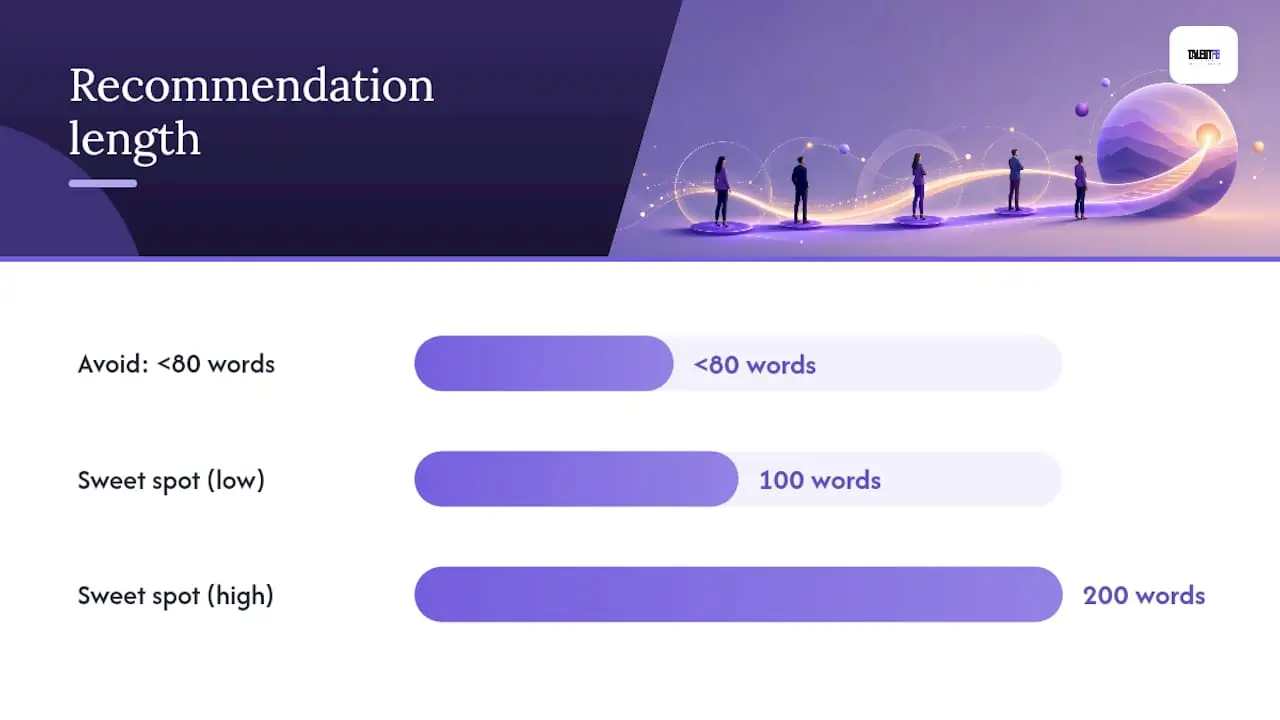
- Length under 80 words. It reads as an afterthought.
The sweet spot is 100 to 200 words. Long enough to include real detail, short enough that a recruiter skimming your profile at midnight actually finishes reading it.
Pro Tip: Feature your strongest, most metric-driven recommendation first in your Featured section, not chronologically. The first one a reader sees sets the bar for how they read the rest.
Recommendation Examples for CEOs, VPs, and Board Advisors
These follow the five-part structure above. Adjust names, numbers, and specifics to fit your actual story, but keep the bones intact.
For a CEO (from a board member):
“I served alongside Maria on the board of [company] for four years. Her calm under pressure and her ability to align a fractured leadership team were the difference between a company in crisis and one positioned for its Series C. I’d back Maria in any turnaround situation without hesitation.”
Why it works: the before/after crisis framing, a real percentage, and a closing line that’s specific to the situation rather than generic praise.
For a COO:
“David and I worked together for three years while he served as COO. What stood out wasn’t just the fix. It was how he communicated the plan to a nervous executive team and kept morale intact through the disruption. David is the operator you want when things break.”
For a VP of Sales (from a direct report):
“I reported to Angela for two years as an account executive. She’s the rare VP who coaches individually instead of managing by dashboard. I learned more from Angela than from anyone else in my career.”
Why it works: the direct-report angle adds a perspective a peer recommendation can’t, and the specific quota recovery number does the heavy lifting.
For a Director:
“Tom led our data platform team through a full re-architecture while I managed the adjacent product org. Tom’s technical judgment paired with his patience for cross-team politics made him the person everyone wanted in the room for hard decisions.”
For a board advisor:
“I brought Jane on as an advisor during our Series B fundraise. Her network and her blunt feedback on our go-to-market strategy shaped decisions that got us to a term sheet within four months, faster than our original timeline. She asks the uncomfortable questions founders need and rarely get.”
Why it works: this shows how to write a recommendation for a non-traditional, part-time role, since advisory work still needs a project, a timeframe, and an outcome to feel credible.
For a mentor:
“I was paired with Robert through an executive mentorship program in my first year as a VP. He pushed me to rethink how I ran my staff meetings and helped me navigate a reorg that could have derailed my team. Robert’s mentorship had a direct hand in that number.”
For a senior consultant:
“We brought in Priya to redesign our pricing strategy during a period of flat growth. Her ability to translate financial modeling into something our sales team could actually use in the field set her apart from consultants we’d worked with before.”
Pro Tip: Notice none of these open with “I had the pleasure of working with.” That phrase is so common it’s become filler. Start with the relationship fact instead.
How and When to Ask for Executive Recommendations
Who you ask matters as much as how you ask. Recruiters and hiring committees notice when every recommendation comes from peers at the same level. It reads as a lack of leadership reach across the organization, not a strength.
Prioritize in this order:
- Former direct supervisors who can speak to how you were managed and what you delivered upward.
- Direct reports, current or former, who can speak to how you lead, not just what you achieved.
- Clients or external stakeholders who saw your work from outside the building.
- Board members or advisors, if applicable, who can speak to strategic judgment.
That mix, supervisors plus direct reports plus clients, is what recruiters expect to see on a senior profile. A stack of peer-only recommendations, however glowing, tends to raise the question of whether you’ve actually managed people or influenced outcomes beyond your own lane.
Timing matters more than most executives realize. The guidance from Jobscan on LinkedIn recommendations is direct: ask when context is fresh, right after a project wraps or a strong performance review lands, and give the recommender clear direction on the top three things you’d like known. Waiting six months to ask means asking someone to reconstruct a memory instead of describe one.
Copy-ready scripts:
- LinkedIn DM: “Hi [Name], I’m updating my LinkedIn profile and would love a short recommendation about our work on [project]. Happy to send three quick talking points if that’s helpful, no worries if you’re slammed.”
- Email: “I’m putting together a few recommendations to reflect my recent work, and yours would mean a lot given [specific project or moment]. I’ve drafted three bullet points below covering the challenge, what I did, and the outcome, feel free to use, edit, or ignore entirely.”
- In-person or video call: Mention it at the natural end of a check-in. “Before we wrap, would you be open to a short LinkedIn recommendation about the [project] work? I can send you a quick outline afterward.”
Whatever channel you use, Pursue Networking’s advice on asking for recommendations without feeling awkward backs up the same tactic: offering a draft and concrete talking points measurably increases both response rate and the quality of what comes back. Give three bullets, not ten. The recommender should personalize, not compose from scratch.
Follow up once, no sooner than ten days out, with a friendly one-line nudge. If it doesn’t happen after that, let it go gracefully and move to the next name on your list.
A Quick Guide for Writing Someone Else’s Executive Recommendation
If you’re on the receiving end of this ask, here’s how to produce something genuinely useful in fifteen minutes instead of staring at a blank box for a week.
- Open with the relationship. One sentence: how you know them, for how long, in what capacity.
- Name the project or role, not just the job title.
- Highlight one metric or outcome. If you don’t have an exact number, describe the tangible change you saw.
- Describe a leadership behavior with a short example. How did they handle a hard moment, a tough stakeholder, or a team in crisis?
- Close with a clear, direct endorsement. Say plainly whether you’d work with them again.
Sample sentences you can copy and adapt:
- “I managed [Name] as [title] for [duration], where they were responsible for [specific initiative].”
- “Under pressure during [specific challenge], [Name] [specific action], resulting in [outcome/metric].”
- “What sets [Name] apart is [specific leadership trait], which I saw firsthand when [brief example].”
Keep it tight. Senior recommendations read best around 100 to 150 words, evidence-driven and specific, not padded with adjectives that could describe anyone.
Common Mistakes to Avoid When Collecting Recommendations
A weak recommendation is often worse than no recommendation, because it sits on your profile signaling less than you’d like it to.
- Generic, entry-level praise. “Always on time and a great team player” undersells a senior leader badly and reads like it was written for an intern.
- Outdated recommendations pinned at the top. A glowing note from a manager role you left eight years ago tells recruiters your best work is behind you.
- Too many peer-only recommendations. As covered above, it raises questions about leadership reach rather than answering them.
- Sharing confidential client or deal details. A recommendation that names a client contract value or an unannounced initiative can create real problems, keep specifics general enough to stay appropriate.
- Obvious reciprocal “logrolling.” Trading recommendations back and forth with the exact same three people in the same month looks staged to anyone paying attention.
Pro Tip: Use LinkedIn’s hide feature to remove anything outdated or off-brand, and pin your three strongest, most metric-rich recommendations in the Featured section. A skim-reader should see your best proof first, not scroll through five years of history to find it.
What Hiring Teams Actually Look for in Executive Recommendations
After years of sitting inside hiring rooms across tech, fintech, adtech, and gaming companies in APAC, the pattern that stands out isn’t subtle: hiring panels barely glance at endorsements, but they read written recommendations closely, especially the first two or three on a profile.
What they’re scanning for is a portfolio, not a highlight reel. A study on LinkedIn’s endorsement value suggests executives are better served by 5 to 10 high-quality, long-form recommendations than by a wall of one-click endorsements, and that lines up with what hiring committees actually respond to. They want to see a former boss, a direct report, and a client or board contact, not five colleagues from the same three-year stretch.
The single biggest tell in a weak executive profile isn’t a missing recommendation. It’s a recommendation portfolio that’s all peers, all from the same era, all praising the same three adjectives. Hiring panels notice the shape of your recommender list before they finish reading a single sentence of what it says.
At TalentFB, part of building an executive brand that attracts the right attention means curating recommendations the same way you’d curate a board deck: refresh them as your role targets shift, retire ones that no longer reflect your current level, and make sure the mix matches the seniority you’re targeting next, not the seniority you held five years ago.
- Aim for a deliberate mix: two supervisors, two direct reports, one client or board contact.
- Refresh at least one recommendation every time you make a significant career move.
- Match the language in your recommendations to the language in your target job descriptions, since recruiters often search recommendation text for keywords.
My Honest Take on Getting This Right
Here’s what I’d tell any senior leader sitting on three recommendations from 2019: stop waiting for the perfect moment to ask. There isn’t one. The people who write you the best recommendations are usually busy, slightly overcommitted, and would genuinely be glad to help if you make it easy for them.
The mistake I see most often isn’t laziness, it’s perfectionism. Executives wait for a recommender to produce something polished and comprehensive on their own, when the honest truth is that a three-bullet draft from you will get a better result than an open-ended ask ever will. Authenticity doesn’t come from someone writing every word unprompted. It comes from someone confirming a true story you helped them remember.

So here’s my direct suggestion: pick three people right now, one former boss, one direct report, one client, and send the request template from the top of this piece before the day ends. That’s the whole game. Not a perfect strategy, just three honest asks sent this week instead of “someday.”
If you want a second pair of eyes on how your current recommendations read against the roles you’re actually targeting, that’s exactly the kind of work I like doing with clients. I’d rather help you fix it now than watch a strong candidate get passed over because their profile told an outdated story.
Get Your LinkedIn Recommendations Working as Hard as You Do
Most executives collect recommendations passively and hope the right ones show up. TalentFB does the opposite: as part of a full LinkedIn rebrand, we help you audit your existing recommendation portfolio, identify the gaps in your recommender mix, and build the outreach scripts that get the right five people to say yes.
Whether you’re preparing for a board search, a VP-to-C-suite jump, or simply want your profile to reflect the leader you are today instead of the one you were in 2019, a free LinkedIn brand audit takes about two minutes and shows you exactly where your profile, recommendations included, is underselling you. Start there, and you’ll know within minutes whether your recommendation portfolio matches the roles you’re actually chasing next.
Frequently Asked Questions
How many LinkedIn recommendations should an executive have?
Somewhere between 5 and 10 strong, long-form recommendations tends to outperform a large stack of thin ones. Quality and a balanced mix of recommenders matter more than the total count.
Do LinkedIn endorsements matter for executive job search?
Less than written recommendations do. Endorsements help with keyword discoverability, but recruiters and hiring committees treat written recommendations as the real evidence during screening.
Who should I ask for a LinkedIn recommendation as a senior executive?
Prioritize a mix: a former direct supervisor, a direct report, and a client or board contact. Avoid a portfolio made up entirely of same-level peers.
What’s the ideal length for an executive LinkedIn recommendation?
100 to 200 words. Long enough to include a specific project and a measurable outcome, short enough that a busy reader finishes it.
When is the best time to ask for a recommendation?
Right after a project wraps, a promotion lands, or a strong performance review, while the details are still fresh for your recommender.
Should I write the recommendation for the person I’m asking?
Offering a short draft, three bullets covering the challenge, your action, and the outcome, speeds things up and usually improves the quality of what comes back, as long as the recommender is free to edit or rewrite it.
Sources
- How To Write A Killer LinkedIn Recommendation
- LinkedIn skills & endorsements — HubSpot
- LinkedIn endorsements — Jobscan
- How to Ask for Recommendations (on LinkedIn) Without Feeling Awkward | Pursue Networking