Yes. A LinkedIn newsletter is one of the highest-leverage personal-brand channels a CEO can run when the goal is thought leadership, talent attraction, or passive lead generation. It costs nothing, it takes minutes to set up, and it puts your thinking directly into the inbox and notification feed of the people you most want watching your company.
Here’s what to do this week if that verdict lands right:
- Check whether “Create a newsletter” appears in your LinkedIn publishing tool (Write article → Manage). If it doesn’t, keep reading. Section three explains the fix.
- Pick one primary outcome. Not three. One. Talent attraction, business development, or brand authority. You can support the other two, but only one gets to run the show.
- Draft the title, description, and cadence for your first edition before you touch the “publish” button. Rushed newsletters read rushed.
Pro Tip: Publishing on LinkedIn takes as little as five minutes once you know the path, according to ZDNET’s step-by-step walkthrough. The setup isn’t the bottleneck. Consistency is.
Don’t expect fireworks in week one. Most CEOs who commit to a weekly cadence see meaningful subscriber growth over one to three months, not days. If you’re looking for an overnight lead-gen hack, this isn’t it. If you’re building a durable channel that compounds for years, keep reading.
Table of Contents
- How to Create a CEO LinkedIn Newsletter Step by Step
- Why Doesn’t the “Create Newsletter” Option Show Up Yet?
- What Should a CEO’s Newsletter Actually Achieve?
- How Often Should a CEO Publish, and What Should Each Issue Say?
- How Do You Grow Subscribers and Turn Attention Into Leads?
- What Metrics Actually Matter for a CEO Newsletter?
- What Mistakes Sink Most CEO Newsletters?
- An 8-Week Playbook to Launch a CEO Newsletter
- Why I Think Every CEO Should Treat This as a Real Channel
- Get Help Launching a CEO Newsletter That Actually Works
- Where to Learn More
- Frequently Asked Questions
- Sources
How to Create a CEO LinkedIn Newsletter Step by Step
The path is short, and LinkedIn keeps it deliberately simple. Here’s the exact sequence, straight from LinkedIn’s own help documentation:
- Go to the “Write article” tool from your homepage or profile.
- Click “Manage” in the article editor.
- Select “Create newsletter.”
- Fill in four fields: title, description, publishing frequency, and an optional logo image.
- Write your first edition and publish.
That last step trips people up more than any other. Publishing a newsletter edition notifies every subscriber and pushes the piece into their feed with your newsletter’s branding attached. Publishing a standalone article does neither. If your goal is to build a habit-forming channel, you always want to publish through the newsletter, not as a one-off article that happens to share the same editor.
Before you hit publish on edition one, run this checklist:
- Title: short, benefit-forward, and something you’d still want your name attached to in two years.
- Description: one or two sentences explaining exactly who this is for and what they’ll get.
- Frequency: pick weekly, biweekly, or monthly. LinkedIn asks you to commit up front, and your subscribers will notice if you drift.
- Image or logo: a clean headshot or simple wordmark. Skip anything busy.
Pro Tip: If you’re unsure whether your setup matches LinkedIn’s current interface, LinkedIn Help keeps a screenshot-by-screenshot walkthrough of the newsletter creation flow. UI details shift occasionally, so it’s worth a two-minute check before your first launch.
One detail that surprises a lot of executives: LinkedIn owns the subscriber relationship, not you. You can’t export the list. That’s not a reason to skip the newsletter, but it is a reason to build a parallel path to an owned email list from day one, something we’ll come back to in the growth section.
Why Doesn’t the “Create Newsletter” Option Show Up Yet?
If you don’t see the option, you’re not doing anything wrong. LinkedIn doesn’t grant newsletter access to every account on day one. Eligibility ties to a track record of original content and general account standing, and for company pages, it requires admin roles rather than being open to any team member.
That means a fresh account with no posting history, or one that’s been dormant for months, often won’t have the feature yet. The fix isn’t complicated, but it does require patience:
- Publish 5 to 10 original posts (not reshares) over several weeks to establish a content history.
- Keep your profile complete and active. Half-finished profiles and stale accounts read as low-signal to LinkedIn’s systems.
- If you’re publishing under a company page, confirm you or a colleague holds admin access. This is a five-minute IT ticket, not a strategic problem.
- Check back weekly. Access tends to unlock quietly, without a notification announcing it.
Pro Tip: Assign this to your executive assistant or comms lead, not yourself. Checking for a feature toggle every few days isn’t a CEO-level task, but forgetting to check for six weeks is a CEO-level delay.
If it’s been more than a month with consistent posting and the option still hasn’t appeared, that’s the moment to loop in someone who’s navigated LinkedIn’s publishing quirks before rather than guessing at workarounds.
What Should a CEO’s Newsletter Actually Achieve?
This is the question most executives skip, and it’s the one that determines whether the newsletter becomes a real asset or a vanity project that quietly dies after issue four.
There are three legitimate primary outcomes for a CEO newsletter, and you should choose exactly one:
- Brand authority. You want to be the recognized voice on a specific topic in your industry, the person journalists and peers cite when that subject comes up.
- Passive lead generation. You want the newsletter working quietly in the background, warming up prospects who aren’t ready for a sales conversation yet but will remember you when they are.
- Executive talent attraction. You want senior candidates discovering your thinking before a recruiter ever reaches out, so by the time you’re hiring, half the work of building trust is already done.
Here’s a simple way to decide which one is yours:
- Ask what’s actually constraining your business growth right now. Is it awareness, pipeline, or hiring?
- Pick the outcome tied to that constraint as your primary goal.
- Let the other two ride along as secondary benefits. Don’t write for three audiences at once.
- Revisit this choice every quarter. Constraints shift as companies grow.
Content strategy research on CEO LinkedIn programs backs this focus. Programs that pick three or four content pillars tied directly to the business, rather than posting whatever feels interesting that week, consistently outperform generalist accounts on engagement and pipeline signals.
A useful positioning statement for your newsletter’s description field, adapted to your outcome:
“A weekly note for [specific role/industry] on [specific problem], written by the CEO who’s solved it inside [company type].”
That’s specific enough to filter for the right subscribers and honest enough that people know exactly what they’re signing up for. Vague newsletters attract vague, disengaged audiences.
How Often Should a CEO Publish, and What Should Each Issue Say?
Cadence is the single decision that determines whether your newsletter survives past month three. Publish more often than you can sustain, and you’ll quietly abandon it. Publish too rarely, and readers forget you exist between issues.

Forbes’ research on weekly newsletters found weekly cadence tied to the fastest audience growth among top performers, largely because it builds a habit loop faster than any slower schedule. But weekly only works if you genuinely have something to say every seven days. If you don’t, biweekly is a perfectly respectable choice, and monthly works for CEOs who want depth over frequency. The sustainability rule is simple: pick the cadence you could keep up during your busiest month of the year, not your calmest one.
Whatever cadence you choose, the content format matters as much as the schedule. The strongest CEO newsletters follow what one editorial strategist calls the “read loop”: promise something specific in the opening line, deliver exactly one idea in the body, then tease what’s coming next issue. One idea per issue, not three crammed together, is the detail most first-time newsletter writers get wrong.
Here’s how three formats stack up for a busy executive:
Three templates you can adapt directly:
- Short weekly insight: Open with a specific claim or contrarian observation. Follow with one supporting example from your own operating experience. Close with a single question inviting comments.
- Biweekly deep dive: Frame a real business problem you or a peer company faced. Walk through the decision and the outcome. End with a takeaway readers can apply this week.
- Monthly hiring issue: Describe a challenge your team solved recently that reveals your culture and standards. Close with an explicit note that you’re building the team and a way to reach out.
How Do You Grow Subscribers and Turn Attention Into Leads?
Growth doesn’t happen by accident, and it doesn’t happen just because you hit publish. It happens because you actively promote each issue the way you’d promote any other piece of content that matters to your business.
Start with these tactics:
- Promote every edition as its own feed post, separate from the newsletter’s automatic notification. LinkedIn’s algorithm rewards early engagement, and driving comments and reactions in the first ten minutes after publishing noticeably improves how far the post travels into second and third-degree networks.
- Ask two or three senior colleagues to comment thoughtfully within that same window, not just like the post. Genuine comments carry more weight than reactions.
- Repurpose each issue’s core idea into a standalone post, a comment on a relevant industry conversation, and a slide or quote graphic. One good idea deserves three formats, not one.
- Reference the newsletter explicitly in your profile “About” section and in your featured content, so first-time profile visitors see it immediately.
Your call-to-action should match your chosen outcome, not just default to “subscribe”:
- For brand authority: ask a direct question and invite readers to reply in the comments. Comments are a better engagement signal than views for most CEO programs, according to pipeline-focused LinkedIn strategy research.
- For lead generation: invite readers to book a short call or download a resource tied to the issue’s topic.
- For talent attraction: point directly to open roles or an easy way to start a conversation about joining the team.
- For list-building generally: offer an email opt-in, since converting even a small share of LinkedIn subscribers to an owned list compounds meaningfully over a year of consistent publishing.
A repurposing checklist worth keeping on hand: pull one quote for a standalone post, one statistic or claim for a comment on someone else’s relevant post, and one visual for your company page if you run one. A single newsletter issue can fuel a week of secondary content when you break it apart deliberately.
If lead capture is your primary goal, pairing the newsletter with a dedicated landing page built around conversion best practices gives readers a clear place to land instead of a generic contact form.
What Metrics Actually Matter for a CEO Newsletter?
Track the full funnel, not just the vanity number at the top. Subscribers matter, but they’re only the entry point.
The funnel looks like this: subscribers, then views or opens on each issue, then engagement in the form of comments and reactions, then conversions, whether that’s a reply, a booked call, or an inbound resume. Most CEOs stop measuring at subscriber count, which is a mistake. A newsletter with 2,000 subscribers and near-zero comments is doing less work for your business than one with 500 subscribers and a lively comment section every issue.
Set realistic expectations for the first few months. Growth tends to be slow initially and then accelerate as your habit loop kicks in and word spreads through shares and comments. Weekly publishers see this acceleration faster than monthly ones, simply because they have more issues in market building momentum.
A few practical tracking steps to set up before your second issue:
- Add UTM parameters to any link inside your newsletter that points to your website, so you can see exactly how much traffic and conversion each edition drives.
- Build a single simple landing page for your primary conversion action, whether that’s a call booking or an email signup, so you’re not sending readers to a generic homepage.
- Keep a lightweight spreadsheet or dashboard tracking subscriber count, average comments per issue, and conversions per issue side by side. Patterns emerge faster than you’d expect once you’re looking at three numbers together instead of one.
- Weight comments more heavily than reactions in your own internal scoring. Comment-driven engagement correlates more closely with real pipeline interest than passive likes.
What Mistakes Sink Most CEO Newsletters?
I’ve watched enough executive content programs launch and quietly fizzle to know the failure pattern rarely comes from a lack of good ideas. It comes from a handful of avoidable habits.
| Mistake | Why it fails | Quick fix |
|---|---|---|
| Inconsistent cadence | Readers stop expecting your issues and unsubscribe passively | Commit to a schedule you can keep during your busiest month |
| Cramming multiple ideas into one issue | Dilutes the core message and confuses the “promise” of the issue | Cut to one idea per edition, save the rest for next time |
| Weak opening line | Readers decide whether to open based on the preview text alone | Rewrite the first line five times before publishing |
| No clear CTA | Readers finish the issue with nothing to do next | Match the CTA to your single primary outcome every time |
Beyond the table, two troubleshooting scenarios come up often enough to flag directly. If your distribution suddenly drops after several strong issues, check whether you’ve drifted from your usual publishing time or day. LinkedIn’s algorithm tends to reward predictability. If you still don’t have newsletter access after weeks of consistent posting, revisit your account standing and confirm you’re posting original content rather than reshares, since reshares generally don’t count toward the history LinkedIn evaluates.
Know when to pause versus when to push through. If three consecutive issues get meaningfully weaker engagement than your average, that’s a signal to change format or topic, not necessarily to quit. If you’ve genuinely run out of things to say on your chosen topic after six months, that’s a sign to either widen your pillar or move to a lower-frequency cadence rather than forcing content that isn’t there.
An 8-Week Playbook to Launch a CEO Newsletter
Here’s a week-by-week plan that turns everything above into something you can actually execute, with clear ownership so it’s not all sitting on your calendar.
- Week 1: Confirm newsletter access, choose your single primary outcome, and draft your title and description. CEO owns the outcome decision; comms lead handles the drafting.
- Week 2: Write and refine your positioning statement. Publish two to three original standalone posts to build content history if access hasn’t unlocked yet.
- Week 3: Draft issues one through four using the templates above. Ops owner sets up UTM tracking and the landing page.
- Week 4: Publish issue one. Promote as a standalone feed post. Ask two colleagues to comment within the first ten minutes.
- Week 5: Publish issue two. Review week one’s metrics: views, comments, and any conversions.
- Week 6: Publish issue three. Begin repurposing issue one’s core idea into a secondary post or comment thread.
- Week 7: Publish issue four. Compare cadence sustainability, is weekly still realistic, or does biweekly fit better going forward?
- Week 8: Review the full funnel, subscriber growth, engagement trend, and any leads or hiring inquiries. Decide whether to scale cadence, adjust format, or hold steady.
| Role | Responsibilities |
|---|---|
| CEO | Sets primary outcome, writes or heavily edits each issue, engages personally with comments |
| Comms lead | Manages drafting calendar, refines opening lines, coordinates promotion timing |
| Ops owner | Sets up UTM tracking, landing page, and the metrics dashboard |
Pro Tip: Draft your first four issues before you publish issue one. Having a runway means you’re never scrambling the night before a deadline, and that calm shows up in the writing quality.
Why I Think Every CEO Should Treat This as a Real Channel
I’ve spent 15 years inside hiring rooms watching how executives get evaluated before a single interview happens, and here’s the uncomfortable truth: candidates and prospects have already formed an opinion of you before you say a word. A LinkedIn newsletter is one of the few channels where a CEO controls that opinion directly, in their own words, on their own schedule.
Most executives treat LinkedIn as an afterthought, something the marketing team handles or a place to reshare company announcements. That’s a mistake, and it’s the gap that makes a consistent CEO newsletter so disproportionately effective. When nearly all of the top-performing LinkedIn newsletters come from individuals rather than company pages, that’s not a coincidence. People trust people. They don’t build relationships with logos.
What I’d push back on is the idea that a newsletter needs to be polished to be worth publishing. The CEOs who win at this treat it more like a running conversation with their industry than a corporate communication. That means occasional imperfection, real opinions, and enough consistency that people start to expect you in their feed. This is exactly the muscle we help CEOs and founders build inside TalentFB’s executive branding work, not by writing content for them, but by teaching them to think and publish like someone worth following.
If you’re on the fence about starting one, my honest advice is to stop weighing it and just publish the first issue this week. Momentum, not perfection, is what actually builds an audience.
Get Help Launching a CEO Newsletter That Actually Works
Setting up a newsletter takes five minutes. Building one that attracts talent, opens doors, and compounds for years takes a system, and that’s the part most CEOs never get around to building on their own between board meetings and product decisions.
TalentFB works with CEOs and founders to build exactly that system: positioning your primary outcome, structuring an editorial cadence you can actually sustain, drafting templates that sound like you rather than a marketing department, and coaching you through the first several issues until the habit sticks. A typical engagement covers your profile positioning, your content pillars, and a launch calendar you can run independently once we’ve built it together, usually delivered over a few focused weeks rather than months. If you’d rather have an experienced partner build the playbook with you than figure it out alone through trial and error, take a look at our LinkedIn coaching tools for CEOs and book a first conversation about what your newsletter could look like.
Where to Learn More
- LinkedIn Help: Manage a newsletter covers the exact, current UI steps for setup and publishing edits.
- ZDNET’s walkthrough is a fast, practical reference if you want a second pair of eyes on the setup process.
- Forbes’ guide to weekly LinkedIn newsletters digs deeper into cadence strategy for business growth.
- Ordinal’s growth system is worth reading in full if subscriber growth is your main sticking point.
- InstantPress’s writing strategy guide breaks down the read loop framework in more detail than space allows here.
Frequently Asked Questions
Is a CEO LinkedIn newsletter really free to start?
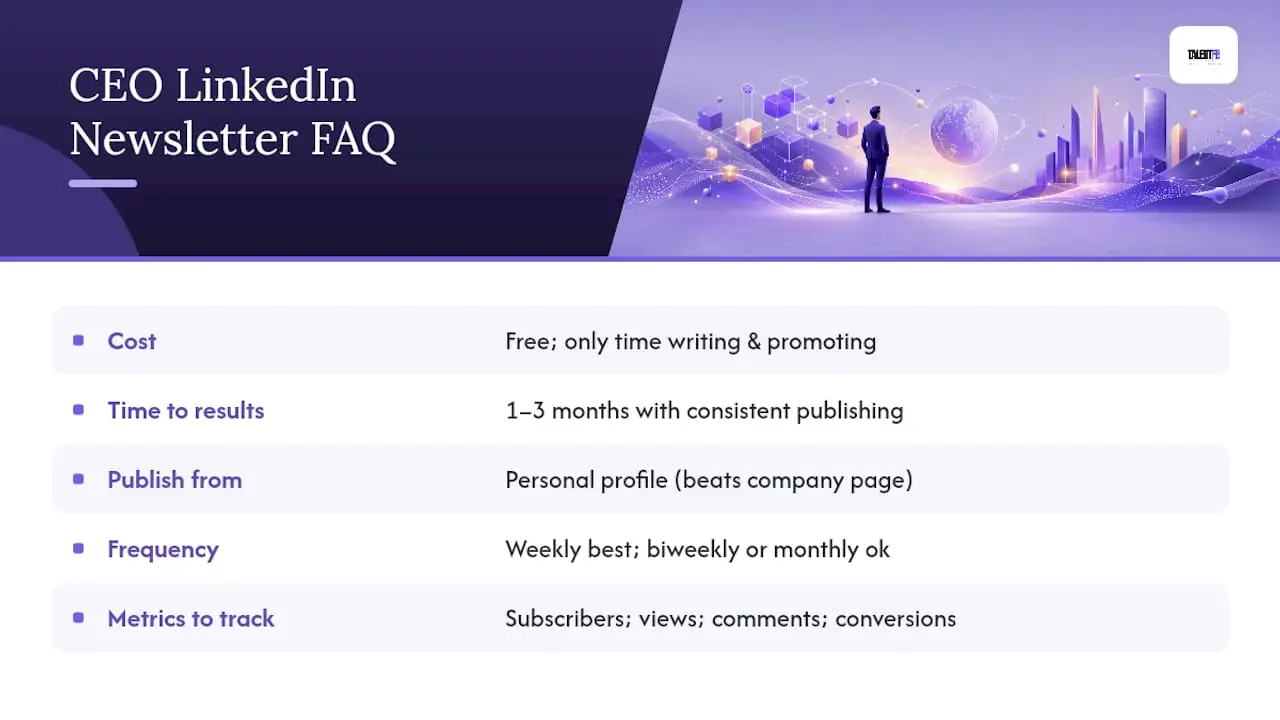
Yes. LinkedIn’s native newsletter tool costs nothing to set up or use. The only investment is your time writing and promoting each issue.
How long does it take to see results from a CEO LinkedIn newsletter?
Most CEOs start seeing meaningful subscriber growth and engagement within one to three months of consistent publishing, especially at a weekly cadence. Early issues often build slowly while the habit loop forms.
Should a CEO publish the newsletter personally or through the company page?
Personal profiles significantly outperform company pages for LinkedIn newsletters, largely because readers trust and engage with individuals more than brand accounts. Publish from your personal profile whenever possible.
What if the “Create newsletter” option isn’t available on my account?
LinkedIn ties access to content history and account standing. Publish original posts consistently for several weeks, confirm admin access if you’re on a company page, and check back periodically, since access tends to unlock without a specific notification.
How often should a CEO publish a LinkedIn newsletter?
Weekly cadence tends to build audience fastest, but only if you can sustain it during your busiest months. Biweekly or monthly are legitimate choices if weekly isn’t realistic for your schedule.
What should a CEO track to know if the newsletter is working?
Follow the full funnel: subscriber growth, views per issue, comments and reactions, and downstream conversions like booked calls or inbound candidate interest. Comments are generally a stronger signal than passive views or reactions.
This article provides general guidance on LinkedIn’s publishing features and executive content strategy. Confirm current platform behavior with LinkedIn Help and align any public commentary with your company’s own communications and disclosure policies.
Sources
- Manage a newsletter on LinkedIn | LinkedIn Help
- LinkedIn Newsletter Guide: Build & Monetize B2B Email List | InfluencersKit
- LinkedIn Newsletter Strategy: 5 Moves That Get Read | IP
- Grow Your Business Fast With A Weekly LinkedIn Newsletter — Forbes