For busy CEOs, six moves separate a network that pays off from one that just sits there: set clear objectives, audit who you already know, lead with value before asking for anything, build a disciplined digital presence, join one curated peer group instead of ten mixers, and put a follow-up system in place so relationships don’t die on your calendar. Skip the rest of the generic advice out there. The highest-ROI actions are simple: audit your top 12 relationships this week, block 30 minutes every Friday for follow-up, and join a single peer group that actually vets its members. Every one of these has a remote-friendly version, which matters because most executive relationship-building now happens over Zoom and LinkedIn DMs before it ever happens in person.
Here’s the full shortlist:
- Set specific networking objectives tied to business outcomes
- Audit and tier your existing contacts by relevance and engagement level
- Lead with value in every outreach: introductions, insight, or time
- Build an executive digital presence that signals substance, not noise
- Choose curated peer groups, boards, or invite-only summits instead of generic mixers
- Install a lightweight follow-up cadence you’ll actually keep
- Track outcomes quarterly, not connection counts
- Prioritize depth (strategic social capital) over sheer network size
Table of Contents
- How Do You Set CEO Networking Objectives and Audit Your Network?
- What Does Value-First Outreach Look Like for CEOs?
- Which Networking Forums Are Worth a CEO’s Limited Time?
- How Should CEOs Maintain Relationships Without Losing Time?
- What KPIs Should CEOs Use to Measure Networking ROI?
- Why Strategic Social Capital Beats a Bigger Rolodex
- What I’ve Learned Watching CEOs Network Well (and Badly)
- Want Help Building the System, Not Just the Habit?
- Frequently Asked Questions About CEO Networking Strategies
- Sources
How Do You Set CEO Networking Objectives and Audit Your Network?
Most executives network the way they exercise: sporadically, with no plan, and with vague hope that something good happens. That’s the opposite of how you’d run any other part of the business, and it’s why so much executive networking produces nothing but LinkedIn notifications.
Start with objectives. Pick two or three, and tie each one to something concrete: you need a board member with fintech regulatory experience, you’re hiring a VP of Engineering in the next two quarters, or you want two new channel partnerships before year-end. Vague goals like “expand my network” produce vague results.
- Write down your top 2 to 3 objectives in one sentence each, naming the outcome you want (a hire, a partner, a board seat).
- List every contact you’ve had a real conversation with in the past 18 months.
- Tier them: A (trusted, high-relevance, reciprocal), B (useful but underdeveloped), C (dormant or low-relevance).
- Mark the gaps: which objective has zero A-tier contacts behind it?
- Build a one-page map of your top 12 relationships, noting what they need from you and what you need from them.
This whole exercise takes about 30 minutes, and it usually reveals something uncomfortable: most CEOs have plenty of B and C contacts and almost no A-tier ties around the objective that matters most right now.
Pro Tip: Do this audit on a Sunday evening with a coffee, not squeezed between meetings. The honest answers about who you actually trust take a few quiet minutes to surface.
What Does Value-First Outreach Look Like for CEOs?
The old model of networking, where you show up, hand out a card, and hope someone remembers you, is dead weight for a CEO’s calendar. What works now is leading with something the other person actually needs before you ask for anything: an introduction, a sharp piece of insight, or simply your time on a problem they’re stuck on. Practitioner research on executive relationship-building consistently points to improving your social presence and adding value first as two of the highest-return tactics available to leaders, ahead of things like conference attendance alone.
Your executive digital presence is the front door to all of this. A few non-negotiables:
- A headline that states your role and the outcome you drive, not a generic title
- An About section written in two or three sentences about who you help and how
- A content rhythm: one short lesson post or timely industry take per week, written in your own voice
- A LinkedIn presence built for actual engagement, not just a static résumé page
Practitioner guides on CEO LinkedIn strategy confirm that disciplined, authentic short-form content, not viral posts or constant self-promotion, is what attracts the right conversations over time.
When you reach out cold, keep it to two lines: name a specific reason you’re reaching out, and offer something concrete. “I read your piece on supply chain resilience. I ran into a similar issue scaling ours in APAC. Open to a 20-minute call?” beats any templated connection request. The goal of every digital exchange is the same: move it to a short, problem-focused call within two or three messages, before the thread goes cold.
Pro Tip: Never ask for “15 minutes to pick your brain.” Ask about one specific problem you’re trying to solve. Specificity is what makes a busy executive say yes.
Which Networking Forums Are Worth a CEO’s Limited Time?
Not all forums deserve equal time. A curated peer group where members work through real operating problems together builds trust faster than a hundred casual mixers ever will, largely because structured, problem-focused sessions force genuine vulnerability instead of small talk.
Rank your options by what they actually deliver:
- Curated peer groups (Vistage-style, industry-specific cohorts): high trust, recurring cadence, best for ongoing strategic advice
- Board service: deep, long-term relationship building plus governance exposure
- Small workshops or masterminds: fast trust formation around a narrow problem
- Invite-only summits: strong for landing one or two A-tier relationships in a short window
- Large industry conferences: useful for market intelligence, weak for relationship depth unless paired with pre-scheduled 1:1s
Before committing to anything, check three things: who else will be in the room, what format they’re using (panel versus working session), and what outcome you’d walk away with if the event delivered on its promise.
Virtual events need their own discipline. Read the attendee list beforehand and message two or three people to set up breakout time. Push for small-group formats over broadcast webinars. And always leave with a one-line follow-up plan for each person you actually connected with, sent within 24 hours. A mixer where you collect ten business cards is a worse investment than one working session where you solve a real problem alongside three peers.

How Should CEOs Maintain Relationships Without Losing Time?
Relationships decay without structure, and most CEOs lose good contacts simply because nobody owns the follow-up. Practitioner guidance on executive relationship management is consistent on this: timely, simple notes and light recurring check-ins outperform elaborate but inconsistent outreach every time.
- Set a follow-up cadence by tier, with more frequent touchpoints for your highest priority contacts.
- Use a lightweight tool, a CRM like HubSpot’s free tier or even a shared spreadsheet works fine, to log the last contact date and the next planned touch.
- Block consistent weekly time on your calendar specifically for follow-up. Treat it like a board meeting, not an optional task.
- Send one-sentence check-ins tied to something specific: an article, a milestone, a mutual contact’s news.
- Delegate the tracking, not the relationship, to an executive assistant. They can flag “you haven’t spoken to this person in 10 weeks,” but you write the note.
Pro Tip: Batch your follow-ups on Friday afternoons. It’s a low-energy slot for most executives, and five short notes take less time than one long meeting.
What KPIs Should CEOs Use to Measure Networking ROI?
Connection count is a vanity metric. It tells you nothing about whether your network is producing decisions, hires, or deals. Track networking outcomes such as introductions that lead to opportunities, strategic partnerships, or insights that influenced decisions, and review them regularly to refine your approach. If that list comes up empty two quarters running, the problem usually isn’t your network, it’s your objectives.
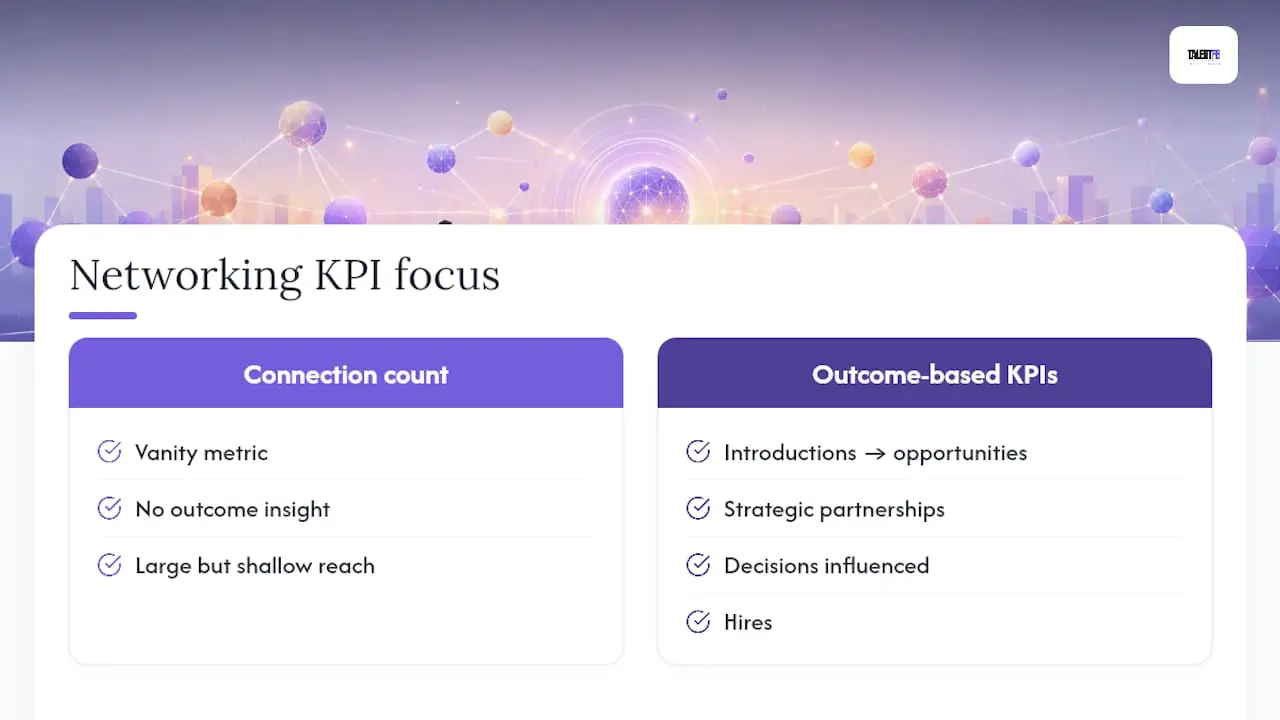
Depth beats reach here. Research on strategic social capital finds that a smaller circle of trusted peers who know your real operating challenges improves decision quality more than a sprawling but shallow contact list ever does.
Why Strategic Social Capital Beats a Bigger Rolodex
Academic work on tie strength gives CEOs a useful mental model: think of relationships on a benefit/cost curve. Strong ties, the people who know your real numbers and your real doubts, cost more time to maintain but pay off in judgment and candor. Weaker, bridging ties cost less but open doors to information and opportunities your inner circle can’t reach. A conceptual framework on tie strength shows the optimal mix depends on context: high uncertainty or heavy resource dependence usually justifies investing more in strong ties, while stable, well-understood markets can lean on a wider set of weaker connections.
Harvard Business Review’s analysis of executive networks makes a related point that’s easy to miss: the most valuable conversations don’t just answer your questions, they reshape the questions you’re asking in the first place.
The CEOs who make the best decisions aren’t the ones with the biggest networks. They’re the ones with three or four people who will tell them the truth before a decision, not after it fails.
A simple exercise to apply this now:
- Pick one A-tier relationship you’ve underinvested in
- Send a specific, honest note asking for their real read on a decision you’re facing
- Notice whether their answer changes your thinking, not just your confidence
That’s the test for whether a tie is strong enough to matter.
Networking tips for founders
Founders face the same networking problem as CEOs with even less time. A few habits make the biggest difference.
- Aim for a steady rhythm, not bursts. Three to five meaningful conversations a week beats a month of silence followed by a conference.
- Give before you ask. An introduction, a customer lead or honest feedback on someone’s product builds more goodwill than any pitch.
- Invest in peer founders. Founders two or three years ahead of you have solved the problems you are about to face, and they know the investors, hires and customers you need.
- Prefer small groups. A dinner for eight produces better relationships than an event for eight hundred.
- Follow up consistently. Keep a simple list of your 50 most important relationships and check in with each one at least once a quarter.
What I’ve Learned Watching CEOs Network Well (and Badly)
The CEOs who build real networks treat it like a monthly discipline, not an occasional event. Once a month, I’d ask: who did I add real value to, and who added value to me? Two habits do most of the work: a 20-minute follow-up right after any meaningful event or call, before the details fade, and one value-first introduction sent every week, no strings attached.

None of this requires charisma. It requires consistency, and a willingness to give before you ask. Try just one of these habits for a month and see what shifts.
Want Help Building the System, Not Just the Habit?
Knowing the strategies is one thing. Actually building a LinkedIn presence and outreach system that runs on its own, week after week, is another, and it’s the exact gap TalentFB’s Talent/OS™ was built to close. Rather than another executive search retainer, Talent/OS™ works directly with CEOs and founders (and up to the full C-suite, five people max) to rebuild their LinkedIn presence and content system so the right talent and partnership conversations start coming to you.
If you recognize yourself in the audit exercise above, plenty of A-tier gaps and a digital presence that isn’t pulling its weight, that’s exactly where this work starts. It covers the same territory this article walked through: positioning, content discipline, and a repeatable outreach rhythm, but built out fully for your specific role and industry instead of left as a to-do list. Take a look at what executive branding actually involves and book a short consult to see whether it fits where you’re headed next.
Frequently Asked Questions About CEO Networking Strategies
What’s the single highest-ROI CEO networking strategy?
Value-first outreach paired with a disciplined follow-up cadence. Most executives lose relationships not from bad first meetings but from letting them go cold afterward.
How much time should a CEO spend networking each week?
Thirty minutes for follow-up and maintenance, plus one or two intentional conversations tied to a specific objective. More time doesn’t help if it isn’t tied to a goal.
Are virtual networking events worth a CEO’s time?
Yes, if you prepare beforehand and push for small breakout formats. A virtual working session with three peers beats a large hybrid conference for relationship depth.
How do CEOs network when time is the biggest obstacle?
Tier your contacts, focus effort only on A-tier relationships and clear objectives, and delegate tracking (not the relationship itself) to an assistant. Depth over breadth solves the time problem better than adding more events.
Should CEOs prioritize peer groups or one-on-one relationships?
Both, for different reasons. Peer groups build trust fast around shared problems; one-on-one strong ties give you the candor and judgment that groups can’t always provide.
Sources
- Beyond Business Cards: Building Executive Relationships in 2026
- How Leaders Create and Use Networks
- The strength of strong ties: social networks and intergroup conflict in organizations