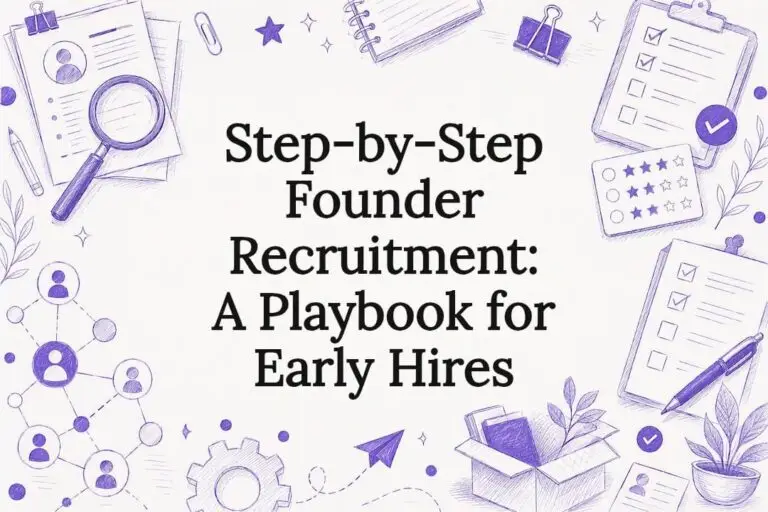
Step by step founder recruitment comes down to ten moves in order: decide it’s time to hire, define must-haves, write a job description and scorecard together, source through multiple channels, run a tight funnel, check references properly, make a fast offer, onboard with a 30/60/90 plan, and measure the whole thing so you get better each time. Skip a step and you’ll feel it later, usually around week three when a hire who looked great on paper stalls out.
Here’s the sequence, laid flat so you can act on it today:
- Decide whether the role is truly urgent (not just uncomfortable)
- Separate must-have skills from nice-to-have potential
- Write a public job description plus an internal scorecard
- Source through your network, LinkedIn, and niche communities, not just job boards
- Run a compressed funnel: screen, interview, exercise, final conversation
- Check references and back-channels before you extend an offer.
- Build a compensation package and close within days, not weeks
- Onboard with a written 30/60/90-day plan
- Track time-to-hire and offer-acceptance rate
- Review what worked after every single hire
One number matters more than any other: did the person you hired meet the scorecard and start contributing inside 90 days? Everything above exists to get you a “yes” on that question.
Table of Contents
- When Should You Hire Your First Employee?
- Must-Haves vs. Nice-to-Haves for Early Hires
- How to Write a Job Description and Scorecard
- Where Should You Source Your First Employees?
- What Does a Fast, Founder-Led Hiring Funnel Look Like?
- How Do You Structure a Competitive Early-Stage Offer?
- How Do You Onboard a New Hire in the First 90 Days?
- Which Hiring Metrics Actually Matter?
- What Does the Research Say About Founder-Led Hiring?
- What I’d Tell Any Founder Before Their First Hire
- How TalentFB Supports Your Founder Recruitment Process
- Useful Resources to Bookmark
- Frequently Asked Questions
- Sources
When Should You Hire Your First Employee?
Hire when a specific job is bottlenecking growth, not when you’re simply tired. That distinction sounds obvious, but it’s the single most common founder mistake: hiring to relieve personal exhaustion instead of solving a measurable business constraint. A real hiring trigger looks like this: you’re turning down qualified sales leads because nobody follows up within 24 hours, or your only engineer hasn’t shipped a feature in three weeks because they’re buried in support tickets.

Before you post anything, write a one-sentence outcome the hire must deliver.
A simple calibration brief template:
- Outcome: What must be true in 90 days that isn’t true now?
- Ownership: What decisions does this person make without asking you?
- Constraints: Budget, headcount, and tools they’ll actually have
- Non-negotiable: The one skill that can’t be trained on the job
Pro Tip: Wait until the pain is specific enough to write that one-sentence outcome. If you can’t write it in under 15 words, you’re not ready to hire, you’re ready to delegate a task.
Must-Haves vs. Nice-to-Haves for Early Hires
Every early role has maybe three things a candidate must already do on day one, and everything else is a growth signal you can develop. Confusing the two is how founders end up interviewing 40 people for a role that needed four.
Split your list this way:
- Must-have (day-one capable): Can this person do the core task without training? For an engineer, that might mean shipping production code in your primary language within a week. For a growth hire, it means they’ve run paid acquisition campaigns with a budget, not just “studied marketing.”
- Nice-to-have (grows into it): Leadership potential, adjacent skills, industry familiarity. Valuable, but not worth rejecting an otherwise strong candidate over.
- Minimum seniority rule: For your first five hires, favor people who’ve done the job before at a company one stage ahead of yours. Untested potential is a luxury you can’t afford yet.
Keep this list to no more than five items total. If your must-have list runs past that, you’re probably describing two jobs.
How to Write a Job Description and Scorecard
Your public job description and your internal scorecard are two different documents doing two different jobs, and most founders only write the first one.
The job description should be short: a one-line hook, a one-sentence mission tied to your calibration brief, three to five must-do outcomes for the first quarter, an honest compensation range, and your remote or location policy stated plainly. Candidates skim. Give them the real information fast.
The scorecard is internal and it’s what keeps you honest across candidates. Build it from four to six competencies, each tied directly to a 30/60/90-day output, each scored on the same scale for every person you interview. Structured interviews and scorecards consistently beat gut-feel hiring, mainly because they force you to define what “good” means before you’re charmed by someone in the room.
A workable scorecard structure:
- Core competency (e.g., “ships working code independently”) — rate 1 to 4
- Communication (writes clearly, flags problems early) — rate 1 to 4
- Ownership signal (took a project from zero to done previously) — rate 1 to 4
- Culture add (brings something you don’t already have) — rate 1 to 4
- Pass threshold: define in advance what score triggers an offer
Pair the scorecard with one short, relevant, time-boxed exercise, something that mirrors real work and takes under two hours. Building a two-stage process with a qualifying screen and a deep-dive exercise is enough rigor for almost any early-stage role. Skip elaborate take-home projects that eat a weekend; they filter out busy senior people more than they filter out weak ones.
Where Should You Source Your First Employees?
Relying on one job board is the single biggest reason early hiring stalls. The strongest early hires almost always come through a channel with some personal signal attached, not a cold application.
Build a short list and work all of it simultaneously:
- Your direct network: Reach out personally to 10 to 15 people who fit the must-have list, even if they’re not actively looking.
- LinkedIn, paid and free: A paid LinkedIn post on a small company page can reach roughly 5,000 views versus about 50 for a free post, a gap large enough to justify the spend for a critical role. Explore LinkedIn coaching tools if your own profile isn’t pulling weight yet.
- Niche communities: Slack groups, Discord servers, and subreddits built around your exact stack or industry outperform generalist boards for fit.
- Silver medalists: Re-engaging strong finalists from past searches is often faster than starting cold, since they’ve already cleared your bar once.
- Referral asks with specificity: Don’t say “know anyone good?” Say exactly which skill and context you need, that specificity is what gets a real name back.
- General boards, cautiously: Sites like Craigslist still generate volume, but rarely the fit an early, high-signal role needs.
Track response rate by channel from week one; it tells you where to spend your next hour, not just your next dollar. For a deeper breakdown of channels, TalentFB’s guide on proactive sourcing is worth bookmarking.
What Does a Fast, Founder-Led Hiring Funnel Look Like?
Speed and rigor aren’t opposites in early hiring, they’re the same discipline. The best hiring processes front-load difficulty so that by the final interview, you’re already about 80% confident you’ll make an offer. If you’re rejecting people at the final stage repeatedly, your early screening is too soft, not your candidates too weak.
A compact funnel that works for almost any early role:
- Application or inbound message (day 1)
- Triage against your must-have list, same day
- 15-minute phone screen, focused only on the non-negotiables
- 60 to 90 minute deep interview plus a live exercise, scored against your scorecard
- Final founder conversation, culture and mutual fit only
- Offer, extended within 24 hours of the final call
A five-day sprint, post on Monday, triage Tuesday, screen Wednesday, deep interview Thursday, offer Friday, is aggressive but genuinely achievable for a single role once you’ve got a candidate slate ready.
Interview rubric guidance that keeps things honest:
- Score immediately after each interview, before comparing notes with anyone else
- Anchor every score to a specific example the candidate gave, not a general impression
- Treat a “maybe” as a “no.” Ambivalence at this stage rarely resolves later.
How Do You Structure a Competitive Early-Stage Offer?
Move fast here. A strong candidate who’s still deciding three days after your final interview is usually deciding between you and something else.
Your offer checklist:
- Base salary, benchmarked against real market data for your city and stage, not what you wish you could pay
- Equity specifics: percentage or share count, vesting schedule, strike price if applicable
- Benefits, stated plainly even if modest
- Start date and any contingencies (background check, reference sign-off)
- Acceptance deadline, typically 3 to 5 business days
When cash can’t fully match market rate, equity is the honest bridge, but be specific about it. Vague equity promises (“you’ll get a good chunk”) kill trust faster than a lower cash number ever will. If a candidate starts asking about your runway or team turnover during negotiation, that’s usually a sign they’re weighing risk more than money, address it directly rather than sweetening the offer blindly.
How Do You Onboard a New Hire in the First 90 Days?

The scorecard that got someone hired should be the same document that guides their first quarter. If it isn’t, you’ve wasted the work you put into writing it.
Build a 30/60/90 plan before day one:
- Day 30: Understands the product, has shipped or delivered one small, real piece of work
- Day 60: Owns a defined slice of the outcome from the calibration brief independently
- Day 90: Meeting the original one-sentence outcome you wrote when you decided to hire
Preboarding matters more than founders expect: have accounts, tools, and a first-week schedule ready before the start date, and introduce them to your network ahead of time. A quick check-in at the end of week one and again at day 30 catches drift early, before it becomes a resignation.
Which Hiring Metrics Actually Matter?
You don’t need a dashboard. You need four numbers and the discipline to look at them after every hire.
- Time-to-hire: Once this drags past 30 days, the problem is almost always process friction, not a thin candidate pool.
- Offer-acceptance rate: A low rate points to a compensation or speed problem, not a sourcing problem.
- Quality signal: Did the hire meet the 30/60/90 plan? This is your real scorecard for the scorecard.
- Channel ROI: Which source produced your best hires, not just your most applicants?
After each hire, spend 20 minutes asking what you’d change in the calibration brief next time. That habit compounds faster than any tool you could buy.
What Does the Research Say About Founder-Led Hiring?
The evidence lines up cleanly behind what practiced founders already sense: hiring is a discipline, not a scramble. Multi-channel sourcing and direct outreach consistently outperform relying on a single job post, and the paid-versus-free LinkedIn reach gap (roughly 5,000 views versus 50) explains why a small spend on visibility often beats hours spent refreshing a job board.
The “fast and hard” principle deserves more attention than it gets. Structured, well-sequenced recruitment, covering planning, sourcing, selection, offer, and onboarding as distinct phases, reduces hiring risk measurably compared to an improvised process that treats each hire as a one-off event.
Put concretely: a founder who messages 12 specific people this week, referencing exact skills and exact context for the role, will typically get a handful of real conversations. A generic job post might generate more volume but far less signal. Both citing hiring authorities and simple habit changes point the same direction: know exactly who you’re looking for before you go looking.
How to scale hiring without losing quality
The playbook above works for your first ten hires. Somewhere between 10 and 50 people, founders hit a wall: they cannot personally interview everyone, and quality starts to slip. Scalable hiring means keeping the standard while you step back from the day to day.
- Write the standard down. Turn what you look for into scorecards and interview guides so other people can apply it.
- Use structured interviews. The same core questions for every candidate, scored against the scorecard, make decisions fairer and faster.
- Train your interviewers. An hour of calibration saves weeks of bad hires.
- Automate the admin, not the judgement. Scheduling, reminders and status updates can be automated. Assessment and closing should stay human.
- Stay on the senior hires. Delegate the rest, but keep final say on leadership roles.
Candidate experience: the part founders forget
Every candidate you interview talks to other people in your market. A slow, disorganised or silent process costs you more than one hire. It costs you referrals. Reply to every applicant, give real feedback after interviews, keep processes short, and make sure the founder meets finalists for senior roles. Small companies can offer a better candidate experience than large ones because they can be personal. Use that advantage.
What I’d Tell Any Founder Before Their First Hire
Spend your own time on the calibration brief, the scorecard, and the final interview. Delegate the scheduling and initial resume triage the moment you can afford to, that part doesn’t need founder judgment, the rest does.
The mistakes I see most often: hiring for “potential” before you have product-market fit (you need doers, not projects), running six-round interview loops that exhaust good candidates, and skipping the scorecard because “you’ll just know it when you see it.” You won’t, not reliably, and the data on structured hiring backs that up.
Keep hiring yourself until you’ve made roughly 20 to 30 hires. At that point you’ll have a real system, and a recruiter can inherit a process instead of chaos.
How TalentFB Supports Your Founder Recruitment Process
Everything in this playbook depends on candidates finding you credible before you ever send an outreach message, and that’s usually where founders leave the most value on the table. If your LinkedIn profile still reads like a resume instead of a magnet for the exact people you need to hire, your outreach response rate will suffer no matter how good your scorecard is.
TalentFB’s Talent/OS™ helps CEOs and founders rebuild their LinkedIn presence and content system specifically to attract talent organically, the same 5,000-view paid reach problem mentioned earlier becomes far less relevant when candidates are already finding you. It’s built for founders through full C-suite teams, and it maps directly onto the sourcing and offer-conversion steps in this guide: sharper positioning, warmer inbound interest, and faster acceptance once you extend an offer. If you’re a senior tech professional on the other side of the table, JobSearch/OS™ applies the same rigor to landing your next role. Either way, the next step is simple: book a quick consult through the Job Search OS Masterclass and see which parts of your hiring or job search process need the most work first.
Useful Resources to Bookmark
A few sources worth saving as you build out your own process:
- SHRM’s step-by-step recruitment guide: phase-by-phase structure, good for planning
- a16z’s founding team hiring guide: sourcing math and interview philosophy
- Penroll’s five-day hiring sprint: copyable day-by-day template
- Dover’s recruitment process guide: metrics and KPI framing
- HireFormly’s startup hiring guide: two-stage funnel and role-outcome templates
- TalentFB’s hiring strategy guide: aligning hires to business priorities
Frequently Asked Questions
What is the first step in founder recruitment?
Decide whether you actually have a hiring trigger, a measurable bottleneck, not just personal fatigue, then write a one-sentence outcome the hire must deliver within 90 days.
How long should early-stage hiring take?
A well-run process can move from job post to offer in under a week. If it’s dragging past 30 days, the issue is almost always process friction rather than a lack of candidates.
Should founders use a recruiter for their first hires?
Most founders should run hiring themselves for the first 20 to 30 hires so they build a repeatable system and only later consider passing the process to a recruiter.
What’s the biggest mistake early founders make when hiring?
Skipping the scorecard and relying on gut feel. Structured evaluation criteria, defined before you source candidates, consistently outperform impression-based hiring.
How do I know if a candidate is a strong culture fit?
Ask about how they’ve handled ambiguity and conflicting priorities in past roles, then check whether their answers match how references describe their actual behavior on the job.
Sources
Most founders treat references as a formality. Used properly, they’re a management tool that hands you a playbook for someone’s first 90 days before they’ve even started.
Ask specific, behavior-based questions:
- How to hire a strong founding team (a16z)
- A step-by-step guide to the recruitment process (SHRM Advisor)
- The first-time founder’s hiring guide: from job post to offer in under a week (Penroll)
- The Complete Recruitment Process Guide: 7 Steps to Hire Top Talent (Dover)
- Startup Hiring Guide: First hire to scaling (HireFormly)
For back-channel checks, use your own network to reach someone who worked alongside the candidate but wasn’t listed as a reference; a quiet LinkedIn message asking for five minutes usually works and rarely burns a bridge. Use the answers to shape how you’ll manage this person, not just whether you’ll hire them. A reference who dodges specifics about performance, only ever, is the clearest red flag you’ll get in this whole process.