
If a startup hands you an offer letter with a stock option number on it, ignore the number for a second. What matters is the percentage of the fully diluted company that number represents, and whether you can negotiate a longer post-termination exercise window and acceleration protection before you sign anything. Those two moves protect more real value than almost anything else you’ll ask for.
Before you respond to any offer, get the company to answer five questions in writing: the fully diluted share count, the current 409A valuation and strike price, the vesting schedule, the post-termination exercise window, and whether acceleration applies if you’re let go after an acquisition. A raw option grant, say “40,000 shares,” tells you nothing on its own. It could be 2% of the company or 0.02%, depending entirely on the denominator nobody mentioned.
- Fully diluted share count (the denominator that turns your grant into a real percentage)
- Current 409A valuation and strike price
- Vesting schedule and cliff length
- Post-termination exercise window
- Acceleration terms (single trigger vs. double trigger)
Pro Tip: Seed-stage option pools typically run 10 to 15% of fully diluted shares. If a recruiter can’t tell you where your grant sits within that pool, that’s your first answer about how organized this company really is.
Table of Contents
- How to Negotiate Equity Percentage and Value Your Grant
- What Scripts Actually Work When You Ask for More Equity
- Which Equity Terms Are Actually Negotiable
- Five Questions to Ask Before You Sign an Equity Offer
- What 15 Years in the Hiring Room Taught Me About Equity Asks
- What a 409A Valuation Actually Tells You
- Why the Vesting Schedule and Cliff Matter More Than You Think
- What Equity Negotiation Actually Rewards
- Get Real Negotiation Practice Before You Sign Anything
- Sources
How to Negotiate Equity Percentage and Value Your Grant
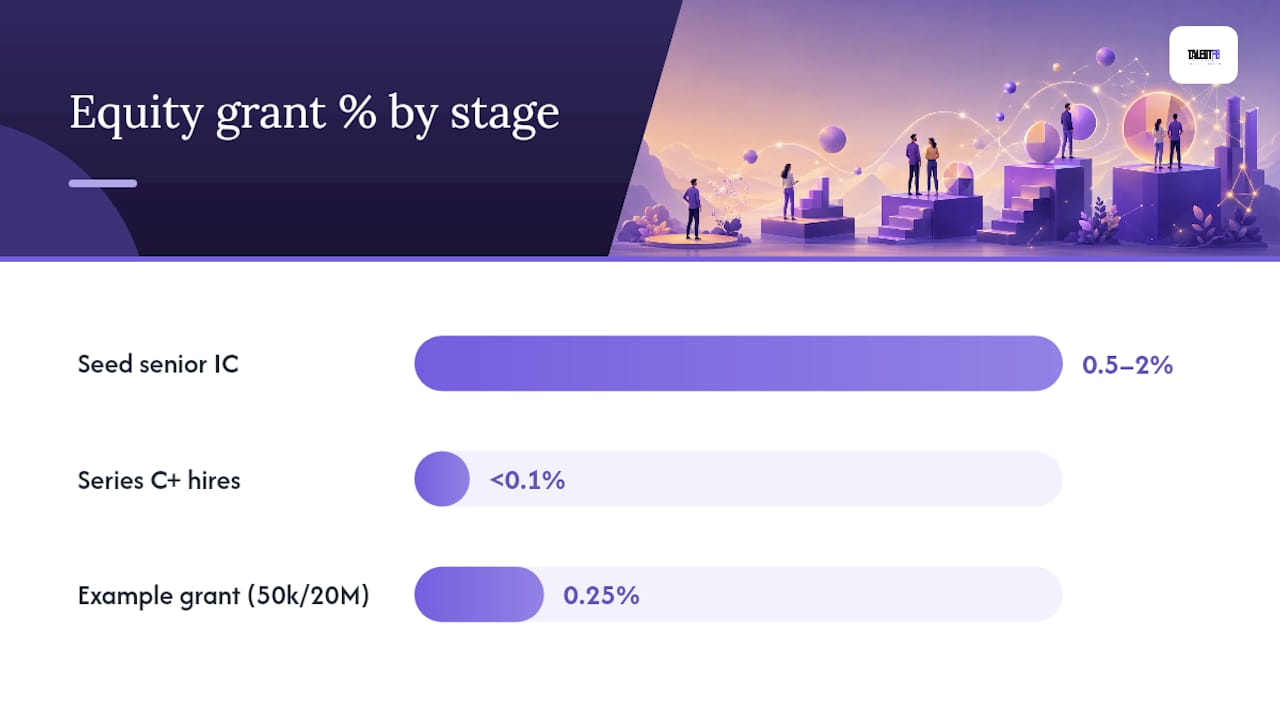
Every equity conversation should start with one calculation: your shares divided by the fully diluted share count, not the “shares outstanding” figure some companies quote to make an offer look bigger than it is. Fully diluted includes every issued share, every outstanding option, and the entire unallocated option pool. If a company gives you 50,000 options and the fully diluted count is 20 million shares, you own 0.25%. Full stop.
- Get the fully diluted share count. Ask directly. If HR hedges, ask again in the same email thread so there’s a record of the request.
- Divide your grant by that number. This is your ownership percentage, and it’s the only number worth comparing across offers.
- Find your strike price and current 409A valuation. Your paper value per share is the 409A price minus your strike price. If the strike price equals the 409A price, your options are worth nothing today, which is normal and expected at grant time.
- Model two exit scenarios. ValueAddVC recommends running both a 5x and a 10x scenario off the current valuation, then applying a stage-based discount, since most startups never reach a meaningful exit at all.
- Subtract dilution and liquidation preferences. Every future funding round dilutes your percentage unless you get refresh grants, and preferred investors typically get paid out before common shareholders in an acquisition.
Here’s a simple worked example. Say the company’s current valuation implies a $2 strike price, and the 409A puts fair market value at $2 per share too (typical at grant time for an early hire). If the company later raises at a valuation that pushes the common share price to $10, your paper gain is $8 per share before taxes and before any liquidation preference eats into it. Now run the same math at $20 a share (the 10x case) and you can see the real spread of outcomes instead of anchoring on one rosy number a founder mentioned in a pitch meeting.
Benchmarks vary by stage and role. A senior individual contributor joining a company at seed tends to land between 0.5% and 2%, while later-stage hires (Series C and beyond) often see grants well under 0.1% because the company has already priced in years of growth. Don’t compare your Series B offer to a friend’s seed-stage grant. They’re not the same asset.

Liquidation preferences complicate this further. If investors hold a 1x preference, they get their invested capital back before common shareholders see a dollar, which can significantly shrink your actual take-home even in a decent exit. Ask what preference stack exists before you get attached to a headline valuation number.
What Scripts Actually Work When You Ask for More Equity
Timing matters more than most candidates realize. Open the equity conversation only after you have a written offer in hand, never during the interview loop when the company hasn’t committed to anything yet. Once you have a number on paper, you have something concrete to push against, and the company has already decided it wants you.
Here’s language that works when you’re asking for a larger grant:
“Thanks for the offer. Based on my research into equity benchmarks for this stage and role, I was expecting a grant closer to [X]%. Given [specific contribution, e.g., leading the platform migration, owning the go-to-market for this segment], can we revisit the equity component?”
Naming a specific percentage, backed by a stage benchmark, signals you’ve done homework rather than just fishing for more. Vague requests (“can you do better on equity?”) get vague answers. Specific ones get real conversations.
If you’d rather trade cash for ownership, this script tends to land well with founders watching burn rate closely:
“I’m flexible on base salary if it means a meaningfully larger equity grant. Would you be open to modeling a version of this offer with $[X] less in salary and a larger option grant, calculated against the current 409A?”
Countered notes that senior hires who can show the conversion math using the company’s own 409A valuation tend to get further with this ask than those who just state a preference. It reads as collaborative, not transactional, and founders respond better to that framing than to a demand.
For the exercise window specifically, keep it simple:
“I’d like to request a longer post-termination exercise window, ideally 5 to 10 years, so I’m not forced into a cash crunch if I leave or the company parts ways with me.”
Competing offers are legitimate leverage, but use them carefully. Mentioning a real competing offer (“I have another offer with a higher equity component, and I’d love to make this work if there’s flexibility”) is fair. Bluffing about an offer that doesn’t exist is not, and founders in tight networks talk to each other more than candidates expect.
- Anchor your ask to a specific percentage benchmark for your stage and role, not a vague “more.”
- Bring up equity only after receiving a written offer, so you’re negotiating from a position the company already committed to.
- Frame trades (salary for equity) as flexibility, not desperation.
- Use real competing offers as leverage; never invent one.
Pro Tip: The post-termination exercise window is often the easiest ask on the table. It costs the company almost nothing to extend, yet it protects you from losing vested shares if you can’t afford to exercise within 90 days of leaving. Founders concede this one more often than any other request, because it doesn’t touch their cap table today.
Which Equity Terms Are Actually Negotiable
Not every line in an offer letter is up for discussion, and knowing which battles to skip saves your credibility for the ones that matter.
Almost always negotiable:
- Grant size (the percentage, not just the raw share count)
- Post-termination exercise window
- Accelerated vesting on acquisition (single or double trigger)
- Early exercise rights
- Timing and size of future refresh grants
Rarely negotiable:
- Strike price (set by the 409A valuation, not by preference)
- Existing liquidation preferences already baked into the cap table
- Standard vesting structure itself, though cliff length sometimes flexes for senior hires
Countered’s breakdown of negotiable versus fixed terms lines up with what actually happens in offer negotiations: founders can move numbers that affect the future, but they generally won’t touch structural terms already locked in with existing investors.
A good compromise, when a company won’t budge on grant size, is to ask for the same grant paired with an extended exercise window or an earlier refresh grant review (say, at 18 months instead of the standard annual cycle). That combination often gets a yes faster than pushing hard on the percentage alone.

One tax note worth flagging early: incentive stock options (ISOs) and non-qualified stock options (NSOs) are taxed differently, and extending your exercise window past 90 days can convert your ISOs into NSOs, changing how and when you owe tax. Early exercise combined with a timely 83(b) election can also be valuable when your strike price is low, but this decision has real tax consequences. Talk to a tax advisor before you elect early exercise or negotiate an extended window; this isn’t a place to guess.
Five Questions to Ask Before You Sign an Equity Offer
Due diligence on an equity offer isn’t adversarial. It’s basic homework, and a company that treats it as an attack usually has something to hide.
- What is the fully diluted share count, including the unallocated option pool? This is the denominator you need for every calculation that follows.
- What’s the current 409A valuation and my strike price? A 409A older than 12 months is a red flag; valuations move fast between funding rounds.
- What’s the exact vesting schedule and cliff? Confirm it in writing, not just verbally in the offer call.
- What’s the post-termination exercise window? Ninety days is standard but increasingly negotiable for senior hires.
- Does acceleration apply, and is it single trigger or double trigger? Single trigger vests you immediately on acquisition; double trigger requires both an acquisition and a termination.
Watch for these red flags: refusal to disclose the fully diluted share count, a 409A valuation that’s clearly stale, a punitive 90-day exercise window with no willingness to discuss extending it, and vague or evasive answers about liquidation preference stacking. How a company handles this conversation tends to preview how it treats employees later, so pay attention to tone as much as substance.
If the company won’t move on your core asks, you have options short of walking away: request a signing bonus to offset the gap, ask for a written commitment to revisit equity at the next funding round, or request escrow language protecting your vested shares. If none of that lands and the disclosure stays foggy, walking is often the right call. A company that can’t answer five basic questions about its own cap table isn’t ready to negotiate fairly with anyone.
What 15 Years in the Hiring Room Taught Me About Equity Asks
Founders concede the exercise window and acceleration far more often than they concede raw percentage, because those terms do not immediately impact current ownership and represent a bet against a future that hasn’t happened yet. Percentage points feel like taking something away from existing investors and the founders’ own stake, so that’s the harder conversation.
The candidates who get the best outcomes never frame requests as entitlement. They frame them as alignment: “I want my incentives to match the outcome I’m being asked to help create.” That reframing changes the entire tone of the conversation from a tug of war to a shared calculation.
Coaching changes outcomes here more than people expect, not because it teaches charm, but because rehearsed numbers beat improvised ones every time. Candidates who walk in with a modeled percentage, a specific ask, and a script they’ve said out loud before consistently land better terms than those winging it in the moment.
— Frederic Bonifassy
What a 409A Valuation Actually Tells You
Every private company that grants stock options needs an independent 409A valuation, a formal appraisal of what a single common share is worth right now, separate from whatever number gets thrown around in press releases about the company’s total valuation. That 409A number sets your strike price, the amount you’ll pay per share when you exercise your options.
Here’s the part candidates miss: the 409A valuation and the “headline” valuation from the last funding round are not the same thing, and they’re rarely close. A press release might say the company raised at a $200 million valuation. That figure applies to preferred shares held by investors, who carry protections like liquidation preferences that common shareholders (that’s you) don’t get. The 409A, by contrast, values common stock specifically, and it’s almost always lower, sometimes dramatically so.
This matters because your paper value calculation, 409A price minus strike price, only works if the 409A is current. Valuations shift fast, especially after a funding round, a strong revenue quarter, or a public market correction affecting comparable companies. A 409A more than a year old should raise questions. Ask when it was last updated and whether a new round is expected to trigger a fresh one soon, since that will change your strike price on any future grants.
Why the Vesting Schedule and Cliff Matter More Than You Think
The most common vesting structure in venture-backed startups is four years with a one-year cliff, meaning you vest nothing during your first 12 months, then a quarter of your total grant vests all at once at the one-year mark, followed by monthly or quarterly vesting for the remaining three years.
The cliff exists to protect the company from granting equity to someone who leaves after a few months, and it’s rarely negotiable for that reason. What is sometimes negotiable, particularly for senior hires with leverage, is the shape of vesting after the cliff (monthly instead of quarterly, for smoother liquidity) or acceleration provisions that trigger extra vesting on specific events like an acquisition.
Double-trigger acceleration, which requires both an acquisition and a subsequent termination to vest extra shares, is the version investors usually accept without much friction. Single-trigger acceleration, which vests everything the moment the company gets acquired regardless of what happens to your job, is a much harder ask, since it can complicate a deal for the acquiring company and make investors nervous about the incentive structure post-close. If you’re negotiating from a senior or specialized role, asking for double-trigger acceleration is a reasonable, often-granted request. Asking for single-trigger is a much bigger swing, and you should expect more resistance.
What Equity Negotiation Actually Rewards
Most advice on this topic treats equity negotiation like salary negotiation with extra steps, and that’s the wrong model entirely. Salary is a known number today. Equity is a probability distribution multiplied by a percentage you often can’t verify without asking five specific questions most candidates never ask.
The conventional wisdom, “just push for more shares,” misses where the real value sits. A bigger raw grant on a stale 409A with a punitive exercise window is worth less than a smaller grant with a clean cap table, a current valuation, and a 5 to 10 year window to exercise if you leave. Sequence matters too: negotiate after the written offer, not during interviews, when you actually have something concrete to work against.
If you take one thing from this: the percentage conversation and the exercise window conversation are both worth having, but they’re not equally hard for the company to say yes to. Start with the ask that costs them nothing.
Get Real Negotiation Practice Before You Sign Anything
Reading scripts on a page is different from saying them out loud to someone who’s sat on the other side of the table for fifteen years across tech, fintech, and gaming hiring rooms. TalentFB’s coaching exists specifically for senior professionals who want to walk into an equity conversation with modeled numbers and a rehearsed script instead of guesswork.

Working through your offer with a coach who’s evaluated hundreds of these packages from the hiring side gives you:
- A clear valuation model built around your specific offer, stage, and role
- A rehearsed, personalized script for the exact ask you’re planning to make
- Feedback on framing before you’re in the room, not after
- A second opinion on whether the offer’s red flags are dealbreakers or negotiable friction
If you’re weighing an equity-heavy offer right now, or trying to figure out whether to push back on a grant before you sign, TalentFB’s career coaching guide for tech executives is the place to start. Book a look at what a modeled negotiation plan actually looks like before your next offer call.
Sources
- CRV — Stock options for employees
- ValueAddVC — How to Negotiate Equity at a Startup
- Countered Blog — Startup Equity Negotiation