
TL;DR:
- Most senior tech professionals need a deliberate strategy to access hidden executive opportunities.
- Building external networks and proactively engaging with recruiters are crucial for career advancement.
- Choosing between technical, management, or hybrid paths depends on personal strengths, motivation, and company structure.
Most senior tech professionals assume that doing excellent work will naturally open doors to the next leadership role. It rarely works that way. 57% of technology CxO appointments are external hires, and the vast majority of executive roles are never posted on public job boards. That means your next career move is almost certainly invisible to you right now unless you build a deliberate, structured strategy to surface it. This guide gives you a step-by-step career development checklist designed specifically for senior tech professionals who want to advance with intention, speed, and confidence.
Table of Contents
- Start with self-assessment: where are you now?
- Build your targeted development checklist
- Master executive job search tactics
- Choose and calibrate your path: IC vs management vs hybrid
- Why the real career unlock isn’t on any checklist
- Accelerate your executive journey with expert tools
- Frequently asked questions
Key Takeaways
| Point | Details |
|---|---|
| Benchmark before action | Understand how your experience and age compare to tech leadership norms before planning your next move. |
| Prioritize visibility | Invest in your professional network and LinkedIn presence to access the hidden job market. |
| Choose your ladder intentionally | Decide between IC, management, or hybrid paths based on your true motivations and market realities. |
| Leverage AI and recruiters | Align your resume and outreach with both AI/ATS and executive recruiters for maximum exposure. |
Start with self-assessment: where are you now?
Once you recognize the reality of the executive search market, the logical first step is a thorough self-assessment. You cannot plot a course without knowing your precise starting point, and in executive career development, vague self-awareness is a liability.
Begin by benchmarking yourself honestly. Tech CxOs average 51 years old and 57% are external hires, which means internal visibility alone will not carry you to the top. You need to understand how the market perceives you, not just how your current employer does.
Here are the core areas to evaluate:
- Current role and scope: Are you leading cross-functional initiatives, or are you primarily executing within a defined lane?
- Technical depth vs. leadership breadth: Where do you sit on the spectrum between deep individual contributor expertise and broad organizational influence?
- External visibility: How recognizable is your professional brand beyond your current company?
- Career trajectory alignment: Are you on the individual contributor (IC) ladder, the engineering management (EM) ladder, or somewhere in between?
- Skill gaps: Which competencies, such as AI fluency, enterprise architecture, or P&L ownership, are missing from your profile?
Understanding the IC versus EM distinction is particularly important. The IC path rewards deep technical mastery and thought leadership. The EM path rewards people development, organizational design, and strategic execution. Neither is superior, but defaulting to management because it feels like the obvious next step is a mistake many senior professionals make.
Pro Tip: Use the executive visibility scorecard to get a structured, objective read on how your current profile measures up against executive benchmarks. It takes less than ten minutes and surfaces gaps you may not have considered.
Once you have a clear picture of where you stand, you are ready to build your targeted development plan.
Build your targeted development checklist
With a clear self-assessment, you can now design a checklist of developmental priorities that accelerates your executive profile. Think of this as your personal operating system for career advancement, not a generic to-do list.
Here is a prioritized sequence to follow:
- Deepen AI and emerging tech fluency. AI literacy is now a baseline expectation for senior tech leaders. If you cannot speak credibly about AI strategy, you will be filtered out early in executive searches.
- Build cross-functional influence. Executives are evaluated on their ability to lead beyond their function. Seek out projects that require collaboration with finance, product, legal, or operations.
- Optimize your LinkedIn profile for recruiter discovery. 90% of recruiters use LinkedIn as their primary sourcing tool. Your profile is your most important career asset outside your resume. Treat it accordingly with LinkedIn career branding strategies that position you as a thought leader, not just a job seeker.
- Drive or sponsor a transformation initiative. Midlevel leaders drive 96% of organizational transformations, and executive hiring committees look for this pattern specifically. Even if you are not the executive sponsor, being visibly associated with a major change program signals readiness.
- Expand your peer network intentionally. Warm introductions are the currency of executive hiring. Prioritize relationships with people one or two levels above your target role, not just your current peer group.
- Engage with an executive career coach. Structured executive career coaching accelerates your timeline significantly because it helps you avoid the costly trial-and-error that most senior professionals go through alone.
Pro Tip: Access career search resources to find templates, frameworks, and guides specifically built for senior tech professionals navigating complex career transitions.
The goal of this checklist is not to complete every item simultaneously. It is to sequence your efforts so that each action compounds the one before it.

Master executive job search tactics
Once your development checklist is underway, shift focus to the nuanced, often opaque world of senior job search. This is where most experienced professionals lose significant ground, because they apply mid-level job search tactics to an executive market that operates by entirely different rules.
The single most important fact to internalize: 80% of executive positions are filled through the hidden job market. They are never posted. They are filled through referrals, recruiter relationships, and targeted outreach before a formal search even begins.
“The executives who land the best roles are not the ones who apply the most. They are the ones who are already in conversation before the role is defined.”
Here is how to position yourself inside that hidden market:
- Build relationships with retained search firms. Firms like Korn Ferry, Heidrick and Struggles, and Spencer Stuart manage the majority of C-suite and VP-level searches. Introduce yourself before you need them, not after.
- Tailor your resume and LinkedIn profile for AI and ATS screening. Every application passes through some form of automated screening. Use the AI job search guide to align your language with what these systems prioritize.
- Engage visibly on LinkedIn. Comment on industry conversations, share original insights, and engage with content from leaders in your target companies. Passive profiles get passive results.
- Use a reverse job search approach. Instead of responding to postings, identify your target companies and roles first, then work backward to find the right people to connect with. The reverse job search system explains this methodology in detail.
- Prioritize strategic pivots over volume. Applying to every relevant posting is a mid-level strategy. At the executive level, five highly targeted approaches outperform fifty generic applications every time.
The shift in mindset here is significant. You are not a candidate waiting to be selected. You are a leader who is evaluating opportunities, and your outreach should reflect that confidence.
Choose and calibrate your path: IC vs management vs hybrid
To avoid stagnation, the final step is selecting the optimal path for your experience, motivations, and opportunities. This decision shapes everything from your compensation ceiling to your day-to-day satisfaction, so it deserves serious analysis rather than a default choice.
Here is a comparison of the three primary paths:
| Path | Typical compensation | Best for | Key risk |
|---|---|---|---|
| Individual contributor (IC) | $400K to $600K+ total comp at Staff/Principal level | Deep technical experts, thought leaders | Limited at firms without strong IC ladders |
| Engineering manager (EM) | Comparable to senior IC at most top firms | People developers, org builders | Burnout if people leadership is not a genuine strength |
| Hybrid or dual ladder | Varies; increasingly common at top tech firms | Leaders who want both technical and organizational influence | Role ambiguity if not clearly defined |
Staff Engineers earn $400K to $600K in total compensation at leading tech firms, rivaling engineering managers at equivalent levels. This is a relatively recent shift, and it matters because it removes the financial pressure to move into management if that is not where your strengths lie.
However, there is a real constraint: 30% of firms do not offer IC tracks beyond the senior level. If you are committed to the IC path, you may need to be selective about which companies you target.
Key questions to guide your decision:
- Do you find genuine energy in coaching and developing others, or does it feel like overhead?
- Is your strongest value in technical depth, organizational influence, or both?
- Does your target company have a mature dual-ladder structure?
The executive masterclass walks through this decision framework in detail, with real examples from senior tech professionals who have navigated each path successfully.
Why the real career unlock isn’t on any checklist
Here is the perspective that most career guides will not give you: checklists are necessary, but they are not sufficient. They systematize what is visible and measurable. What actually moves senior careers forward is harder to codify.
The executives who make the most significant leaps are not the ones who completed every item on their development list. They are the ones who embraced genuinely uncomfortable pivots, took roles that felt like lateral moves, or stepped into environments where they were not the smartest person in the room. That discomfort is the mechanism of growth, not a sign that something has gone wrong.
External hires bring fresh perspectives that internal candidates often cannot replicate, which is precisely why 57% of CxO appointments come from outside. The implication is clear: exposure to new environments, new business models, and new leadership cultures is a career accelerant that no internal promotion can fully substitute.
Most senior professionals also underestimate the compounding value of their external network. Not the network they have built inside their current company, but the one they have invested in across industries, functions, and geographies. That external network is where the nonlinear, exponential career moves originate. Explore the executive outplacement perspective for a deeper look at how senior leaders have used strategic transitions to reset and accelerate their trajectories.
The checklist gets you organized. The mindset gets you to the next level.
Accelerate your executive journey with expert tools
For leaders who want tailored guidance, structured tools can bridge the gap between strategy and action.
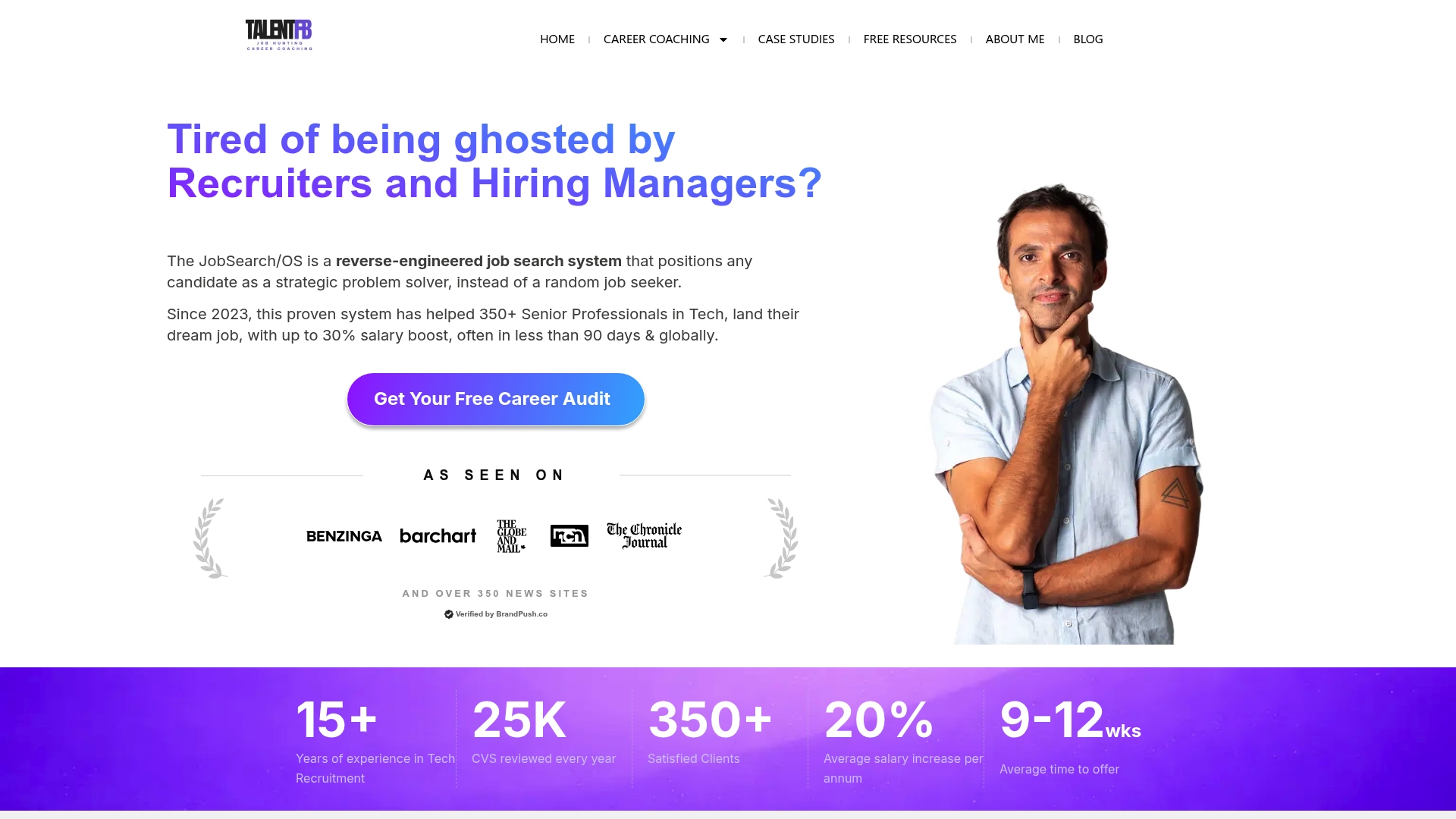
TalentFB is built specifically for senior tech professionals who are ready to move from planning to execution. The AI job search playbook gives you a proven framework for targeting the hidden market, optimizing your profile for AI screening, and building the recruiter relationships that open unadvertised roles. If you want personalized support, AI career coaching sessions provide one-on-one strategic guidance tailored to your specific situation, timeline, and goals. Start by benchmarking your current position with the executive visibility scorecard and identify exactly where to focus your energy first.
Frequently asked questions
What’s the biggest mistake senior tech leaders make with career development?
Relying only on posted jobs or internal moves is the most common and costly error. Since 80% of executive roles are unadvertised, senior professionals must actively build external networks and pursue hidden opportunities to advance at the leadership level.
How can I choose between IC and management tracks as a tech executive?
Base your decision on where you create the most value and where you find genuine motivation. ICs can earn as much as EMs at top firms, and dual-ladder tracks are expanding, so financial pressure alone should not drive the choice.
Do executive recruiters or AI systems matter more for job search?
Both channels are essential and work together. 90% of recruiters use LinkedIn as their primary sourcing tool, and AI-based ATS systems screen nearly every formal application, so optimizing for both simultaneously gives you the strongest possible position.
Is it harder to advance remotely in 2026?
Remote progression is fully viable for senior tech roles, but it requires deliberate effort to signal impact and influence without physical presence. Proactive communication, visible thought leadership, and strong digital branding are non-negotiable for remote executives seeking advancement.