
TL;DR:
- An executive resume is a leadership narrative that emphasizes measurable impact over responsibilities. It targets boards and C-suite leaders, focusing on signals of authority like P&L scope and transformation results. Crafting tailored, outcome-focused resumes and summaries helps executives stand out and communicate their leadership story effectively.
An executive resume is defined as a strategic leadership narrative document, not a career biography. Knowing how to craft executive resumes that actually open doors means shifting your entire mindset from listing responsibilities to proving measurable impact. Boards, C-suite hiring committees, and executive search firms read your resume differently than a standard recruiter does. They scan for leadership signals first: P&L scope, team size, transformation results, and board interaction. This guide gives you the exact framework to build a resume that speaks their language and positions you for your next senior role.
What makes an executive resume different from other resumes?
An executive resume is not a longer version of a mid-career resume. It is a fundamentally different document built for a different audience and a different decision-making process.
Executive resumes target boards, senior search firms, and C-suite peers who evaluate leadership scope before they read a single bullet point. That means your document must signal authority within the first third of the page. Hiring experts confirm that executive recruiters scan for signals like P&L scope, team size, and board interaction before reading any detail. If those signals are buried, your resume fails before it is read.
The standard length for an executive resume is 2–3 pages, with two pages being the norm. A third page is justified only for sitting CEOs or professionals with extensive board portfolios. Anything shorter risks looking thin. Anything longer risks looking unfocused.
The core difference comes down to outcomes versus duties. Shifting from a “responsibilities” mindset to an “outcomes” mindset is the single most important change senior professionals must make. A VP who “led a global sales team” tells a hiring committee nothing. A VP who “grew annual recurring revenue from $40M to $112M across 14 markets in three years” tells them everything.
- Leadership scope signals: P&L size, headcount managed, geographic reach
- Transformation proof: Turnarounds, integrations, market entries, restructures
- Stakeholder reach: Board reporting, investor relations, cross-functional authority
- Financial fluency: Revenue growth, cost reduction, margin improvement with specific numbers
Pro Tip: Read your resume as if you are a board member seeing it for the first time. If you cannot identify your leadership scope within 10 seconds, rewrite the top third.
How do you write an executive summary that sets the leadership narrative?
The executive summary is the most important paragraph on your resume. It acts as a 30-second elevator introduction that positions you for your next role, not your last one. Search consultants use it to decide whether to read further or move on.
An effective executive summary in 2026 follows a clear structure: establish your operating context, name your repeating success pattern, and anchor the whole thing with one or two proof points. A well-crafted summary runs 4–6 sentences, focused entirely on leadership narrative. Every sentence must earn its place.
“A strong executive summary does not describe what you have done. It argues why you are the right person for the next challenge, using the language of the hiring committee, not the language of your last job description.”
Here is what a strong summary includes:
- Industry and stage context: “B2B SaaS, Series C to IPO” or “global maritime-tech, $500M revenue”
- Repeating success pattern: The theme that connects your wins across roles
- Anchor proof points: One or two specific results that validate the pattern
- Next role alignment: A forward-facing statement that signals where you are headed
The most common mistake executives make in their summary is loading it with adjectives. Words like “visionary,” “dynamic,” and “results-oriented” carry zero weight with experienced search consultants. Generic adjectives vanish on executive resumes. Replace them with concrete impact statements. “Scaled three fintech platforms from seed to $200M+ ARR” is worth more than any adjective you can name.

How to select and showcase core competencies and executive achievements
Your competencies section is not a skills list. It is a curated set of leadership domains that tells the reader exactly what kind of executive you are.
Generic lists like “communication,” “leadership,” and “problem-solving” belong on entry-level resumes. At the executive level, you need domain-specific language that matches the role you are targeting. A growth-stage CEO needs competencies like “revenue acceleration,” “go-to-market architecture,” and “board governance.” A transformation-focused COO needs “operational restructuring,” “post-merger integration,” and “P&L accountability.” Tailor this section every time you apply.
Structuring your experience section for maximum impact
Senior executives compress older roles and emphasize recent, high-impact positions. The rule is straightforward: older roles get 1–2 sentences summarizing scope and title. Recent roles get 4–6 bullets, each anchored by a quantified result. This approach keeps your resume focused on what matters most to the hiring committee.
| Role age | Format | Focus |
|---|---|---|
| Last 5 years | 4–6 bullets with metrics | Strategic outcomes and scope |
| 6–10 years ago | 2–3 bullets or short paragraph | Key achievements only |
| 10+ years ago | Title, company, dates only | Context, no detail |
When writing achievement bullets, follow a simple structure: action verb, context, and measurable result. “Restructured APAC operations across seven markets, reducing overhead by 22% while growing regional revenue by $38M” is a complete executive bullet. It tells the reader what you did, where you did it, and what it produced.
When to include board positions, speaking engagements, and awards
Board positions belong on your resume if they are current or recent, and if they add credibility to your leadership narrative. A board seat at a funded startup or a listed company signals that peers trust your judgment. Speaking engagements at recognized industry events, such as Money20/20 or Web Summit, reinforce your authority in a specific domain. Awards are worth including only when they come from credible external bodies, not internal company programs.
Pro Tip: If you have a board seat or advisory role, list it in a dedicated “Board and Advisory” section rather than burying it under work experience. It signals a level of seniority that deserves its own real estate.
How should you format and tailor your executive resume for recruiter impact?
Format is not decoration. It is a communication tool. The way your resume is structured tells the reader how organized your thinking is before they read a single word.
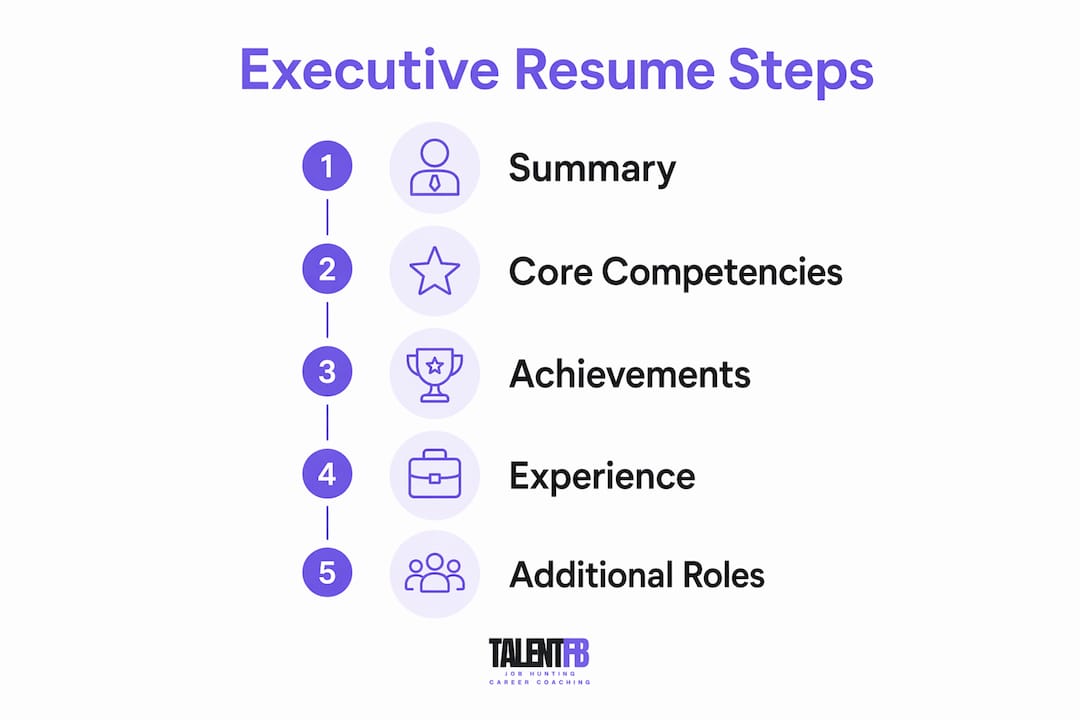
The section order that works best for most executive resumes is: contact information, executive summary, core competencies, professional experience, board and advisory roles, education, and then any additional credentials. Place your strongest material at the top. Recruiters and search consultants read in an F-pattern, meaning the top-left of your document gets the most attention.
Tailoring your resume for each target role
Successful executives maintain 3–4 resume versions with different summaries and lead bullets targeting specific roles. This is not about rewriting your entire resume. It is about adjusting the narrative emphasis. A CFO targeting a private equity-backed company emphasizes capital structure and investor relations. The same CFO targeting a public company leads with SEC reporting and board audit experience.
Tailoring is about narrative emphasis, not keyword stuffing. Applicant Tracking Systems do scan executive resumes at some firms, so including role-relevant terms matters. But the primary reader is always a human with high judgment. Write for that person first.
Common mistakes senior professionals make:
- Chronological task lists: Describing what the role required, not what you delivered
- Filler content: Listing every conference attended or every internal training completed
- Outdated formatting: Dense paragraphs, small fonts, and no white space signal a document from another era
- Missing metrics: Vague language like “improved performance” without a number attached
- One-size-fits-all approach: Sending the same resume to every role without adjusting the narrative
For a deeper look at how your executive CV writing connects to your broader leadership brand, the principles of tailoring and narrative emphasis apply equally to your LinkedIn profile. A professional headshot also matters more than most executives realize. An executive portrait guide can help you align your visual brand with the authority your resume projects.
What I have learned after 15 years inside the hiring room
The most common thing I see when senior professionals share their resumes with me is a document that reads like a job description. It lists what the role required. It does not argue why this particular person was exceptional in it.
The mindset shift from “career archive” to “leadership thesis” is harder than it sounds. You have spent years doing the work. Writing about it feels like bragging. But the hiring committee is not looking for humility. They are looking for evidence. Your resume is the evidence file, and every line either builds the case or weakens it.
Executive resumes also influence internal politics in ways most candidates do not consider. When a search firm presents your profile to a board, multiple stakeholders read it: the Chair, the CHRO, the CFO, and sometimes the outgoing executive. Each of them reads for something different. A resume that speaks only to one of those readers will lose votes from the others.
My honest recommendation is to get a trusted second opinion from someone who has sat in a hiring room, not just someone who writes resumes for a living. The difference is significant. A career coach with real hiring experience will tell you when a bullet sounds weak, when your summary is too backward-looking, and when your competencies list is generic. That feedback is worth more than any template.
The executives who land the best roles in 2026 are not the ones with the longest resumes. They are the ones who can tell a clear, confident story about where they have been, what they built, and where they are going next. Your resume is the first chapter of that story. Make it count.
— Frederic Bonifassy
How TalentFB can help you build your executive leadership narrative
Crafting a resume that speaks to boards and search firms takes more than good writing. It takes someone who knows what those rooms actually look for.
TalentFB’s executive career coaching is built specifically for Directors, VPs, and C-suite professionals in tech, fintech, and adjacent sectors across APAC. The JobSearch/OS™ program covers resume crafting, LinkedIn profile positioning, and targeted outreach, all within a 90-day structure designed to produce interviews and salary increases of 20–30%. With 350+ professionals coached, TalentFB brings real hiring-room experience to every engagement. If you are ready to move from a generic resume to a leadership thesis that opens doors, explore the client success stories and see what is possible.
FAQ
What is an executive resume?
An executive resume is a strategic leadership narrative document that proves measurable impact across P&L, team scope, and business transformation. It differs from a standard resume by targeting boards, search firms, and C-suite hiring committees rather than HR generalists.
How long should an executive resume be?
Executive resumes are typically 2–3 pages. Two pages is the standard for most senior professionals, while a third page is justified for sitting CEOs or executives with extensive board portfolios.
How do you write a strong executive summary?
An effective executive summary runs 4–6 sentences and establishes your industry context, repeating success pattern, and one or two anchor proof points. It should position you for your next role, not simply describe your last one.
How many resume versions should an executive have?
Successful executives maintain 3–4 resume versions, each with a different summary and lead bullets tailored to a specific role type or industry context. Narrative emphasis, not keyword stuffing, is what makes each version effective.
What is the biggest mistake executives make on their resumes?
The most common mistake is listing responsibilities instead of outcomes. Every bullet point should answer the question “What did you produce?” with a specific, quantified result rather than a description of what the role required.