TL;DR:
- HR leads organizational transformation by redesigning work, managing culture change, and governing technology adoption. Success depends on HR’s ability to reshape workflows, upskill employees, and foster trust in AI and automation. Effective measurement of digital impact includes adoption rates, mobility, retention, and leadership effectiveness.
HR’s role in digital transformation is to serve as the architect of people-centered change, ensuring that technology enhances work, culture, and business outcomes rather than simply automating what already exists. Most organizations treat digital transformation as a technology project. The ones that succeed treat it as a people project. BCG research confirms this distinction with a striking finding: 70% of AI’s value comes from organizational, people, and process transformation, not from algorithms or infrastructure. That number reframes everything. It means HR is not a support function in digital transformation. HR is the primary driver of it.
The industry term for what HR leads here is “organizational transformation,” and it goes well beyond digitization. Digitization means converting paper to software. Organizational transformation means rethinking how work gets done, who does it, and what skills the workforce needs to thrive alongside new technology. HR owns that redesign.
What is the role of HR in digital transformation?
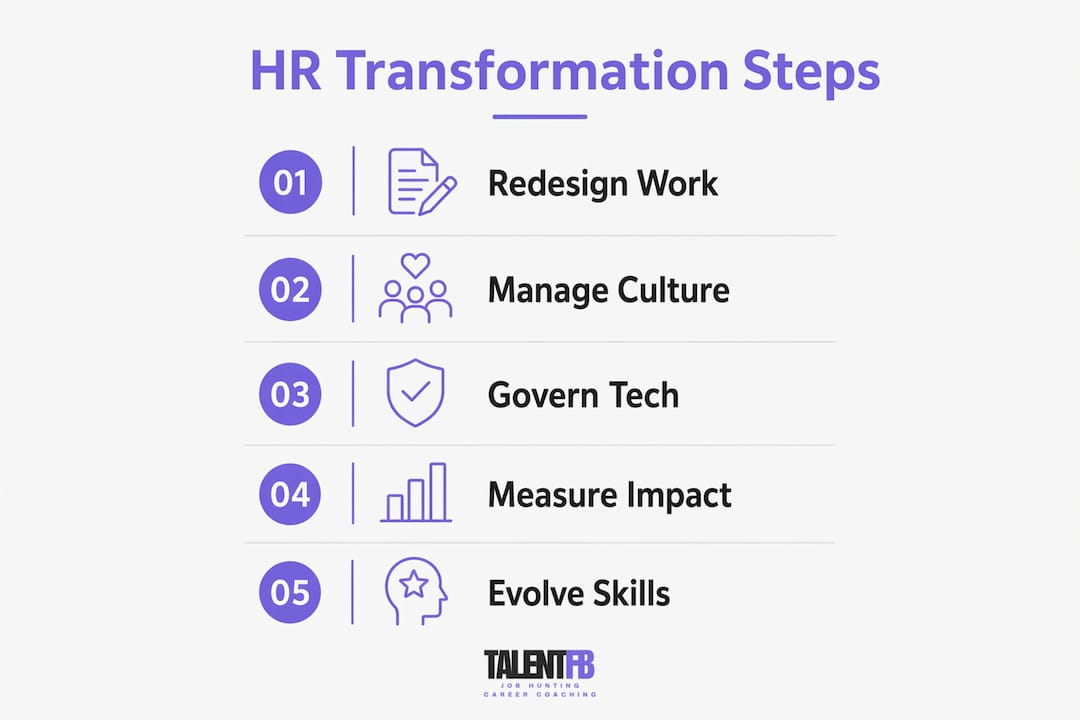
HR’s role in digital transformation covers three interconnected responsibilities: redesigning work, managing culture change, and governing technology adoption. Each one depends on the others. You cannot successfully adopt AI tools if your workflows are unchanged. You cannot change workflows if your culture resists new ways of working. And you cannot sustain any of it without governance that builds trust.
66% of AI-agentic leaders expect roles and governance structures to be redefined as AI becomes embedded in daily operations. That expectation lands directly on HR’s desk. The CHRO role is evolving from steward of human capital to architect of a hybrid workforce that integrates people and AI agents working side by side. This is a fundamentally different job than managing benefits and compliance.
HR also holds a unique position at the intersection of business strategy and employee experience. No other function has visibility into workforce capability, culture health, and organizational design simultaneously. That cross-functional view makes HR the natural leader of transformation, not just a participant in it.
How HR leads work redesign and skills evolution
Work redesign is where HR’s impact on digital change becomes most concrete. When a company deploys automation or AI tools, the question is not just “what can the technology do?” The real question is “how do we restructure roles so humans and technology each do what they do best?” HR answers that question.
A practical approach follows four steps:
- Map current roles against automation potential. Identify which tasks within each role are candidates for automation and which require human judgment, creativity, or relationship skills.
- Conduct a skills gap analysis. Compare the skills your workforce has today against the skills the redesigned roles will require. This is the foundation of any credible upskilling plan.
- Build internal mobility pathways. Rather than defaulting to external hiring, create structured paths for existing employees to move into new or evolved roles. This protects institutional knowledge and reduces attrition.
- Redesign workflows before deploying technology. This step is where most organizations fail. 67% of organizations implement new HR technologies without adapting their underlying processes. The technology lands on top of broken workflows and delivers a fraction of its potential value.
Pro Tip: Before selecting any new HR technology, document the current workflow in detail. If the process would not work well on paper, it will not work well in software. Fix the process first, then choose the tool.
HR’s role in tech adoption also includes building a culture of continuous learning. Skills planning is not a one-time project. As technology evolves, workforce capabilities must evolve with it. HR leaders who integrate AI into talent acquisition and workforce planning create a feedback loop that keeps the organization ahead of skill gaps rather than reacting to them.

Why change management and culture shaping are critical
Technology does not transform organizations. People do. And people resist change when they do not understand it, do not trust it, or do not see themselves in the future it promises. This is where HR’s change management function becomes the difference between a transformation that sticks and one that stalls.
HR’s responsibilities in change management include:
- Building a clear narrative. Employees need to understand why the transformation is happening, what it means for their roles, and what support they will receive. Vague messaging creates anxiety. Specific, honest communication builds trust.
- Equipping people leaders. HR must give managers the tools, talking points, and skills to lead their teams through change. Managers are the most influential voice in any employee’s experience of transformation.
- Embedding ethical AI governance. HR needs to establish AI usage norms across the enterprise, including clear guidelines on how AI is used in performance management, hiring, and decision-making. Without these guardrails, employees lose trust in the systems they are asked to use.
- Measuring cultural readiness. Pulse surveys, focus groups, and adoption metrics tell HR where resistance is concentrated and what specific concerns need to be addressed.
HR acts as a change agent that facilitates adoption and shapes organizational culture for transformation success. That role requires empathy as much as it requires process expertise. The HR leaders who succeed here are the ones who listen before they prescribe.
Pro Tip: Run a “change readiness audit” before launching any major technology rollout. Survey employees on their confidence, concerns, and perceived support. Use the results to tailor your communication and training plan. This single step dramatically improves adoption rates.
The role of HR in CEO success is closely tied to this cultural work. When HR shapes a culture that embraces learning and change, the entire organization becomes more agile, and the CEO’s transformation agenda becomes achievable rather than aspirational.
How integrated HR technology ecosystems support transformation
The technology HR chooses and how it connects those tools matters as much as the strategy behind them. Fragmented HR tech stacks increase complexity and reduce return on investment, whereas integrated platforms with AI-embedded analytics improve data consistency and the speed of decision-making.
The distinction between legacy and modern approaches to HR technology is significant:
| Dimension | Legacy HR tech approach | Modern integrated approach |
|---|---|---|
| Data architecture | Siloed systems, manual exports | Connected platforms, real-time data flow |
| Analytics capability | Backward-looking reports | Predictive people analytics |
| Employee experience | Fragmented, inconsistent interfaces | Unified, consumer-grade digital experience |
| Process alignment | Technology layered on old workflows | Workflows redesigned before technology deployment |
| Governance | Reactive, compliance-driven | Proactive, ethics-first AI governance |
Technology should catalyze transformation, not lead it. The human and process redesign aspects are the primary success drivers. An integrated platform built on redesigned processes gives HR leaders the data they need to make confident decisions on retention, development, and productivity. A fragmented stack built on old workflows gives them noise.
HR leaders who want to understand the role of data in HR will find that the quality of their technology architecture directly determines the quality of their people analytics. You cannot draw meaningful insights from disconnected data sources.
Measuring HR’s digital transformation impact on business outcomes
Measuring the impact of HR’s digital initiatives is where many HR leaders lose confidence. The instinct is to track activity metrics: training hours completed, software licenses activated, onboarding time reduced. These matter, but they do not tell the business story that executives need to hear.
The metrics that connect HR’s work to business outcomes include:
- Technology adoption rate by role and department. Low adoption signals either a training gap or a trust gap. Both are HR problems to solve.
- Internal mobility rate. A rising rate shows that workforce redesign and upskilling are working. A flat rate suggests skills pathways are not yet effective.
- Retention in high-impact roles. Cost efficiency is highly linked to HR tech maturity, but productivity and sustainability gains require broader governance and leadership alignment. Retention in critical roles is a leading indicator of both.
- Manager effectiveness scores. Since managers carry the change management burden, their effectiveness directly predicts team-level adoption and engagement.
- Time-to-productivity for redesigned roles. When roles change, how quickly do employees reach full effectiveness? This metric captures the quality of HR’s transition support.
Digital transformation impacts employee efficiency when socio-technical factors, including leadership alignment, process design, and skills development, work together. HR’s measurement framework should reflect that complexity. Track the human factors alongside the technology metrics, and you will have a story that resonates with both the CFO and the workforce.
Pro Tip: Present transformation metrics to executives in a one-page dashboard that connects HR inputs (training, redesign, governance) to business outputs (retention, productivity, agility). Executives respond to causation, not correlation. Show the chain of impact clearly.
For a deeper look at how technology shapes HR strategy, the connection between people analytics and business performance becomes even clearer.
What 15 years in hiring rooms taught me about HR’s digital leadership gap
I have spent 15 years inside hiring rooms across tech, fintech, adtech, gaming, and maritime-tech in APAC. I have watched organizations invest heavily in HR technology and get almost nothing back. I have also watched leaner organizations with less sophisticated tools outperform them consistently. The difference was never the software. It was always the people leading the change.
The uncomfortable truth is that most HR leaders are not yet equipped to lead digital transformation. Not because they lack intelligence or commitment, but because the role has changed faster than the training and career paths that prepare people for it. The CHRO of 2026 needs to be fluent in workforce analytics, AI governance, and organizational design. Most HR programs still train people primarily in compliance, compensation, and talent acquisition.
My honest recommendation: if you are an HR leader who wants to drive real transformation, invest in three specific capabilities before anything else. Learn how to read and interpret people analytics data. Build your understanding of AI ethics and governance frameworks. And develop your ability to redesign work, not just manage it. These three skills separate HR leaders who get a seat at the transformation table from those who get a summary of decisions made without them.
The organizations I have seen succeed in digital transformation share one trait. Their HR leaders were proactive, not reactive. They shaped the transformation agenda rather than responding to it. That proactive posture starts with building the right skills and the confidence to use them.
— Frederic Bonifassy
How TalentFB supports HR leaders navigating digital change
HR leaders who want to advance their digital leadership skills need more than reading lists. They need a structured approach that connects their current experience to where the market is heading.
TalentFB works with senior HR and tech professionals across APAC who are navigating exactly this kind of leadership transition. Whether you are stepping into a broader transformation mandate or positioning yourself for a CHRO role, the career coaching guide for tech executives gives you a clear, personalized path forward. TalentFB’s coaching has helped 350+ senior professionals land their next role within 90 days, often with a 20–30% salary increase. If you are ready to lead digital transformation from the front, that starts with positioning yourself as the leader who can.
FAQ
What is the role of HR in digital transformation?
HR’s role in digital transformation is to redesign work, manage culture change, and govern technology adoption so that digital investments deliver real business value. BCG research shows that 70% of AI’s value comes from people and process transformation, which HR directly leads.
Why does HR digitalization fail so often?
67% of organizations implement new HR technologies without changing their underlying workflows, which is the primary cause of failed transformation initiatives. Technology layered on broken processes amplifies inefficiency rather than eliminating it.
What skills does HR need for digital transformation leadership?
HR leaders need proficiency in people analytics, AI governance, and organizational design to lead digital transformation effectively. These capabilities allow HR to connect workforce decisions to business outcomes and build trust across the organization.
How does HR measure digital transformation success?
HR measures transformation success through technology adoption rates, internal mobility, retention in critical roles, manager effectiveness scores, and time-to-productivity for redesigned roles. These metrics connect HR’s work directly to business performance rather than tracking activity alone.
What is the CHRO’s evolving role in an AI-driven organization?
The CHRO role is shifting from managing human capital to architecting a hybrid workforce that integrates people and AI agents. This requires HR leadership to set AI usage norms, redesign roles around automation, and build the governance frameworks that sustain employee trust.