TL;DR:
- Executive assessment is a structured evaluation process that combines psychometric tests, behavioral interviews, and simulations. It significantly improves hiring accuracy, raising success prediction from 14% to up to 95%. Many organizations now view it as an essential discipline for selecting and developing senior leaders.
You reach the final stage for a senior role and the recruiter mentions an assessment centre, a psychometric test or a session with a business psychologist. Many experienced leaders find this more unsettling than any interview. Executive assessment is a structured evaluation that combines psychometric tools, behavioural interviews, simulations and sometimes 360 feedback to predict how you will perform in a leadership role.
In my years on the hiring side, I saw strong candidates lose ground at this stage for avoidable reasons: they treated it as a test to game, or they did not prepare at all. This guide explains how executive assessment works, the psychometric tools you are likely to meet, and how to prepare so the result reflects how you really lead.
What is executive assessment and how does it work?
Executive assessment is the industry-recognized term for what practitioners also call a leadership evaluation protocol or senior talent appraisal. It is a standardized process governed by professional practice standards, including those set by the AESC (Association of Executive Search and Leadership Consultants). The process applies specifically to C-suite, Director, and Vice President roles where the cost of a wrong hire is severe. A failed executive hire costs three to four times the executive’s annual salary. That figure makes the investment in a thorough assessment process look modest by comparison.

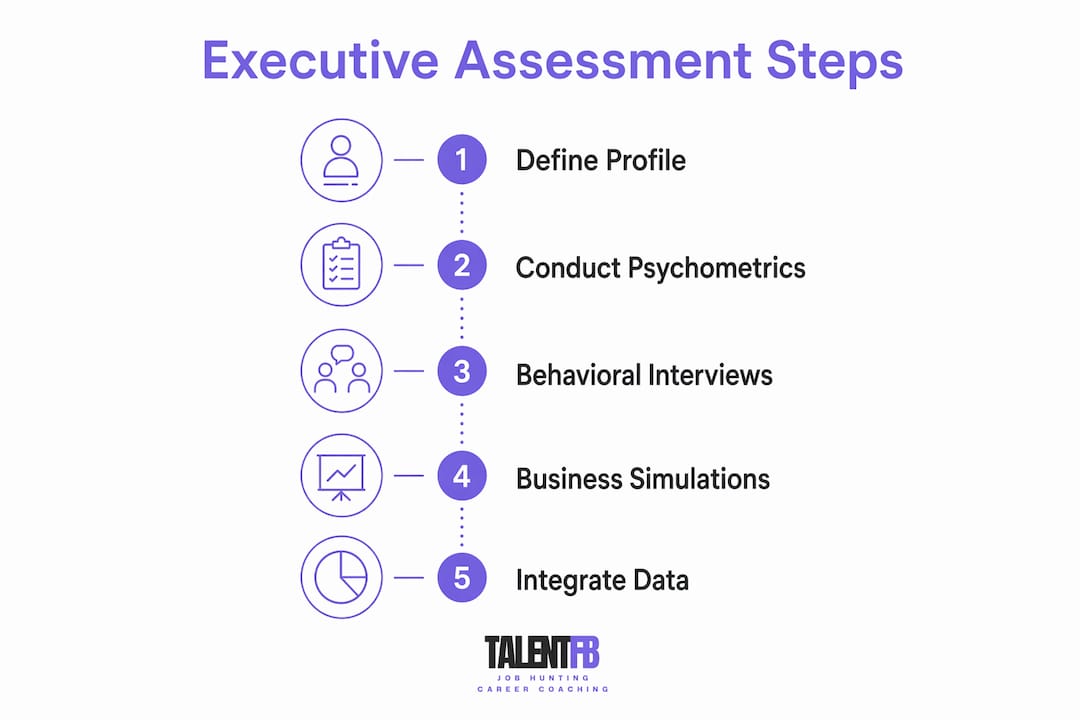
The process begins with defining a success profile. This profile maps the specific competencies, behaviors, and cognitive requirements the role demands. Every subsequent assessment stage is measured against that profile, which keeps evaluation criteria consistent and defensible.
What methods and tools comprise the executive assessment process?
A typical executive assessment involves five core components, each measuring a different dimension of leadership capability.
- Success profile definition. The organization defines the exact competencies, decision-making styles, and cultural attributes the role requires before any candidate is evaluated.
- Psychometric testing. Validated instruments like Hogan assess personality traits, leadership derailment risks, and cognitive capacity. Pymetrics uses neuroscience-based games to measure cognitive and emotional attributes. These tools produce data that a resume simply cannot.
- Structured behavioral interviews using the STAR technique. STAR stands for Situation, Task, Action, and Result. This format forces candidates to provide specific evidence of past behavior rather than hypothetical answers. It removes the advantage that naturally confident or articulate candidates hold in unstructured conversations.
- Business simulations and role-playing exercises. Candidates work through real scenarios: a board presentation, a crisis communication exercise, or a resource allocation decision. These exercises reveal how executives actually think under pressure, not how they describe their thinking.
- 360-degree feedback and structured behavioral referencing. Feedback is gathered from peers, direct reports, and managers. Cross-validating reported actions against observations from multiple professional contacts exposes gaps between a leader’s self-perception and their actual impact.
- Coaching debrief. A 1:1 coaching session converts the diagnostic data into a clear development plan. Without this step, the assessment produces insight that never gets applied.
Pro Tip: Sequence matters. Run psychometrics before behavioral interviews so interviewers can probe specific data points rather than starting blind. This sequencing improves the quality of follow-up questions and the depth of insight you extract.
You can explore how psychometric tools work in practice to understand which instruments suit different executive roles.
What strategic purposes do executive assessments serve?
Executive assessments serve three strategic goals: external selection, internal mobility, and targeted leadership development. Each use case produces different outputs, but all three rely on the same structured methodology.
-
External hiring. When recruiting a new CFO, CTO, or CEO, assessments provide objective data that goes far beyond the resume and the interview room. They reveal how a candidate processes ambiguity, manages conflict, and makes decisions under pressure. These are the qualities that determine executive success, and they rarely surface in a standard interview.
-
Internal mobility and promotion decisions. Assessments identify which internal leaders are genuinely ready for expanded responsibility and which ones need targeted development first. This prevents the common mistake of promoting the highest performer in a current role into a leadership position they are not yet equipped to hold.
-
Leadership development and succession planning. Leading organizations treat executive assessment as a discipline integral to leadership pipeline health. Assessments produce individual development plans that map a leader’s growth trajectory against the organization’s future needs. This turns assessment data into a living roadmap rather than a one-time report.
The benefits of executive assessment extend beyond individual decisions. Organizations that assess systematically build a clearer picture of their leadership bench strength. They identify systemic gaps before those gaps cause failures. They also create a culture where development is evidence-based and personal, not generic.
How does executive assessment improve decision-making?
The core problem with traditional hiring is that unstructured interviews predict job success at roughly 14%. That number comes from decades of research on hiring validity. Structured executive assessments push that figure to above 50%, and well-designed multi-method protocols can reach 95% in predictive accuracy.
| Evaluation method | Predictive validity | Key risk |
|---|---|---|
| Unstructured interview | ~14% | High bias, low consistency |
| Structured behavioral interview | ~50% | Requires trained interviewers |
| Multi-method executive assessment | Up to 95% | Requires proper sequencing |
Structured assessments provide earlier, higher-confidence decisions by augmenting human judgment rather than replacing it. This addresses one of the most common misconceptions about the process. Many HR leaders worry that assessments slow hiring down or override the instincts of experienced interviewers. The opposite is true. Objective data gives decision-makers a firmer foundation for their judgment, which speeds up consensus and reduces second-guessing after an offer is made.
A second misconception is that assessments favor candidates who present well. Business simulations and structured behavioral referencing specifically counteract this. A candidate who performs brilliantly in a presentation exercise but receives contradictory feedback from former subordinates will show a very different profile than their interview performance suggests.
Pro Tip: Use a decision matrix to integrate data from each assessment stage before the final hiring conversation. Assign weights to competencies based on the success profile. This prevents one strong interview from overriding weaker psychometric or referencing data.
For a broader view of how to reduce C-suite hiring risk, the C-suite hiring tips for HR leaders guide covers the full selection process in practical detail.
What best practices should organizations follow when conducting executive assessments?
Getting the methodology right matters as much as choosing to assess at all. Several nuances separate effective executive assessment programs from ones that produce data nobody trusts.
-
Distinguish assessment centers from development centers. Assessment centers are decision-oriented with binary outcomes: hire or do not hire, promote or develop further. Development centers focus on growth and produce individualized plans rather than pass/fail results. Mixing these two purposes in a single process creates candidate anxiety and distorts performance data. Be explicit with participants about which type of process they are entering.
-
Do not over-rely on presentation skills. Simulations that require polished presentations favor executives who are naturally comfortable in front of an audience. This is a useful data point, but it is not a proxy for strategic thinking, team leadership, or resilience. Balance simulation types to capture a fuller picture.
-
Prioritize structured behavioral referencing. Structured behavioral referencing uses targeted questions across multiple professional contacts to expose distortions between a leader’s self-view and their actual leadership impact. Generic reference calls that ask “Would you rehire this person?” produce almost no useful data. Structured referencing asks specific behavioral questions tied directly to the success profile.
-
Make the coaching debrief mandatory, not optional. Organizations frequently invest in rigorous assessment and then skip the debrief because the hiring decision has already been made. This wastes the most valuable output the process produces. The debrief is where assessment data becomes a development plan. It is also where newly hired executives gain self-awareness that accelerates their onboarding.
-
Assess internal candidates with the same rigor as external ones. Familiarity bias is real. A leader who has been visible and well-liked internally often receives less scrutiny than an outside candidate. Applying the same structured process to both groups produces fairer, more defensible decisions.
Why I believe executive assessment is the most underused leadership tool
I have spent 15 years inside hiring rooms across tech, fintech, adtech, gaming, and maritime-tech in APAC. I have watched organizations spend months searching for the right executive, conduct six rounds of interviews, and still make a hire that fails within 18 months. Almost every time, the failure was predictable. The warning signs were in the behavioral data that nobody collected.
The honest truth is that most organizations assess executives less rigorously than they assess graduate hires. A junior analyst might complete a full psychometric battery and a structured case study. A VP candidate gets three conversations with the leadership team and a gut-feel decision. That inversion is a serious risk management failure.
What I have seen work is treating assessment as a leadership discipline, not a hiring step. The organizations with the healthiest leadership pipelines assess continuously. They use career development frameworks to map leaders against future role requirements long before a vacancy opens. They invest in coaching debriefs that turn data into growth. And they build internal capability to conduct structured behavioral interviews rather than outsourcing all judgment to external consultants.
My recommendation is direct: if your organization is making C-suite decisions without a structured, multi-method assessment process, you are accepting a level of risk that the data does not support. The cost of getting this right is small compared to the cost of getting it wrong.
— Frederic Bonifassy
The psychometric tests senior candidates are most likely to face
- Personality questionnaires such as the Hogan assessments or OPQ32 describe your preferred behaviours: how you influence, handle pressure and make decisions. There are no right answers, but there are inconsistent ones.
- Cognitive ability tests measure verbal, numerical and abstract reasoning under time pressure. They are more common for finance, strategy and analytics roles.
- Situational judgement tests present realistic leadership dilemmas and ask what you would do.
- Motivation and values inventories check whether what drives you matches the role and the culture.
Reputable employers use these tools as one input among several, and they should explain how the results feed into the decision. You are entitled to ask.
How to prepare for an executive assessment
- Ask what is involved. Which tools, how long, who sees the report, and whether you will get feedback. A good recruiter will tell you.
- Practise the format, not the answers. Timed practice tests help you manage the clock on reasoning tests. Trying to engineer a personality profile usually backfires, because the questionnaires include consistency checks.
- Answer as you are at work on a normal day, not on your best day and not as the person you think they want.
- Prepare stories for the debrief. Many assessments end with a feedback interview. Have two or three examples ready that show how you handled pressure, conflict and a decision that went wrong.
- Look after the basics. Sleep, a quiet room and a reliable connection matter more than any preparation guide.
Assessment is only one stage of a senior search. If you want to see which part of your search needs the most work, take the free Senior Job Search Score.
How TalentFB supports your executive assessment and leadership growth
Understanding the executive assessment process is the first step. Knowing how to use that insight to advance your own career or build a stronger leadership team is where real progress happens.
TalentFB works with senior tech professionals and HR leaders across APAC who want to move faster and smarter. Whether you are preparing for an executive assessment as a candidate or building a more rigorous evaluation process for your organization, the career coaching guide for tech executives walks you through the exact frameworks that produce results. TalentFB has coached 350+ senior professionals and brings 15 years of hiring-room experience to every engagement. The playbook is proven, and it is available to you now.
FAQ
What is executive assessment in simple terms?
Executive assessment is a structured, multi-method evaluation that measures a senior leader’s competencies, cognitive abilities, and cultural fit using psychometric tests, behavioral interviews, simulations, and 360-degree feedback. It produces objective data to support hiring and development decisions.
How long does an executive assessment process take?
The timeline varies by organization and role complexity, but a full multi-method assessment typically spans one to three days of structured activities, followed by a coaching debrief session.
What is the difference between an assessment center and a development center?
An assessment center is decision-oriented and produces a hire or no-hire outcome. A development center focuses on growth and generates an individualized development plan rather than a pass/fail result.
What executive assessment tools are most commonly used?
Validated psychometric instruments like Hogan and Pymetrics are widely used, alongside structured behavioral interviews using the STAR technique, business simulations, and 360-degree referencing frameworks.
Why do executive assessments outperform traditional interviews?
Unstructured interviews predict hiring success at roughly 14%, while multi-method structured assessments reach up to 95% predictive validity by combining objective data sources and reducing the influence of interviewer bias.