
TL;DR:
- Outplacement provides employer-funded career coaching, resume support, and emotional aid during layoffs. It helps employees find new jobs faster and reduces legal, reputational, and morale risks for employers. Tailoring programs by employee level and choosing supportive providers ensures better outcomes for everyone involved.
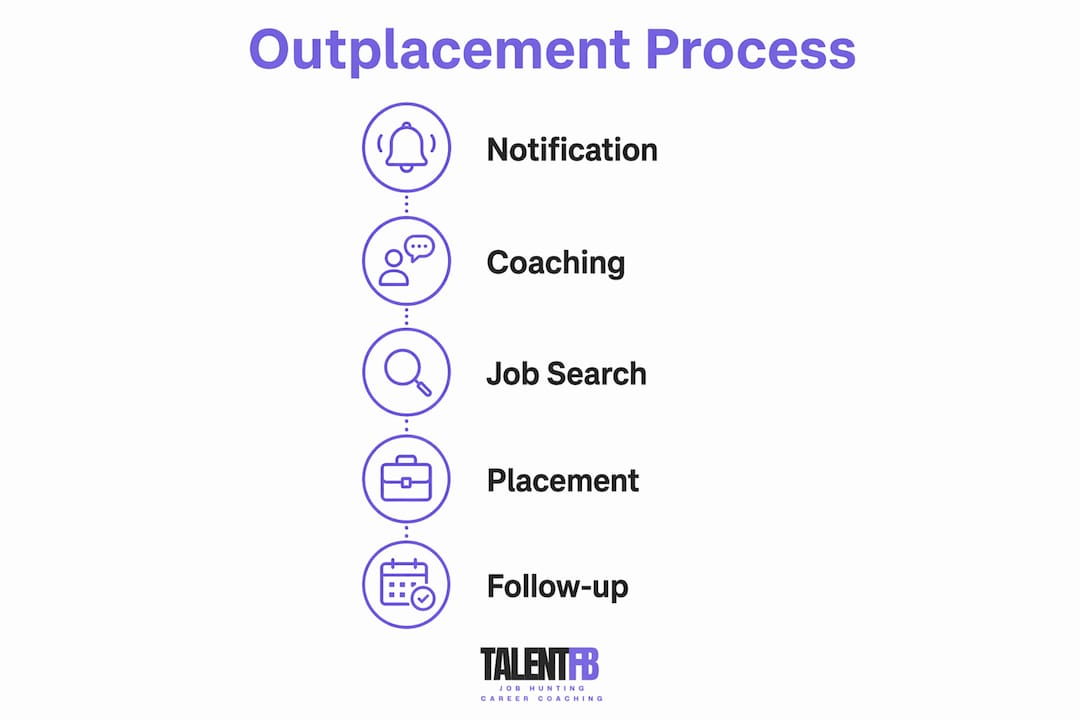
Outplacement is defined as an employer-funded support service provided to departing employees during layoffs, restructuring, or role eliminations. The service typically includes career coaching, resume optimization, job search strategy, and emotional support to help employees land new roles faster. For HR professionals and corporate leaders, understanding outplacement services means recognizing both the human obligation and the business case behind them. Done well, outplacement protects your employer brand, keeps remaining staff engaged, and reduces the legal and reputational risks that come with workforce reductions.

What is outplacement and what does it typically involve?
Outplacement is not a single service. It is a structured program covering several interconnected areas of support, each designed to address a different barrier to reemployment.
The core components of most outplacement programs include:
- Career coaching: One-on-one sessions with a professional coach who helps the employee clarify their career direction, identify target roles, and build a personal job search plan.
- Resume and LinkedIn profile optimization: Rewriting documents to reflect current market expectations, keyword standards, and the employee’s actual value proposition.
- Interview preparation: Mock interviews, feedback sessions, and coaching on how to handle difficult questions about the circumstances of departure.
- Salary negotiation training: Guidance on how to evaluate offers, counter effectively, and avoid leaving money on the table.
- Job search strategy: Structured outreach plans, networking guidance, and access to job market intelligence.
- Psychological support: Counseling or coaching to help employees process the emotional impact of job loss before they begin active searching.
Structured outplacement coaching helps employees secure new positions faster than those without support. Programs typically run from a few months up to 12 months for senior-level transitions, depending on complexity and seniority.
Delivery formats vary. Some programs run entirely virtually, with video coaching sessions and digital resources. Others combine in-person workshops with individual coaching. Group workshops work well for large-scale layoffs where cost efficiency matters. Individual coaching works better for mid-career and senior professionals who need personalized attention.
Pro Tip: When evaluating outplacement providers, ask specifically whether psychological support is built into the program or treated as an optional add-on. Employees who receive emotional stabilization support early in the process tend to perform significantly better in interviews.
How does outplacement benefit employers?
The business case for outplacement is stronger than most HR leaders initially expect. Employers implement outplacement primarily to minimize legal risks, protect employer brand, and maintain morale among remaining staff. Each of those outcomes has a measurable impact on the organization.
Here is what outplacement does for the employer side of the equation:
- Reduces legal exposure: Offering outplacement demonstrates good-faith effort during a termination process. This matters in wrongful dismissal claims and severance negotiations.
- Protects employer brand: Employees who feel supported during a layoff are far less likely to post negative reviews on platforms like Glassdoor or LinkedIn. That directly affects your ability to attract future talent.
- Maintains morale among remaining staff: The employees who stay are watching how you treat the ones who leave. Remaining employees see demonstrated care, which improves morale and reinforces organizational culture.
- Reduces unemployment insurance costs: Faster reemployment for departing employees means fewer and shorter unemployment claims tied to your account.
- Reinforces organizational values: Offering outplacement signals that your company treats people as more than a line item. That signal matters internally and externally.
Offering outplacement helps organizations demonstrate people-first values and fosters loyalty, which aids recruitment and strengthens employer brand over time. The reputational benefit compounds. Companies known for treating departing employees well attract better candidates and retain existing talent more effectively.
How should outplacement be tailored to different employee levels?
One-size-fits-all outplacement programs consistently underperform. The needs of a 28-year-old individual contributor are fundamentally different from those of a 52-year-old Vice President with 25 years of specialized experience. Outplacement should be tailored to organization size and employee level, because standard group programs are ineffective for senior executives and can cause resentment if applied improperly.
A practical framework for tailoring programs by level:
- Entry-level and early-career employees: Group workshops, digital resources, and short-duration coaching (4–8 weeks) typically suffice. The focus is on resume basics, job board strategy, and interview confidence.
- Mid-career professionals: Individual coaching becomes more important here. These employees often need help repositioning their experience across industries or functions, not just polishing a resume.
- Senior managers and directors: Programs at this level require deeper personal branding work, LinkedIn profile strategy, and coaching on how to approach a more relationship-driven job market.
- C-suite and executive leaders: Senior executives require specialized executive transition services that emphasize networking, reputational management, and board positioning rather than basic resume help. This category is sometimes called ICEO (Interim CEO or Executive Outplacement) services.
Mass layoffs introduce additional complexity. When 50 or 500 employees are affected simultaneously, the emotional and logistical demands multiply. Group support sessions, dedicated hotlines, and phased coaching rollouts help manage scale without sacrificing quality.
Pro Tip: For senior leaders, the most valuable outplacement investment is not resume writing. It is coaching on how to activate and expand their professional network with intention. Most executives underestimate how much of the senior job market operates through direct relationships rather than posted roles.
Best practices for implementing outplacement programs
Effective implementation separates outplacement programs that deliver real outcomes from those that simply check a compliance box. The decisions you make before the program launches matter as much as the coaching itself.
Selecting the right provider
Prioritize providers who offer “until placed” terms over fixed-duration packages. Effective outplacement agreements prioritize support duration until placement rather than fixed timelines, which better serves difficult-to-place candidates. A 90-day package that expires while a senior employee is still searching creates frustration and reputational risk for your organization.
When evaluating providers, compare across these dimensions:
| Evaluation criteria | What to look for |
|---|---|
| Coaching quality | Certified coaches with industry-specific experience |
| Program duration | “Until placed” options for senior roles |
| Delivery format | Virtual, in-person, or hybrid flexibility |
| Psychological support | Built-in, not optional |
| Reporting and metrics | Time-to-placement, satisfaction scores, placement rates |
| Customization | Programs tailored by level and function |
Communicating the program to employees
Transparency matters enormously during a layoff. Employees who learn about outplacement support at the same time as their termination notice feel more supported than those who receive it as an afterthought days later. Communicate the program clearly, explain what it covers, and assign a specific point of contact for questions.
Remaining employees also need to hear about the program. Knowing that departing colleagues are being supported reduces anxiety and signals that leadership acts with integrity under pressure.
Measuring ROI and program success
Track time-to-placement as your primary metric. Secondary metrics include employee satisfaction scores from program participants, placement rate within 90 days, and quality of roles secured relative to prior compensation. These numbers give you the data to justify future investment and improve program design over time.
Psychological support during outplacement is fundamental to ensuring sustainable, long-term career success rather than quick-fix placements. Programs that skip this step often show faster initial placement rates but lower job satisfaction and higher turnover in the new role.
The human element that most outplacement programs miss
I have spent 15 years inside hiring rooms across tech, fintech, and adtech in APAC. I have seen what happens when companies treat outplacement as a legal formality rather than a genuine act of care. The programs that fail share one common trait: they skip the emotional work and go straight to the resume.
The real value of outplacement comes from empathetic coaches acting as partners for emotional and strategic job market navigation, not from polished documents alone. A candidate who has not processed the shock of losing their job will sabotage their own interviews, even with a perfect resume in hand. I have watched it happen repeatedly.
The mistake I see HR leaders make most often is purchasing outplacement as a package rather than as a relationship. They select a vendor based on price, hand over a list of names, and assume the rest is handled. The best programs I have seen work differently. They start with a human conversation, not a career assessment form.
My honest recommendation: treat outplacement as the final chapter of your employee experience, not the epilogue. The care you show at the end of someone’s tenure shapes how they talk about your company for the rest of their career. That word of mouth reaches your next generation of candidates, your clients, and your investors. Outplacement is not a cost. It is a long-term investment in your reputation as an employer who does the right thing when it is hard.
— Frederic Bonifassy
TalentFB’s approach to career transition support
For HR leaders looking to support senior professionals through a career transition, TalentFB offers a structured, personalized coaching model built specifically for Directors, VPs, and Senior Managers with 15 or more years of experience.
TalentFB’s JobSearch/OS™ program helps transitioning professionals land their next role within 90 days, with a focus on building direct relationships with hiring managers rather than relying on job boards. The approach combines LinkedIn profile positioning, targeted outreach, and salary negotiation coaching. If you are evaluating outplacement support for senior tech professionals, the career coaching guide for tech executives is a strong starting point. For executives navigating a leadership transition specifically, the executive career transition guide covers the full playbook in detail.
FAQ
What is outplacement support?
Outplacement support is an employer-funded service that provides departing employees with career coaching, resume help, job search strategy, and emotional support to help them transition to new roles faster.
What does outplacement coaching involve?
Outplacement coaching includes one-on-one sessions with a career coach covering personal branding, interview preparation, salary negotiation, and job search planning. Coaching programs typically run from a few months up to 12 months depending on the employee’s seniority.
Who pays for outplacement services?
The employer pays for outplacement services. Costs are typically budgeted as a percentage of labor costs and are included as part of the severance or workforce transition package offered to departing employees.
How long does an outplacement program last?
Program duration ranges from 4–8 weeks for entry-level employees to 12 months or longer for senior executives. Best practice agreements prioritize “until placed” terms over fixed timelines to avoid leaving difficult-to-place candidates without support.
Does outplacement actually help employees find jobs faster?
Yes. Structured outplacement programs reduce unemployment duration compared to job searching without support. The combination of coaching, personal branding, and psychological support produces more sustainable placements than job searching alone.