
Proactive sourcing is the practice of identifying, engaging, and nurturing qualified candidates before a role is officially open. For senior tech professionals and hiring leaders, this shift changes everything: hiring speed is earned weeks or months before a job post goes live, and the best candidates are already in conversation with you when the req drops. Teams using proactive recruitment report significantly faster time-to-fill because the sourcing phase has already happened. TalentFB has seen this dynamic play out across 350+ senior professionals coached, and the pattern is consistent: the executives who land faster are the ones who made themselves visible before the search began.
“In 2026, proactive sourcing is no longer a future trend — it is the foundation of modern hiring. Hiring speed is now earned before a job posts.”
Forbes Human Resources Council
Table of Contents
- Why proactive sourcing matters more than ever in 2026
- The three operational pillars every team needs
- When is proactive sourcing the right primary channel?
- How to implement proactive sourcing step by step
- Common mistakes teams make when adopting proactive sourcing
- How to measure whether proactive sourcing is working
- Your 30/60/90 day launch checklist
- How proactive sourcing fits your broader talent acquisition strategy
- Data privacy and compliance in proactive sourcing
- What proactive sourcing looks like in practice in 2026
- How to train your recruiting team on proactive sourcing skills
- The perspective that most teams miss
- What most hiring teams get backwards about proactive sourcing
- TalentFB helps senior tech professionals get ahead of the search
- Further reading and authority sources
Why proactive sourcing matters more than ever in 2026
The hiring market for senior tech talent has shifted structurally. A large portion of the global workforce consists of passive talent, meaning many people you want are not browsing job boards. They are reachable only through deliberate, personalized outreach. AI-driven talent mapping has made it faster to identify these candidates, but it has also raised the bar: every competitor with a sourcing function is running the same scans. The differentiator is relationship depth, not search volume.
For senior roles specifically, the average time-to-fill is lengthy, with sourcing alone accounting for a substantial portion of those days. A proactive model eliminates that lag. Personalized outreach also signals organizational intent in a way that generic job posts cannot. Candidates who receive tailored outreach report higher acceptance rates and a better overall experience, which compounds into stronger employer brand perception over time.
The three operational pillars every team needs
Proactive sourcing rests on three pillars: always-warm talent pools by function, continuous passive outreach sequences, and quarterly alignment sessions between recruiters and hiring managers.
Always-warm talent pools mean maintaining a segmented, living database of senior candidates organized by function, seniority, and readiness. For engineering talent, a healthy pool targets 20–50 warm candidates per expected hire. “Warm” means they have received at least one meaningful touchpoint in the past 90 days, not just a LinkedIn connection request.

Continuous passive outreach sequences keep candidates engaged between roles. Modern proactive sourcing is unsustainable without CRM and AI-driven mapping tools; manual one-off emails are no longer competitive at scale. A minimum viable stack includes a candidate CRM, an AI mapping tool for talent identification, and a content channel (LinkedIn, email newsletter, or community) to share value between direct outreach touches.
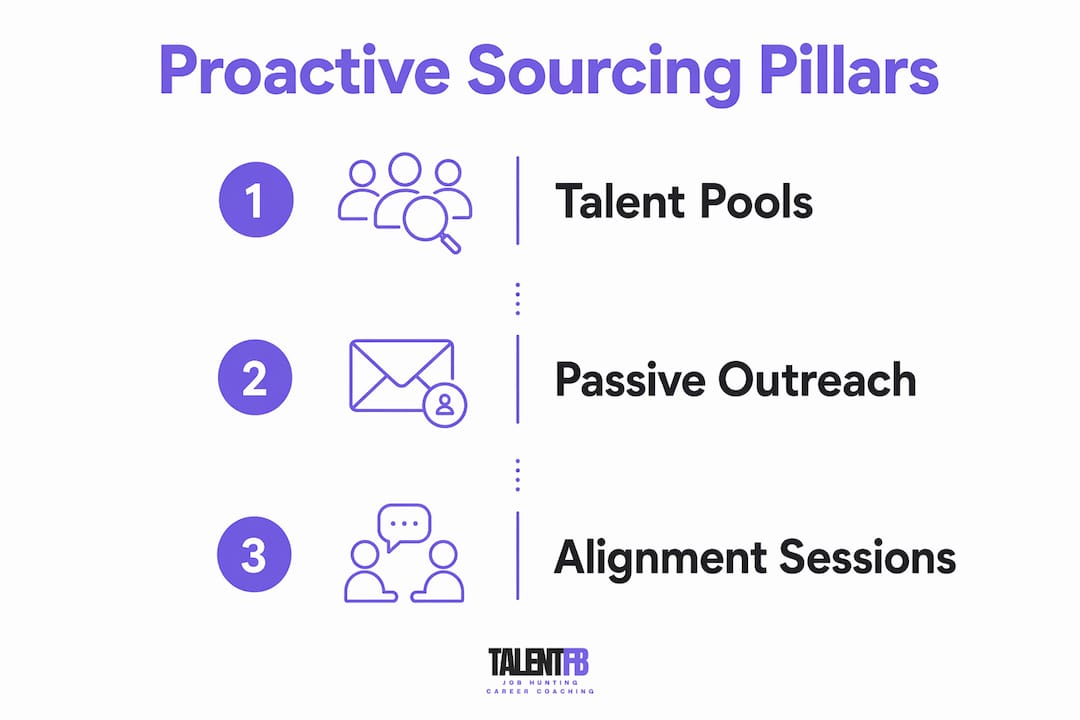
Quarterly alignment sessions between recruiters and hiring managers are the operational glue. These sessions calibrate the pipeline against upcoming headcount, surface new role requirements early, and prevent the classic failure mode where a sourcer builds a pool for a role that has quietly changed scope. Regular alignment reduces hiring surprises and keeps sourcing effort pointed at the right targets.
Pro Tip: Before any outreach goes out, every role needs a brief that answers four questions: What are the immediate six-month realities of this role? What is the compensation ceiling? What did the previous person find most challenging? And why is this company worth leaving a stable employer for? No brief, no outreach.
When is proactive sourcing the right primary channel?
Three questions help you decide quickly.
First: Is the role senior or highly specialized? Cybersecurity architects, senior data engineers, and AI infrastructure leads require proactive outreach rather than job boards because passive candidate concentration in these functions is extremely high. Second: Is the role mission-critical with low tolerance for a long vacancy? A VP of Engineering vacancy that stalls a product roadmap cannot wait for inbound applications. Third: Is the talent pool genuinely scarce, meaning fewer than a handful of qualified candidates are actively searching at any given time?
If you answer yes to two or more of those questions, proactive sourcing should be your primary channel. Job boards and inbound channels remain appropriate for high-volume, lower-seniority roles where active candidates are plentiful and speed is less dependent on relationship depth.
How to implement proactive sourcing step by step
The outcome is faster, higher-quality hires for teams and faster visibility for senior executives managing their own career trajectory. Here is the sequence.
- Define role briefs (Week 1–2): Document the brief quality standard for every target role. No outreach without a completed brief.
- Build your talent map (Week 2–4): Use AI mapping tools to identify 50–100 candidates per priority function. Segment by seniority, location, and readiness signal.
- Load your CRM (Week 3–4): Import segmented lists, tag by function and engagement status, and set reminder cadences.
- Launch outreach sequences (Week 4 onward): For niche senior roles, start sourcing several months ahead of an expected opening; for recurring engineering roles, begin a few weeks ahead.
- Run quarterly alignment sessions: Calibrate pool health against headcount forecasts. Adjust outreach intensity based on pipeline coverage ratio.
- Measure and iterate: Track time-to-engage, engagement rate, and pipeline-to-hire ratio monthly.
Sample outreach cadence for a senior engineering role:
- Day 1: Personalized LinkedIn connection with a one-line context note (no ask)
- Day 7: Value share — a relevant article, insight, or community event
- Day 21: Soft intro message referencing their work and a specific reason for reaching out
- Day 45: Calendar touchpoint — a brief conversation offer, no pressure
- Day 90: Re-engagement with a new value share or role update
Roles and responsibilities:
| Role | Primary Responsibility | Key Deliverable | Frequency |
|---|---|---|---|
| Recruiter | Outreach execution, CRM hygiene | Engaged pipeline per function | Weekly |
| Sourcer | Talent mapping, pool segmentation | Candidate shortlists | Bi-weekly |
| Hiring Manager | Brief quality, candidate feedback | Approved role brief | Per req + quarterly |
| Talent Marketing | Content and employer brand signals | Nurture content calendar | Monthly |
For tooling, you need four categories: a candidate CRM, an AI talent-mapping platform, a content hub for nurture assets, and an analytics layer to track pipeline health. Exploring modern AI-driven alternatives in each category is worth the time before you commit to a stack.
Common mistakes teams make when adopting proactive sourcing
- Treating sourcing as extra work. Proactive sourcing only becomes a capability when embedded in standard workflows. Fix: add it to recruiter KPIs from day one.
- Vague networking with no brief. Outreach without a role brief produces misaligned conversations. Fix: enforce the brief quality gate before any message goes out.
- No CRM. Spreadsheets cannot maintain relationship context at scale. Fix: implement even a lightweight CRM before building pools.
- One-off emails. A single cold message is not a sequence. Fix: build a minimum four-touch cadence with value between asks.
- Ignoring passive candidate experience. Generic copy signals low effort. Fix: personalize every first touch with a specific reference to the candidate’s work.
- No measurement baseline. Without a current time-to-fill benchmark, you cannot prove ROI. Fix: document baseline metrics before the pilot starts.
“The shift from concept to operational practice is the main barrier. Companies must embed proactive sourcing into recruiter KPIs and briefs — not treat it as a nice-to-have layer on top of reactive hiring.”
Tallenxis Proactive Sourcing Guide 2026
How to measure whether proactive sourcing is working
Success looks like a shorter time-to-fill combined with higher interview-to-offer quality. These five KPIs give you the full picture.
| KPI | Definition | Sample Target (Senior Roles) |
|---|---|---|
| Pipeline coverage ratio | Warm candidates per expected hire | 20–50 per open req |
| Time-to-engage | Days from role open to first qualified interview | — |
| Engagement rate | % of outreach recipients who respond meaningfully | — |
| Pipeline-to-hire | Candidates entering pool vs. offers accepted | — |
| Forecast accuracy | Headcount filled within planned window | 80%+ |
The pipeline coverage ratio is the single most useful anchor for senior roles. If your coverage ratio drops below 20 warm candidates per expected hire, sourcing intensity needs to increase before the req opens, not after.
Your 30/60/90 day launch checklist
Days 1–30 (Foundation):
- Document current time-to-fill as your baseline
- Write role briefs for the top three priority functions
- Run an initial talent map for each function (50+ candidates each)
- Select and configure your CRM
- Schedule the first quarterly alignment session with hiring managers
Days 31–60 (Activation):
- Load segmented candidate lists into CRM
- Launch outreach sequences for priority pools
- Publish first nurture content piece to LinkedIn or email
- Hold the first alignment session; calibrate pool targets
- Track engagement rate weekly
Days 61–90 (Optimization):
- Review pipeline coverage ratio against the 20–50 target
- Identify and fix low-engagement sequences
- Document first pipeline-to-hire data point
- Present ROI case to leadership using baseline vs. current time-to-fill
- Assign ongoing ownership for each function’s pool
Quick wins to aim for in the first 30 days: a completed brief for every priority role, a talent map with at least 20–50 candidates per function, and a CRM with active sequences running.
How proactive sourcing fits your broader talent acquisition strategy
Proactive sourcing does not replace your talent acquisition strategy. It sharpens it. When talent pools are healthy, employer branding content has a ready audience. When alignment sessions are running quarterly, workforce planning becomes more accurate. Building talent pools through content and community converts passive interest into active pipeline, which supports diversity goals and long-term retention simultaneously.
For senior executives managing their own visibility, the same logic applies. Publishing thought leadership in channels that hiring managers read positions you as a pre-qualified candidate before any search begins. That is the talent pipeline advantage that separates executives who land roles in 60 days from those who spend six months reacting to job posts.
Data privacy and compliance in proactive sourcing
Proactive sourcing involves storing and processing personal data on candidates who have not applied for a role. In the United States, this means operating within the framework of applicable state privacy laws, including the California Consumer Privacy Act (CCPA) for California residents, and sector-specific regulations where relevant. At minimum, your CRM should document the lawful basis for storing each candidate’s data, provide a clear opt-out mechanism in every outreach sequence, and purge records that have not been refreshed within a defined retention window (typically 12–24 months). Candidates who ask to be removed must be honored promptly. This is not just a legal requirement; it protects your employer brand with the very people you are trying to attract.
What proactive sourcing looks like in practice in 2026
A mid-size fintech company with a recurring need for senior security engineers stopped posting roles and instead built a segmented pool of 80 pre-vetted candidates over 90 days. When a VP-level security role opened, the team had warm candidates already in conversation. Time-to-fill dropped significantly, and the accepted offer came from a candidate who had been nurtured well before the req was approved.
On the individual side, a VP of Engineering used the same logic in reverse. She identified the five companies she wanted to work for, mapped their engineering leadership teams on LinkedIn, and began publishing weekly posts on distributed systems architecture. Within 90 days, two of those hiring managers had engaged with her content, and one reached out directly. She never applied through a job board. This is what passive job search strategy looks like when it is executed with intent.
How to train your recruiting team on proactive sourcing skills
The most common training gap is not tool proficiency. It is the mindset shift from reactive to relationship-based work. Start with a half-day workshop that covers three things: the brief quality standard (what a good brief looks like and why it gates outreach), the difference between a warm touchpoint and a cold pitch, and how to read engagement signals in a CRM. Follow that with a 30-day live pilot on one priority role, with weekly coaching check-ins to review outreach copy and pipeline health. Recruiters who run one successful proactive pilot internalize the model faster than any training module can deliver. Pair new practitioners with a sourcer who has run sequences before, and measure their engagement rate weekly rather than their resume volume.
The perspective that most teams miss
What most hiring teams get backwards about proactive sourcing
The common assumption is that proactive sourcing is a recruiting team problem. It is not. It is a leadership problem. The reason most proactive sourcing programs stall is not a lack of tools or even a lack of time. It is that hiring managers have never been asked to own a role brief before a req opens. They hand over a job description when the role is urgent, and then wonder why the pipeline is thin.
The brief quality standard changes that dynamic. When a hiring manager has to answer what the previous person found most challenging, and why a strong candidate should leave a stable role for this one, the conversation shifts from transactional to strategic. That is where proactive sourcing actually starts, not in the CRM.
For senior executives on the candidate side, the same inversion applies. Most professionals wait to be found. The ones who move fastest are the ones who build visibility with hiring managers before any search begins, publishing in the right channels, engaging with the right people, and making it easy for a hiring leader to say “I already know this person.” That is not luck. That is a system.
TalentFB helps senior tech professionals get ahead of the search
If you are a senior tech professional who wants to stop reacting to job posts and start being found before roles open, TalentFB’s career coaching for tech executives gives you the exact system to build that visibility. The JobSearch/OS™ program has helped many Directors, VPs, and senior managers land their next role within a few months, often with a significant salary increase, by starting with hiring managers rather than job applications.
If you lead a team and want to attract senior talent without executive search fees, Talent/OS™ rebuilds your LinkedIn presence and content system so the right candidates come to you. Explore the personal branding framework for executives and see how the system works. When you are ready to move, book a strategy call and we will map out your next 90 days together.
Further reading and authority sources
- TalentFB: Talent Pipeline Advantage for Senior Tech Leaders
- TalentFB: Passive Candidate Outreach Guide 2026
- VamoTalent: Pre-Sourcing in Recruitment — Build Pipelines Before Roles Open
- Tallenxis: Proactive Sourcing Strategy Guide 2026
- PageUp: Proactive Sourcing and Talent Pipelining
- Forbes Human Resources Council: Proactive Sourcing as the 2026 Speed Advantage