
TL;DR:
- Most senior technology executives lack a strategic LinkedIn approach that drives career and business outcomes.
- Aligning LinkedIn activities with organizational goals and showcasing leadership impact enhances visibility for board and executive opportunities.
Most senior technology executives have a LinkedIn profile, but far fewer have a LinkedIn strategy. There is a meaningful difference. Profiles filled with impressive titles and technical credentials attract views, yet fail to generate board introductions, strategic partnerships, or the kind of executive visibility that actually moves careers forward. Research consistently shows that when executive visibility drives pipeline, tangible outcomes follow. This guide cuts through the noise and delivers the specific, strategy-driven moves that tech executives need to turn LinkedIn from a passive resume placeholder into an active leadership asset.
Table of Contents
- Align LinkedIn networking with executive business priorities
- Optimize your LinkedIn profile for executive discoverability
- Showcase leadership impact in executive terms, not just technical expertise
- Engage intentionally: Building influence, not just connections
- Why the standard LinkedIn playbook isn’t enough for tech executives
- Next steps to elevate your executive LinkedIn strategy
- Frequently asked questions
Key Takeaways
| Point | Details |
|---|---|
| Strategic alignment | Executive LinkedIn networking works best when integrated with business priorities for measurable impact. |
| Discoverability tactics | Optimizing your profile for recruiter searches and visibility controls increases leadership opportunities. |
| Leadership language | Using board-level terminology signals mandate fit and distinguishes executive profiles from technical peers. |
| Intentional engagement | Influence grows by orchestrating interactions and content with strategic audiences—not just expanding connections. |
| Pipeline focus | Chasing likes and comments misses the mark; focus on actions tied to executive pipeline and outcomes. |
Align LinkedIn networking with executive business priorities
With the challenge established, let’s start by reframing LinkedIn networking for executives as a strategic communication pillar, not a social media hobby.
Most executives treat LinkedIn as a separate activity, something to update when job searching or “engage with” during downtime. That instinct is understandable, but it is also costly. The most effective executive LinkedIn programs are woven directly into a broader communications strategy that serves measurable business goals, whether those goals are building pipeline, strengthening board candidacy, or accelerating a leadership transition.
Executive LinkedIn networking works best when it is treated as an integrated communications strategy aligned to business priorities, not as a standalone digital presence. Think of it this way: a CTO who publishes bylines in trade media, amplifies those pieces on LinkedIn, and then participates in relevant conversations creates a compounding visibility cycle. Each element reinforces the others. That is an orchestrated strategy.
What executives should track vs. what they typically track
| What executives typically track | What actually matters |
|---|---|
| Post likes and comment volume | Pipeline conversations initiated |
| Connection count growth | Quality introductions made |
| Profile view count | Recruiter or board outreach received |
| Follower growth rate | Content cited by peers or media |
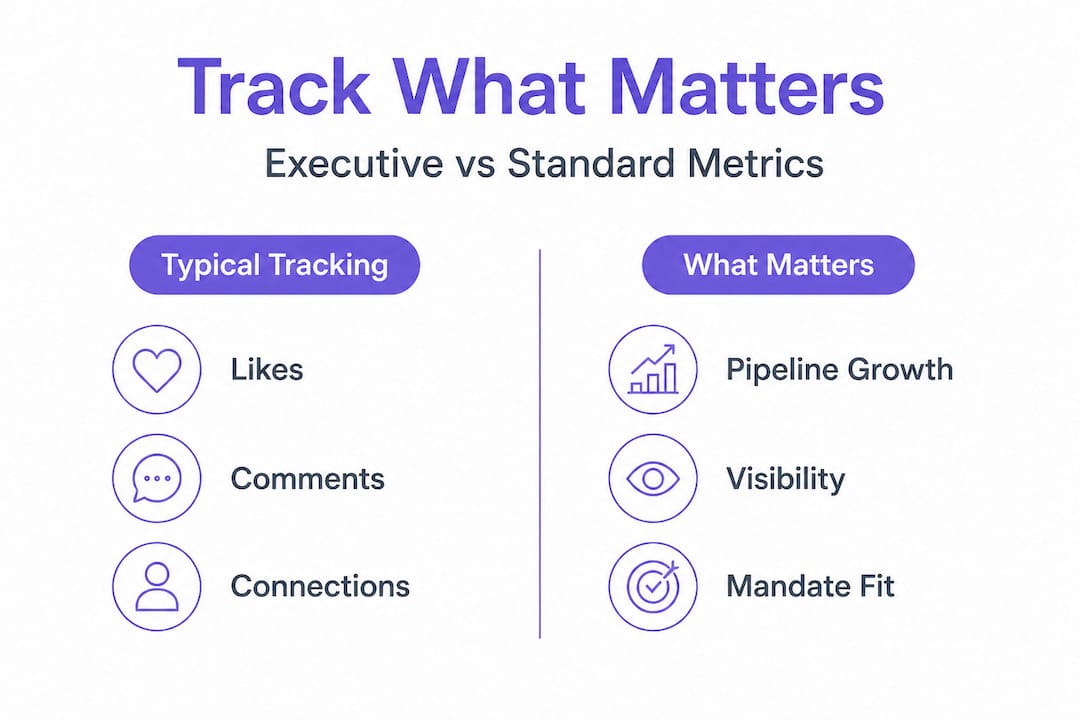
The table above makes the contrast visible. Vanity metrics feel satisfying because they are immediate and easy to measure. But for a VP of Engineering considering a C-suite move, or a Chief Product Officer exploring board advisory roles, the real indicators are fundamentally different.
Here is a practical framework for aligning LinkedIn with executive goals:
- Define the outcome first. Are you building pipeline for a business development goal, positioning yourself for a board seat, or signaling readiness for a CEO transition?
- Map content to that outcome. Each post, comment, or article should serve one of your defined goals, not just fill the feed.
- Integrate with other earned channels. Speaking engagements, published articles, and media interviews should cross-pollinate with LinkedIn activity to maximize reach.
- Review quarterly. Executive visibility is a long game. Audit your activity every quarter against your stated business priorities.
You can also build on this by reviewing the AI Job Search Playbook, which provides a structured approach to aligning your LinkedIn presence with specific career or business milestones.
Optimize your LinkedIn profile for executive discoverability
Once your networking strategy is aligned, optimizing your LinkedIn profile for discoverability unlocks the next level of executive visibility.
Senior executives are often surprised to learn that LinkedIn functions partly as a search engine. Recruiters, board directors, and investors use keyword-driven searches to surface candidates, advisors, and partners. If your profile lacks the right signals, you simply will not appear, no matter how impressive your track record.
From a discoverability standpoint, senior executives should ensure their profile is search-optimized for executive recruiters. That means going beyond job titles and thinking carefully about the language your ideal searcher would use to find someone like you.
Key optimization steps for executive profiles
- Complete every profile section fully. Partially filled profiles rank lower in LinkedIn’s algorithm. Your headline, summary, all experience entries, skills, and featured section should be complete and current.
- Lead with your most critical keyword in the first 300 characters. LinkedIn’s search algorithm weights the opening of your summary heavily. A phrase like “Chief Technology Officer | SaaS Scale-Up | Digital Transformation” signals intent and seniority immediately.
- Use full titles, not acronyms. Many executives shorten their titles or rely on internal company language. Recruiters search for “Vice President of Engineering,” not “VP Eng.”
- Activate the recruiter-only visibility setting. This setting allows your profile to appear in recruiter sourcing searches while keeping activity discreet from your current employer’s network, a critical option for executives conducting confidential searches.
- Keep activity signals active. Commenting and posting regularly signals to LinkedIn’s algorithm that your profile is current and relevant, which improves your ranking in search results.
“The profile summary is your first executive handshake. It must communicate scope, authority, and direction within seconds, not paragraphs.”
You can explore deeper guidance on LinkedIn profile optimization tailored specifically for senior technology roles, as well as how LinkedIn recruitment guidance applies to executives at the VP level and above.
Common discoverability mistakes
| Mistake | Impact | Fix |
|---|---|---|
| Acronym-heavy title (e.g., “SVP, GTM Ops”) | Missed recruiter searches | Spell out full titles |
| No activity for 90+ days | Lower search ranking | Post or comment weekly |
| Generic headline (“Experienced Leader”) | Fails keyword filtering | Use specific role and domain |
| Weak About section | No differentiation | Lead with outcomes and scope |
Pro Tip: Use board-appropriate terminology in your leadership sections. Words like “governance,” “fiduciary oversight,” “capital allocation,” and “organizational transformation” signal executive maturity to board nominating committees and executive search firms who specialize in C-suite and non-executive director placements.
Working with executive recruiters in tech also becomes significantly more productive when your profile meets their search criteria before they even reach out.
Showcase leadership impact in executive terms, not just technical expertise
After optimizing for search discovery, the next step is demonstrating your mandate fit through strategic language that resonates with C-suite stakeholders and board members.

This is where many technology executives plateau. They have stellar credentials and genuine impact, but their LinkedIn language still reads like a senior technical contributor rather than an organizational leader. Boards and executive search firms are not scanning for technical skills. They are looking for evidence of decision quality, organizational scope, and strategic transformation.
Present leadership language in business and board terms, specifically scope, outcomes, and decision quality, rather than purely technical descriptors. This shift in language is not about hiding your technical depth. It is about framing it in terms that matter to a board director or an incoming CEO evaluating potential C-suite peers.
Language that signals executive maturity
- Replace “Led development of cloud architecture” with “Directed $12M infrastructure modernization, reducing operational costs by 23% and enabling a 40% increase in platform uptime.”
- Replace “Managed engineering teams” with “Built and scaled a 120-person engineering organization across four countries, establishing succession pathways for three senior directors.”
- Replace “Worked on AI/ML initiatives” with “Drove AI-powered product strategy that contributed $4.2M in incremental revenue within 18 months.”
Notice that each revision introduces scope, financial impact, and organizational consequence. These are the three axes that board-level stakeholders evaluate when assessing executive readiness.
“The executives who earn board advisory roles are those who demonstrate they can hold organizational risk, not just technical complexity.”
Avoid buzzwords that have lost all signal value: “visionary,” “thought leader,” “passionate,” and “innovative.” These words appear on virtually every executive profile and actively dilute your credibility. Replace them with specific, verifiable claims about what you changed, how large the organization was, and what the financial or strategic outcome was.
Pro Tip: Review your executive success profile against an executive visibility scorecard to identify gaps in how you are communicating scope and mandate fit. Even small language adjustments can dramatically shift how you are perceived at the board level.
Strong leadership language also applies to your recommendations, featured posts, and any LinkedIn articles you publish. Every piece of content on your profile contributes to the overall narrative you are building.
Engage intentionally: Building influence, not just connections
Once your profile and language are structured for leadership visibility, the final pillar is engaging in ways that genuinely drive influence and strategic outcomes.
The most common trap for senior executives on LinkedIn is activity without strategy. Commenting on trending posts, accepting every connection request, and posting about personal milestones generates engagement numbers but rarely advances a career agenda. Executives who build real influence on LinkedIn are deliberate about where, when, and why they engage.
Teams should orchestrate earned and owned integration, combining bylines, LinkedIn posts, and interviews, while avoiding optimizing solely for engagement. This principle applies directly to your individual executive presence.
A strategic engagement framework for tech executives
- Identify your target audience of 30 to 50 key stakeholders. These are the board directors, investors, CEOs, and senior executives whose attention directly supports your career or business goals. Follow them, and engage thoughtfully with their content first.
- Post original perspectives, not reshared articles. Curated content signals passivity. Original posts, even short ones that offer a distinct point of view on a technology trend or business challenge, build executive authority faster.
- Comment with substance, not affirmation. A comment that says “Great insights!” adds nothing. A comment that adds a counter-perspective, a relevant data point, or a real-world example positions you as a peer, not an admirer.
- Send targeted, personalized connection messages. When reaching out to influential contacts, reference something specific: a talk they gave, a decision their company made, or a shared professional context. Generic “I’d like to connect” messages are ignored at the executive level.
- Publish LinkedIn articles on leadership and strategy topics. Long-form content amplifies your profile in search, establishes topical authority, and gives your network a reason to share your perspective broadly.
- What to post about: Industry transformations, organizational lessons learned, perspectives on technology strategy, commentary on market shifts in your domain
- What to avoid: Motivational quotes without context, personal milestones that lack professional relevance, commentary on topics outside your credibility zone
- Cadence that works: Two to three substantive posts per month, combined with five to ten thoughtful comments per week, outperforms daily low-value activity
You can refine these executive networking strategies further and pair them with executive job search strategies that ensure your LinkedIn engagement translates into real career momentum.
Pro Tip: Before posting, ask yourself one question: “Would a board director or CEO find this perspective worth their 60 seconds?” If the answer is uncertain, revise the framing toward a business outcome, a strategic observation, or a leadership lesson before publishing.
Why the standard LinkedIn playbook isn’t enough for tech executives
Stepping beyond the how-to, here is a candid perspective on what most executive networking articles miss, and how you can stand apart in tech leadership circles.
Most LinkedIn advice is built for one audience: professionals building general career visibility. The tactics work well enough for mid-level managers looking to grow a network. But for a VP, SVP, or C-suite executive in technology, following that same playbook is not just ineffective. It can actively undermine your positioning.
Here is the uncomfortable truth: executives who optimize for engagement often damage their executive brand without realizing it. When a CTO posts daily motivational content or chases viral topics outside their credibility zone, they signal volume over judgment. Boards and senior search firms notice. They are not looking for the most active LinkedIn user. They are looking for evidence of strategic thinking, sound decision-making, and a credible leadership narrative.
The executives who successfully transition into C-suite roles or board positions using LinkedIn are not the ones with the most followers. They are the ones who have built a tightly focused, coherent narrative that aligns their visible activity with the mandates those roles require. They treat visibility as a byproduct of having something genuinely important to say, not as the goal itself.
We have seen this play out repeatedly. Leaders who shifted from technical showcasing to business-aligned LinkedIn strategies, emphasizing transformation outcomes, organizational scope, and strategic pivots, began receiving meaningful inbound interest within 60 to 90 days of making that shift. Not because they posted more, but because they posted with clarity of purpose.
If you want to explore proven approaches used by senior tech job seekers navigating competitive markets, the pattern is consistent: deliberate narrative, integrated strategy, and restraint in engagement beat volume every time.
A simple LinkedIn connection workflow
LinkedIn gives senior tech professionals something in person networking cannot: reach across companies and countries, and a public record of how you think. The advantage only appears if you work it with a routine.
- Prepare first. Make sure your headline and About section say what you do and for whom before you send any requests.
- Pick 10 to 15 people a week at your target companies or in your field. Quality beats volume.
- Personalise every request. One or two lines on why you want to connect: a post of theirs, a shared interest, a mutual contact.
- Follow up after they accept. Do not pitch. Comment on their work, share something useful, or ask one good question.
- Stay visible. Comment thoughtfully on posts from your network a few times a week. It keeps you in their feed without asking for anything.
- Move to a conversation when there is a natural reason: a shared topic, a question about their company, an event you are both attending.
Common problems are easy to spot: low acceptance usually means a weak profile or generic requests, and no replies usually means you asked too soon. Fix those before you increase volume.
Next steps to elevate your executive LinkedIn strategy
After understanding the real networking game, here is how you can accelerate your LinkedIn strategy with specialized support.
Knowing the right tactics is only the first step. Executing them with precision, especially while managing a demanding leadership role, is where most executives stall. That is exactly the gap that TalentFB is designed to close.
TalentFB’s career coaching for executives provides a structured, AI-powered approach that translates these LinkedIn strategies into a personalized action plan, covering profile optimization, leadership narrative development, targeted outreach, and recruiter engagement. Our programs are built specifically for senior technology professionals who want results within 90 days, not 90 weeks. Explore the LinkedIn recruitment insights that drive executive discoverability, and get started with the LinkedIn career branding playbook to build a strategy that actually works at the executive level.
Frequently asked questions
How can executives make their LinkedIn profiles visible to recruiters without alerting their current employer?
Executives can use the “recruiter-only” visibility setting so their profile appears in recruiter searches without surfacing prominently in their current employer’s network activity feed.
What LinkedIn engagement metrics matter most for executives seeking leadership roles?
For executives, metrics tied to pipeline growth and leadership visibility are more important than post likes or comments, because a mismatch between visibility and outcomes breaks executive visibility programs before they deliver results.
Should executives use technical jargon on LinkedIn?
Executives should emphasize leadership outcomes and mandate fit, using board-level language in all leadership sections rather than technical jargon that may limit their perceived scope.
What are the most common mistakes executives make with LinkedIn networking?
Chasing engagement metrics and using generic descriptors instead of aligning LinkedIn presence with business priorities are the most frequent errors, since optimizing solely for engagement disconnects executive visibility from the strategic outcomes that actually matter.