

TL;DR:
- Successful executive transitions rely on preparation, strategic clarity, and structured processes.
- Mapping purpose to specific activities like board membership or consulting guides effective role choice.
- Coaching, mentorship, and realistic timelines accelerate reinvention and reduce feelings of isolation.
Stepping away from a senior technology role, whether by choice or circumstance, can feel like standing at the edge of a vast and unfamiliar landscape. You have spent years building expertise, leading teams, and delivering results, yet when the corporate safety net disappears, many experienced executives describe a surprising sense of isolation and uncertainty. That feeling is both common and valid. What separates executives who successfully pivot into their next leadership chapter from those who stall is not talent or experience. It is preparation, strategic clarity, and a willingness to engage a structured process. This guide gives you that process.
Table of Contents
- Assessing readiness for an executive transition
- Strategic mapping: Identifying new pathways and roles
- Leveraging coaching and mentorship to accelerate growth
- Mastering the executive job search: Tools and proven strategies
- The uncomfortable truth about executive reinvention
- Next steps: Transition resources and coaching
- Frequently asked questions
Key Takeaways
| Point | Details |
|---|---|
| Self-assessment is vital | Understanding motivations and vulnerabilities ensures a smoother transition for executives. |
| Strategic planning wins | Mapping purposes to activities aligns skills with leadership pathways and accelerates growth. |
| Coaching accelerates progress | Mentors and professional coaches reduce isolation and provide actionable feedback. |
| Advanced job search tools | Using executive-specific strategies and optimizing your digital presence secures top roles more efficiently. |
| Embrace discomfort | Acknowledging and accepting the emotional challenges of transition leads to meaningful reinvention. |
Assessing readiness for an executive transition
Having introduced the challenge, let’s evaluate how prepared you are for an executive career transition.
Most senior professionals underestimate how much their identity is tied to their current role. When that role ends, the vacuum can be disorienting. Before you update your LinkedIn profile or send a single outreach message, an honest self-assessment is essential. Research confirms that mid-career switches grow harder with increased tenure, because vulnerabilities multiply as the gap between your last role and a new opportunity widens. Planning for those vulnerabilities is not a sign of weakness. It is the first act of strategic leadership.
Use the following checklist to gauge your transition readiness:
- Motivation clarity: Can you articulate, in one clear sentence, why you are making this move?
- Financial runway: Do you have at least 6 to 12 months of living expenses secured, giving you negotiating leverage?
- Network strength: Have you maintained relationships outside your immediate organization?
- Skills inventory: Have you mapped your competencies against current market demand?
- Emotional resilience: Are you prepared for the uncertainty and occasional rejection that come with a major pivot?
- Support system: Do you have peers, mentors, or advisors who will offer honest, sometimes uncomfortable feedback?
That last point deserves particular attention. Welcoming critics, not just cheerleaders, is one of the most underutilized assets in an executive reinvention journey. Many executives surround themselves with supportive networks that validate existing beliefs rather than challenge them. A realistic transition plan requires people willing to tell you what is not working.
| Readiness dimension | Early stage | Transition ready |
|---|---|---|
| Motivation clarity | Vague or reactive | Specific and proactive |
| Financial buffer | Less than 3 months | 6 to 12 months |
| Skills mapping | Not completed | Documented and current |
| Network strength | Mostly internal | Active external network |
| Emotional readiness | Avoidant | Engaged and reflective |
Pro Tip: Use a career development checklist specifically designed for tech leaders to identify gaps before you launch your search. Addressing one gap per week builds momentum without overwhelming your schedule.
Revisiting your core driver, the fundamental reason you are making this move, is not a one-time exercise. As the transition progresses and new opportunities surface, your core driver will serve as a compass. Executives who skip this step often find themselves six months into a search, entertaining roles that pay well but feel hollow.
Strategic mapping: Identifying new pathways and roles
Once readiness is assessed, the next step is strategically mapping out new pathways tailored to your strengths and goals.
Not every post-corporate path looks the same, and that is actually an advantage for experienced tech executives. Research from Kellogg School of Management shows that post-corporate executives map purposes such as learning, engagement, and relevance to specific activities including board membership, academic teaching, and independent consulting, but they must go in with eyes fully open to the differences between each option.
Consider the three primary purposes that drive executive transitions:
- Learning: You want to absorb new domains, industries, or models of leadership.
- Engagement: You want to stay active, contribute meaningfully, and remain in the professional conversation.
- Relevance: You want your expertise to continue influencing outcomes at scale.
Each purpose maps to different activities, and each activity carries different demands, timelines, and reward structures.
“Mapping your post-corporate purpose to the right activity is not optional. Without that alignment, you risk investing months into a pathway that does not match your motivations or your market value.”
A critical distinction many executives overlook is the difference between public and private board roles. Public company boards carry fiduciary responsibilities, regulatory scrutiny, and reputational exposure that private boards do not. They also require a different preparation process, including board-ready executive biographies, governance literacy, and in many cases, prior board experience. Exploring strategic career growth paths through a structured framework helps you avoid pursuing the wrong type of board without the right preparation.

| Pathway | Time to first engagement | Primary qualification needed | Compensation model |
|---|---|---|---|
| Public board member | 12 to 24 months | Governance experience, C-suite tenure | Retainer plus equity |
| Private board advisor | 3 to 9 months | Domain expertise, network depth | Equity or project fees |
| Independent consultant | 1 to 6 months | Specialized skills, client network | Hourly or retainer |
| Academic or adjunct faculty | 6 to 18 months | Subject expertise, communication | Salary or per-course |
| Interim executive | 2 to 8 months | Functional leadership experience | Daily or monthly rate |
Understanding these timelines is important because many executives enter transitions expecting quick wins, then lose momentum when results take longer than anticipated. A proven executive job search strategy accounts for these realistic timelines and builds parallel pipelines rather than betting on a single pathway.
Leveraging coaching and mentorship to accelerate growth
After mapping potential pathways, leveraging mentors and coaches can accelerate your progress and help overcome obstacles.
One of the quieter truths about executive career transitions is that they can be profoundly lonely. You have spent years operating within structures, teams, and reporting lines that provided both purpose and community. When those disappear, many executives find the silence louder than expected. This is precisely where executive coaching delivers its most immediate value, not just as a tactical resource, but as a structural anchor during a period of identity reconstruction.
Here is a practical sequence for building and maximizing your coaching and mentorship ecosystem:
- Identify your development gaps first. Before selecting a coach, know what you need. Is it accountability, strategic clarity, communication skills, or negotiation capability? The clearest brief gets the best result.
- Distinguish between a mentor and a coach. Mentors share lived experience and perspective from similar journeys. Coaches use structured frameworks to challenge your thinking and hold you accountable. Both are valuable, but they serve different functions.
- Seek coaches with executive transition experience in tech. Generic career coaches rarely understand the nuances of the technology sector, including how engineering leadership roles differ from product leadership roles, or how compensation structures work at series B startups versus publicly traded companies.
- Schedule regular check-ins and honor them. Sporadic engagement produces sporadic results. Weekly or biweekly sessions with a coach create the rhythm of progress and prevent the inertia that derails many transitions.
- Welcome difficult feedback actively. Ask your coach and mentors directly, “What am I not seeing?” That question alone can surface blind spots that would otherwise cost you months of misdirected effort.
Pro Tip: Review executive coaching strategies before your first session. Having a clear sense of your goals and the questions you want to explore makes every coaching engagement more productive and cost-effective.
Research reinforces this approach. Career reinvention is described as lonely and daunting, and not something every executive navigates successfully alone. The executives who shorten their transition timelines most dramatically are typically the ones who invest earliest in structured guidance. Understanding the tech leadership coaching benefits available in today’s market gives you a clear starting point for selecting the right partner for your specific situation.
Mastering the executive job search: Tools and proven strategies
With coaching guidance in place, you can now implement proven strategies to position yourself for high-level roles in tech.
The executive job search operates by different rules than the mid-level search, and many experienced professionals make the mistake of applying outdated tactics. Sending mass applications through job boards, for instance, is almost never effective at the leadership level. Most senior technology roles are filled through referrals, retained search firms, or direct outreach, often before a public posting exists.
Here are the core tools and practices for a modern executive job search:
- Optimize your LinkedIn profile for leadership positioning. Your headline, about section, and featured content should communicate your leadership philosophy and domain expertise, not just a job title history. LinkedIn optimization tips specific to executives can significantly increase inbound interest from recruiters and search firms.
- Build a target company list of 30 to 50 organizations. Research their leadership structures, recent funding or M&A activity, and strategic priorities. Personalized outreach to decision-makers at these companies will outperform broad applications every time.
- Activate your existing network with intention. Map your first-degree connections to your target list. Request warm introductions to hiring managers, board members, and retained search consultants. Research from Kellogg School of Management confirms that post-corporate executives who actively engage their networks with a clear purpose outperform those who rely on passive visibility alone.
- Develop a crisp executive narrative. Be able to communicate your value in 90 seconds in a conversation and in two paragraphs in writing. Ambiguity at the leadership level raises red flags.
- Engage two to three retained search firms in your sector. These firms fill a significant portion of C-suite and VP-level technology roles. Building relationships with consultants at these firms is a long-term investment that pays compounding returns.
| Job search channel | Effectiveness at executive level | Time investment | Key action required |
|---|---|---|---|
| LinkedIn outreach | High | Medium | Optimized profile plus direct messaging |
| Retained search firms | High | Low (once engaged) | Relationship building plus resume |
| Referral from network | Very high | High | Consistent networking plus clear ask |
| Job board applications | Low | High | Targeted, tailored submissions only |
| Speaking or publishing | Medium to high (long-term) | High | Consistent thought leadership |
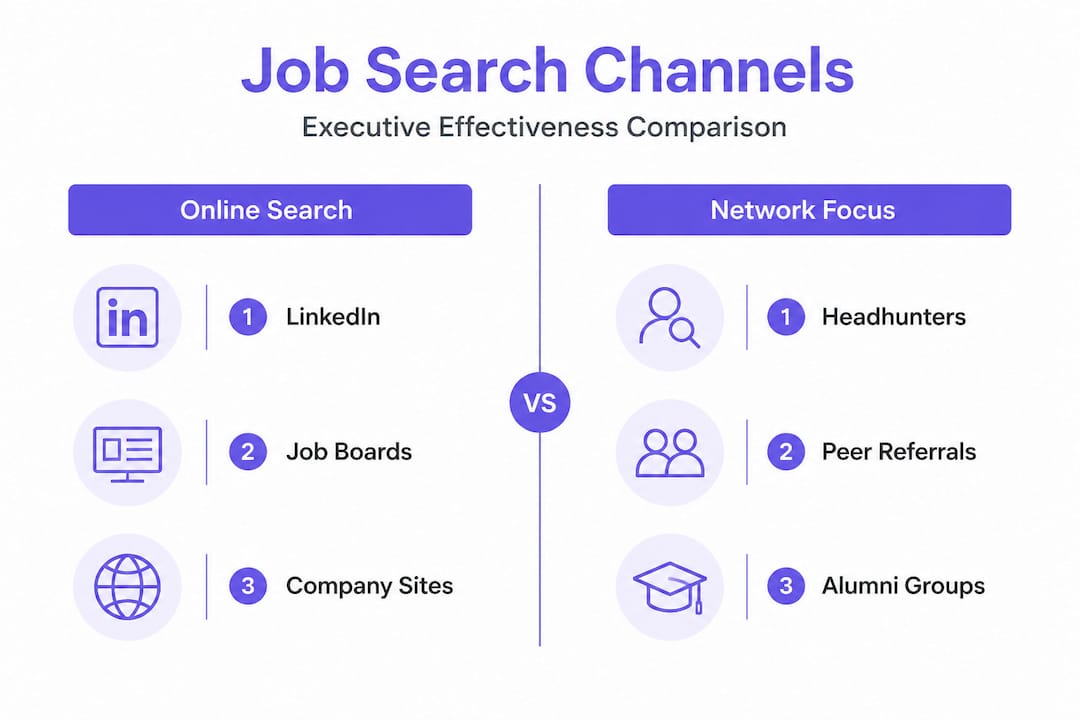
Pro Tip: Explore the tech leadership job search guide for a channel-by-channel breakdown of where senior technology professionals are actually landing their next roles. The data may shift your strategy significantly.
Common mistakes at this stage include neglecting a personal website or portfolio, failing to update references proactively, and underestimating the time required to prepare for executive interviews. At the leadership level, interviewers probe decision-making frameworks, cultural leadership, and strategic vision, not just past accomplishments.
The uncomfortable truth about executive reinvention
While strategies and tactics are essential, it is equally important to address the deeper realities that most executive career guides quietly skip over.
Here is what we rarely say loudly enough: reinvention is lonely, and it is not for everyone. That is not pessimism. It is honesty. Many executives who leave corporate life expect that their credentials will carry them smoothly into the next chapter. What they do not anticipate is the identity erosion that begins when the business card no longer defines them. The title, the team, the daily structure, and the social proof of organizational affiliation, all of it disappears at once.
Reinvention is described as daunting and not universally rewarding. That framing matters. It challenges the notion that a well-structured plan guarantees a smooth outcome. Even with the right tools, the right coach, and the right strategy, there will be weeks where progress feels invisible and the uncertainty feels unsustainable.
What we have seen through the reinvention approaches of many experienced professionals is that the ones who succeed do not eliminate discomfort. They develop a different relationship with it. They treat uncertainty as information, not as evidence of failure. They reframe rejection not as a verdict on their worth but as a signal to refine their targeting or their message.
The conventional career advice framework tends to focus exclusively on execution, the resume, the network, the interviews. What it consistently underweights is the emotional and identity work that must run in parallel. Executives who do both, who master the tactics and do the inner work simultaneously, are the ones who arrive at their next chapter with clarity and conviction rather than exhaustion and compromise.
Next steps: Transition resources and coaching
Ready to act? Here are curated resources and coaching opportunities to guide your next move.
At TalentFB, we work with senior technology professionals who are serious about making their next move with intention and efficiency. Whether you are mapping your post-corporate purpose, rebuilding your digital presence, or preparing for board-level conversations, we have built structured programs to support each phase of that journey.
Our career coaching for executives program provides personalized guidance across strategy, positioning, and outreach. The leadership job search resources on our platform give you practical frameworks used by technology leaders who have successfully secured roles at the VP, SVP, and C-suite levels. For executives who want to move faster using AI-powered outreach and targeting, our AI-powered job search playbook is specifically designed to compress your timeline and sharpen your focus. The right next step begins with a conversation. Reach out and let’s map your path forward together.
Frequently asked questions
What are the biggest challenges in executive career transitions for tech leaders?
Isolation, unclear mapping of skills to new roles, and increased vulnerability are the top issues, with reinvention described as lonely and not universally straightforward for experienced professionals.
How can senior professionals determine the best new pathway after leaving a corporate role?
Mapping personal purposes such as learning or relevance to specific activities like board membership or consulting is the most effective starting point, as post-corporate executives who align purpose to activity enter new roles with greater clarity and commitment.
Is executive coaching necessary for successful career transitions?
Coaching speeds up reinvention, reduces isolation, and delivers critical feedback that most professionals cannot access on their own, making it highly valuable even if not strictly mandatory, especially given that mid-career switches grow harder without structured support.
What should I avoid during an executive job search?
Avoid misaligning your skills with target roles, neglecting your LinkedIn profile and digital presence, and bypassing honest feedback from mentors, as vulnerabilities require planning and ignoring them prolongs the search significantly.