
TL;DR:
- Singapore’s tech job market remains resilient with sustained employment growth, but senior professionals face tighter hiring standards. The market is highly selective, prioritizing niche skills and precise candidate positioning, especially for executive roles. Strategic use of labor data, networking, and targeted upskilling are essential for career advancement in this competitive environment.
Singapore’s senior tech job market in 2026 tells two stories at once. On the surface, employment has expanded for 18 consecutive quarters as of Q1 2026, unemployment remains low, and retrenchments are stable. Yet many senior professionals and executives find themselves navigating a hiring environment that feels surprisingly tight. The disconnect is real, and it matters. Understanding what drives this paradox is not just intellectually useful; it is the foundation of any smart career strategy in technology leadership today.
Table of Contents
- What defines a job market trend in Singapore tech
- Singapore’s 2026 senior tech job market: The facts
- Why resilience doesn’t mean easy opportunity
- Strategies for leveraging job market trends
- A fresh perspective: Why most executives miss the market’s real signals
- How TalentFB helps you turn insights into executive outcomes
- Frequently asked questions
Key Takeaways
| Point | Details |
|---|---|
| Data-driven insights | Singapore’s tech market is growing but demands strategic career moves for advancement. |
| Selective hiring reality | Opportunities are robust, but competition and targeted roles mean not all benefit equally. |
| Actionable frameworks | Understanding market trends empowers smarter job targeting and skill development. |
| Executive strategies | Fast hiring processes, focused upskilling, and leveraging niche demand boost career outcomes. |
| Unlock next steps | Coaching and tailored playbooks can maximize executive results in Singapore’s 2026 market. |
What defines a job market trend in Singapore tech
With the context set, let’s drill down into what a “job market trend” actually means and how it is measured in Singapore’s tech sector. The phrase gets used loosely, often reduced to headlines about hiring freezes or talent shortages. For senior professionals, that kind of surface reading is not enough.
A job market trend is a sustained, measurable shift in the conditions under which talent is hired, retained, and compensated. It is shaped by several interconnected factors:
- Employment levels: The total number of workers employed in a sector over time
- Labor force participation: The proportion of working-age residents actively employed or seeking work
- Skills in demand: Which technical and leadership capabilities attract premium compensation
- Pay movement: How median and upper-quartile salaries shift across role categories
- Hiring velocity: How quickly organizations move from posting to offer, and how selective that process is
One common misconception is that a growing market creates broad opportunity. It does not, especially at the executive level. Growth can be concentrated in specific specializations, such as cloud infrastructure, AI governance, or digital transformation leadership, while demand in adjacent roles stays flat or shrinks. Singapore’s job market remains resilient, but resilience is not uniformly distributed.
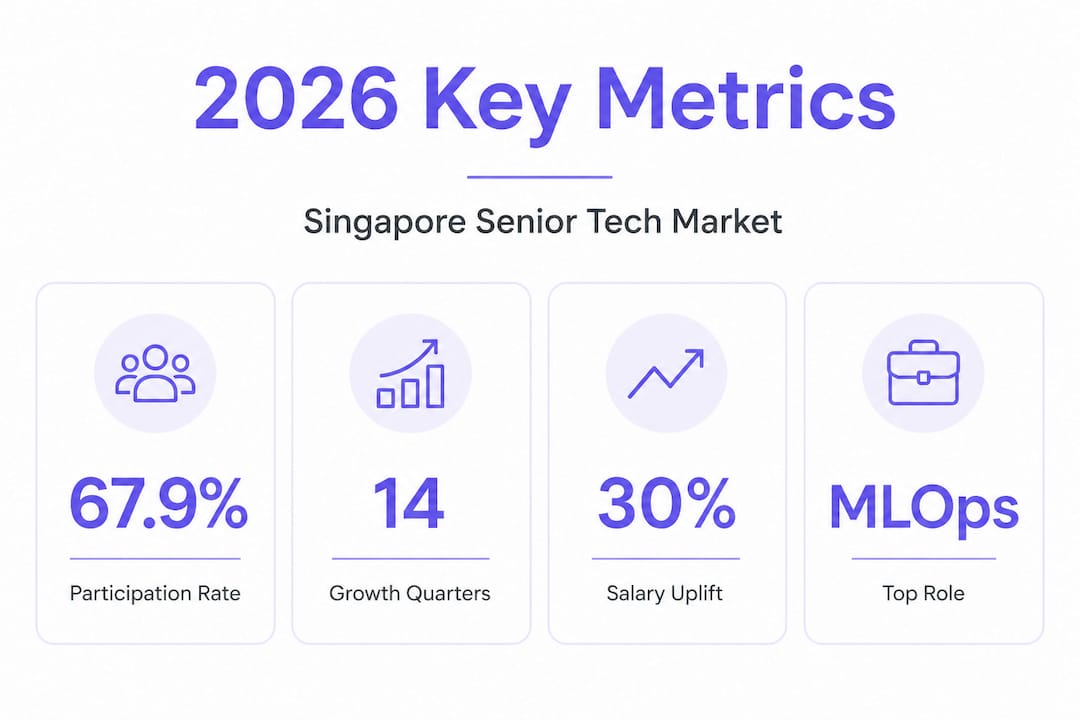
For executives pursuing career growth in tech, the practical implication is clear. You need to read trend data at the role level, not the market level. Knowing that tech employment is up tells you very little. Knowing that MLOps architects are commanding 30% salary premiums, while mid-tier project managers face flattening demand, tells you everything you need to make a sharper move.
Key metrics from Singapore’s Ministry of Manpower (MOM):
| Metric | Relevance for tech executives |
|---|---|
| Resident employment rate | Indicates overall labor market health |
| Retrenchment numbers | Signals sector-specific risk or stability |
| Median gross monthly income | Benchmarks salary negotiation expectations |
| Vacancy-to-unemployed ratio | Reflects hiring difficulty and candidate leverage |
| Skills shortage indicators | Points to premium-demand specializations |
The most useful career advice for tech executives starts here: treat MOM’s quarterly labor market reports as strategic inputs, not just background noise. They contain sector-level data that, when read with context, can reveal where real competitive advantage lies.
Singapore’s 2026 senior tech job market: The facts
Once the fundamentals are clear, it is important to look at how these dynamics manifest in real numbers and recent developments. The picture is genuinely encouraging, but it comes with important nuance.
“Singapore’s employment expanded for 18 consecutive quarters as of Q1 2026, with low unemployment and stable retrenchment figures, demonstrating sustained labor market resilience.”
That is a strong foundation. Yet the same data also reveals selective pressure at the senior level. Companies are hiring, but with tighter specifications, longer assessment processes, and a clear preference for candidates who demonstrate both technical fluency and leadership impact.
Here is how the numbers compare across recent periods:
| Indicator | 2023 | 2024 | 2025 | Q1 2026 |
|---|---|---|---|---|
| Consecutive quarters of employment growth | 12 | 14 | 16 | 18 |
| Resident unemployment rate | ~2.8% | ~2.5% | ~2.3% | Stable/Low |
| Labour force participation rate | 69.2% | 68.5% | 67.9% | Stable |
| Tech-specific retrenchments | Elevated | Moderating | Stable | Stable |
The resident labour force participation rate declined to 67.9% in 2025, primarily due to population aging. This trend has a direct consequence for senior hiring: fewer experienced candidates are actively available, which increases competition for truly qualified executives while simultaneously narrowing the pool that hiring managers are willing to consider.

This is the core paradox. The market is healthy at the macro level, but the conditions for individual executives are far more complex. Hiring is selective because organizations can afford to be selective. They know experienced talent exists; they are simply looking for a precise fit. For leaders pursuing tech leadership growth, this means that a strong career history is necessary but not sufficient. The way you position and present that history determines whether you clear the initial screen.
The three signals most executives overlook:
- Vacancy-to-hire ratios in tech leadership roles have stretched longer, meaning more candidates are screened before an offer is made
- Hybrid and remote specifications are contracting, with Singapore-based presence increasingly required for senior roles
- Cross-functional fluency is now weighted alongside technical depth in most executive job descriptions
Why resilience doesn’t mean easy opportunity
Numbers are only half the story. What the data means for real candidate experiences is where most senior professionals need a clearer lens.
Selective hiring is the defining characteristic of Singapore’s senior tech market right now. Hiring remains cautious even as overall employment continues to expand. Organizations are replacing headcount strategically, not reflexively. That means a vacant VP of Engineering role is not simply backfilled; it is restructured, rescoped, and filled with someone who meets a tighter specification than before.
For executives, this creates several concrete challenges:
- Longer hiring cycles: Senior roles now routinely involve four to six rounds of evaluation, including stakeholder panels and case study presentations
- Heightened specificity: Job descriptions increasingly list niche capabilities, such as experience with specific cloud platforms, AI governance frameworks, or regulated industry compliance
- Referral preference: Many senior roles are filled before they reach public job boards, making your professional network a primary channel, not a secondary one
- Cultural alignment scrutiny: Executives are evaluated not just on their track record but on their ability to lead through ambiguity and organizational change
Niche specializations do create real premiums. MLOps architects and cloud infrastructure leaders, for example, are seeing meaningful salary uplifts precisely because demand exceeds the available talent pool. If your skill set sits at the intersection of AI implementation and enterprise architecture, the market is genuinely working in your favor. Other profiles face a more measured environment.
For foreign executives, the landscape has an additional layer. Singapore’s COMPASS framework and Shortage Occupation List (SOL) requirements mean that work pass eligibility is tied to both compensation levels and skill scarcity. Understanding your COMPASS score and ensuring your profile aligns with SOL categories is not optional; it is foundational to any Singapore-targeted search. Hiring strategies for tech execs must account for this compliance dimension from the outset.
“The executives who succeed fastest in this market are not necessarily the most qualified. They are the most strategically positioned.”
Pro Tip: Engage with executive recruiters on an informational basis every quarter, even when you are not actively searching. Recruiters share candid market intelligence in informal conversations that never appears in public reports. This ongoing dialogue positions you as a known quantity when the right role emerges. For deeper insight into this approach, the perspective from executive recruiters on career growth strategy is worth reviewing.
Strategies for leveraging job market trends
Given these nuanced realities, here is how to actively turn job market insights into a strategy for real career gains. Reading the data is valuable. Acting on it is where the advantage is built.
Step-by-step framework for market-informed career advancement:
-
Monitor quarterly MOM releases. Set a calendar reminder for each Ministry of Manpower quarterly report. Extract the metrics most relevant to your sector: employment levels, retrenchment figures, and wage growth data. Cross-reference these with sector-specific reports from major tech employers and recruitment firms.
-
Identify where demand is concentrated. Use job board data, LinkedIn Talent Insights, and recruiter conversations to map which roles are growing in volume and which are contracting. Compare that against your current positioning and identify the gap or the advantage.
-
Align your skills profile with resilient demand. If cloud infrastructure, AI governance, or digital transformation leadership is commanding premiums, assess honestly whether your resume and LinkedIn profile communicate those capabilities clearly. Targeted upskilling through SkillsFuture programs can close a gap faster than many executives realize.
-
Adapt your job search to the hiring reality. Senior roles are won through networks more than applications. Prioritize referral pathways, speak to former colleagues now in hiring positions, and attend industry events where C-suite conversations happen organically.
-
Use market data in salary negotiation. Walk into every offer conversation with benchmarked data. Knowing that niche roles command 30% uplifts gives you a factual basis for negotiation, not just aspiration. An executive career coaching guide can help you structure this conversation with precision.
Frameworks for reading market signals effectively:
- Leading vs. lagging indicators: Retrenchments are a lagging signal; they reflect decisions made months earlier. Focus on leading signals like job posting volumes and recruiter activity in your sector.
- Salary benchmarking: Use at least three sources to triangulate compensation expectations. A single data point is not a benchmark.
- Skill adjacency mapping: When a role you want requires a skill you don’t have, identify the fastest credible path to close that gap and name it explicitly in your job search narrative.
Pro Tip: Speed matters on both sides of a senior hiring process. When you identify a target role, move quickly through your application and outreach. Companies that are actively hiring at the executive level often have urgent business drivers behind the search. Demonstrating decisiveness early signals leadership presence before the first interview even begins. Understanding talent acquisition strategies from the employer’s perspective gives you a meaningful edge in calibrating your timing and outreach.
A fresh perspective: Why most executives miss the market’s real signals
With practical strategies in hand, it is worth reflecting on how most professionals interpret, or misinterpret, job market trend signals. The honest answer is that many experienced executives over-rely on macro data and under-invest in qualitative intelligence.
Here is the pattern we observe consistently: a senior professional reads that Singapore’s tech job market is resilient, concludes that good opportunities are plentiful, and proceeds with a conventional job search. They apply to visible openings, wait for responses, and interpret slow feedback as a market problem. It is not. It is a positioning problem.
The executives who navigate selective markets most effectively treat market data as a starting point, not a conclusion. They supplement MOM statistics with direct conversations: informal chats with heads of talent acquisition, peer discussions with former colleagues who have recently changed roles, and candid exchanges with executive search partners. This qualitative layer reveals nuances that no quarterly report captures. Which companies are genuinely planning headcount growth? Which are restructuring under the surface? Which hiring managers have the budget and authority to move quickly?
There is also a salary negotiation dimension that most executives handle too conservatively. In a selective market, the employers who are truly eager to close a senior hire are often willing to stretch on compensation, especially for niche capabilities. But that willingness only surfaces when you enter the negotiation with confidence, data, and a clear articulation of your specific value. Executives who default to their most recent package as a baseline leave meaningful money on the table.
The most effective mindset shift is this: stop reading the market to decide whether to search, and start reading it to determine how to position. The career advice for tech executives that actually moves careers forward is not about waiting for the right window. It is about shaping your narrative so you are the obvious choice when that window opens.
How TalentFB helps you turn insights into executive outcomes
To apply these insights and frameworks, consider how TalentFB’s resources can accelerate your search or advancement.
TalentFB works specifically with senior technology professionals and executives in Singapore who want to move faster and smarter in their career transitions. Through the AI Job Search Accelerator and personalized career coaching guide, we help you translate market intelligence into a targeted action plan: from resume and LinkedIn revitalization to salary negotiation and referral strategy. Whether you are navigating a leadership pivot or pursuing a step up to the C-suite, our structured program, as detailed in the coaching for tech leaders guide, delivers clarity and momentum. Explore our AI job search playbook to see how a data-driven approach can position you at the front of the hiring conversation, often within 90 days.
Frequently asked questions
What are the most in-demand senior tech roles in Singapore for 2026?
MLOps architects, cloud infrastructure leaders, and digital transformation heads command the highest demand and salary premiums, with niche role uplifts reaching up to 30% above standard compensation bands.
How does the COMPASS/SOL framework affect foreign tech executives?
Foreign executives must ensure their work pass applications align with COMPASS scoring thresholds and the Shortage Occupation List, as selective hiring practices mean compliance is now a prerequisite for serious consideration.
What salary trends should senior tech leaders expect?
Niche specializations can see salary uplifts approaching 30%, but broader salary movement is measured as companies balance growth ambition against global economic uncertainty.
How do global uncertainties affect Singapore’s senior tech job market?
The market is resilient but cautious, with sustained employment growth running alongside tighter screening processes and longer hiring cycles for executive roles.
What resources can senior executives use to reskill or stay competitive?
SkillsFuture programs and structured executive coaching are the most accessible and impactful options for staying competitive in a market that rewards precise, up-to-date specialization.