
TL;DR:
- A confidential job search for senior tech leaders requires careful digital hygiene, strategic scheduling, and discreet networking to protect reputation and leverage. Risks include damaging relationships, losing negotiating power, and unintended disclosures, often caused by simple digital habits or public activity. Proper planning, proactive preparation, and structured support enable executives to navigate transitions with integrity and confidence.
You’ve built your reputation over decades, and one careless move could unravel it overnight. For senior tech leaders, a job search is never just a personal decision — it’s a high-stakes operation where confidentiality can make or break your next career move, your current team’s stability, and your leverage at the negotiating table. The risks are real, the exposure points are many, and the consequences of being discovered before you’re ready can range from damaged relationships to a sudden, unwanted exit. This guide walks you through a structured, proven approach to conducting a fully confidential search without sacrificing momentum or professional integrity.
Table of Contents
- Understand the risks of a visible job search
- Set up your confidential search toolkit
- Master discreet scheduling and communication
- Network and reference-check without tipping your hand
- Monitor confidentiality and handle setbacks
- The real test of leadership: Owning your confidential search
- Confidential search support for tech leaders
- Frequently asked questions
Key Takeaways
| Point | Details |
|---|---|
| Protect your reputation | Maintaining confidentiality ensures you preserve trust and leverage during your career move. |
| Set up private systems | Use separate tools and secure channels to keep your search invisible to current colleagues. |
| Schedule with care | Plan interviews and outreach during off-peak hours with neutral excuses to limit suspicion. |
| Vet your network thoughtfully | Rely on trusted external contacts for references and discreet information gathering. |
| Monitor and adapt | Watch for warning signs your confidentiality is at risk and have calm responses ready. |
Understand the risks of a visible job search
The stakes for a senior technology professional are fundamentally different from those facing a mid-level contributor. You hold institutional knowledge, lead key initiatives, and often have direct visibility to your organization’s board, investors, or top clients. Any hint that you’re considering a move creates ripple effects that can destabilize teams and shift internal power dynamics overnight.
Damaged internal relationships, loss of leverage, and premature exit are the most cited risks when confidentiality breaks down during a senior job search. These aren’t just abstract concerns. Real-world consequences include being quietly passed over for critical projects, losing budget authority, or finding yourself managed out before you’re ready to leave on your own terms.
The indirect risks are equally damaging. Once your employer suspects you’re looking, your negotiating power with them evaporates. Simultaneously, if prospective employers sense instability in how you’re approaching your search, it signals poor judgment, the last impression you want to leave.
Common mistakes that make senior searches visible:
- Updating your LinkedIn profile all at once (profile views spike dramatically)
- Using your work email or device for job search correspondence
- Scheduling interviews during core business hours without a credible cover
- Asking current colleagues to serve as references prematurely
- Posting in public industry forums or commenting on competitor content in ways that signal dissatisfaction
“The most damaging breaches rarely come from deliberate leaks. They come from small habits and digital patterns that go unexamined.” — A pattern we consistently see with senior tech executives in career transition.
Understanding these risks is the first step toward confidential executive job search strategies that actually work. You can’t protect what you haven’t assessed.
Set up your confidential search toolkit
Knowing the risks is one thing. Having the right infrastructure to avoid them is another. Before you send a single application or reach out to a recruiter, your digital and logistical environment needs to be airtight.
Your digital hygiene checklist:
- Create a dedicated, personal email address (not tied to your current employer domain) for all job search correspondence
- Review and tighten your LinkedIn privacy settings: turn off “notify your network” before making any profile changes
- Store all job search documents in a personal cloud storage account, fully separated from employer systems
- Use a personal device for all search-related activities, including phone calls, emails, and video interviews
- Set up a separate calendar application for tracking interview schedules, recruiter callbacks, and application deadlines
| Tool category | Recommended approach | Risk if skipped |
|---|---|---|
| Personal, non-work account | Employer discovery via email audit | |
| Calendar | Separate personal calendar app | Visible meeting blocks on work calendar |
| Documents | Personal cloud storage (Google Drive, etc.) | File access logs visible to IT |
| Privacy settings adjusted before updates | Network notified of profile changes | |
| Phone | Personal device for all calls | Call logs accessible through work plans |
| References | Former colleagues only | Current team alerts employer |
When it comes to timing your interviews and communications, scheduling interviews during early morning, late afternoon, or lunch hours with neutral excuses and using virtual-first formats gives you the most scheduling flexibility without creating visible patterns.
Pro Tip: Use a project management tool like Notion or Trello on a personal device to track every application, follow-up, and contact discreetly. Color-code by stage so you can review progress in seconds, not minutes.
Beyond digital hygiene, set up a dedicated voicemail greeting on your personal phone that sounds professional but not too formal, since recruiters will notice tone. And before you go deep into a search, explore AI tools for executive job search that can streamline your outreach and document preparation without relying on shared employer systems.

A note on references: approach former colleagues, mentors, or past board members early. Give them context. Let them know you may be asking for a reference in the coming weeks. This preparation avoids the frantic last-minute ask that signals urgency and, worse, tips off people who may still be loosely connected to your current organization.
Master discreet scheduling and communication
With your toolkit in place, execution discipline becomes your most important asset. Even a well-prepared executive can create visible patterns through inconsistent scheduling or careless communication habits.
Strategic scheduling for senior executives:
- Block recurring personal time. Establish a standing “personal appointment” or “offsite focus time” on your work calendar well before your search begins. This normalizes your unavailability in advance.
- Use virtual interviews first. Always request virtual first-round meetings. This eliminates the need for unusual scheduling or conspicuous out-of-office absences during early stages.
- Cluster activities. Group recruiter calls, interviews, and follow-up tasks into the same days or time windows so your absence from Slack or Teams doesn’t appear erratic.
- Leverage existing travel. If you have upcoming business travel or off-site meetings, these are ideal cover for in-person interviews. Combining your search with business travel is one of the most effective and naturally defensible strategies available.
- Use PTO thoughtfully. Save one or two PTO days as flexible buffers for late-stage, multi-hour interviews rather than using them all at once, which draws attention.
| Scheduling approach | Risk level | Recommended use |
|---|---|---|
| Early morning (before 8 AM) | Low | First-round recruiter calls |
| Lunch break (1 hour max) | Low to Medium | Short virtual screening interviews |
| Late afternoon (after 5 PM) | Low | Follow-up calls and panel interviews |
| Mid-day block on PTO day | Low | Full-day, multi-panel in-person meetings |
| Mid-core-hours with no cover | High | Avoid at all stages |
For communication, treat every recruiter and hiring manager interaction as if your employer is watching, not because they are, but because the discipline will prevent careless errors. Use a consistent, professional voicemail and email signature on your personal accounts. Keep your language neutral. Avoid venting about your current employer in any written communication, since even private messages can surface unexpectedly.
Pro Tip: When a recruiter or hiring manager asks about your availability, name two or three specific time windows in your personal schedule rather than saying “anytime” or “just let me know.” It signals professionalism and keeps control of your schedule in your hands.
Explore secure job search strategies that are purpose-built for senior roles, where the selection process is longer, the circles are smaller, and one misplaced word travels fast. For those who want a structured framework, the confidential job search masterclass is a strong starting point.
Network and reference-check without tipping your hand
Networking is where most confidential searches break down. Senior professionals often feel the tension between needing to be visible in their industry and keeping their search under wraps. You can do both, but it requires intentional choices.
The key principle: your networking target should be contacts outside your current organization. Former colleagues from previous companies, peers from industry associations, mentors who have moved on, and professional contacts from speaking engagements or conferences are all fair game.
Guidelines for discreet networking:
- Reach out individually, not via mass messages or public posts
- Frame conversations around sharing knowledge or catching up, not explicitly asking for job leads
- Avoid using LinkedIn InMail for sensitive outreach — a direct email to a trusted contact is far more private
- Participate in smaller, curated professional groups (not public comment sections) where visibility is controlled
- Attend industry events selectively, with a clear sense of who you want to speak with before you arrive
Discreet networking and reference checks are essential to a truly confidential process, and using current colleagues as references is one of the fastest ways to blow your cover. Instead, cultivate a short list of two to three former managers, board members, or senior partners who know your work, respect your trajectory, and can speak credibly to what you bring to leadership roles.
When you approach references, be direct but measured. Tell them you’re quietly exploring new opportunities and may need their support in the coming weeks. Give them a brief summary of the kinds of roles you’re targeting so their recommendation feels coherent and current.
Pro Tip: Ask a trusted former colleague or mentor to act as a “market intelligence” source. Their read on industry trends, which companies are growing, and which leaders are building teams can help you prioritize your targets without making your search broadly visible.
For deeper guidance on building the right connections at the right level, explore executive networking best practices and consider the reverse job search approach as a way to position yourself so opportunities come to you.
Monitor confidentiality and handle setbacks
Even the most carefully managed search can hit unexpected turbulence. A well-meaning contact mentions your name at the wrong moment. A LinkedIn notification slips through. Someone notices you’ve been less available than usual. These moments require calm, clarity, and a plan.
Signs your confidentiality may be at risk:
- Your manager schedules a sudden one-on-one without an obvious agenda
- Team members ask you casually about your “future plans” more than once
- You’re excluded from a meeting or project you’d normally be included in
- Your access to certain systems or resources is quietly reduced
- A recruiter accidentally copies your work email instead of your personal one
Monitoring your digital patterns and communication habits is a practical discipline. Periodically audit your work calendar for inadvertent gaps, check whether your personal search tools have any crossover with employer systems, and review who can see your LinkedIn activity.
If you believe your search has been discovered:
- Stay calm. An assumption that your employer knows is not the same as a confirmed breach.
- Do not volunteer information. Answer direct questions honestly but without elaboration.
- Accelerate your timeline thoughtfully. If you’re close to an offer, now is the time to prioritize.
- Review your employment agreement for any clauses related to dual employment, non-solicitation, or notice periods.
- Consult a trusted legal or HR advisor if the situation escalates.
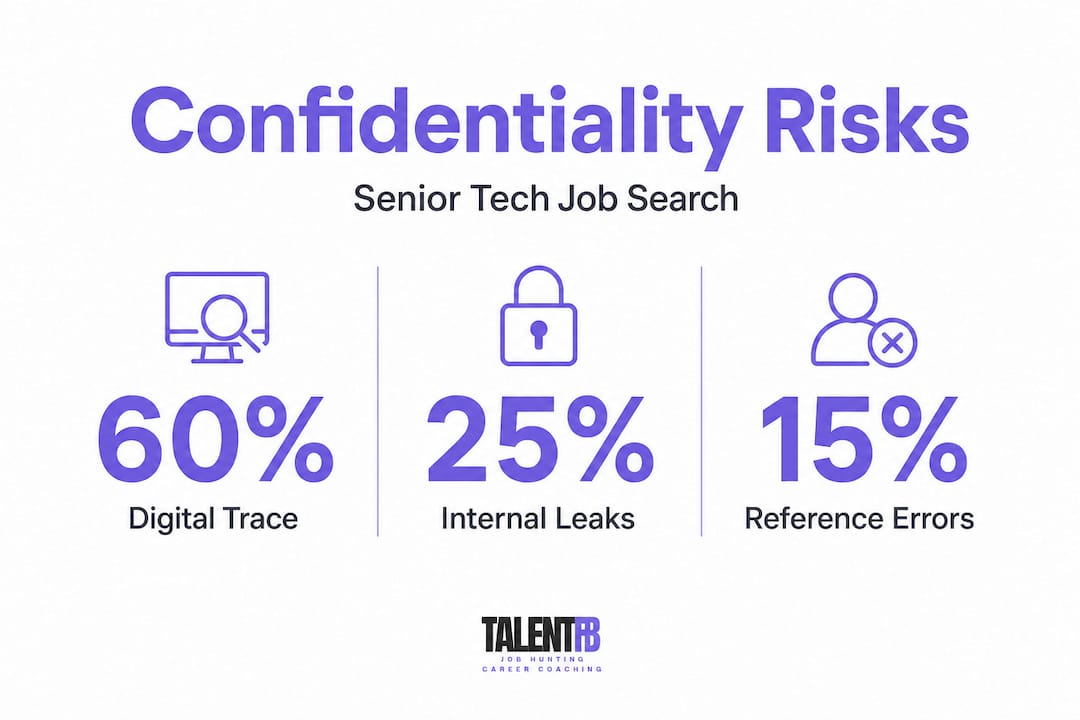
Roughly 60% of senior executives who reported a confidential search breach said the exposure came from their own digital footprint rather than from another person. That number should refocus your attention on systems and habits, not just people.
Pro Tip: Conduct a quarterly “confidentiality audit” of your search. Review your email threads, calendar blocks, and LinkedIn settings to ensure nothing has drifted. Five minutes of prevention is worth far more than hours of damage control.
Explore case studies on confidential searches to see how other senior tech leaders navigated similar situations and what they learned along the way.
The real test of leadership: Owning your confidential search
Here’s a perspective that most career advice skips entirely. Managing a confidential job search is not just a logistical challenge. It’s one of the clearest demonstrations of executive maturity you’ll ever face.
Think about it. You’re being asked to plan strategically under pressure, manage competing priorities without external support, and make high-stakes decisions with incomplete information. Sound familiar? That’s leadership.
The executives who handle confidential searches best are not the ones who keep the most secrets. They’re the ones who are most honest with themselves. They know their value clearly, they’ve done the preparation work before the urgency arrives, and they approach the market from a position of strength rather than desperation.
There’s an uncomfortable truth worth naming here: many senior professionals wait too long to start looking. They wait until frustration peaks, until a reorg catches them off guard, or until the culture shift has already eroded their engagement. By that point, the search feels reactive, and reactive searches are rarely confidential ones. They’re rushed, emotionally charged, and more likely to produce visible missteps.
Proactive, honest preparation always outperforms simple secrecy. The leaders who succeed quietly are those who have already defined what they want next, have maintained a warm network over years rather than months, and treat their career as an ongoing portfolio rather than a one-time transaction.
If a breach does happen, don’t treat it as a failure. Treat it as data. What did it reveal about your process? About your network’s boundaries? About how visible your dissatisfaction had already become? Some of the most growth-oriented conversations we see come directly after a near-miss. Explore real-world executive search stories to see how leaders turned setbacks into stronger, faster outcomes.
Confidential search support for tech leaders
Navigating a confidential job search at the senior level requires more than good intentions. It requires a structured system, expert coaching, and tools designed specifically for the complexity of leadership transitions.

At TalentFB, we work with senior tech professionals who are ready to move strategically, not reactively. Our AI Job Search Accelerator combines personalized coaching, resume and LinkedIn profile revitalization, confidential outreach strategies, and salary negotiation support into a single, results-focused program. Whether you’re an engineering leader, a product executive, or a technology officer exploring your next chapter, we provide a framework built for the pace and stakes of senior-level transitions. Access our coaching guide for tech executives and our leadership job search guide to start with a solid foundation, or browse our free job search resources to take the first step today.
Frequently asked questions
What are the most common mistakes that reveal a confidential job search?
Visible calendar events, discussing intentions with colleagues, and inconsistent work patterns are the top ways a senior executive’s search becomes visible before they’re ready.
How do I deal with direct questions from my manager about my job search?
Stay professional, keep your explanations neutral, and avoid offering specifics. A calm, honest-but-limited response is always more credible than evasion or overexplaining.
What is the safest way to get references as a senior executive?
Seek references from former colleagues, mentors, or board members rather than current coworkers, and brief them early so they’re prepared when a hiring team reaches out.
How can I keep my LinkedIn activity private during a job search?
Adjust your LinkedIn privacy settings to disable network notifications before making profile updates, and turn off the “share profile updates” toggle so your changes don’t appear in your connections’ feeds.