

TL;DR:
- Reactive hiring is costly because it causes delays, wastes resources, and hampers organizational momentum. Building a proactive talent pipeline involves defining critical roles, assessing capacity, segmenting candidates, and maintaining engagement through structured sequences and regular reviews. Successful pipelines depend on accurate metrics, stakeholder alignment, ongoing re-engagement, and utilizing automation to enhance sourcing efficiency.
Reactive hiring is one of the most expensive habits in talent acquisition. When a seat goes empty and you scramble to fill it, you pay in time, money, and momentum. 63% of organizations now rank developing a critical talent sourcing strategy as their top priority in 2026, and that urgency reflects a hard truth: waiting for a vacancy to open a search is no longer viable. The talent pipeline building steps covered here give you a practical, sequence-driven framework to move from reactive to proactive, so qualified candidates are already in motion before a role ever goes live.
Table of Contents
- Key takeaways
- Talent pipeline building steps: the right foundation
- Step-by-step talent pipeline building process
- Common pitfalls in pipeline development
- Measuring pipeline performance over time
- My honest take on building pipelines that actually work
- Take your pipeline strategy further with Talentfb
- FAQ
Key takeaways
| Point | Details |
|---|---|
| Preparation precedes execution | Map critical roles and budget before you activate any outreach or sourcing activity. |
| Passive candidates require nurturing | Most skilled professionals are not actively looking, so relationship-based outreach is the core of every healthy pipeline. |
| Volume alone signals nothing | Track conversion rates at every stage, not just candidate counts, to identify where pipelines stall. |
| Automation multiplies recruiter capacity | Automated workflows free up sourcing time and reduce candidate drop-off significantly. |
| Metrics must connect to business goals | Pipeline health metrics like quality of hire link recruiting performance to organizational outcomes. |
Talent pipeline building steps: the right foundation
Before you source a single candidate, you need clarity on what you are building toward. Skipping this preparation is the most common reason pipelines collapse within 90 days of launch.
Define your critical roles first
Start with workforce planning data. Work with business leaders to identify roles where vacancy creates the highest operational or revenue risk. Critical roles include mid-level technical specialists and relationship owners, not only senior executives. A senior cloud architect sitting on an unfilled seat costs far more than most teams calculate. Replacement costs for critical talent can exceed 200% of annual salary when you factor in lost productivity, knowledge transfer, and ramp time.
Assess budget and recruiting capacity
A talent pipeline is not free to maintain. You need budget for sourcing tools, candidate relationship management (CRM) licenses, and recruiter bandwidth. Map your existing technology stack before adding layers. Most organizations already have an applicant tracking system (ATS) with underused pipeline features. Understanding what you already own prevents redundant spending and speeds up deployment.
Here is what your technology foundation should include before you begin:
- A CRM or ATS with candidate tagging and stage tracking
- Email automation for nurture sequences
- A LinkedIn Recruiter license or equivalent sourcing tool
- A defined set of intake forms or skills-capture mechanisms
- Reporting dashboards that surface conversion data by stage
Pro Tip: Before purchasing new tools, audit your existing ATS. Most platforms contain pipeline management features that go unused because recruiters were never trained on them. A two-hour internal training session often unlocks capability you are already paying for.
| Preparation element | Why it matters |
|---|---|
| Critical role mapping | Focuses pipeline investment where vacancy risk is highest |
| Budget allocation | Prevents sourcing activity from stalling mid-pipeline |
| Technology audit | Avoids duplicating tools you already own |
| Metric definition | Establishes what success looks like before you start |
| Stakeholder alignment | Confirms hiring manager commitment to pipeline participation |
Step-by-step talent pipeline building process
With your foundation set, you can execute the pipeline build in a clear sequence. Each step builds on the last. Skipping steps creates gaps that surface later as candidate drop-off or poor conversion.
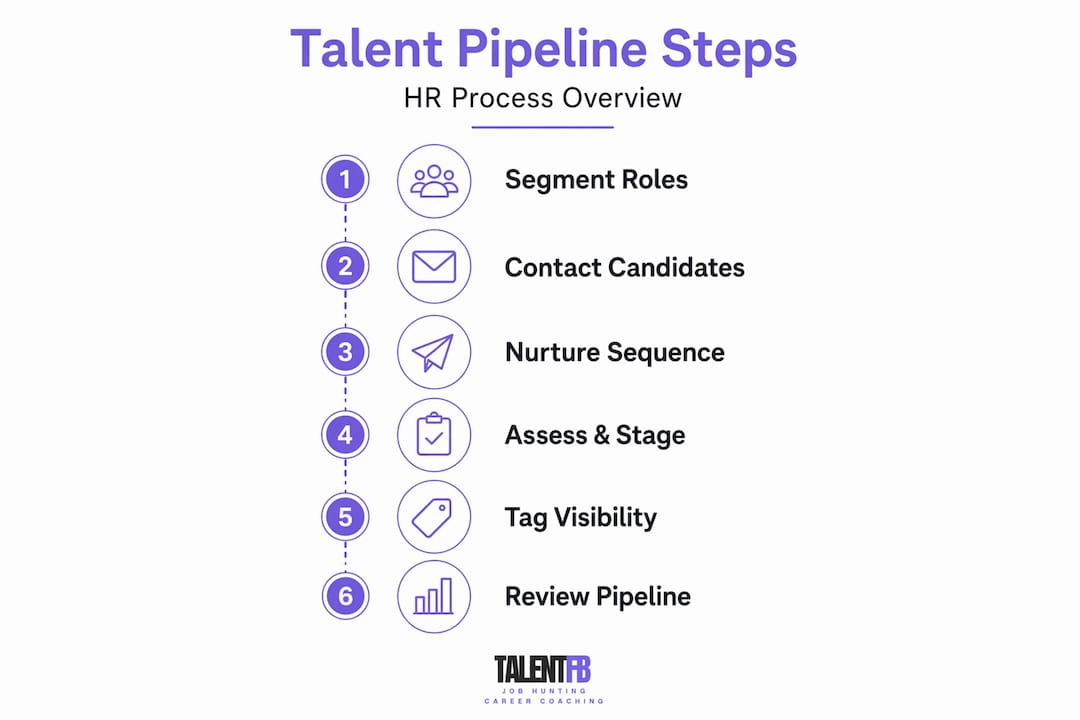
Step 1: Segment your candidate pools by role and skill cluster
Group target roles into clusters based on skill overlap. For example, a DevOps engineer and a platform reliability engineer share 70% of their core skill profile. Building one pool that covers both roles is more efficient than running two parallel outreach tracks. Use your CRM or ATS to create tagged segments before you contact anyone.

Step 2: Initiate contact with passive candidates
Passive candidates represent the majority of skilled professionals in high-demand roles. Your opening message is not a job pitch. It is an introduction to a professional relationship. Reference specific work, shared interests, or a relevant industry development. Personalization at this stage determines whether a passive candidate responds or ignores you. Explore proactive sourcing methods that reduce cost and increase response rates for technical roles.
Step 3: Build a structured nurture sequence
One touchpoint is not a pipeline. You need a planned sequence of communications across 60 to 90 days that provides value without pushing a job. Share relevant content, industry insights, and company updates. Space your messages three to four weeks apart to stay present without becoming noise.
Step 4: Qualify and stage candidates using assessments
Skills assessment in a talent pipeline is not about filtering people out. It is about placing candidates in the right stage so your team knows exactly how ready each person is when a requisition opens. Use brief structured conversations, skills check-ins, or async video screening to capture data on experience, compensation expectations, and interest level. Tag this data in your ATS immediately.
Step 5: Implement consistent tagging and pipeline visibility
Every candidate in your pipeline needs a stage label, a readiness rating, and a last-contacted date. This data is what converts a list of names into a functional recruitment pipeline. Without it, your pipeline is just a spreadsheet. Visibility means any recruiter on the team can pick up a candidate record and know exactly where things stand.
Step 6: Conduct regular pipeline health reviews
Set a monthly cadence to review pipeline coverage by role, conversion rates by stage, and engagement velocity. Automated pipeline tracking reduces time-to-fill by 22 days and decreases mid-process candidate loss by 47%. Schedule these reviews on the calendar now, before they become optional. Reviews without a fixed owner and agenda rarely happen consistently.
Pro Tip: Assign a named pipeline owner for each critical role cluster. When no one owns a pipeline segment, no one maintains it. Ownership creates accountability, and accountability keeps pipelines active.
Common pitfalls in pipeline development
Even well-resourced teams make predictable mistakes when building a recruitment pipeline. Knowing them in advance allows you to design your process around them.
The biggest error is treating volume as success. A pipeline with 200 contacts that converts none of them to interviews is not a healthy pipeline. Pipeline health depends on conversion rates at each stage, not total headcount. If your lead-to-screen rate drops below 15%, the problem is usually targeting or messaging quality, not insufficient outreach volume.
The second major mistake is treating pipelines as static lists rather than living systems. A candidate who was not ready six months ago may be ready today. A candidate who was enthusiastic may have accepted another offer. Without regular re-engagement and data updates, your pipeline becomes outdated within 90 days.
Here is a quick checklist of other pitfalls to watch:
- Limiting critical roles to C-suite only, which leaves operational gaps unaddressed
- Failing to set candidate expectations about timelines, which accelerates drop-off
- Ignoring hiring manager involvement, which creates misalignment when roles open
- Running outreach without a follow-up sequence, leaving warm contacts cold
Candidate drop-off is rarely about the candidate. It is almost always about the process. When candidates stop hearing from you, they assume the opportunity has disappeared, and they move on. Consistent, value-driven communication is the difference between a pipeline and an abandoned list.
Measuring pipeline performance over time
Effective talent pipeline management does not end at launch. Measurement is what separates a one-time project from a permanent recruiting asset. Review pipeline coverage ratios monthly. Industry benchmarks recommend a 3:1 ratio of qualified candidates to open roles, with a target of 70 to 80% internal fill rate for senior positions.
Quality of Hire is the metric that most directly ties recruiting activity to business outcomes. It measures how well a hire performs against role expectations at 90, 180, and 365 days. Tracking it requires partnership with people managers, but the payoff is that you can demonstrate recruiter impact in terms leadership actually cares about.
Pro Tip: Create a simple one-page pipeline health report for leadership that shows three numbers: pipeline coverage ratio by critical role, average time-to-fill trend over the last 90 days, and quality of hire score for recent placements. Executives respond to data that connects recruiting to revenue, and these three metrics do exactly that.
| Metric | What it reveals |
|---|---|
| Pipeline coverage ratio | Whether enough qualified candidates exist per open role |
| Lead-to-screen conversion | Quality and precision of sourcing and targeting |
| Time-to-fill trend | Speed improvements from pipeline versus reactive hiring |
| Quality of hire score | Long-term fit and performance of pipeline-sourced candidates |
| Candidate re-engagement rate | Pipeline freshness and the health of your nurture sequences |
Pair your pipeline metrics with workforce continuity planning. Pipelines built in isolation from succession strategy miss the longer arc of talent risk. Knowing which roles are at risk of turnover in the next 12 months should directly inform which pipeline segments receive the most attention and investment.
My honest take on building pipelines that actually work
I’ve watched organizations invest significant time in setting up talent pipelines and then abandon them within a quarter because they stopped producing immediate results. The mindset issue underneath that pattern is the real problem.
In my experience, the most effective pipelines are not built by recruiters who are optimizing for speed. They are built by recruiters who genuinely enjoy relationship building and see candidate conversations as long-term investments. That orientation changes everything about how outreach gets written, how follow-ups get scheduled, and how drop-off gets responded to.
I’ve also learned that AI-powered sourcing workflows are not a replacement for recruiter judgment. They are an amplifier. Recruiting teams with automation spend 31% more time on proactive sourcing, which is the highest-value activity in the process. Automation handles the coordination overhead so recruiters can do the work that actually builds trust with candidates.
One contrarian view I hold firmly: pipeline building fails most often not because of bad tools or bad candidates, but because internal stakeholders do not treat pipeline maintenance as a shared responsibility. Hiring managers who ghost candidates, delay feedback, or disengage from pipeline reviews are the single largest source of candidate loss I’ve seen. Fixing that is a culture and process problem, not a recruiting technology problem.
The organizations that do this well treat their talent pipeline advantage as a strategic asset, not an HR project. That framing changes how budgets are allocated, how success is measured, and how seriously leaders take their own participation in the process.
— Frederic
Take your pipeline strategy further with Talentfb
If you are working to sharpen your pipeline strategy and want guidance that goes beyond generic frameworks, Talentfb offers resources built for exactly that.
Talentfb’s AI-powered coaching programs and career advancement resources help talent acquisition professionals and HR leaders build the strategic skills to execute at a higher level. Whether you are building a recruitment pipeline for the first time or optimizing a system that has stalled, the structured guidance and community support available through Talentfb give you a practical edge. Explore the LinkedIn sourcing OS to unlock outreach techniques that increase passive candidate response rates and keep your pipeline moving consistently.
FAQ
What are the first steps to build a talent pipeline?
Start by identifying your critical roles based on workforce planning, then segment target candidate pools by skill cluster before initiating any outreach. Preparation and role definition must precede sourcing activity.
How do you measure if a talent pipeline is working?
Track conversion rates at each recruiting stage, pipeline coverage ratios per open role, and quality of hire scores for placed candidates. These three metrics together show whether your pipeline is producing results or just accumulating contacts.
How often should you review your talent pipeline?
Monthly reviews are the recommended cadence for most teams, covering coverage ratios, engagement velocity, and stage conversion data. Without a fixed review schedule and a named owner, pipeline health deteriorates quickly.
What is the biggest mistake in talent pipeline building?
Treating a pipeline as a static list of names rather than an active, relationship-based system is the most common and costly mistake. Candidates go stale within 90 days without re-engagement, rendering the pipeline useless when a role opens.
How does automation improve talent pipeline efficiency?
Automated tracking and hiring manager workflows reduce time-to-fill by 22 days and cut mid-process candidate loss by 47%, freeing recruiters to spend more time on proactive sourcing and relationship building.