
TL;DR:
- Executive coaching is a confidential partnership focused on enhancing leadership effectiveness rather than remediation, especially vital for tech leaders navigating complex environments. It fosters observable behavioral changes such as decisiveness, influence, and resilience, delivered through structured, goal-oriented sessions. Its success depends on organizational context, genuine leader readiness, and rigorous measurement of outcomes, not just positive intentions.
Executive coaching occupies a unique position in the leadership development landscape, yet it remains widely misunderstood. Many senior technology professionals still associate coaching with remediation, something reserved for leaders who are struggling or flagged for performance concerns. That assumption costs high performers dearly. In reality, executive coaching is a confidential, structured partnership between a credentialed coach and a senior leader, focused on improving leadership effectiveness and organizational impact. For technology executives navigating rapid disruption, cross-functional complexity, and high-stakes transitions, coaching is increasingly the strategic lever separating good leaders from exceptional ones.
Table of Contents
- What is executive coaching?
- How executive coaching works: Steps and structures
- Executive coaching for technology leaders: Real outcomes and applications
- When and why organizations (and executives) invest in coaching
- ROI and effectiveness: What the numbers really say
- The overlooked truth about executive coaching in tech
- Discover tailored coaching solutions for your tech leadership journey
- Frequently asked questions
Key Takeaways
| Point | Details |
|---|---|
| Growth lever, not remediation | Executive coaching accelerates high-potential leaders rather than fixing poor performance. |
| Structured, confidential partnership | It is a goal-driven, confidential process led by credentialed professionals. |
| Observable leadership outcomes | Expect concrete improvements in decisions, alignment, and execution—especially in complex technology environments. |
| Context is critical | Coaching adds value when issues are leader-centric, not systemic or organizational. |
| ROI is nuanced | Effectiveness and ROI can be hard to measure and depend on clear objectives and attributions. |
What is executive coaching?
Executive coaching is not a one-size-fits-all program, nor is it the same as attending a leadership workshop. At its core, it is a tailored, high-trust relationship built around observable behavioral change and measurable leadership outcomes. A credentialed coach works alongside a senior leader, often VP-level and above, to surface blind spots, sharpen decision-making instincts, and translate self-awareness into concrete shifts in how that leader shows up every day.
A critical distinction that separates executive coaching from other support mechanisms: executive coaching is not the same as mentoring, consulting, or therapy. Mentors share experience and advice. Consultants diagnose and prescribe solutions. Therapists address psychological wellbeing. Coaches do none of those things in the traditional sense. Instead, they hold a structured space where leaders generate their own insights, test new approaches, and practice behavioral change rather than receive directives. This distinction matters enormously in the technology sector, where leaders are surrounded by smart people offering strong opinions. Coaching creates room for the leader to think, not just react.
Confidentiality is the foundational principle that makes real conversations possible. Without it, leaders guard what they say, and the coaching relationship loses its depth. When it functions well, you can see real coaching client stories that reveal the kind of breakthroughs rarely visible in typical leadership development programs.
Key benefits tech executives commonly report from coaching:
- Sharper clarity on strategic priorities and trade-offs
- Stronger executive presence in board-level and cross-functional settings
- Improved ability to influence without direct authority
- Greater resilience and composure under organizational pressure
- More effective stakeholder alignment and communication
“The coach’s role is not to have the answers. It’s to ask the questions that help the leader find their own, then hold them accountable for acting on them. That process, repeated consistently over months, is where real leadership transformation lives.”
How executive coaching works: Steps and structures
Having defined executive coaching, it’s worth breaking down the mechanics, because the structure of an engagement shapes its effectiveness as much as the quality of the coach.
Executive coaching typically starts with a coaching agreement followed by an assessment phase, then moves through developmental, performance, or transition-focused work, often blending these modes as the engagement evolves. Here is how a structured engagement generally unfolds:
- Coaching agreement: Scope, session cadence, confidentiality boundaries, and measurement criteria are agreed upon upfront. This document protects both parties and creates a shared accountability framework.
- Intake and assessment: The coach gathers data through structured interviews, psychometric tools (such as 360-degree feedback), and stakeholder input. This phase surfaces the leader’s starting point with objectivity.
- Goal setting: Leadership development goals are co-created. The best goals are specific, observable, and connected to both the leader’s career aspirations and the organization’s strategic needs.
- Active coaching sessions: Regular one-on-one sessions, typically bi-weekly or monthly, where the leader works through real-time leadership challenges using the coach as a thinking partner.
- Reflection and experimentation: Between sessions, the leader applies new approaches in live situations, then brings observations back to the coaching conversation for refinement.
- Progress review and closure: Near the engagement’s end, outcomes are reviewed against agreed goals, lessons are consolidated, and the leader’s ongoing development plan is embedded.
The ICF Core Competencies define professional standards for coaching, covering everything from active listening and powerful questioning to ethical boundaries and maintaining coaching presence. These competencies are what separate credentialed coaches from the growing field of self-styled “leadership advisors.”
| Coaching mode | Primary purpose | Typical trigger |
|---|---|---|
| Developmental | Build leadership capability proactively | High-potential identification, succession planning |
| Performance | Address specific leadership gaps impacting results | Feedback from stakeholders, role expansion |
| Transition | Navigate role or career change effectively | New appointment, promotion, industry pivot |
| Team coaching | Align leadership team dynamics and effectiveness | Merger, restructuring, culture change |
| Blended | Combine two or more modes within one engagement | Complex senior leader contexts |
If you are currently navigating career transitions in the technology sector, a blended coaching engagement often delivers the fastest and most durable results, because the demands of transition rarely fit neatly into a single category.
You can review an example executive coaching engagement to see what this looks like in practice before committing to a program.
Pro Tip: Before beginning a coaching engagement, ask your prospective coach how they align their approach with your organization’s strategic priorities, not just your personal goals. The most impactful coaching operates at the intersection of both, and coaches who ignore organizational context tend to produce insights that don’t translate into real-world results.
Executive coaching for technology leaders: Real outcomes and applications
Understanding the mechanics prompts the practical question: how does executive coaching actually show up in the daily lives and impact of technology leaders?

For technology executives, coaching outcomes center on translating insight into observable leadership behaviors, including decision clarity, stakeholder alignment, executive presence, and execution cadence under ambiguity and complexity. These are not soft skills. In high-stakes tech environments, the ability to make confident decisions with incomplete data, or to align diverse engineering, product, and commercial stakeholders around a single priority, directly determines business outcomes.
Consider the cross-functional complexity that most senior tech leaders face daily. A VP of Engineering who cannot influence product roadmap decisions without formal authority is a classic pain point coaching addresses directly. Or a CTO navigating board expectations while managing a distributed team through a major platform migration. These are not problems solved by a training course. They require a thinking partner who can help the leader examine their own patterns, assumptions, and behaviors in real time.
Top five outcomes tech executives experience through coaching:
- Decision clarity: Moving from analysis paralysis to confident, principled decisions in ambiguous situations
- Executive presence: Projecting authority and credibility with boards, investors, and senior leadership teams
- Influence without authority: Building cross-functional relationships that drive alignment without relying on hierarchy
- Stakeholder management: Communicating strategically with multiple audiences who have competing priorities
- Resilience under pressure: Maintaining composure and performance quality during organizational disruption or rapid scaling
| Tech leadership challenge | Coaching-enabled solution |
|---|---|
| Difficulty influencing product decisions without authority | Develops stakeholder mapping and influence strategies |
| Feedback: “too technical, not strategic enough” | Builds executive communication and narrative framing skills |
| Conflict avoidance in cross-functional teams | Surfaces assumptions and creates structured conflict resolution approaches |
| Frozen decision-making under ambiguity | Installs decision frameworks and risk tolerance clarity |
| Isolation at the top: “no one to talk to” | Provides a confidential, objective thinking partnership |
Explore what advancing as a tech executive genuinely requires at each career stage, and consider how the value for tech leaders extends well beyond the coaching room. For additional insight on how senior leaders build credibility externally, thought leadership strategies on LinkedIn are an increasingly relevant complement to executive coaching work.
When and why organizations (and executives) invest in coaching
So when does coaching add the most strategic value, and how do organizations and executives decide when and why to invest?
The most important reframe here: executive coaching is not a remediation tool. It is a leadership development lever for senior leaders and high-potential leaders, particularly during role expansion or when leaders feel stuck despite strong track records. Organizations that treat coaching as a performance management intervention are, frankly, misusing it and diminishing its effectiveness.
The highest-value triggers for coaching investment include:
- New role or expanded scope: When a leader moves from managing a team to managing an organization, the skillset that produced past success can become an obstacle. Coaching accelerates the transition.
- Succession preparation: Leaders being groomed for the next level often have functional excellence but need to develop the executive presence and strategic thinking that senior roles demand.
- Feeling stuck despite results: Some of the most effective leaders reach a ceiling not because they lack capability but because their default approaches stop scaling. Coaching identifies those invisible limits.
- Cross-cultural or cross-functional complexity: Global tech organizations require leaders who can adapt communication and influence strategies across very different stakeholder contexts.
- Visible leadership derailment risks: Patterns such as micromanagement, communication breakdowns, or conflict avoidance that are noted in 360 feedback and, if unaddressed, carry career risk.
The quantitative case is genuinely compelling. Research consistently shows meaningful financial returns attributed to coaching programs, though the methodology behind those figures deserves scrutiny (more on that shortly). What is less debated: organizations that invest in coaching as a proactive growth tool retain senior talent more effectively and accelerate their leadership pipeline. Those are measurable outcomes.
For context on how leadership growth in Singapore and other high-growth tech markets has been shaped by coaching investment, the patterns are consistent: the leaders who benefit most are those who entered coaching from a position of strength, not distress.
Pro Tip: Before investing in coaching, honestly assess whether the challenges you face are truly leader-centric or whether they stem from systemic or structural issues in your organization. Coaching a leader whose problems are caused by broken role design, dysfunctional culture, or lack of organizational resources is unlikely to produce lasting change. Fix the context first, then invest in the person.
ROI and effectiveness: What the numbers really say
With triggers and value cases clear, it’s vital to examine the effectiveness question. How can tech leaders and their organizations genuinely judge ROI?
The honest answer is that ROI benchmarks in coaching are contested. Meaningful financial returns are commonly cited in executive coaching discussions, but measurement approaches vary widely and attribution to coaching specifically is difficult to establish with rigor. When a VP-level leader improves their team’s performance metrics after six months of coaching, how much of that improvement is attributable to the coaching, versus the business cycle, versus other development initiatives running in parallel?
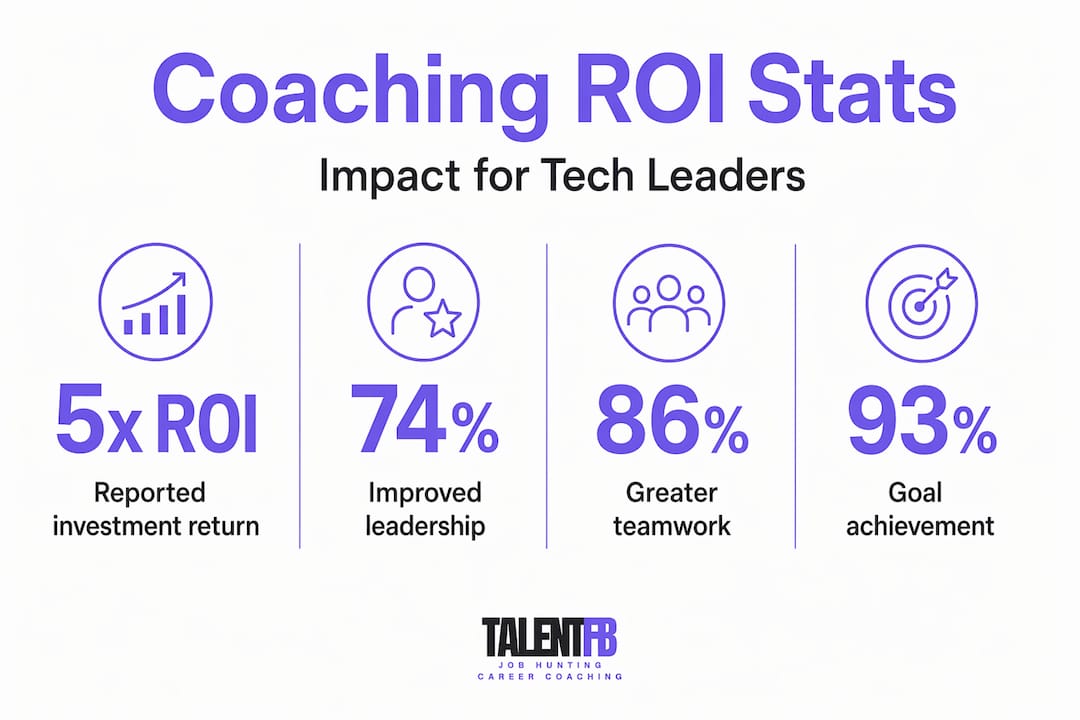
The efficacy of coaching as an independent variable is further complicated by the fact that most ROI studies rely on self-reports, correlation-based business metrics, and very limited control-group rigor. A leader who believes coaching is valuable is likely to report improvement. That is not the same as proving causation.
| ROI metric | Strength | Limitation | Question to ask |
|---|---|---|---|
| Self-reported goal attainment | Immediate and specific | Highly subjective | How were goals defined and verified externally? |
| 360-degree feedback improvement | Observable behavioral change | Rater bias, halo effects | How long after coaching was follow-up measured? |
| Retention of coached leaders | Quantifiable business value | Confounded by many variables | What is the base retention rate for comparable leaders? |
| Business outcome improvement | Most compelling to sponsors | Extremely difficult to attribute | What controls existed for market and business cycle effects? |
| Team engagement scores | Reflects leadership behavior | Team dynamics have multiple drivers | Were other team-level interventions occurring simultaneously? |
“The most honest answer to ‘Is coaching worth it?’ is this: it depends entirely on what problem you are actually trying to solve, how well the coaching is matched to that problem, and how rigorously you are willing to measure what changes.”
Senior tech leaders should ask prospective coaching providers exactly how they measure progress, what their attribution methodology looks like, and whether they offer any post-engagement follow-up to capture durable change. Providers who cannot answer these questions clearly deserve scrutiny.
The overlooked truth about executive coaching in tech
Most executive coaching guides focus on when to start coaching and what benefits to expect. Fewer address the situations where coaching is the wrong intervention entirely, and that omission is a disservice to the technology leaders who are paying for it.
The candid reality: coaching only moves the needle when the challenge at hand is genuinely leader-centric. If a senior engineering leader is underperforming because their organization has misaligned incentives, unclear decision rights, or a culture that punishes calculated risk, no amount of behavioral change coaching will produce organizational ROI. As research confirms, when underlying problems are organizational, rather than rooted in individual leader capability, coaching may improve the leader’s self-awareness while leaving the real problem completely untouched.
The best technology leaders we have seen benefit most from coaching are those who approached it with a rigorous diagnostic mindset. Before they committed, they asked honest questions: Is the friction I’m experiencing about my own patterns, or about the system I’m operating in? Am I looking for insight and accountability, or am I hoping coaching will solve a structural problem that my organization needs to own?
This matters because the coaching industry, like any industry, has a commercial incentive to present its offering as broadly applicable. The phrase “every leader benefits from coaching” is not false, but it is incomplete. The leaders who benefit most are those who enter coaching with genuine readiness, honest self-reflection, and organizational conditions that allow new behaviors to actually take hold. Exploring uncovering true coaching value means asking harder questions before signing an engagement, not just celebrating the potential upside.
The uncomfortable advice: if you are a technology executive being recommended coaching by your organization, ask who diagnosed the problem that coaching is supposed to solve. If the answer is unclear, push back. A good coach will welcome that question. A good organization will have a thoughtful answer.
Discover tailored coaching solutions for your tech leadership journey
The questions this article raises about executive coaching are ones that high-performing technology leaders should be asking before they invest time, credibility, and budget into any coaching engagement.
If you are ready to move from understanding to action, TalentFB offers resources designed specifically for senior tech professionals. Our career coaching for tech executives guide maps the leadership development strategies most relevant to your career stage. Our AI coaching sessions bring structured, technology-enhanced coaching support directly to where you are in your journey. And if you want to understand the full coaching value for tech leaders before committing, that resource gives you the evidence and the right questions to ask. Your next leadership step deserves a strategic foundation, not a reactive one.
Frequently asked questions
What makes executive coaching different from mentoring or consulting?
Executive coaching enables leaders to generate their own solutions and behavioral change, while mentoring and consulting provide advice, direction, and experience-based guidance. The distinction is fundamental to how lasting change happens.
How long does a typical executive coaching engagement last?
Coaching engagements commonly run six to twelve months, though duration depends on the complexity of goals and the organizational context surrounding the leader.
Can executive coaching guarantee leadership promotion?
No. Coaching is designed to sharpen effectiveness and leadership readiness, but ROI benchmarks and outcomes are influenced by many variables, and no credible coaching program promises a specific promotion or outcome.
What outcomes should tech executives expect from coaching?
Tech executives should expect progress in decision clarity, stakeholder alignment, executive presence, and the ability to execute confidently amid organizational complexity and ambiguity.
Is coaching more valuable for individual executives or for organizational change?
Coaching produces its strongest results at the individual leadership level. When organizational constraints drive performance issues, structural intervention is needed first, and coaching will have limited impact without it.