TL;DR:
- Career resilience goes beyond enduring difficult jobs; it involves adapting and making proactive career decisions. Strong resilience influences job satisfaction, stability, and the confidence to transition, especially when supported by organizational backing and career adaptability. Practicing self-awareness, building external relationships, and monitoring market signals enhance resilience, enabling professionals to navigate career turbulence effectively.
Most professionals think career resilience means gritting your teeth through a bad job until things improve. That framing is not just incomplete — it actively works against you. Why career resilience truly matters comes down to something more nuanced: your ability to adapt, stay engaged, and make proactive decisions about your career trajectory, even when the ground shifts beneath you. Recent research from 2026 confirms that resilience is a dynamic personal resource, not a fixed personality trait. And that changes everything about how you should be building it.
Table of Contents
- Why career resilience shapes your decisions
- Career adaptability as a resilience engine
- How organizational support amplifies resilience
- When labor market uncertainty changes the equation
- My perspective: resilience is a practice, not a personality trait
- Build your career resilience with Talentfb
- FAQ
Why career resilience shapes your decisions
Resilience does more than help you endure difficult stretches at work. It actively shapes how satisfied you feel in your current role and, perhaps more interestingly, whether you choose to stay or move on. A study of 204 full-time employees found that resilience links positively to career satisfaction and influences career change intentions, even when job alternatives are limited.

This tells us something critically useful. Career resilience is not simply a buffer against burnout. It serves two roles simultaneously: it stabilizes your sense of meaning in your current role, and it fuels the confidence to pursue a transition when the time is right.
Two psychological theories explain this well. Conservation of Resources theory suggests that resilient professionals protect and build the personal resources (energy, confidence, professional relationships) that sustain long-term career health. Self-Determination theory adds another layer, pointing to intrinsic motivation as the fuel. When your work connects to autonomy, competence, and purpose, resilience grows naturally. When those needs go unmet, resilience erodes regardless of how “tough” you are.
Here is what this means practically for you:
- Resilient professionals are not just better at handling setbacks. They make more deliberate career choices.
- Career satisfaction acts as the connector between resilience and career change decisions, meaning day-to-day meaning matters as much as long-term strategy.
- Low resilience does not just affect mood. It can lock you into passive career drift, staying in roles that no longer fit simply because moving feels too risky.
Pro Tip: Track your career satisfaction monthly using a simple 1-10 rating across three areas: challenge, recognition, and growth. When scores stay low for three consecutive months, treat that as a signal to take action, not a reason to push harder at the same thing.
Career adaptability as a resilience engine
Many professionals confuse career adaptability with simply being “open to change.” That undersells it significantly. Career adaptability is a meta-competency involving planning, control, curiosity, and confidence, and it functions as one of the most powerful engines of career resilience available to you.
The four dimensions, often called the “4 Cs,” each play a distinct role:
| Dimension | What it means | How it builds resilience |
|---|---|---|
| Concern | Planning for your career future | Reduces anxiety by replacing drift with direction |
| Control | Taking ownership of your choices | Builds agency and reduces victim-thinking |
| Curiosity | Exploring possibilities and roles | Expands your option set before you need it |
| Confidence | Believing you can handle transitions | Lowers the psychological cost of career moves |
Research confirms that career adaptability correlates with employability, job satisfaction, career success, and psychological well-being. It is not one benefit. It is a cluster of outcomes that compound over time.
The practical tools for building adaptability are more accessible than most professionals realize:
- Job crafting: Actively reshape your current role by adding tasks that use your strengths, reducing tasks that drain you, and reframing the purpose of your work. You do not need a new job to feel more engaged in your career.
- Strengths use: Deliberately deploying your recognized strengths during work increases engagement. A Lithuanian employee study found that strengths use motivates engagement, which then grows self-assessed external employability.
- Work engagement as a bridge: Research shows that personal resources boost employability indirectly through higher work engagement. Engagement is the mechanism. Build it deliberately.
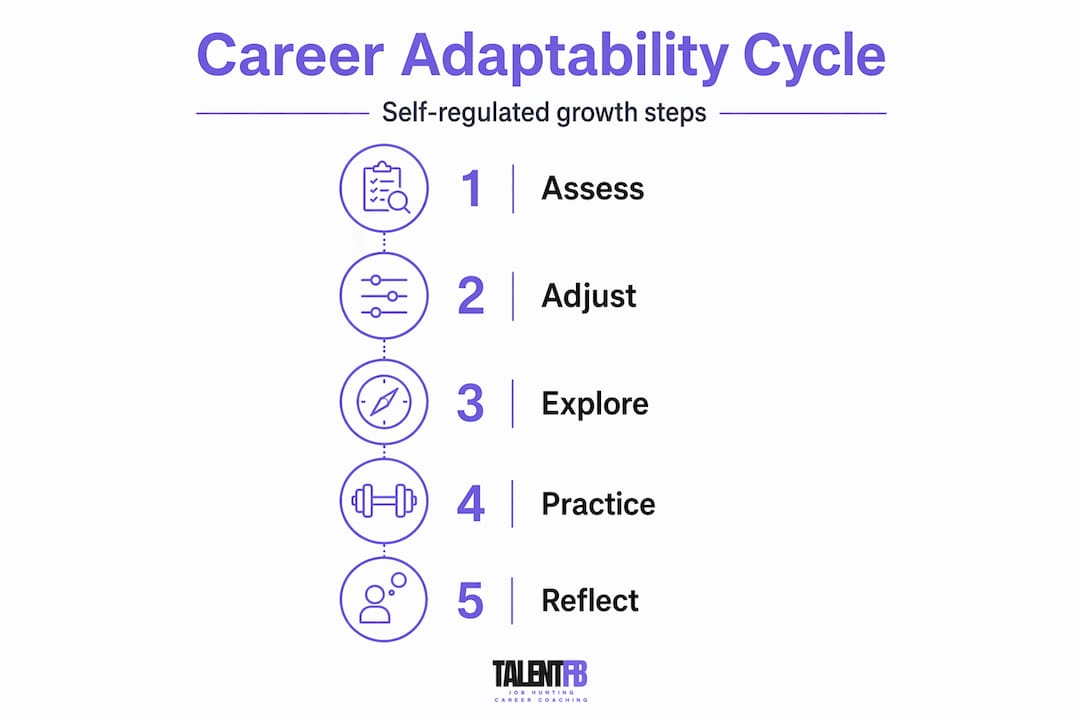
Career adaptability, at its core, is a self-regulated cycle: assess where you are, adjust your goals, test new approaches, and learn from the result. Professionals who internalize this cycle move through career challenges with far less friction than those waiting for external circumstances to change. For deeper guidance on putting these skills to work, the strategic career growth guide from Talentfb covers this territory in practical detail for senior leaders in tech.
How organizational support amplifies resilience
One of the most underappreciated truths about career resilience is that it does not exist in a vacuum. Your workplace environment shapes your capacity to be resilient, far more than most professionals acknowledge. Perceived organizational support (POS), meaning your sense that your organization values your contributions and cares about your well-being, is a direct driver of resilience strength.
A study of hospital nurses found that POS is positively associated with resilience and negatively associated with turnover intention, with resilience itself acting as the connector between the two. Professionals who felt their organization listened to their opinions and genuinely valued them developed stronger persistence, greater commitment, and a lower tendency to disengage.
This creates a powerful implication. Resilience is partly a system-level property, not purely a personal one. If your organization suppresses voice, ignores feedback, and signals that your development is your problem alone, your individual resilience strategies will face a structural headwind.
Here is what you can do regardless of your current organization:
- Request regular feedback. Do not wait for annual reviews. Ask your manager directly for quarterly input on where you are adding value and where gaps exist.
- Signal your development intentions. Mention career goals in one-on-one meetings. Managers who know your ambitions are far more likely to create development opportunities.
- Identify your organizational allies. Sponsors and mentors inside your organization amplify your resilience by advocating for you when decisions are made behind closed doors.
Pro Tip: When joining a new organization or team, pay close attention to how leaders respond to employee suggestions within the first 90 days. Organizations that dismiss or ignore input consistently will undermine your resilience over time, regardless of how strong your personal practices are.
The executive career transition guide at Talentfb offers additional context on reading organizational culture as part of any career move decision.
When labor market uncertainty changes the equation
Here is something the popular resilience conversation rarely acknowledges: external conditions affect how much your internal resilience actually delivers. A 2026 study examining school-to-work transitions found that labor market uncertainty weakens resilience’s link to well-being and employability. In other words, working harder on your mindset during a period of severe market disruption yields diminishing returns if you are not simultaneously tracking what is happening outside your organization.
This does not mean resilience stops mattering. It means the strategy has to evolve. Here is a practical framework for pairing internal resilience with external market awareness:
- Monitor labor market signals weekly. Set aside 20 minutes each week to review job postings in your target roles, track hiring trends in your sector, and note which skills appear most frequently in senior postings. This is not job hunting. It is market intelligence.
- Reframe uncertainty as data. Instead of treating volatility as a threat to your stability, treat it as information about where the market is heading. The sectors growing despite broader disruption are where your adaptability investments will pay the most.
- Build your external network before you need it. Professionals who maintain active external connections during stable periods have far more resources available during turbulent ones. One meaningful conversation per week with someone outside your current organization is a low-effort, high-return practice.
- Calibrate your timeline expectations. During high-uncertainty periods, resilience building solely based on internal coping risks underperformance. Expect transitions to take longer, require more iterations, and demand more external information than they would in a stable market. That expectation itself is a resilience tool.
- Use career coaches as external market proxies. A good coach who works across multiple clients and industries sees patterns in hiring, rejection, and career stagnation that you simply cannot observe from inside one organization. That external view is genuinely valuable.
My perspective: resilience is a practice, not a personality trait
I have worked with hundreds of senior technology professionals navigating layoffs, role eliminations, leadership transitions, and dramatic sector shifts. The single biggest misconception I encounter is that resilient people are simply wired differently. They are not.
What I have consistently observed is that the professionals who navigate career turbulence most effectively are the ones doing three specific things: they are tracking their career satisfaction as an early warning system, not waiting until they are fully disengaged to take stock. They are building relationships inside and outside their organizations with the same intentionality they bring to technical or strategic work. And they are treating career adaptability as a practice, something you do in small, regular acts, not something you summon in a crisis.
The research backs this up. Career satisfaction connects resilience to decisions, meaning if you are not monitoring satisfaction, you are flying blind on one of your most important resilience metrics. And the data on organizational support is sobering in its clarity: if your organization is not signaling that your voice and development matter, your individual resilience is working harder than it should have to. That is useful information for career decisions too.
My honest recommendation is to spend less time building “toughness” and more time building self-awareness, external relationships, and clarity about what genuinely satisfying work looks like for you at this stage of your career. The professionals I have seen thrive through difficult markets are not the ones who endured the most. They are the ones who stayed most aware of themselves and their options.
You can find practical starting points in Talentfb’s career advice for senior professionals if you want frameworks to put these ideas into practice immediately.
— Frederic
Build your career resilience with Talentfb
If the research in this article resonates with where you are right now, whether you are sensing early signs of disengagement, considering a career transition, or preparing for the next major move, Talentfb’s AI Job Search Accelerator is built precisely for this moment.
Talentfb works with senior professionals in the technology sector to build the kind of resilience that is practical, structured, and results-oriented. The Job Search OS Masterclass gives you a complete framework for accelerating your career transition, from resume positioning and LinkedIn optimization to targeted outreach and salary negotiation. For professionals evaluating the right tools to support that process, the top job search accelerator alternatives guide is a good place to assess your options and make an informed choice.
FAQ
What does career resilience actually mean?
Career resilience is your capacity to adapt to setbacks, transitions, and uncertainty in your professional life while maintaining motivation and direction. It is not about enduring poor conditions indefinitely. It is about staying engaged and making proactive choices.
Why is career resilience important for professionals in tech?
The technology sector changes faster than most industries, with layoffs, role shifts, and skill demands evolving rapidly. Career resilience helps you maintain employability and career satisfaction through those transitions rather than being caught unprepared.
How can you build career resilience at work?
Research points to several practical approaches: developing career adaptability through planning and curiosity, using your strengths deliberately to grow work engagement, seeking organizational support and feedback, and tracking your career satisfaction as an early signal for action.
Does a supportive organization affect your resilience?
Yes, significantly. Studies show that perceived organizational support directly strengthens psychological resilience and reduces turnover intention. Organizations that value employee voice create conditions where individual resilience efforts are far more effective.
Can resilience fail during uncertain job markets?
It can underperform. Research confirms that high labor market uncertainty weakens the connection between resilience and employability outcomes. Pairing internal resilience practices with active external market awareness significantly improves results.