
TL;DR:
- Most organizations mistakenly believe they face a hiring problem when, in fact, their system design is flawed.
- Implementing scalable hiring requires standardized processes, decision frameworks, and role definitions to handle increased volume without chaos.
Most organizations think they have a hiring problem when their open roles pile up. What they actually have is a system design problem. To genuinely explain scalable hiring, you need to move past the idea that it is simply about buying better software or posting to more job boards. True scalable hiring is the architecture behind your entire recruiting operation — the standardized processes, decision frameworks, and role definitions that allow your team to handle five times the volume without five times the chaos.
Table of Contents
- What scalable hiring really means
- The role of structured interviews in scaling
- Automation: where it helps and where it stops
- Common pitfalls when scaling hiring
- A practical framework for implementation
- My honest take on what makes this work
- How Talentfb helps you hire smarter at scale
- FAQ
What scalable hiring really means
Scalable hiring is a repeatable, standardized process that allows an organization to handle significant increases in hiring volume without a corresponding drop in quality or speed. Think of it as the operating system behind your talent function, not just a collection of tools running in parallel.
The key distinction is this: an ad hoc hiring workflow might work fine when you are filling three roles a month. The moment you need to fill 30, everything breaks. Requirements shift, hiring managers give contradictory feedback, candidates fall through the gaps, and your team spends more time managing confusion than selecting talent. A scalable hiring process treats each of those failure points as a design problem to be solved before volume arrives, not during the surge.
The foundation of that design starts with standardized intake. This means every new role begins with a completed role profile, a defined scorecard, and agreed-upon service level agreements between recruiting and the hiring manager. Without this, teams waste recruiter time clarifying requirements rather than advancing candidates.
Here are the core components of a hiring operating system:
- Standardized role profiles: Agreed-upon criteria before sourcing begins, preventing mid-process scope creep
- Scoring rubrics: Predefined rating scales for each competency, applied consistently across interviewers
- SLAs between recruiting and hiring managers: Clear turnaround expectations at every stage
- Automated scheduling: Interview scheduling automation cuts scheduling time by approximately 26%, improving both data quality and candidate experience
- Predefined decision gates: Clear pass or no-pass criteria at each funnel stage, removing subjective bottlenecks
Pro Tip: Before you invest in any new hiring technology, audit whether your intake process is actually standardized. Technology built on a broken foundation will only surface your problems faster.
Scaling talent effectively requires redesigning the underlying people operating model entirely. Simply accelerating the existing workflow with AI tools is not true scalability. It is a faster version of the same problem.

The role of structured interviews in scaling
If standardized intake is the front door of your hiring system, structured interviewing is the engine inside. And it is one of the most underused tools in the scalable recruitment strategies toolkit.
Structured interviews use vetted, role-specific questions paired with scoring rubrics and trained interviewers. Every candidate answers the same questions, and every interviewer uses the same criteria to evaluate responses. Structured interviews outperform unstructured ones in predicting job success and improving candidate satisfaction, according to Google re:Work research.
The practical benefits compound significantly at scale:
- Reduced bias: When interviewers follow a defined script and score against fixed criteria, personal impressions carry less weight
- Improved consistency: Candidates evaluated across different sites or by different managers are measured against the same standard
- Faster calibration: Structured scoring data makes post-interview debriefs shorter and more productive
- Better candidate experience: Candidates report feeling more fairly treated when they sense clear process logic
Here is how structured and unstructured interviews compare at scale:
| Factor | Unstructured interviews | Structured interviews |
|---|---|---|
| Predictive validity | Low | High |
| Bias exposure | High | Reduced |
| Interviewer training required | Minimal | Moderate |
| Time per interview | Variable | Consistent |
| Candidate satisfaction (rejected candidates) | Lower | 35% higher |
| Time saved per interview | Baseline | ~40 minutes saved |
Implementation works best in phases. Start by building a question bank for your highest-volume roles, train interviewers with calibration sessions, and establish a refresh cycle for questions every six to twelve months. Consistent scoring rubrics and anchored scoring scales are non-negotiable if you want evaluation equivalence across multiple teams or locations.
Pro Tip: Run a calibration exercise where two interviewers independently score the same recorded interview response. If scores diverge significantly, your rubric needs clearer behavioral anchors before you scale.
You can find practical guidance on reducing interviewer bias in our resources on diversity hiring in tech, which applies directly to structured interviewing design.
Automation: where it helps and where it stops
Automation has earned its place in the scalable hiring process. But it is not a solution to every problem, and organizations that treat it as one create a different set of failures.
The legitimate use cases for automation in high-volume hiring are well-defined:
- Interview scheduling: Removes back-and-forth email chains and accelerates pipeline velocity
- Application screening: Filters candidates based on minimum defined criteria
- Candidate communication: Sends timely updates, reminders, and status notifications at scale
- Data collection: Captures structured feedback from interviewers automatically
Where automation hits a hard limit is human judgment. AI reduces manual scheduling time significantly, but human recruiters remain essential for assessment quality, nuanced evaluation, and calibration. A tool that scores resumes cannot tell you whether a candidate has the leadership presence your team needs. That judgment cannot be automated away.
“Automated hiring tools must measure only job-relevant skills and must not unfairly screen out qualified applicants with disabilities.” — ADA.gov guidance on AI in hiring
This is where compliance becomes central to your automation strategy. The ADA requires that algorithmic hiring tools be carefully validated to measure relevant job skills without inadvertently screening out candidates with disabilities. Many organizations purchase AI screening tools without running this validation, which creates legal exposure and demographic bias in their pipelines.
The principle to follow: automate repetitive logistics and communications, but keep humans in the loop at every decision gate where a candidate’s advancement depends on judgment rather than criteria.
Pro Tip: Before deploying any AI screening tool, ask the vendor for third-party bias audits and documentation of job-relevance validation. If they cannot provide it, treat that as a significant red flag.
Common pitfalls when scaling hiring
Knowing how to implement scalable hiring is one thing. Knowing what causes it to collapse in practice is equally important. Here are the most common breakdowns, ranked by how frequently they derail organizations:
-
Scaling volume before scaling decision architecture. Organizations add headcount to the recruiting team, invest in ATS upgrades, and launch new sourcing channels, all before locking role profiles and scorecards. The result is a faster pipeline producing inconsistent decisions. Decision architecture failures during volume surges are one of the most predictable and preventable causes of hiring chaos.
-
Inconsistent evaluation across hiring managers. When 12 hiring managers each interpret “strong communicator” differently, your scoring data becomes meaningless. Without anchored scoring rubrics across all interviewers, you lose consistency even if your scheduling and ATS workflows are perfectly structured.
-
Skipping interviewer calibration. Training interviewers once and assuming alignment is a common mistake. Calibration needs to be an ongoing practice, particularly as new managers join the panel or roles evolve.
-
Optimizing only for speed metrics. Time-to-fill is an important KPI, but optimizing for it in isolation produces fast bad hires. Quality of hire metrics, offer acceptance rates, and 90-day retention figures must sit alongside speed metrics in your measurement framework.
-
Assuming system maturity happens automatically. Hiring system predictability tends to stabilize around 100 employees in early-stage companies, but it does not improve on its own. Organizations that do not actively monitor pass-through rates, stage conversion, and interviewer scoring variance will miss the warning signs before they become crises.
A practical framework for implementation
When you are ready to move from concept to execution, a phased approach prevents the most common mistakes. Here is a roadmap worth following:
Phase 1: Design the intake architecture. Before sourcing a single candidate, build your role profiles, define your scorecards, and establish SLAs with hiring managers. This phase takes the most upfront work and delivers the most downstream value.
Phase 2: Build your structured interview library. Develop competency-based question banks for your top five to ten most frequently hired roles. Train interviewers and run calibration sessions before launch.
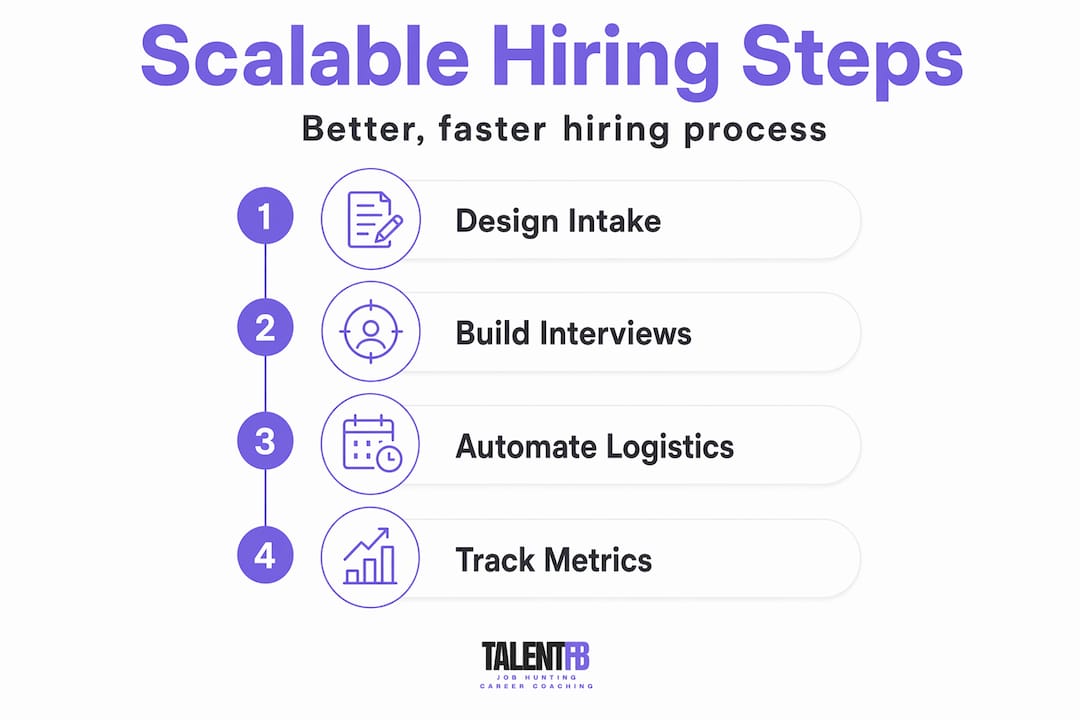
Phase 3: Automate logistics, not judgment. Implement scheduling automation, candidate communication workflows, and ATS stage tracking. Define the decision gates where human review is mandatory.
Phase 4: Instrument your metrics. Track time-to-hire, stage conversion rates, offer acceptance, and interviewer scoring variance from day one. You cannot improve what you cannot measure.
Here is how the three hiring models compare:
| Model | Speed | Consistency | Bias risk | Scale capacity |
|---|---|---|---|---|
| Manual, ad hoc | Slow | Low | High | Very limited |
| Semi-automated | Medium | Moderate | Medium | Moderate |
| Fully scalable system | Fast | High | Low | High |
The benefits of scalable hiring become clearest in that final column. Organizations that build the system correctly can triple hiring volume without proportional team growth, while maintaining candidate experience quality. You can explore how to optimize your talent acquisition workflow for additional implementation support.
For leaders focused on senior and executive hiring, the C-suite hiring strategy considerations are worth reviewing alongside this framework.
My honest take on what makes this work
I have watched organizations spend significant budget on applicant tracking systems, AI screening tools, and scheduling software, then wonder why their hiring is still inconsistent and slow. The technology is rarely the problem. The system behind the technology almost always is.
What I have learned is that scalable hiring succeeds or fails at the leadership level before it ever reaches the recruiting team. When a CHRO or VP of Talent cannot get hiring manager alignment on what “good” looks like for a role, no amount of automation will fix it. The intake conversation, the scorecard design, the calibration sessions — these are leadership commitments, not recruiting tasks.
I have also seen organizations get genuinely impressive results when they treat scalable hiring as a cross-functional operating model rather than an HR project. When legal, finance, and the business line are aligned on SLAs and decision criteria before sourcing begins, the whole system moves faster and with more confidence.
The human element that technology cannot replace is judgment under ambiguity. An experienced recruiter reading a candidate’s energy in a conversation, recognizing a skill gap that a scorecard missed, or knowing when a hiring manager’s hesitation is meaningful — that is irreplaceable. The goal of a scalable hiring system is not to remove those humans from the process. It is to free them from the administrative noise so their judgment can be applied where it actually matters.
If you are starting this work, my honest recommendation is to start smaller than you think you need to. Build one excellent intake process for one role family. Run it, measure it, calibrate it, then expand. Trying to overhaul the entire hiring function at once is how transformation projects lose momentum before they ever land.
— Frederic
How Talentfb helps you hire smarter at scale
Scaling a hiring operation is one of the most complex leadership challenges in a growing organization, and having the right frameworks and tools in place from the start makes a measurable difference. At Talentfb, we work at the intersection of AI-driven recruiting strategy and practical execution — helping both organizations building their talent function and senior professionals navigating complex hiring processes from the other side of the table.
Whether you are a recruiting leader looking to build a more consistent hiring operating model or a senior professional who wants to understand how top organizations evaluate talent, Talentfb offers resources designed for real-world application. Explore our client success stories to see how AI-driven approaches translate into measurable hiring outcomes. Or visit the Talentfb home to discover how our AI Job Search Accelerator and recruitment strategy resources can support your next phase of workforce growth.
FAQ
What does scalable hiring mean?
Scalable hiring is a repeatable, standardized recruitment system that allows an organization to handle higher hiring volume without a proportional drop in speed or quality. It relies on standardized intake processes, scoring rubrics, and structured decision-making rather than ad hoc workflows.
What are the core benefits of scalable hiring?
The primary benefits of scalable hiring include faster time-to-hire, more consistent candidate evaluation, reduced bias, and the ability to increase hiring volume without overwhelming your recruiting team. Organizations with scalable systems can triple volume while maintaining candidate experience quality.
How do structured interviews support effective hiring at scale?
Structured interviews use vetted questions and scoring rubrics that apply consistently across all candidates and interviewers. Research from Google re:Work shows they improve predictive validity, reduce demographic bias, save approximately 40 minutes per interview, and increase candidate satisfaction by 35% even among rejected applicants.
What are the biggest risks in scalable recruitment strategies?
The most common failure is scaling volume before standardizing decision architecture. When role profiles and scorecards are not locked before sourcing begins, recruiting teams spend their time managing confusion rather than advancing qualified candidates, which undermines every other investment in the system.
How do you start implementing scalable hiring practices?
Begin by designing your intake architecture for your highest-volume roles: define role profiles, build scorecards, and establish SLAs with hiring managers. Then build a structured interview library, train interviewers with calibration sessions, and automate only the logistical steps before launching the system at full volume.