TL;DR:
- Workforce planning forecasts future talent needs and creates a strategic path to meet them.
- It involves multiple steps, including demand forecasting, supply analysis, and continuous adjustment.
Workforce planning is the process of forecasting your organization’s future talent needs and building a clear path to meet them. The formal industry term is strategic workforce planning, and it covers everything from identifying skill gaps to deciding whether to hire, retrain, or restructure. Done well, it ensures you have the right people, with the right capabilities, in the right roles, before a gap becomes a crisis. This article explains workforce planning from the ground up, covering the core process, the most useful models, common misconceptions, and what good implementation actually looks like in practice.
What does it mean to explain workforce planning?
Strategic workforce planning is a forward-looking, multi-year process that typically spans 3–10 years. That time horizon separates it from day-to-day workforce management, which focuses on scheduling, coverage, and immediate capacity. Strategic planning asks a different question: “What talent will we need to execute our business strategy two, five, or ten years from now?”

The distinction matters because the two require completely different inputs and decisions. Operational workforce management reacts to what is happening now. Strategic workforce planning shapes what your organization becomes. Both are necessary, but confusing them is one of the most common reasons workforce plans fail before they start.
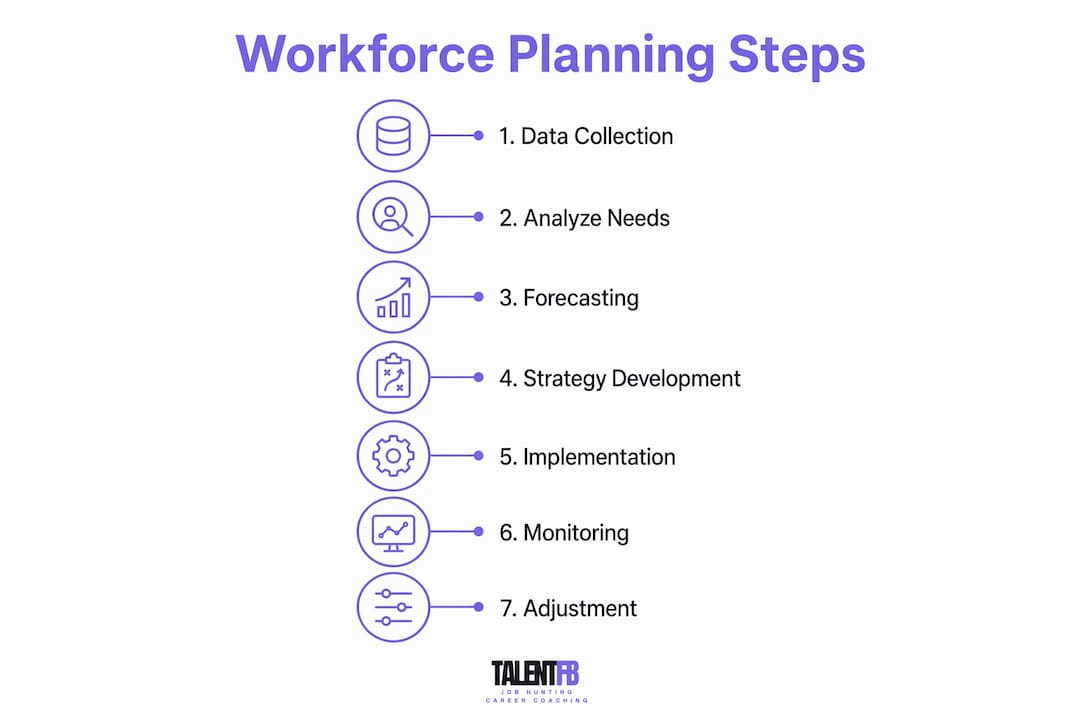
What are the key steps in the workforce planning process?
Effective workforce planning follows five integrated steps. Each builds on the previous one, and skipping any step creates blind spots that surface later as expensive surprises.
- Forecast talent demand. Start with your business strategy. What growth targets, new products, or market expansions are planned? Translate those goals into specific roles, skills, and headcount requirements.
- Analyze current workforce supply. Audit what you already have. Map existing skills, experience levels, performance data, and flight risk. This is your baseline.
- Identify gaps. Compare demand against supply. Gaps can be quantitative (not enough people) or qualitative (wrong skills for future needs). Both require different responses.
- Develop resourcing strategies. Decide how to close each gap. Options include hiring externally, upskilling current staff, restructuring teams, or using talent development programs to build capabilities from within.
- Monitor and adjust continuously. Business conditions change. Build feedback loops that let you update your plan quarterly, not just annually.
Cross-functional collaboration is not optional at any of these steps. HR brings people data. Finance brings budget constraints. Operations brings capacity realities. Leadership brings strategic direction. Without all four at the table, the plan reflects only one part of the picture.
Pro Tip: Map your workforce planning calendar to your annual budgeting cycle. When headcount requests arrive with financial projections already attached, they move faster through approval.
A few practical behaviors separate organizations that plan well from those that plan on paper only:
- Assign a named owner for each workforce gap, not just a department.
- Use skills taxonomies (structured lists of capabilities) rather than job titles when mapping gaps. Titles change; skills persist.
- Build scenario versions of your plan. A base case, a downside case, and an upside case give decision-makers real choices rather than a single fragile forecast.
Which workforce planning models should you know?
At least seven recognized models exist for workforce planning, each suited to different organizational needs and planning horizons. Choosing the wrong model for your context is a common source of wasted effort.
| Model | Best used for | Core strength |
|---|---|---|
| Scenario planning | Long-term uncertainty | Tests multiple futures before committing |
| Skills-based planning | Capability transformation | Maps competencies, not just headcount |
| Demand-driven planning | High-growth phases | Ties headcount directly to revenue targets |
| Supply-driven planning | Talent-scarce markets | Starts from what is available, then adapts |
| Equilibrium model | Stable organizations | Balances inflows and outflows over time |
| Umbrella framework | Enterprise-wide alignment | Integrates multiple sub-plans under one structure |
| Operational model | Short-term execution | Covers scheduling, coverage, and immediate gaps |
Skills-based workforce planning deserves special attention right now. It focuses on mapping the capabilities your organization needs, regardless of job titles. A company moving into AI-driven products does not simply need more engineers. It needs engineers with specific machine learning, data pipeline, and product integration skills. Skills-based planning makes that distinction visible and actionable.
Scenario planning is the right tool when your industry faces genuine uncertainty, such as regulatory shifts, rapid technology change, or market consolidation. It forces leadership to think through “what if” situations before they become emergencies. For talent mapping and anticipating future workforce needs, scenario planning is the most practical long-term tool available.
Pro Tip: Do not try to run all seven models simultaneously. Pick the one that matches your current business challenge, then add complexity only when your data quality and team capacity can support it.
Why is workforce planning critical, and what are the common myths?
Workforce planning prevents the two most expensive talent problems organizations face: shortage and mismatch. Shortage means you do not have enough people to execute your strategy. Mismatch means you have people, but not with the skills the strategy requires. Both are avoidable with planning. Both are costly without it.
Cross-functional involvement elevates workforce planning from a headcount exercise to a genuine talent alignment tool. When HR plans in isolation, the output is a hiring list. When HR plans alongside finance, operations, and leadership, the output is a talent strategy with budget, timeline, and accountability built in.
Three myths consistently undermine workforce planning efforts:
- Myth: It is HR’s job. Workforce planning is a business strategy function. HR facilitates it, but business leaders own it.
- Myth: It is just about full-time employees. True workforce planning includes contingent workers, contractors, and digital workers. Leaving those categories out creates a distorted picture of actual capacity.
- Myth: An annual plan is enough. Markets move faster than annual cycles. A plan built in january can be obsolete by april if a competitor launches, a regulation changes, or a key team exits.
“Workforce planning is not a once-a-year HR exercise. It is a continuous business discipline that keeps your talent strategy as current as your financial forecast.”
The organizations that treat workforce planning as a living process, rather than a document, are the ones that avoid reactive hiring, reduce turnover costs, and build the kind of workforce resilience that shows up in business results.
How can organizations implement workforce planning effectively?
Good implementation comes down to four disciplines practiced consistently, not four steps completed once.
Data quality first. Without accurate, integrated HRIS data, workforce planning becomes reactive and ineffective. If your people data is incomplete or siloed across systems, your gap analysis will be wrong. Fix data hygiene before building complex models.
Cross-functional ownership. Assign workforce planning responsibilities across HR, finance, and operations. Each function brings data the others cannot see. Finance knows where budget will be allocated. Operations knows where capacity is already stretched. HR knows where skills are thin and where attrition risk is highest. Effective talent management for tech leaders depends on exactly this kind of integrated view.
Continuous monitoring, not annual reviews. Modern workforce planning is continuous and agile, pivoting on real-time business data rather than static annual plans. Set quarterly checkpoints. Review your gap analysis every time a major business assumption changes.
Pro Tip: Build a simple workforce planning dashboard that shows three numbers: current headcount vs. plan, open critical roles vs. target fill date, and skills gap score by department. Visibility drives accountability.
Closing identified gaps requires a mix of approaches. The right combination depends on timeline, budget, and the nature of the gap:
- Hire externally when the skill does not exist internally and time is short.
- Upskill internally when the capability gap is adjacent to existing strengths and time allows.
- Outsource or use contractors when the need is temporary or highly specialized.
- Restructure when the gap reflects a misalignment between current roles and future strategy.
Explore proven talent acquisition strategies to understand how leading tech organizations attract the specific skills their workforce plans identify as critical.
What I have learned about workforce planning after 15 years in hiring rooms
Most workforce plans I have seen fail for one reason: business leaders hand it off to HR and consider it done. That is the single biggest mistake. HR can build the framework, run the analysis, and facilitate the process. But the plan only works when the CEO, CFO, and department heads treat it as their own strategic tool, not a compliance document someone else manages.
The second pattern I see consistently is treating workforce planning as a headcount exercise. Leaders count seats, not skills. They ask “how many people do we need?” instead of “what capabilities do we need to build?” That shift in question changes everything about the output.
The organizations I have watched build genuinely future-ready workforces share one habit: they plan continuously. They do not wait for the annual HR cycle. They update their workforce assumptions every time a business assumption changes. That discipline is what separates organizations that react to talent crises from those that prevent them.
My honest recommendation is this: start simple. Pick one planning model, clean up your people data, and get HR, finance, and one business unit leader in the same room. A rough plan built collaboratively beats a polished plan built in isolation every time.
— Frederic Bonifassy
How TalentFB supports leaders navigating talent strategy
Workforce planning reveals where your organization needs to grow. But for the leaders responsible for executing that growth, personal career positioning matters just as much as organizational strategy.
TalentFB works with senior tech professionals and executives across APAC to close the gap between where they are and where their organization needs them to be. Whether you are a business leader building a talent strategy or a senior professional navigating a leadership transition, the career coaching guide for tech executives gives you a practical framework for the next move. For a step-by-step path forward, the 2026 career advancement roadmap maps the exact actions that move senior professionals into their next role, faster and at a higher level.
FAQ
What is workforce planning in simple terms?
Workforce planning is the process of figuring out what talent your organization will need in the future and deciding how to get it. It covers hiring, upskilling, restructuring, and scenario preparation.
How does strategic workforce planning differ from operational workforce management?
Strategic workforce planning spans 3–10 years and aligns talent with long-term business goals. Operational workforce management handles immediate scheduling, coverage, and short-term capacity.
Why is workforce planning not just an HR responsibility?
Workforce planning requires input from finance, operations, and business leadership to reflect real budget constraints, capacity realities, and strategic priorities. HR facilitates the process, but business leaders own the outcomes.
What is the most common workforce planning mistake?
Treating it as an annual, static exercise is the most common failure point. Continuous planning with real-time data keeps the plan relevant as business conditions shift throughout the year.
Which workforce planning model works best for most organizations?
The right model depends on your planning horizon and business complexity. Scenario planning suits long-term uncertainty. Skills-based planning suits organizations undergoing capability transformation. Most organizations benefit from starting with a demand-driven model and adding scenario layers as their data quality improves.