TL;DR:
- Effective career planning involves actively aligning your skills, values, and goals with a changing job market rather than relying on wishful thinking. It requires ongoing self-assessment, exploring multiple paths, and regular reviews to adapt to industry shifts and personal growth. Recognizing career ownership and maintaining flexibility is crucial for long-term professional success amid rapid workplace change.
Career planning is one of those phrases people nod along to without truly practicing it. Most professionals think they have a plan because they have a vague sense of where they want to be in five years. That is not career planning. That is wishful thinking. Real career planning is a dynamic, ongoing process that aligns your values, skills, and goals with a rapidly shifting job market. The average American worker changes jobs 12 times over a career, and if you are not actively steering that journey, the current will take you somewhere you did not choose.
Table of Contents
- What is career planning and why it matters today
- The core career planning process
- Nuances in career planning: transitions, lateral moves, and adaptability
- Practical strategies to apply career planning effectively
- My honest take on career planning in an unpredictable world
- How Talentfb helps you put career planning into practice
- FAQ
What is career planning and why it matters today
Career planning is the deliberate practice of understanding where you are professionally, where you want to go, and what steps will get you there. It is not a single document you write once and file away. It is a living discipline, one you revisit, refine, and sometimes completely rethink as your skills grow and the market evolves.
There is an important distinction worth making here. Career planning is not the same as career development. Career development refers to the broad accumulation of experience, education, and skills over time. Career planning is the intentional structure you place on top of that. One happens to you. The other you direct.
Why does this distinction matter right now? Because the median employee tenure is just 3.9 years, the lowest since 2002. Short tenures mean more transitions, more decisions, and more risk of drifting between roles without a coherent thread connecting them. Without a plan, you end up reactive rather than selective.

What makes modern career planning especially urgent is that you cannot rely on your employer to do it for you. Only 15% of employees received proactive career planning support from their managers in the last six months. That number has dropped five points since 2024. The message is clear: career ownership sits with you, not with your organization.
Here is what a well-structured career plan actually accounts for:
- Your career capital. Skills, professional reputation, and network connections that travel with you regardless of employer.
- Multiple potential paths. Not one linear track but two or three realistic directions you could pursue based on your interests and market demand.
- A timeframe with flexibility. Specific enough to motivate action, loose enough to absorb unexpected opportunities or setbacks.
- Regular reassessment triggers. Scheduled moments to check whether your plan still reflects your goals and the market’s reality.
Thinking of your career as a single track toward promotion is outdated. A more useful frame is a career ecosystem, one where different skills, relationships, industries, and experiences interact and compound over time.
The core career planning process
Knowing that you should plan is not the same as knowing how. The good news is that the career planning process does not require a spreadsheet the size of a business plan. It requires honesty, iteration, and consistency.
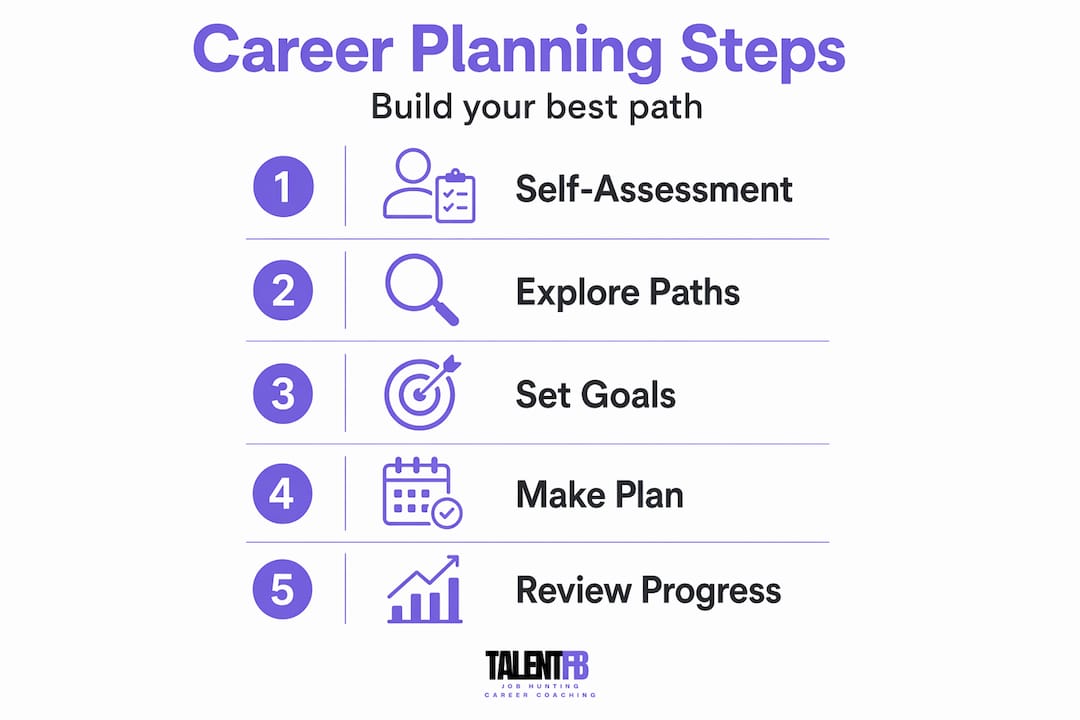
Here is a practical framework you can follow:
- Self-assessment. Start by mapping your current skills, strengths, values, and what energizes you versus what drains you. Be honest about gaps. Most professionals overestimate technical skills and underestimate the value of communication, influence, and adaptability.
- Exploration. Research roles, industries, and companies that align with your strengths and interests. Informational interviews are underused and extraordinarily effective here. Talking to three people doing the job you want will tell you more than any job description.
- Goal setting. Avoid locking in a single rigid destination. Instead, think in terms of two or three viable roles you would be satisfied pursuing over the next five years. This A/B planning approach, where you hold multiple possible paths simultaneously, is far more resilient than betting everything on one outcome.
- Development planning. Identify the specific skills, credentials, and experiences that would make you a credible candidate for each path. Then close those gaps with intention, whether through projects, courses, lateral moves, or mentorship.
- Review and recalibrate. Career planning experts recommend reviewing your plan every 6 to 24 months rather than waiting for annual performance reviews. The frequency should match how quickly your field is shifting.
The Z planning element is worth noting here. Plan A is your primary direction. Plan B is a related alternative if Plan A becomes unavailable or unappealing. Plan Z is your fallback: the stable, lower-risk option you could pursue if both A and B fall through. Having a Plan Z reduces the fear that keeps many professionals paralyzed.
Pro Tip: Schedule a 60-minute career review every quarter. Use that time to ask one simple question: Am I building career capital that will still matter in three years? If the answer is no, that is your signal to recalibrate now, not at your next annual review.
Nuances in career planning: transitions, lateral moves, and adaptability
Most professionals make one of two planning mistakes. They focus exclusively on upward movement, or they create a plan so rigid that any unexpected change feels like failure. Both approaches leave real opportunity on the table.
Lateral career moves consistently demonstrate more long-term value than most professionals realize. Moving sideways into a new function, industry, or team type can broaden your experience base, introduce you to new networks, and build adaptability that a straight vertical climb rarely develops. In an era of industry disruption, range is a form of insurance.
Here is a comparison that illustrates the difference between two common planning orientations:
| Promotion-focused planning | Career capital-focused planning |
|---|---|
| Targets the next title | Targets the next meaningful skill |
| Evaluates moves by salary increase | Evaluates moves by learning potential |
| Resists lateral moves | Welcomes lateral moves that build range |
| Treats plan as fixed | Treats plan as a working hypothesis |
| Dependent on manager support | Driven by personal ownership |
Building career capital, which means your transferable skills, your reputation, and your relationships, is the most durable career strategy available. A title is company-specific. Capital travels with you.
Common pitfalls that undermine career planning include:
- Treating the plan as permanent. Most career planning failures come from treating it as a static roadmap. Interests change. Industries shift. What felt like your dream role at 30 may feel limiting at 40.
- Chasing compensation over growth early on. Early focus on learning environments yields more durable career outcomes than chasing high immediate pay. Skills and networks compound. Salary bumps rarely do.
- Waiting for clarity before acting. Many professionals delay planning until they feel certain about their direction. That certainty rarely arrives on its own. Action generates clarity, not the reverse.
For senior professionals managing a career transition, lateral thinking is especially valuable. A move from a technical leadership role into a product or consulting function, for example, often opens more doors than a sideways shuffle within the same department.
Practical strategies to apply career planning effectively
Understanding the theory is half the work. The other half is execution. These strategies reflect what actually moves careers forward, based on patterns that show up repeatedly among professionals who advance with intention.
- Start before you feel ready. Procrastination is the biggest threat to effective career planning. Starting early, even with incomplete information, builds the career capital needed to stay adaptable when the market shifts unexpectedly.
- Master your current role first. Promotion follows demonstrated competence, not ambition. When you enter a new role, spend the first year genuinely mastering its core responsibilities and identifying your development gaps. Visibility without substance rarely leads anywhere lasting.
- Choose your environment deliberately. The team and company you work in matter as much as the role itself. High-learning environments compound your skills, network, and reputation faster than high-paying but stagnant positions ever will.
- Build visibility with substance. Speak at internal meetings. Contribute to cross-functional projects. Write about what you are learning. Professionals who are known for specific expertise attract opportunities rather than chasing them.
- Network with purpose, not desperation. The strongest career networks are built during periods of stability, not crisis. A targeted career development checklist helps you maintain that proactive discipline even when you are comfortable in your current role.
Pro Tip: When assessing a potential new role or project, ask yourself whether it will add to your professional story in a way that makes sense to a future hiring manager or collaborator. If you cannot articulate that story clearly, the opportunity may not be the right fit at this time.
For mid-level professionals looking to sharpen these habits further, resources on career growth planning offer practical frameworks that complement the strategies above. The intersection of self-knowledge and market awareness is where the most effective plans are built.
My honest take on career planning in an unpredictable world
I have spent years working with senior professionals who are technically exceptional but genuinely unsure how to own their careers. What I have noticed consistently is this: the ones who thrive do not have better plans. They have a better relationship with uncertainty.
The most useful mental model I have encountered treats career planning like a navigation app rather than a paper map. You set a destination, but you accept that the route will recalculate. A road closes. A better highway opens. You do not abandon the destination. You find a new path to it. That willingness to adapt without losing direction is the core skill that separates professionals who feel in control from those who feel at the mercy of their circumstances.
What I have also learned is that waiting for your manager to guide your career is a strategy that works for almost no one. Proactive career ownership is not just better. It is essentially the only approach that holds up in a market where tenures are short, industries shift fast, and AI is reshaping entire job categories.
My honest recommendation: do not build a plan because it feels like the responsible thing to do. Build one because it forces you to have an honest conversation with yourself about what you actually want, not what sounds impressive or safe. That conversation is where real career momentum begins.
— Frederic
How Talentfb helps you put career planning into practice
If you recognize yourself in the professionals described above, including the technically strong, ambitious, but strategically uncertain, you are exactly who Talentfb was built for. The platform’s AI Career Coaching Sessions give senior technology professionals a structured, personalized approach to owning their career direction, from clarifying goals to executing targeted job search strategies.
Talentfb’s AI Job Search Accelerator combines resume positioning, LinkedIn profile optimization, and outreach coaching into a 90-day framework designed to produce real results. You are not left to figure out the strategy alone. Whether you are planning your next leadership move or evaluating whether a transition makes sense, Talentfb provides the clarity and structure that most professionals spend years searching for on their own. For a broader look at the tools available to support your search, explore top job search alternatives that complement a strategic career plan.
FAQ
What is career planning in simple terms?
Career planning is the ongoing process of setting professional goals, assessing your current skills, and identifying the steps needed to reach your desired future roles. It is a personal discipline, not a one-time exercise.
Why is career planning important for professionals?
With median employee tenure at just 3.9 years and less than 15% of employees receiving proactive career support from managers, career planning is the primary tool professionals have to stay in control of their own advancement.
What are the main steps in the career planning process?
The core steps include self-assessment, exploring viable career paths, setting flexible goals, building a development plan to close skill gaps, and reviewing your plan every 6 to 24 months to stay aligned with your evolving goals and the market.
What is a career path and how does it differ from a career plan?
A career path describes the sequence of roles and experiences that make up your professional journey. A career plan is the active strategy you create to move along that path with intention, adjusting course when circumstances change.
How often should I update my career plan?
Career planning experts recommend reviewing your plan every 6 to 24 months, with more frequent check-ins during periods of significant industry change, personal transition, or shifting professional interests.