TL;DR:
- A skills gap is the mismatch between the competencies organizations need and their workforce’s current abilities. It affects productivity, morale, and innovation if left unaddressed and requires continuous analysis and targeted development strategies.
A skills gap is defined as the measurable mismatch between the competencies an organization needs to meet its strategic goals and the capabilities its workforce currently possesses. This definition, recognized across HR frameworks including those used by Alp Consulting, covers both technical and soft skills like leadership, adaptability, and communication. Understanding skills gaps is not an academic exercise. It is the foundation of every sound workforce planning decision you will make as a business leader or HR professional. The organizations that treat this analysis seriously are the ones that stay competitive when markets shift.
What is a skills gap and why does it matter now?
A skills gap is the distance between what your business needs people to do and what they can actually do today. That distance has real consequences: slower project delivery, weaker products, and teams that struggle to execute on strategy. The skills gap definition extends well beyond technical knowledge. It includes soft skills like problem-solving, communication, and adaptability, which are increasingly critical in the digital economy.

The urgency is real. The average skill shelf life is approximately five years, meaning that even a high performer hired in 2021 may already be working with partially outdated competencies in 2026. That timeline shrinks further in fields touched by AI and automation. For HR leaders and executives, this means skills gaps are not a one-time problem to solve. They are a permanent condition to manage.
Effective workforce planning treats skills gaps as a core input, not an afterthought. When you know where your gaps are, you can make better decisions about hiring, training budgets, and organizational design.
What causes skills gaps in organizations today?
Several forces create and widen skills gaps, and most of them are accelerating.
- Rapid technological change. AI, automation, and new platforms reshape job requirements faster than training programs can respond. A data analyst role in 2022 looks very different from the same role in 2026.
- Evolving business strategy. When a company pivots to a new market or product line, the skills it needs shift overnight. The workforce rarely shifts at the same speed.
- Education and training lag. Formal degree programs and corporate training curricula take years to update. By the time a new course is designed and delivered, the skill it teaches may already be evolving again.
- Rising soft skills demand. As automation handles more routine tasks, employers need more human skills: judgment, empathy, collaboration, and creative thinking. These are harder to train and slower to develop.
- Economic pressure. Hiring freezes, budget cuts, and restructuring often eliminate the roles that would have carried institutional knowledge forward, creating sudden, visible gaps.
Pro Tip: When you notice a pattern of missed deadlines or repeated errors in a specific team, do not assume it is a motivation problem. Trace it back to whether the role requirements have changed faster than the team’s skills have grown.
Understanding digital skills for executives is one area where this lag is especially visible. Many senior leaders were promoted based on skills that predate the current technology environment, and their organizations feel that gap at the strategic level.
How to identify and analyze skills gaps in your workforce
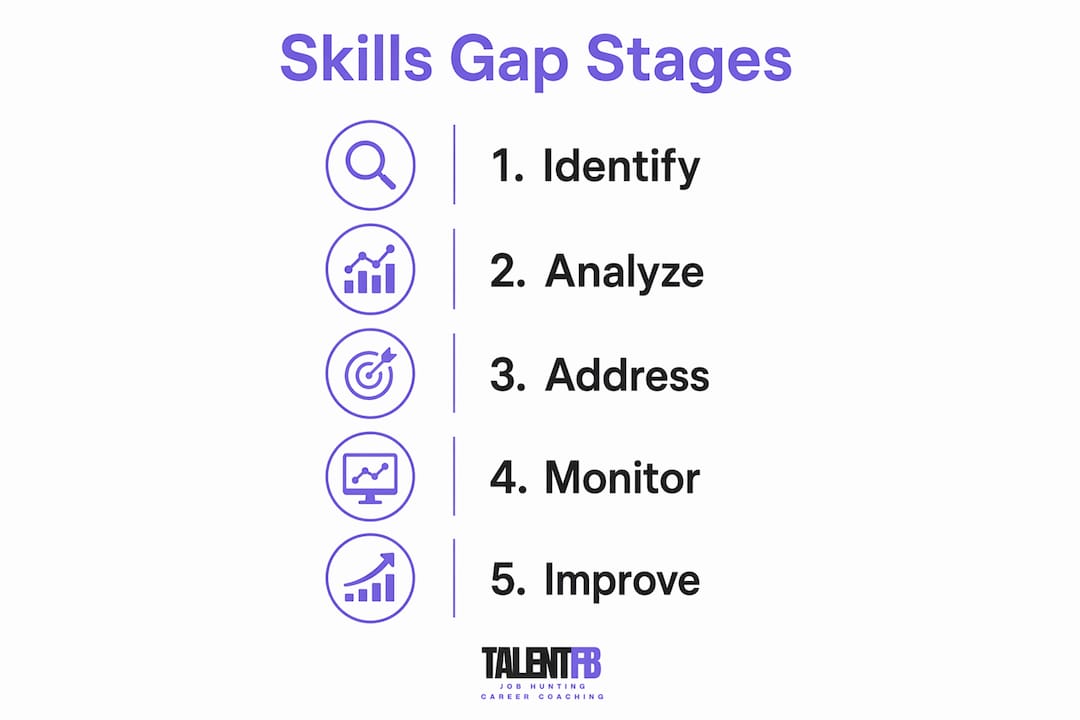
A structured skills gap analysis follows four clear steps. Each step builds on the last, and skipping any one of them produces unreliable results.
-
Define the capabilities your strategy requires. Start with your business goals for the next 12–24 months. What skills does your organization need to execute on those goals? Be specific. “Digital marketing” is too broad. “Paid social campaign management using Meta Ads Manager” is a capability you can measure.
-
Audit current skills across the workforce. Use multiple data sources: employee self-assessments, performance reviews, manager observations, and project outcome data. No single source is reliable on its own. Triangulating self-assessment data with objective performance metrics and manager feedback gives you a far more accurate picture than surveys alone.
-
Compare required skills against current capabilities. Map what you need against what you have. This comparison reveals both the size and the location of each gap. A gap in one team may not exist in another, even for the same role.
-
Prioritize gaps by strategic impact. Not every gap deserves equal attention. Prioritize skill gaps based on their impact on your most critical business objectives, not just their size. A small gap in a capability that drives 60% of your revenue matters more than a large gap in a peripheral function.
Pro Tip: Focus your analysis on 10–20 core competencies at a time. Trying to assess every skill across the entire organization produces data that is too complex to act on. Narrow scope produces sharper insight.
The table below shows how to frame the comparison at the team level.
| Capability needed | Current level | Gap size | Business impact | Priority |
|---|---|---|---|---|
| AI-assisted data analysis | Beginner | Large | High | Critical |
| Executive stakeholder communication | Intermediate | Medium | High | High |
| Agile project management | Advanced | Small | Medium | Low |
| Cybersecurity awareness | Beginner | Large | Medium | Medium |
Skills gap analysis is most valuable during strategic planning cycles, digital transformation programs, and when justifying learning and development budgets. Treat it as a continuous cycle, not a one-time audit. The workforce and the business both keep moving.
What happens when skills gaps go unaddressed?
Unaddressed skills gaps do not stay static. They compound quietly over time, and the damage often goes unrecognized until it is significant.
Skills gaps impair productivity through slower delivery and increased rework, and these symptoms are frequently mistaken for normal business fluctuations. A team that consistently misses sprint goals or produces work that requires multiple revision cycles is often dealing with a skills gap, not a motivation deficit. The distinction matters because the solutions are completely different.
“Many leaders misinterpret skills gaps as underperformance. When a previously strong employee begins to struggle, the most likely explanation is not that they have stopped caring. It is that their role has evolved faster than their skills have. Evolving job requirements explain sudden employee struggles far more often than attitude or effort.”
Employee morale suffers too. People who feel unequipped for their roles disengage. They stop raising their hands for new projects. They start looking for exits. Unaddressed skill gaps quietly erode both competitiveness and employee morale over time, and by the time the turnover numbers show up in a report, the damage is already done.
The competitive cost is harder to quantify but just as real. Organizations that cannot execute on new capabilities fall behind peers who can. Innovation stalls not because of a lack of ideas, but because the workforce lacks the skills to bring those ideas to life.
What practical strategies can business leaders use to close skills gaps?
Closing a skills gap requires matching the right solution to the right type of gap. There is no single approach that works for every situation.
- Prioritize by business impact first. Invest your time and budget in the gaps that affect your most critical capabilities. A gap in a skill that underpins your core revenue stream deserves more resources than a gap in a nice-to-have competency.
- Use flow-of-work learning as your primary tool. Mentoring, shadowing, and stretch assignments are more effective than classroom training for most skill gaps. People learn faster when they practice in real situations with real stakes. Pair a junior analyst with a senior one. Assign a manager to lead a cross-functional project that stretches their current capabilities.
- Reserve formal training for the right cases. Structured courses work well for foundational technical skills, compliance requirements, and certifications. They are less effective for soft skills and leadership development, where practice and feedback matter more than content delivery.
- Make the build-vs-hire decision deliberately. For critical gaps that are large and urgent, hiring may be faster than training. For gaps that are medium-sized and affect existing high performers, internal development almost always produces better long-term results. The talent acquisition strategies you use to fill gaps externally should complement, not replace, your internal development efforts.
- Integrate skills gap management into your workforce planning cycle. Review your gap analysis at least twice a year. Tie it to your business planning calendar so that skills decisions and budget decisions happen at the same time.
Pro Tip: When designing a development plan for a high-potential employee, ask them to identify their own gaps first. Then compare their self-assessment with manager feedback. The difference between the two is often the most important conversation you will have about their growth.
Talent development for tech executives is one area where this integrated approach pays off most clearly. Senior leaders who close their own gaps model the behavior they want to see across the organization.
The skills gap mistake I see most often
After 15 years inside hiring rooms across tech, fintech, and adtech in APAC, the pattern I see most often is this: leaders treat skills gaps as individual problems. They identify a gap in one person and send that person to a training course. The gap persists. They conclude the person is not coachable. They move on.
The real issue is that skills gaps operate at three levels: individual, organizational, and societal. A single employee’s gap is often a symptom of a broader organizational failure to plan for evolving role requirements. And that organizational failure is often a symptom of an education and labor market that cannot keep pace with technological change. Sending one person to a course does not fix a system problem.
What I recommend instead is treating skills gap analysis as an ongoing conversation between HR, line managers, and business leaders. Not a form filled out once a year. Not a report that lands in a drawer. A live, recurring dialogue about where the business is going and whether the workforce can get it there.
The other thing I want to say plainly: do not try to close every gap at once. Focus on the 10–20 competencies that matter most to your strategy right now. Fix those well. Then move to the next set. Organizations that try to fix everything simultaneously fix nothing.
— Frederic Bonifassy
How TalentFB helps leaders and teams close the gap
Skills gaps at the leadership level are some of the most expensive and least visible in any organization. A VP or Director who lacks the capabilities their role now demands does not just underperform. They slow down every team beneath them.
TalentFB works with senior tech professionals and HR leaders to identify exactly where leadership capability gaps exist and build a clear plan to close them. The career coaching guide for tech executives covers skills assessment, LinkedIn positioning, and targeted development strategies that align with where the market is heading. For HR leaders building the case for leadership investment, the C-suite hiring tips resource offers a practical framework for evaluating and developing executive talent. If you want to understand what skills the market actually values right now, the analysis of top operator skills for 2026 is worth your time.
FAQ
What is the skills gap definition in simple terms?
A skills gap is the difference between the skills an organization needs and the skills its workforce currently has. It covers both technical abilities and soft skills like communication and adaptability.
How do I identify a skills gap in my team?
Conduct a skills gap analysis by defining the capabilities your strategy requires, auditing current skills using self-assessments and performance data, comparing the two, and prioritizing gaps by business impact.
What are the most common causes of skills gaps?
The most common causes are rapid technological change, evolving job roles, slow-moving training programs, and rising demand for soft skills that formal education does not develop quickly enough.
How does a skills gap affect business performance?
Unaddressed skills gaps slow project delivery, increase rework, raise employee turnover, and stall innovation. They are often misread as performance problems rather than capability gaps.
What is the most effective way to close a skills gap?
Flow-of-work learning, including mentoring, stretch assignments, and shadowing, closes most gaps faster than classroom training. For large, urgent gaps in critical capabilities, strategic hiring is the faster path.