
TL;DR:
- Effective C-suite profiles focus on why a recruiter or board should engage, not just on career history.
- They highlight measurable outcomes, match tone to platform, and demonstrate cultural fit with target organizations.
Positioning C-suite profiles effectively comes down to one core principle: every sentence must answer why a recruiter, board member, or event organizer should engage with this executive, not simply confirm that the executive exists. The most common mistake is treating a LinkedIn profile or executive bio as a career archive. It is not. It is a positioning document, and the best ones lead with clear business impact, speak directly to the audience’s priorities, and maintain a consistent, authoritative voice across every platform.
Here is what strong C-suite profile positioning looks like in practice:
- Lead with quantified outcomes. Business outcomes like revenue growth, P&L ownership, team leadership, and market expansion. Numbers do the work that adjectives cannot.
- Match tone to context. Use third-person for formal bios like board and media kits, but first-person for LinkedIn to foster authenticity.
- Craft headlines that combine role and mission. Use your LinkedIn headline space fully to communicate what you build and for whom, within character limits.
- Keep the About section forward-facing. It should read like a strategic pitch, not a chronological résumé.
- Signal availability discreetly. Recruiter-only visibility settings protect executive brand authority far better than a public “Open to Work” frame.
- Use multimedia and endorsements deliberately. Pinned content and targeted recommendations add credibility that prose alone cannot.
What are the main C-suite roles and how does positioning vary by title?
The C-suite is not a flat structure. The CEO holds ultimate organizational authority, the COO typically serves as second-in-command with operational oversight, and the CFO anchors financial strategy and P&L accountability. Beyond that core trio, the CHRO owns people strategy, the CMO leads brand and revenue growth, and the CTO or CIO drives technology vision. Newer titles like Chief Data Officer and Chief Sustainability Officer are increasingly common in tech and enterprise companies.
Positioning changes significantly depending on the role. A CEO profile must convey enterprise-wide vision and board-level credibility. A CFO who writes only about accounting sounds like a controller, not a strategic finance leader. A CHRO focused solely on talent acquisition reads as a recruiting manager. Each title carries an implied scope, and the profile must match or exceed that expectation.
Company size and industry also shift the emphasis. At a Series B startup, a CTO profile should highlight speed of execution and team building from scratch. At a Fortune 500, the same title demands governance experience, vendor management at scale, and cross-functional influence.
How to craft LinkedIn headlines and About sections that attract recruiters
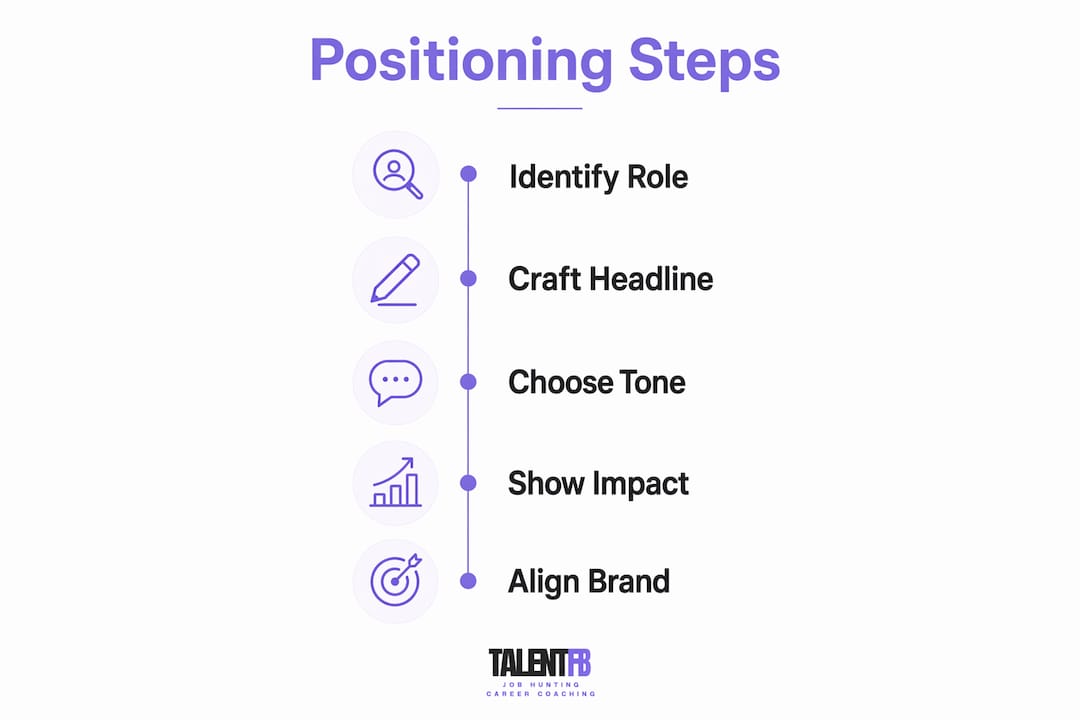
Your LinkedIn headline is the most visible real estate on your profile. It appears in search results, connection requests, and every comment you leave, yet most executives waste it on a job title alone. Strong headlines combine a searchable role title with a mission-driven outcome: “CFO at Stripe | Finance that enables growth, not blocks it” communicates far more than “Chief Financial Officer.”
The About section deserves the same discipline. Think of it as a personal pitch deck compressed into prose. The first 300 characters are visible before the reader clicks “see more,” so open with your most compelling result or a bold claim about the problem you solve. Save the narrative arc for later in the section.
Pro Tip: Audit your About section opening right now. If the first sentence starts with “Open with a result, a specific capability, or a contrarian position that makes a recruiter stop scrolling…” rewrite it immediately. Open with a result, a specific capability, or a contrarian position that makes a recruiter stop scrolling.
- Hook in the first 300 characters with a result or bold claim
- Follow with three to four bulleted proof points: numbers, scale, geography
- Close with your leadership philosophy and a brief human element
- Use natural keyword variations rather than keyword stuffing, which can reduce profile visibility
Choosing the right narrative tone for executive bios across platforms
The platform determines the voice. Board bios, media backgrounders, and company website profiles require third-person narrative because it conveys authority and reads as externally validated. “Sarah Chen is a Chief Operating Officer who has scaled three SaaS companies to $100M+ ARR” lands differently than “I am a COO who…” in a press kit.
LinkedIn is the exception. First-person feels more direct and human on a platform built for professional conversation. Most C-suite executives default to third-person on LinkedIn because it feels “professional,” but first-person typically generates stronger engagement and authenticity signals.
Tailor the emphasis to your specific goal. Seeking a board seat? Lead with governance experience, P&L accountability, and any existing board or advisory roles. Targeting speaking engagements? Emphasize thought leadership, frameworks you have developed, and past conference appearances. The same career history can be framed in multiple directions; the framing you choose signals where you want to go next.
How to demonstrate executive impact through quantifiable outcomes
Hiring teams evaluate executives on measurable business outcomes: revenue impact, P&L accountability, M&A experience, and organizational scale. A bullet that reads “Responsible for enterprise pipeline” is a task description. “Built enterprise pipeline from $0 to tens of millions in revenue in under two years” is a leadership credential.

Clear presentation of leadership scope, including team size, budget ownership, and geographic reach, differentiates executive candidates in a way that adjectives never will. Scale signals authority. A COO who managed 12 people reads very differently from one who led a 2,000-person global organization through a merger.
The transition from VP to C-suite requires a deliberate reframe. VP-level summaries anchor on functional mastery. C-suite summaries must communicate enterprise-wide P&L authority and board-level stakeholder management. If you have owned P&L, presented to the board, or led cross-functional initiatives with company-wide consequences, those are C-suite signals. Name them explicitly.
Common pitfalls that undermine executive profile effectiveness
The most damaging errors in executive profiles are not typos. They are structural and strategic.
- Ego-centric language. Every sentence focused on “I achieved” rather than the business impact created reads as self-promotion, not leadership evidence.
- Title-only headlines. “CEO” tells a recruiter your rank. It tells them nothing about your mission, your market, or your results.
- About sections as résumés. A chronological list of roles belongs on a résumé, not in a LinkedIn summary meant to position you for what comes next.
- Generic adjectives. “Visionary,” “results-driven,” and “passionate” appear on hundreds of thousands of profiles. They add no differentiation.
- Public “Open to Work” frames. For senior executives, the green “Open to Work” banner signals urgency rather than selectivity, which undermines perceived brand authority.
- Stale Featured content. A Featured section pinning a four-year-old article signals that nothing worth sharing has been produced since.
How to signal availability on LinkedIn without damaging your executive brand
The recruiter-only visibility setting on LinkedIn is one of the most underused tools available to senior executives. It allows you to signal active interest to recruiters without broadcasting a public “Open to Work” frame to your entire network, including your current employer and board.
Beyond the visibility toggle, your About section and Featured content do the real signaling work. An About section that clearly articulates what you are building toward, and a Featured section with recent thought leadership, tells the right people exactly what you are open to without a single explicit statement. For executives conducting a confidential job search, this combination is far more effective than any public availability signal.
Why your C-suite profile needs to speak the language of your industry
A technology executive’s profile should reflect fluency in the specific domain: cloud infrastructure, AI product development, or cybersecurity governance. A healthcare executive needs to signal regulatory literacy and patient outcome orientation. Generic leadership language reads as interchangeable; industry-specific framing reads as credible.
This extends to the vocabulary used in headlines and summaries. A C-suite recruiter strategy built around industry-specific search terms dramatically increases profile discoverability. Recruiters searching for a “VP Sales APAC SaaS” type exactly those words. “Strategic Revenue Leader” does not surface in that search. Build your headline around the terms your target audience actually uses, then layer in the outcome anchor.
For executives targeting board positions, corporate advisory contexts reward profiles that demonstrate governance experience, financial acumen, and cross-sector perspective. The framing shifts from operational execution to strategic oversight.
How endorsements and recommendations actually build credibility
Two or three targeted recommendations from former direct reports, peers, or hiring managers carry more weight than a dozen generic ones. The key word is specific. A recommendation that says “great leader” adds nothing. One that says “rebuilt our go-to-market motion and grew pipeline 3x in 18 months” is a verifiable credential.
When requesting recommendations, give the person a clear brief. Tell them which achievement or capability you want highlighted, and why it matters for your current positioning goals. Most people want to help but do not know what to say. A focused prompt produces a focused recommendation.
Skill endorsements matter less than recommendations, but they do contribute to keyword density and profile completeness. Prioritize endorsements for the skills most relevant to your target role, and quietly remove endorsements for skills you no longer want associated with your brand.
Aligning your personal brand with the culture of your target organization
The most effective executive profiles do not just describe past achievements. They signal cultural fit with the organizations the executive wants to join. A profile targeting a high-growth startup should convey speed, adaptability, and comfort with ambiguity. One targeting a regulated financial institution should emphasize governance, risk management, and stakeholder alignment.
This alignment shows up in word choice, the examples you select, and the thought leadership you pin. An executive who consistently publishes perspectives on organizational resilience and cross-functional leadership is signaling something specific about how they operate. That signal reaches hiring managers and board members long before a formal conversation begins.
Keeping your profile current as your career goals evolve
Profiles with active maintenance generate significantly more recruiter outreach than static ones. The practical cadence: update job titles the week you change roles, refresh Featured content every quarter, and revisit your About section any time your positioning shifts.
A stale profile signals a passive candidate. Passive candidates receive generic outreach. Executives who maintain current, specific profiles receive curated approaches from search firms who have already validated their fit before making contact. That difference shows up directly in the quality of conversations and, ultimately, in compensation outcomes.
The honest truth about executive profiles that most guides won’t tell you
Most executives treat their LinkedIn profile as a formality, something to update when they are already in a job search. That is exactly backwards. The profile that generates inbound offers is built and maintained during periods of stability, when there is no urgency and the positioning can be deliberate.
The other thing worth saying plainly: breadth is an asset, not a liability, when it is framed correctly. Executives who have spanned multiple functions, Sales, Operations, Strategy, and General Management, often strip out the complexity to appear more focused. The better move is to position the breadth as the product. COO searches and General Manager roles specifically require someone who can own multiple domains simultaneously. Narrowing the headline to one function actively hurts that archetype.
Your profile is a utility tool. Every sentence should answer one question: why should this specific person, recruiter, board member, or organizer, engage with you? When you write from that frame, the ego-centric language disappears on its own. What remains is a profile that opens doors.
How TalentFB helps C-suite executives get positioned and get hired
Senior executives who have built strong careers often find that positioning those careers for the next move is a different skill entirely. TalentFB has coached 350+ senior tech professionals through exactly this challenge, combining LinkedIn profile rebuilds, executive bio writing, and AI-assisted outreach into a structured 90-day process.
The approach starts where most guides stop: with the hiring manager’s perspective. After 15 years inside tech sector hiring rooms across fintech, adtech, gaming, and maritime-tech, Frederic Bonifassy built TalentFB around one insight: the executives who land the best roles are not the most qualified. They are the best positioned. If you are ready to close that gap, the executive career coaching guide is the right place to start.