TL;DR:
- Alumni networks are a powerful yet underutilized tool for senior tech professionals to access hidden job markets and strategic insights. Engaging consistently with alumni shortens hiring cycles, expands opportunities across industries, and strengthens personal branding efforts. Building relationships over time offers long-term career and organizational benefits that surpass casual or transactional outreach.
Alumni networks are one of the highest-leverage, lowest-friction career tools available to senior tech professionals — and most executives underuse them. The core case is simple: 70–80% of available roles are filled through referrals, personal networks, and hiring managers’ inner circles, not job boards. If you are a VP, Director, or C-suite leader in tech, your alumni connections are a direct line into that hidden market.
Here is what alumni networks deliver at the executive level:
- Trusted insider intelligence on culture, leadership, and role-level realities that no recruiter will share
- High-conversion referrals that bypass the application pile entirely
- Long-term advisory capital for personal brand building, hiring pipelines, and market positioning
The rest of this guide gives you a concrete 30-day playbook, realistic timelines, cost benchmarks, and the specific mistakes that burn bridges. Use it this week.
Table of Contents
- Why alumni networks matter specifically for senior tech professionals
- How alumni networks differ from other professional networks
- A 6-step playbook you can run this month
- Realistic timeline and costs: what to expect
- Common mistakes senior leaders make with alumni networks
- Integrating alumni networks into your personal brand and hiring strategy
- Why I invest in alumni networks — and why you should too
- TalentFB can help you activate your alumni network faster
- Useful sources and further reading
Why alumni networks matter specifically for senior tech professionals
At the junior level, alumni networks open doors. At the senior level, they do something more valuable: they compress the intelligence cycle. When you are evaluating a VP role at a Series C company or quietly exploring a board seat, you need candid context fast. A former colleague who graduated from the same program and now works inside that organization is worth ten recruiter briefings.
As professionals move into senior roles, alumni engagement shifts from entry-level access to strategic intelligence and peer validation. The use cases change entirely:
- Career moves: Warm introductions to hiring managers, confidential role intelligence before a position is posted, and peer validation that protects your reputation during a sensitive search
- Hiring and talent pipelines: Alumni are a natural source of boomerang hires and trusted referrals for senior roles where cultural fit matters as much as credentials
- Market intelligence: Former colleagues surface leadership changes and strategy shifts earlier than any press release
Alumni rehires show measurably higher retention over a three-year window compared with external hires, which means building alumni relationships is not just a personal career move — it is a hiring strategy with a documented return.

How alumni networks differ from other professional networks
LinkedIn connections, industry meetups, and recruiter pipelines all have their place. Alumni networks offer something structurally different: a trust shortcut. Shared institutional history eliminates the vetting friction that makes cold outreach so inefficient at the senior level.
Stanford sociologist Mark Granovetter’s research on weak ties explains the other half of the equation. Alumni connections sit in a productive middle ground: enough familiarity to establish trust, enough distance to expose you to information ecosystems outside your immediate circle. That combination is rare.
Pro Tip: Use LinkedIn’s alumni search feature to map former classmates by company and function before you need them. Building the map before the urgency arrives means you reach out from a position of genuine interest, not desperation.
Three structural advantages set alumni networks apart:
- Candid cultural context that public sources and recruiters consistently lack
- Weak-tie diversity across industries, functions, and geographies that broadens your opportunity surface
- Long-term organizational continuity — alumni reveal what endures about a company beyond any single leadership cycle
LinkedIn Alumni tools and university or company alumni associations work best as amplifiers of this trust, not replacements for it. LinkedIn’s alumni networking features help you identify and reach the right people; the relationship itself still requires a human conversation.
A 6-step playbook you can run this month
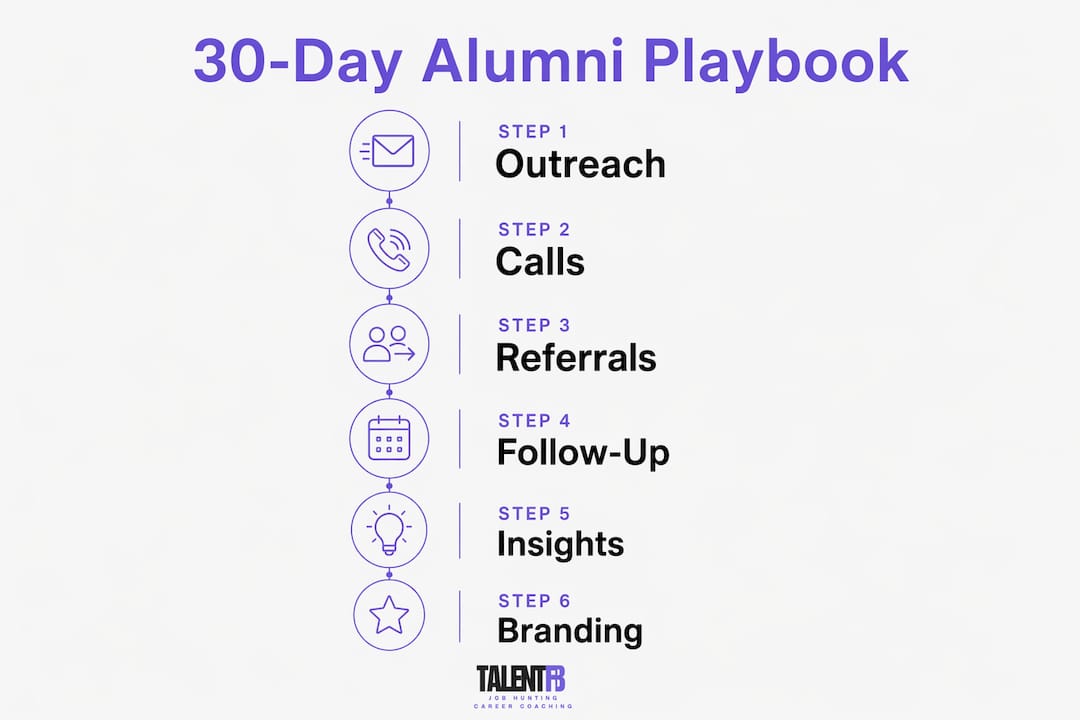
This sequence is designed for a 30-day sprint. Each step builds on the last.
- Audit your alumni assets. Pull your university alumni directory and your company’s alumni portal. List every connection at Director level or above who works in your target sector or at a target company.
- Prioritize by proximity. Score each contact on three dimensions: decision-maker proximity (can they refer or hire?), recency (have you spoken in the last two years?), and sector overlap. Focus your first week on the top 8–10 names.
- Craft your outreach. Frame every first message as a request for trusted insight, not a job ask. Two templates that work:
- Candor request: “Hi [Name], we both came through [Program] — I’ve been following your work at [Company] and would value 20 minutes of your honest perspective on the culture there. No agenda beyond that.”
- Advisory invite: “I’m navigating a transition in [sector] and your experience at [Company] is exactly the vantage point I need. Would you be open to a brief call? Happy to return the favor on [your area of expertise].”
- Run structured 1:1s. Aim for 3 calls in the first two weeks. Prepare two or three specific questions. Listen more than you talk.
- Convert to advisory or referral relationships. After a productive call, follow up with a concrete next step: a relevant article, an introduction you can make for them, or a standing quarterly check-in.
- Systematize follow-up. Use a simple CRM or even a spreadsheet to track last contact date, key topics discussed, and next action. Consistent follow-through is what separates executives who build lasting networks from those who collect contacts.
Weekly targets: 8 outreach messages, 3 calls, 1 referral or advisory relationship initiated. KPIs to track: response rate, meetings booked, qualified referrals, and hires or offers influenced.
Realistic timeline and costs: what to expect
| Activity | Time to first impact | Weekly time investment | Typical cost |
|---|---|---|---|
| Alumni outreach messages | 3 days | 1–2 hours | — |
| Informational interviews | 2–4 weeks | 2–3 hours | —–$50 (coffee) |
| Alumni events and chapters | 4–8 weeks | 2–4 hours/event | — |
| Referral or role introduction | 4 weeks | Ongoing | — |
| Executive coaching to systematize | 30–90 days | 1–2 hours/week | Coaching program fee |
The honest reality: early signals (candid intel, warm introductions) arrive within 2–4 weeks. Referrals and concrete role conversations typically take 1–3 months. Executive search cycles can run longer, but alumni relationships shorten them. Alumni directories and structured mentoring programs increase outreach efficiency significantly when you use them systematically rather than sporadically.
Common mistakes senior leaders make with alumni networks
Most executives who get poor results from alumni outreach make the same errors. The fix is usually a reframe, not more effort.
- Transactional first contact. Asking for a referral or job lead in the opening message signals that you value the outcome, not the person. Lead with curiosity and genuine interest.
- Failing to reciprocate. Alumni networks generate compound value only when both sides invest. Share useful intelligence, make introductions, and offer your own perspective before asking for anything.
- Ignoring conflict-of-interest boundaries. When an alumnus shares internal information about their employer, treat it with discretion. Never use it in ways that could embarrass them or create legal exposure.
- Letting relationships go cold between needs. Reaching out only when you need something is the fastest way to burn goodwill. A brief quarterly check-in keeps the relationship warm at minimal cost.
- Chasing volume over quality. Fifty shallow connections deliver less than five deep ones.
Pro Tip: When a conversation starts feeling transactional, shift it by asking: “What are you working on right now that I might be able to help with?” That single question resets the dynamic and often produces the most useful exchanges.
Watch for red flags in others too: contacts who lead with vague promises, push you toward decisions quickly, or ask you to share confidential information about your own employer. Those patterns signal a relationship that will cost you more than it returns.
Integrating alumni networks into your personal brand and hiring strategy
Alumni activity generates content, candidates, and credibility simultaneously — if you build it into your workflow deliberately.
For your LinkedIn content calendar, alumni conversations are a consistent source of real-world insight. A VP who learns from a former classmate that a particular engineering culture prioritizes autonomy over process can write a thoughtful post on leadership philosophy without disclosing any confidential detail. That kind of grounded perspective is exactly what builds a credible executive presence on LinkedIn.
For hiring, add one simple step to your screening workflow: when a strong candidate surfaces, check whether they share an alma mater with anyone on your hiring panel. A shared institutional background accelerates trust and often produces more candid reference conversations. Build alumni sourcing into your talent acquisition process as a standing channel, not a one-off tactic.
Action checklist for hiring managers:
- Add alumni sourcing to every senior role brief
- Invite alumni to serve on interview panels for cultural-fit assessment
- Track alumni referral hires separately to measure pipeline quality over time
Action checklist for individual contributors and mentors:
- Schedule one alumni conversation per month as a standing calendar item
- Share one useful piece of intelligence or an introduction per quarter
- Contribute to alumni events at least twice a year to stay visible
Why I invest in alumni networks — and why you should too
Here is my honest take, shaped by 15 years inside hiring rooms across tech, fintech, adtech, and gaming: the professionals who advance fastest at the senior level are almost never the ones who apply the most. They are the ones who get called. Alumni networks are the most reliable mechanism I have seen for getting into that category.
At TalentFB, the 350+ senior professionals coached through the JobSearch/OS™ program consistently report that the highest-quality leads in their search came from warm alumni introductions, not job boards. The 90-day timeline and 20–30% salary uplift that characterize successful outcomes are only achievable when the outreach is targeted and trust-based from the start. Cold applications rarely produce either.
My warm recommendation: if you are a Director, VP, or C-suite leader in tech, do not wait until you are actively searching to activate your alumni network. The executives who see the best results build these relationships continuously, then draw on them when the moment arrives. If you want a structured approach to doing that, executive coaching can help you systematize the process so it becomes a repeatable part of your career strategy rather than a reactive scramble.
TalentFB can help you activate your alumni network faster
Senior tech leaders who want to move from knowing alumni networks matter to actually building a system around them often hit the same wall: time. The playbook above works, but executing it alongside a demanding role requires structure and accountability.
TalentFB’s JobSearch/OS™ program is built for exactly this situation. It gives Directors, VPs, and senior leaders a structured, AI-assisted outreach system that targets hiring managers directly, incorporates alumni channels, and is designed to produce results within 90 days, with a documented 20–30% salary uplift across 350+ coached professionals. For CEOs and founders, Talent/OS™ rebuilds your LinkedIn presence and content system so your alumni network and talent pipeline grow organically, without executive search fees.
If you want to see how this maps to your specific situation, start with a free LinkedIn brand audit or explore the full executive coaching guide to understand what a structured engagement looks like.
Useful sources and further reading
- The Power of Alumni Networks in Today’s Changing Economic Landscape — Boston University Questrom School of Business
- Power of Corporate Alumni Networks — World Economic Forum
- How Businesses Can Benefit from Creating Alumni Networks — World Economic Forum
- Alumni Networks Are the Most Undervalued Belonging Strategy — UniversityBusiness
- How to Leverage Your College Alumni Network — The Princeton Review
- The Power of Alumni Networks in Career Advancement — Husson University