If you’re a senior tech professional or C-suite executive who needs measurable career results fast, the clearest recommendation is TalentFB’s executive coaching paired with JobSearch/OS™ or Talent/OS™. These two programs are built specifically for leaders at your level, with a reverse job-search methodology that starts from the hiring manager’s perspective rather than the traditional resume-first approach.
Here’s what that means in practice:
- JobSearch/OS™ is for Directors, VPs, and Senior Managers with 15+ years of experience who want to land their next role within 90 days, typically with a 20–30% salary increase.
- Talent/OS™ is for CEOs and tech founders who want to build a LinkedIn presence that attracts top talent organically, covering the full C-suite (up to 5 people).
- Both programs are delivered virtually, fitting into your schedule without requiring travel or extended time off.
Your next step: book a chemistry call with TalentFB on the exact platform you’ll use for sessions, whether that’s Zoom or Microsoft Teams, so you can assess the fit before committing.
Table of Contents
- What are online executive coaching solutions, and who are they for?
- Why virtual coaching often outperforms in-person for busy executives
- How to choose the right online executive coaching solution
- What a strong coaching program actually delivers
- What measurable outcomes should you demand from a provider?
- My honest take on executive coaching for senior tech leaders
- TalentFB’s coaching programs: what’s included and how to get started
- Sources and further reading
What are online executive coaching solutions, and who are they for?
Online executive coaching solutions are structured, credentialed coaching engagements delivered via video and integrated directly into a leader’s real work. They are not webinars, not self-paced e-learning, and not mentoring. The defining feature is a live, ongoing relationship between a credentialed coach and a senior leader, with sessions built around that leader’s actual professional challenges.
This category serves a specific audience: CEOs, founders, VPs, Directors, and senior tech leaders who are navigating career advancement, job search transitions, executive personal branding, or talent attraction. If you’re a mid-career professional looking for general guidance, this isn’t it. If you’re a senior leader who needs a structured system with measurable outcomes, you’re in the right place.
Delivery formats vary, and the trade-offs matter:
- 1:1 coaching offers the deepest personalization and is the standard for C-suite work.
- Cohort programs add peer accountability but reduce individual customization.
- On-demand modules provide flexibility but lack the real-time coaching relationship that drives the fastest results.
Most strong programs include a chemistry call, a baseline assessment, a defined session cadence, and explicit KPIs agreed upon at the start.
Why virtual coaching often outperforms in-person for busy executives
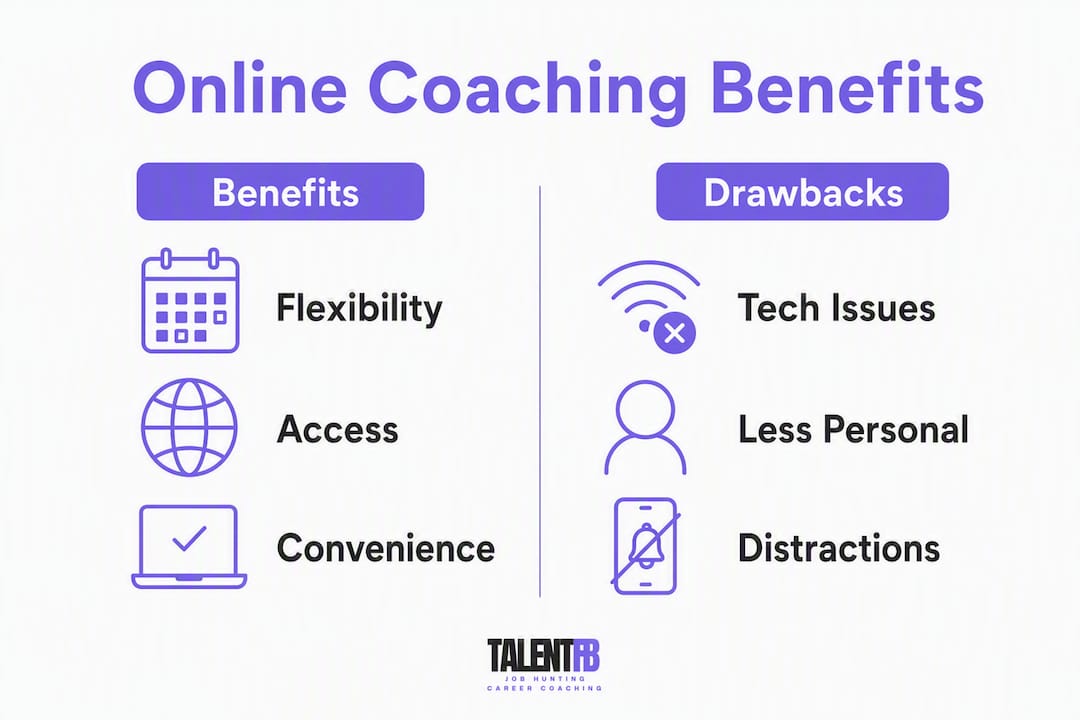
Many senior leaders actually find online leadership coaching more effective than in-person, and the reason is practical: it enables more frequent, shorter check-ins that fit into daily schedules rather than requiring half-day travel blocks. When a coaching session can happen between two back-to-back meetings, it gets used. When it requires a flight, it gets canceled.

There’s another advantage that doesn’t get discussed enough. Executives coached virtually in their own environment tend to drop the performative posturing that shows up in on-site sessions. You’re in your office, not a conference room designed to signal hierarchy. That shift in context often produces more candid, productive conversations.
Virtual coaching also expands your access to the best coaches. Geography no longer limits your options to whoever is local. You can work with an ICF Master Certified Coach (MCC) who has deep hiring-room experience in your specific sector, regardless of where either of you is based. That’s a real advantage when you’re navigating a senior tech transition or building a CEO personal brand.
Pro Tip: Run your chemistry call on the exact platform you plan to use for sessions. Zoom and Microsoft Teams both reveal important signals: does the coach maintain camera eye contact, handle silence comfortably, and engage without reading from notes? Those details tell you a lot about how the coaching relationship will actually feel.
How to choose the right online executive coaching solution
Prioritize coach credentials first. For C-suite work, look for an ICF MCC designation, which requires 2,500+ coaching hours, because identity-level leadership coaching is harder to assess at a distance and requires that depth of experience. An ICF PCC is the minimum for senior individual contributors and Directors.
Your selection checklist:
- Confirm the coach’s ICF credential level and verify it directly on the ICF website.
- Run the chemistry call on your working platform and assess virtual presence, not just content.
- Ask for two or three client references at a similar seniority level and actually call them.
- Request a sample session structure and a concrete KPI example from a past engagement.
- Clarify all fees upfront: assessment costs, platform fees, matching fees, and cancellation terms.
Questions to ask in the chemistry call:
- What does your process look like from week one through month three?
- How do you measure progress, and what KPIs have you tracked with past clients?
- How do you handle confidentiality, especially if my employer is paying?
- What’s your experience inside hiring rooms or with senior tech hiring decisions?
Red flags to watch for:
- No chemistry call offered before commitment.
- Coach reads from notes or avoids direct eye contact on camera.
- Vague or absent measurement approach (“we’ll know it’s working when you feel better”).
- Unwillingness to provide references at your seniority level.
Pricing models range from per-session rates to fixed packages to enterprise contracts. Per-session pricing suits exploratory work; fixed packages are standard for structured programs like JobSearch/OS™. Always ask whether assessment tools, onboarding materials, or follow-up resources carry additional costs.
Pro Tip: Ask every provider for their typical time-to-hire or promotion timeline for clients at your level. A coach who can’t answer that question with a real example probably hasn’t worked with enough senior leaders to have a pattern.
What a strong coaching program actually delivers
The structure of a well-designed remote executive coaching program follows a clear arc: baseline assessment, goal-setting, core coaching cadence, in-work application, measurement, and transition planning. Virtual engagements typically run 4–12 months with biweekly 60-minute sessions, though shorter targeted programs exist for specific outcomes like job search acceleration or LinkedIn brand rebuilding.
Before your first session, prepare:
- Complete the platform setup and test your audio and video on the coaching platform.
- Sign the confidentiality agreement and clarify who has access to session notes.
- Map your key stakeholders: hiring managers you want to reach, internal sponsors, or board members.
- Set your baseline metrics: current salary, target role, target compensation, and timeline.
- Clear your calendar for sessions and protect that time.
Deliverables you should expect from a strong program:
- Session notes and committed action items after every call.
- A revised LinkedIn profile and executive positioning statement.
- Targeted outreach templates for hiring managers and decision-makers.
- Interview rehearsal and salary negotiation preparation.
- A hiring-introduction playbook if talent attraction is part of the scope.
On the technology side, Zoom and Microsoft Teams are the standard platforms. You need a stable connection, a private workspace, and a camera positioned at eye level. Recorded micro-teach assets should only be used with your explicit consent.
The most effective programs, as coaching research consistently shows, use your live, current professional dilemmas as the primary coaching material. Not hypotheticals. Not case studies from other industries. Your actual problems, in real time.
What measurable outcomes should you demand from a provider?
The core ask is simple: any credible provider should be able to give you concrete KPIs from past engagements. Time-to-hire, interview-to-offer conversion rates, salary uplift percentages, and promotion timelines are all trackable. If a provider can’t produce them, that tells you something.
TalentFB’s brand signals are specific: 350+ senior tech professionals coached through JobSearch/OS™, with clients landing roles within 90 days and achieving salary increases of 20–30%. These are TalentFB’s own reported outcomes, and they’re worth asking about directly when you speak with the team.
When reading any provider’s case studies, look for three things:
- A clear baseline (where the client started: role level, salary, timeline).
- A traceable reference (a real client you could contact, even anonymously verified).
- A specific outcome with a timeline, not a generic “significant improvement.”
Metrics to request from any provider before signing:
- Average time-to-hire for clients at your seniority level.
- Percentage of clients who received a salary increase, and the typical range.
- Sample measurement cadence (how often progress is reviewed and how).
- What happens if you’re not making progress at the 30-day or 60-day mark.
Coaching paired with applied learning tends to produce stronger performance outcomes than coaching alone, which is why programs that integrate real work challenges into sessions consistently outperform those that keep coaching separate from daily responsibilities.
My honest take on executive coaching for senior tech leaders
The single biggest mistake I see senior tech professionals make is waiting too long to invest in coaching. They treat it as a last resort after a layoff or a failed job search, rather than a proactive tool at a career inflection point. The executives who get the most out of virtual coaching are the ones who come in with a specific, time-bound goal: land a VP role in 90 days, rebuild my LinkedIn presence before the next board meeting, or attract a CTO without paying a search firm.
My warm recommendation: if you’re at a genuine inflection point, whether that’s a role change, a post-layoff search, or a CEO brand-building moment, scope a short pilot engagement first. Agree on a 90-day outcome with your coach before you sign anything longer. At 90 days, you should have a measurable signal: interviews booked, salary offers received, or inbound talent inquiries on LinkedIn. If you don’t have that signal, the program isn’t working.
The other thing I’d tell you: bring your real problems to every session. The fastest results come when you use coaching time to work through an actual negotiation you’re in the middle of, or a specific hiring manager you’re trying to reach, not abstract leadership theory. The role of coaching in career transitions is most powerful when it’s grounded in what’s happening to you right now.
TalentFB’s coaching programs: what’s included and how to get started
TalentFB offers two programs built specifically for senior tech leaders in the U.S. and globally. JobSearch/OS™ is a structured, AI-driven job-search coaching program for Directors, VPs, and Senior Managers who want to land their next role within 90 days, with TalentFB clients typically seeing salary increases of 20–30%. Talent/OS™ is a LinkedIn executive branding and content system for CEOs and founders who want to attract top talent organically, without paying search fees.
Both programs are delivered as fixed packages, not open-ended subscriptions, so you know exactly what you’re committing to before you start. Pricing is available on request and varies by program scope and team size for Talent/OS™. TalentFB does not publicly list per-session rates; the engagement model is program-based, which means your outcomes are tied to a structured process rather than an hourly clock.
You can review client success stories directly on the TalentFB website, including case signals from the 350+ professionals coached through JobSearch/OS™. Exact terms, cancellation policies, and refund conditions are covered during the chemistry call and confirmed in writing before any commitment.
Your next step is straightforward: book a chemistry call on the platform you’ll use for sessions, come prepared with your target role and timeline, and let the conversation show you whether the fit is right.
Sources and further reading
- Virtual Coaching guidance and relationship-first evaluation criteria — Center for Creative Leadership: authoritative research on what makes virtual coaching work.
- Remote executive coach selection checklist — Tandem Coach: practical guidance on chemistry calls, credential checks, and program structure.
- Why senior leaders benefit from coaching — TalentFB: overview of coaching benefits for senior tech leaders.
- Executive coaching strategic guide for tech leaders — TalentFB: full service overview, brand signals, and program details.
- JobSearch/OS™ masterclass landing page — TalentFB: program details and enrollment for senior tech professionals.
- LinkedIn executive brand audit — TalentFB: free two-minute audit to assess your current LinkedIn positioning before starting a coaching program.
- The power of coaching for professional relationships — Rock Dubois: partner perspective on human connection as the foundation of effective coaching.