If you want a quick answer: start with the O*NET Interest Profiler for free, validated career exploration, then layer in a Big Five/IPIP personality measure and a skills audit before you commit to any direction. Here is how the best career assessment tools map to specific goals:
- Career exploration (starting from scratch): O*NET Interest Profiler or CareerOneStop. Free, government-backed, links results directly to 900+ occupations with salary and outlook data. Best first move for anyone.
- Deep interest profiling: Strong Interest Inventory (SII). Requires a certified counselor and is a paid instrument, but delivers the most research-validated interest report available commercially.
- Personality baseline: Big Five/IPIP. Free, academically grounded, and the preferred model in organizational psychology for predicting work outcomes.
- Strengths focus: CliftonStrengths (Gallup). A paid tool best for professionals who already know their field and want to sharpen their positioning.
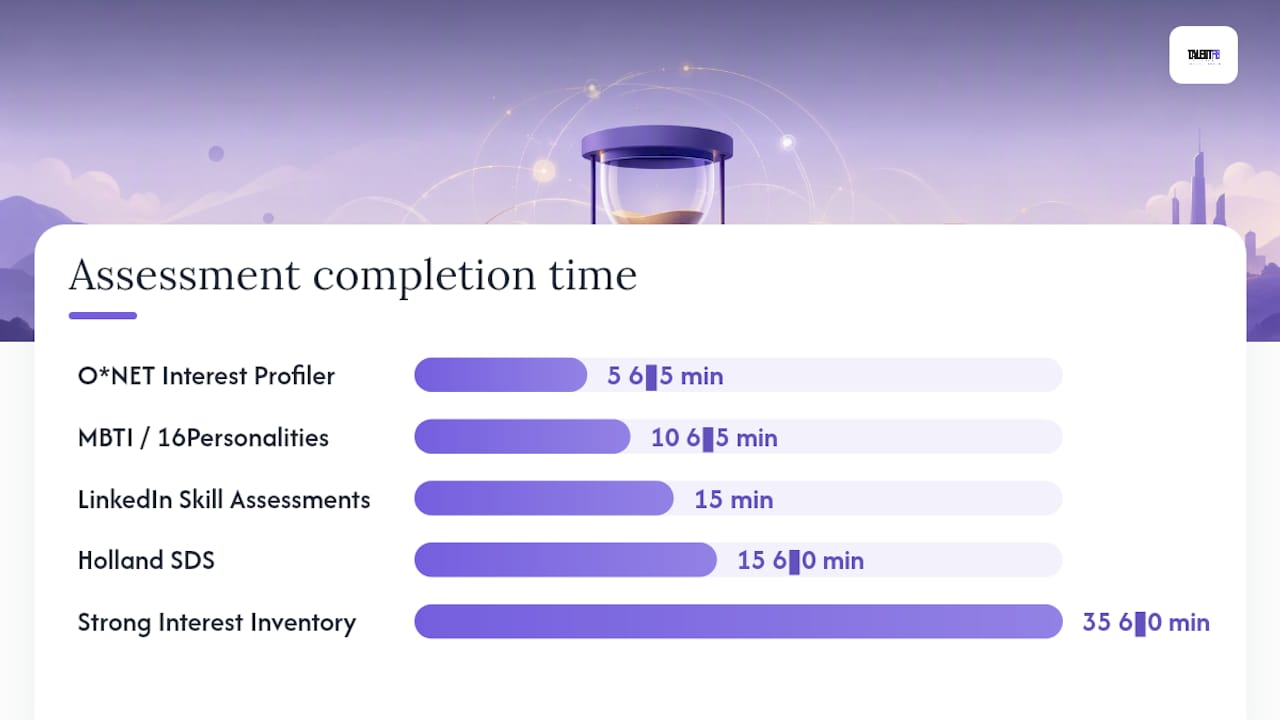
- Fast interest screener: Holland Self-Directed Search (SDS). Takes about 15 to 20 minutes, generates a RIASEC code, and is a low-cost tool available online.
- Skills audit and job matching: O*NET occupational profiles paired with LinkedIn Skill Assessments. Free, practical, and directly tied to recruiter-visible credentials.
- Reflection and team conversations: MBTI or 16Personalities. Useful for self-awareness and team dynamics; treat results as a conversation starter, not a career verdict.
Free tools cover most needs. Paid instruments earn their cost when the stakes are high: a major pivot, a senior hire, or a salary negotiation where self-knowledge is a real asset.
Table of Contents
- What career assessments actually measure (and why the type matters)
- How to choose the right assessment and use results effectively
- The best career assessment tools: profiles and comparison
- What the research says about effectiveness, limits, and bias
- How assessments actually fit into a senior tech professional’s career strategy
- Ready to turn your assessment results into a real career move?
- Authoritative sources and further reading
What career assessments actually measure (and why the type matters)
Not all career evaluation tools ask the same question. Using a personality test to choose a career path is a bit like using a map of the subway to navigate a highway: the information is real, but it answers a different question than the one you are asking.
Vocational assessment theory organizes tools into four complementary domains, each targeting a distinct dimension of fit:
Interests answer: What do you enjoy doing? Interest inventories like the O*NET Interest Profiler use Holland’s RIASEC framework (Realistic, Investigative, Artistic, Social, Enterprising, Conventional) to surface patterns in what energizes you. They predict satisfaction and persistence in a role more reliably than almost any other single measure.
Personality answers: How do you tend to behave? The Big Five model (Openness, Conscientiousness, Extraversion, Agreeableness, Neuroticism) is the standard in organizational psychology. It predicts performance, leadership potential, and team dynamics. Type-based tools like MBTI offer a simpler vocabulary but weaker predictive power.
Aptitudes and abilities answer: What can you learn quickly? Skills and cognitive-ability assessments measure your capacity for training and job complexity, not just what you already know. A career changer validating a move into data science, for example, benefits more from an aptitude check than from another interest quiz.
Work values answer: What conditions make work meaningful? Values assessments surface priorities like autonomy, security, prestige, or service. A senior tech professional who scores high on autonomy will likely struggle in a heavily matrixed organization, regardless of how well their skills match the role.
| Assessment type | Primary question | Best for | Actionability |
|---|---|---|---|
| Interests (RIASEC) | What do I enjoy? | Students, career changers | High: links to O*NET occupations |
| Personality (Big Five) | How do I behave? | All levels; team fit | Medium: informs role/culture fit |
| Aptitudes/skills | What can I learn? | Career changers, upskilling | High: maps to training paths |
| Work values | What matters to me? | Mid-career, senior pivots | Medium: filters role/org type |
| Strengths | What do I do best? | Executives, positioning | High: directly feeds personal brand |
University career centers consistently group tools into these same categories, which tells you something: the framework has held up across decades of practice.
Pro Tip: Never rely on a single assessment type. An interest inventory tells you what you want; an aptitude measure tells you what you can realistically pursue. You need both to make a defensible decision.
How to choose the right assessment and use results effectively
Picking a career test is the easy part. Knowing which one fits your situation, and what to do after you finish it, is where most people lose momentum. Here is a practical decision checklist followed by a workflow for turning results into real next steps.
Decision checklist before you start:
- Clarify your goal. Are you exploring broadly, validating a specific pivot, or sharpening your positioning for a senior role? Each goal calls for a different tool.
- Check the stakes. A student exploring majors can rely on free tools. A VP considering a $200K career pivot should invest in a professionally administered instrument with counselor interpretation.
- Assess your budget. Free tools (O*NET, Big Five/IPIP) cover most needs with strong evidence. Paid tools (SII, CliftonStrengths, SDS) add depth when the decision warrants it.
- Consider format. Self-complete online tools work for exploration. High-stakes decisions benefit from pro-administered formats where a counselor contextualizes your scores.
- Check psychometric quality. Look for published reliability and validity data. Government and academic tools (O*NET, Big Five) publish technical manuals. Many commercial sites do not.
- Review the privacy policy. Before entering personal data, confirm how results are stored, whether they are sold to third parties, and whether you can delete your profile.
After you complete any assessment, follow this workflow:
- Read the full report, not just the headline label or top code.
- Cross-reference your results against O*NET occupational profiles for salary ranges, growth outlook, and required preparation.
- Run a skills audit: list the competencies the target occupations require, then honestly rate your current level in each.
- Shortlist three to five occupations that score well on both interest fit and skills proximity.
- Conduct two or three informational interviews with people in those roles before committing to any reskilling investment.
- Use LinkedIn Skill Assessments to validate and display the skills that appear in your shortlisted job descriptions.
When to bring in a counselor: if you are making a significant career leap, negotiating at the executive level, or feeling genuinely stuck after completing self-directed tools, a session with a certified career counselor who can administer and interpret the Strong Interest Inventory or a full vocational battery is worth the investment. Research confirms that RIASEC-based tools are most effective when used as part of a guided counseling process rather than as standalone exercises.
Pro Tip: Pair your interest inventory results with a skills audit and a quick ONET labor-market check before you commit to any reskilling program. The combination of “I want this” plus “I can get there” plus “the market needs it” is what makes a career path that actually works.*
The best career assessment tools: profiles and comparison
1. O*NET Interest Profiler
What it measures: Holland RIASEC interest types, linked directly to occupational data.
Best for: Anyone starting a career exploration process; students, career changers, and mid-career professionals.
Cost: Free.
Time: 30 questions (Mini-IP) or 60 questions (Short Form); roughly 5–15 minutes.
Psychometric quality: Strong. Published technical manual, reliability evidence, and Spanish-language support. Available as an embeddable widget and web service for institutional use.
What to do with results: Match your top RIASEC codes to occupations in O*NET’s database. Each occupation page shows median wages, job outlook, and required education. This is the most actionable free tool available to U.S. job seekers.
2. CareerOneStop (U.S. Department of Labor)
What it measures: Interests, skills, and work values through a suite of linked tools.
Best for: Job seekers who want a one-stop resource that connects assessment results to local labor-market data, training programs, and job listings.
Cost: Free.
Time: Varies by tool; most complete in under 20 minutes.
Psychometric quality: Government-validated; built on O*NET data infrastructure.
What to do with results: Use the occupation search to filter by interest code, then drill into local salary data and training providers. The DOL’s career exploration tools make this one of the most practically useful free resources in the U.S.
3. Holland Self-Directed Search (SDS)
What it measures: RIASEC interest and activity preferences.
Best for: Professionals who want a fast, structured interest screener with a clear output code.
Cost: Approximately $9.95 for the online version.
Time: 15–20 minutes.
Psychometric quality: Well-established; decades of research support the RIASEC model underlying it.
What to do with results: Your three-letter Holland code maps to a curated list of occupations. Cross-reference with O*NET for depth.
4. Strong Interest Inventory (SII)
What it measures: Interests across six RIASEC themes plus occupational and personal-style scales.
Best for: Career changers and professionals making high-stakes decisions who want the most validated commercial interest instrument available.
Cost: $25–$50+ through a certified counselor or career services provider.
Time: Approximately 35–40 minutes.
Psychometric quality: Excellent. Decades of validity research; norm-referenced against working professionals across hundreds of occupations.
What to do with results: Work through the report with a counselor. The occupational scales compare your interests to those of satisfied professionals in specific fields, which is a genuinely useful signal for a major pivot.
5. CliftonStrengths (Gallup)
What it measures: 34 talent themes grouped into four domains (Executing, Influencing, Relationship Building, Strategic Thinking).
Best for: Senior professionals, executives, and team leaders who want to articulate their strengths for positioning, leadership development, or performance conversations.
Cost: $22.99 for top-5 report; $59.99 for all 34 themes.
Time: Approximately 35–45 minutes.
Psychometric quality: Proprietary; Gallup publishes reliability data, though the model is not part of the mainstream academic personality literature.
What to do with results: Map your top themes to the competencies your target roles require. Particularly useful for building an executive personal brand or preparing for behavioral interviews.
6. Big Five / IPIP (International Personality Item Pool)
What it measures: The five core personality dimensions (Openness, Conscientiousness, Extraversion, Agreeableness, Neuroticism) with facet-level detail.
Best for: Anyone who wants a personality baseline grounded in organizational psychology research. The preferred model for predicting work performance and leadership potential.
Cost: Free (multiple free implementations available, including the IPIP-NEO).
Time: 20–40 minutes depending on version.
Psychometric quality: The strongest evidence base of any personality model used in career contexts. Widely published, norm-referenced, and cross-culturally validated.
What to do with results: Use percentile scores, not labels. High Conscientiousness predicts performance across most roles; high Openness correlates with creative and investigative occupations. Pair with an interest inventory for a fuller picture. Skills-based job matching platforms increasingly incorporate Big Five data alongside skills profiles for more precise role fit.
7. MBTI / 16Personalities
What it measures: Personality type across four dichotomies (E/I, S/N, T/F, J/P), producing one of 16 type labels.
Best for: Team workshops, self-reflection, and introductory conversations about working styles. Not recommended as a primary career-decision tool.
Cost: Official MBTI: $50+ through a certified practitioner. 16Personalities: free.
Psychometric quality: Weaker than Big Five. The type categories have limited test-retest reliability, and the dichotomous scoring discards nuance. Use it for conversation, not for career verdicts.
What to do with results: Treat your type as a starting point for reflection, not a prescription. If you find the framework useful, follow up with a Big Five assessment to get a more granular and research-backed read.
8. LinkedIn Skill Assessments
What it measures: Demonstrated proficiency in specific technical and professional skills (coding languages, software tools, project management, etc.).
Best for: Professionals who want to validate and display skills directly on their LinkedIn profile, making them more visible to recruiters.
Cost: Free.
Time: 15 minutes per assessment (timed, multiple-choice).
Psychometric quality: Moderate; designed for recruiter signaling rather than deep psychometric analysis.
What to do with results: Passing scores earn a verified badge on your LinkedIn profile. Prioritize assessments that match the skills listed in your target job descriptions.
Comparison overview
| Tool | Measures | Best for | Cost | Format | Psychometric quality | Actionability | Time |
|---|---|---|---|---|---|---|---|
| O*NET Interest Profiler | Interests (RIASEC) | All levels, exploration | Free | Online, self-complete | Strong | Very high | 5–15 min |
| CareerOneStop | Interests, skills, values | Job seekers, career changers | Free | Online, self-complete | Strong (DOL-backed) | Very high | Varies |
| Holland SDS | Interests (RIASEC) | Fast screener | ~$9.95 | Online, self-complete | Strong | High | 15–20 min |
| Strong Interest Inventory | Interests (RIASEC + occupational scales) | High-stakes pivots | $25–$50+ | Pro-administered | Excellent | High | 35–40 min |
| CliftonStrengths | Strengths/talent themes | Executives, teams | $22.99–$59.99 | Online, self-complete | Good (proprietary) | High | 35–45 min |
| Big Five / IPIP | Personality (5 factors) | All levels, work fit | Free | Online, self-complete | Excellent | Medium | 20–40 min |
| MBTI / 16Personalities | Personality type | Reflection, team use | Free–$50+ | Online or pro-admin | Weak | Low | 10–15 min |
| LinkedIn Skill Assessments | Demonstrated skills | Active job seekers | Free | Online, timed | Moderate | High | 15 min |
What the research says about effectiveness, limits, and bias
The evidence on career assessments is clearer than most people realize, and it cuts against some popular assumptions.
What works:
- Interest inventories built on the RIASEC model (O*NET, SII, SDS) reliably predict occupational satisfaction and persistence. Matching your interests to an occupation increases the likelihood of staying in that field and performing well over time, though it does not guarantee performance on its own.
- The Big Five is the most research-supported personality model for predicting job performance, leadership emergence, and training success. Independent comparisons consistently find that free, government- and academia-backed tools like O*NET and Big Five/IPIP have stronger evidence than most commercial personality-type platforms.
- Combining interest, aptitude, and values data produces a more defensible assessment than any single instrument. Vocational assessment theory is explicit on this point: no single domain is sufficient.
What to watch for:
- Self-report bias. All self-report tools reflect how you see yourself today, which may not match how others experience you or how you perform under pressure. A skills audit and 360-degree feedback add external calibration.
- Occupational stereotypes. Some older norm groups embedded gendered or culturally narrow occupational patterns. O*NET has updated its norms, but it is worth checking whether the occupations surfaced by any tool reflect your actual options or a historical snapshot.
- Skills are not measured. Interest and personality tools do not assess what you can currently do. A separate skills audit is non-negotiable if you are making a significant career change.
- MBTI-type tests. The type-label format is intuitive but psychometrically fragile. Test-retest reliability is lower than the Big Five, and the forced dichotomies (introvert vs. extrovert) discard meaningful variation.
Research note: University career services at Penn explicitly recommend treating assessments as starting points for exploration, not final answers, and pairing them with counselor guidance and concrete next steps.
Best-practice checklist:
- Combine at least two assessment types (interest + personality, or interest + skills).
- Validate your shortlist against O*NET/CareerOneStop occupational data before committing to reskilling.
- For high-stakes decisions, add counselor interpretation, particularly for the Strong Interest Inventory.
- Revisit assessments every three to five years; interests and values shift with experience.
How assessments actually fit into a senior tech professional’s career strategy
Here is my honest take, having worked with hundreds of senior tech professionals through TalentFB: most people at the Director, VP, or Senior Manager level already know what they enjoy. What they lack is a structured way to translate that self-knowledge into a targeted, high-impact job search.
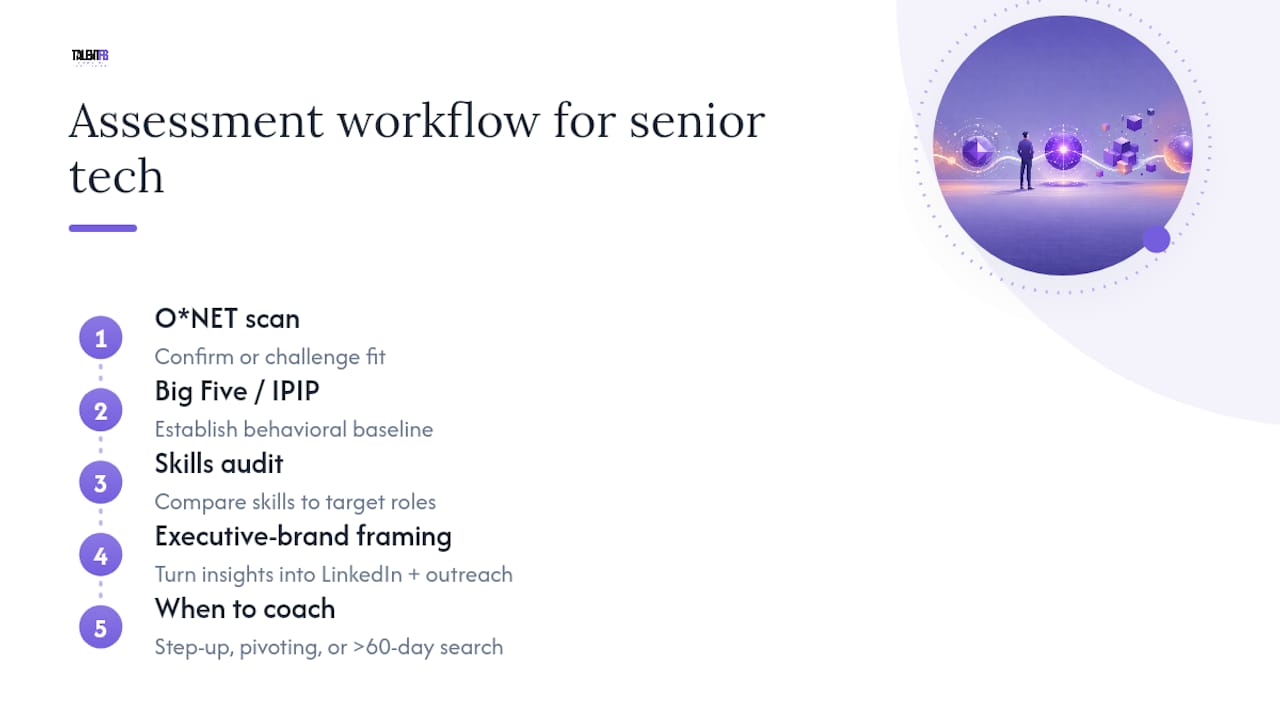
The workflow I recommend starts with a quick O*NET scan to confirm or challenge assumptions about fit, then a Big Five/IPIP assessment to establish a behavioral baseline. Not to label yourself, but to identify the environments and leadership styles where you tend to perform at your best. From there, a skills audit against your target roles reveals the real gaps, which are almost always smaller than people fear.
The piece most professionals skip is the executive-brand framing step: taking assessment outputs and translating them into a LinkedIn profile and outreach narrative that speaks directly to the hiring managers you want to reach. A CliftonStrengths report sitting in a PDF does nothing. The same insights, woven into a compelling professional story, open doors. That translation is where the career development work for tech leaders gets concrete and where coaching pays for itself.
When is coaching worth the investment? When you are targeting a role that represents a genuine step up in seniority or compensation, when you are pivoting across industries, or when you have been searching for more than 60 days without traction. At that point, the cost of not having a structured approach is higher than the cost of the coaching itself.
Career advancement tools: what to use after the assessment
An assessment tells you where you stand. Advancement tools help you move. For senior professionals, the useful ones fall into a few groups.
- Positioning tools: your CV, your LinkedIn profile and a clear one line value proposition.
- Search tools: a target company list and a job search tracker to manage conversations.
- AI tools: for drafting CVs, outreach messages and interview preparation, used with your own judgement.
- Human support: mentors, sponsors, peer groups and coaching when you need accountability.
Choose tools based on your biggest gap, not on what is popular. The free Senior Job Search Score shows which of five areas that is: career clarity, CV, LinkedIn, target companies or outreach.
Ready to turn your assessment results into a real career move?
Self-assessments give you the raw material. What most senior tech professionals need is someone to help them convert that material into a precise, targeted strategy.
TalentFB’s career coaching for tech executives is built for Directors, VPs, and Senior Managers who want to move faster and negotiate better. The engagement covers your behavioral and interest profile, a full skills audit against your target roles, LinkedIn profile positioning, and a targeted outreach system designed to reach hiring managers directly, not just apply to job postings. Over 350 senior professionals have used this approach to land their next role within 90 days, typically with a 20–30% salary increase. If you are ready to put your assessment results to work, that is the logical next step.
Authoritative sources and further reading
These are the resources worth bookmarking, each chosen for credibility, practical utility, and direct relevance to U.S. job seekers:
- Frontiers in Organizational Psychology article on RIASEC-based interventions
- O*NET Career Exploration Tools | U.S. Department of Labor
- Interest Profiler (IP) at O*NET Resource Center
- Vocational Assessment — Interests, Aptitudes, Values & Theories — Cogn-IQ Encyclopedia
- The Ultimate Career Assessment Test for Students (Free)
- Career Assessment Tools | It’s Your Yale
- Career Assessment Tools Compared: Which One Actually Works